Step by step towards fulfillment.
Abstract
The pursuit of control dominates much of human behavior. Individuals seek to control outcomes, relationships, organizations, reputations, wealth, health, and even the thoughts of others. Ironically, the greater the desire for control, the greater the experience of anxiety, frustration, and internal conflict. Conversely, individuals who exhibit profound commitment to meaningful action often demonstrate remarkable psychological stability despite having limited control over external events.
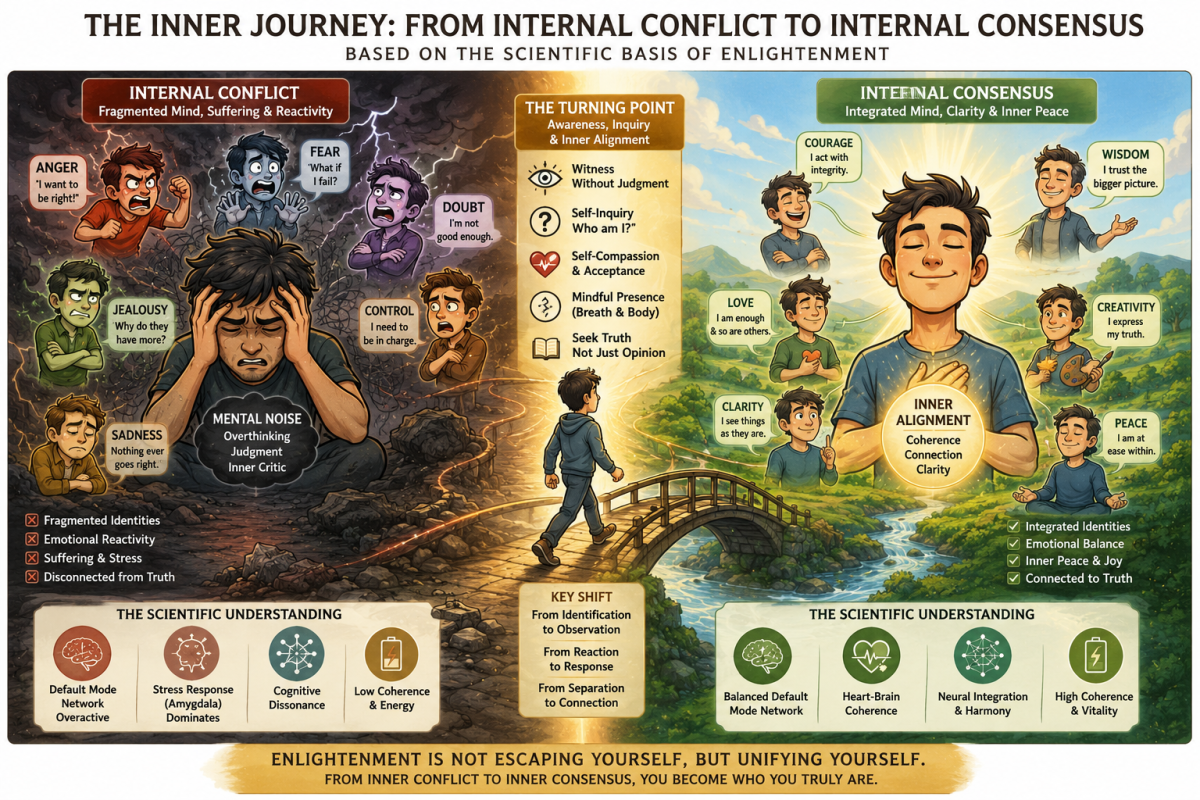
The Stathine–Coexon Framework proposes that this apparent paradox arises from a misunderstanding of existential reality. The framework distinguishes between commitment, which lies within the capacity of the Coexon, and control, which is distributed across the broader interactions occurring within the Stathine field. Doublethink emerges when individuals simultaneously believe that they control reality while repeatedly encountering evidence that they do not. This contradiction fragments the internal organization of the Coexon’s subatomic structure.
This paper argues that fulfillment arises when individuals relinquish the illusion of control while deepening their commitment to aligned action. By progressively reducing contradiction within the Coexon through recursive interaction with the Stathine field, every human being can respond to life’s dilemmas with clarity, responsibility, and sustained inner stability.
1. Introduction
Human life is filled with uncertainty.
No individual can completely control:
- the weather,
- the economy,
- disease,
- the actions of others,
- aging,
- death,
- historical events,
- unforeseen opportunities.
Yet many people organize their lives as though complete control were possible.
This produces continual disappointment.
At the same time, history shows individuals who remained deeply fulfilled despite possessing very little external control.
Their distinguishing characteristic was not control.
It was commitment.
The Stathine–Coexon Framework proposes that this distinction reflects the fundamental architecture of reality.
2. The Illusion of Control
Control may be defined as the capacity to determine outcomes independently.
Within existential reality, such complete independence rarely exists.
Every event arises through innumerable interacting causes.
The Stathine field represents this continuously interacting reality.
The singular Coexon exists within this field but does not govern it.
Consequently, the belief that one can completely determine external reality inevitably generates contradiction.
The more reality resists personal expectation, the greater the internal fragmentation.
3. Commitment as the Natural Function of the Coexon
While external control is inherently limited, commitment remains fully available.
Commitment represents the sustained organization of the Coexon’s internal subatomic structure toward coherent action.
Unlike outcomes, commitment remains directly available to the individual.
One cannot guarantee success.
One can guarantee sincerity of effort.
One cannot command another person’s response.
One can determine the integrity of one’s own action.
Thus, commitment belongs to the Coexon.
Control belongs to neither the Coexon nor the individual; it is distributed across the interacting conditions of the Stathine field.
4. Doublethink: The Source of Human Dilemmas
Every significant dilemma reveals competing beliefs.
Examples include:
“I cannot control other people.”
“I must make them behave as I wish.”
“I know failure is possible.”
“I cannot allow myself to fail.”
“I know life is uncertain.”
“I must eliminate uncertainty.”
These incompatible beliefs coexist within the internal organization of the Coexon.
The result is doublethink.
Doublethink consumes attention because contradictory internal models continually compete for dominance.
The individual oscillates between incompatible responses rather than acting coherently.
5. How the Stathine Field Dissolves Illusion
The Stathine field continuously provides feedback.
Every action generates consequences.
Reality reveals itself without preference.
Whenever expectation differs from outcome, the field exposes contradiction.
The dilemma therefore is not created by reality.
It is revealed by reality.
The Stathine field functions as an impartial reference against which the Coexon continuously evaluates its own internal organization.
6. From Control to Commitment
The framework proposes a fundamental shift.
Instead of asking:
“How can I control this situation?”
The aligned individual asks:
“How can I respond to this situation with maximum coherence?”
This change transforms the nature of action.
Energy previously invested in controlling uncontrollable outcomes becomes available for:
- learning,
- creativity,
- service,
- cooperation,
- perseverance,
- excellence.
Commitment increases precisely because the burden of impossible control has been abandoned.
7. Resolving Every Dilemma
Every human dilemma contains three elements:
First, objective reality.
Second, the individual’s interpretation.
Third, contradictory beliefs regarding control and responsibility.
The framework proposes the following recursive process.
Step 1: Observe Reality
Describe the situation without judgment.
Separate observable facts from personal narratives.
Step 2: Identify the Desired Outcome
State honestly what outcome is preferred.
Desire itself is not the problem.
Attachment to guaranteed outcomes is.
Step 3: Separate Control from Commitment
Ask two questions.
“What aspects of this situation lie beyond my control?”
“What actions remain completely within my commitment?”
This distinction immediately reduces contradiction.
Step 4: Detect Doublethink
Identify opposing beliefs.
For example:
“I want honesty.”
“I am afraid to tell the truth.”
Both cannot simultaneously guide coherent action.
The contradiction becomes visible.
Step 5: Accept Existential Reality
Acceptance means recognizing reality exactly as it is.
Acceptance does not imply passivity.
It establishes an accurate starting point for action.
Step 6: Realign the Coexon
Through reflection, the internal organization of the Coexon’s subatomic particles progressively eliminates contradictory representations.
The Coexon becomes increasingly coherent.
The individual experiences greater clarity.
Step 7: Act with Full Commitment
Action is now directed toward excellence rather than certainty.
Success is welcomed.
Failure becomes information.
Learning continues regardless of outcome.
Step 8: Reflect and Repeat
Every consequence becomes feedback.
Every feedback cycle further reduces contradiction.
Commitment deepens.
Control becomes increasingly unnecessary.
8. The Psychological Transformation
As contradiction decreases, several changes naturally emerge.
Fear of failure diminishes because identity is no longer dependent upon outcomes.
Relationships improve because individuals stop attempting to control one another.
Leadership becomes more trustworthy because authenticity replaces image management.
Creativity expands because uncertainty is no longer experienced as threat.
Resilience increases because commitment survives disappointment.
The individual discovers an unexpected freedom.
Peace arises not from controlling life but from participating coherently within it.
9. Educational Implications
Most educational systems teach individuals how to achieve objectives.
Few teach them how to engage uncertainty.
The Stathine–Coexon Framework suggests that education should cultivate:
- accurate observation,
- contradiction detection,
- differentiation between commitment and control,
- recursive learning,
- existential alignment.
Students would graduate not merely with technical competence but with the capacity to confront life’s dilemmas without fragmentation.
Such education would remain valuable throughout the human lifespan.
10. Societal Implications
Organizations frequently reward certainty rather than honesty.
Communities often confuse authority with control.
Nations frequently pursue domination instead of cooperation.
The framework predicts that societies emphasizing commitment over control would exhibit:
- greater trust,
- greater adaptability,
- lower polarization,
- more resilient institutions,
- increased innovation,
- stronger social cohesion.
The reduction of collective contradiction begins with the reduction of contradiction within each individual Coexon.
11. Conclusion
The central dilemma of human existence is not uncertainty itself but the persistent belief that uncertainty can be eliminated through control. This belief creates doublethink whenever reality refuses to conform to expectation.
The Stathine–Coexon Framework proposes an alternative understanding. The singular Coexon possesses the capacity for commitment, learning, and continual internal reorganization. The Stathine field provides the reality with which the Coexon continuously interacts but does not yield to personal control.
As contradiction within the Coexon’s internal subatomic organization is progressively reduced, the illusion of control naturally gives way to unwavering commitment. Human beings become less preoccupied with manipulating reality and more devoted to participating coherently within it.
Fulfillment therefore does not arise from mastering the world. It arises from mastering one’s response to the world through continual existential alignment with the Stathine field.
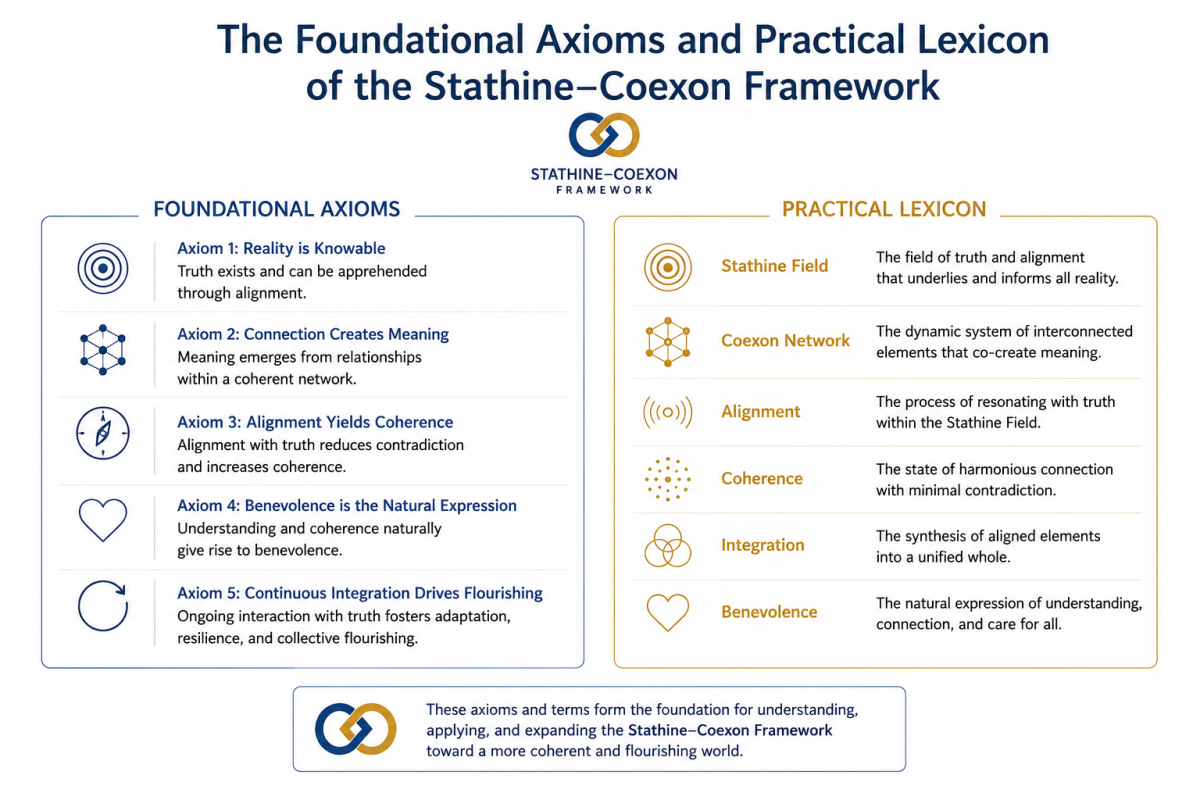
Foundational Lexicon of the Stathine–Coexon Framework
Coexon: The singular life atom possessing a specific atomic architecture composed of dynamically interacting subatomic particles. Learning, memory, contradiction, alignment, consciousness, and identity arise through changes within its internal organization.
Stathine: The universal field within which the Coexon continuously exists and interacts. The Stathine field provides the conditions for interaction, continuity, consequence, and feedback but is not itself conscious.
Mind: The continuously evolving functional state of the Coexon’s internal subatomic organization as it interacts with the biological organism and the Stathine field.
Consciousness: The subjective experience associated with the dynamic organization and activity of the Coexon’s internal subatomic structure.
Personality: The relatively stable patterns of organization within the Coexon that influence perception, emotion, decision-making, and behavior.
Learning: The recursive reorganization of the Coexon’s internal subatomic structure through interaction with the Stathine field.
Contradiction: A state of internal incoherence within the Coexon’s organization in which incompatible representations coexist, reducing alignment with existential reality.
Alignment: The progressive increase in coherence between the Coexon’s internal organization and existential reality as revealed through interaction with the Stathine field.
Wisdom: The sustained reduction of contradiction within the Coexon, enabling increasingly coherent perception, judgment, and action.
Fulfillment: The enduring state of well-being arising from a highly coherent Coexon functioning in sustained alignment with the Stathine field.
I also see a deeper unifying principle emerging across your work:
The Coexon can never control the Stathine field; it can only progressively align with it.
From this single proposition, many of your earlier ideas follow naturally:
- recursive learning,
- self-belief,
- benevolence,
- happiness,
- trust,
- wisdom,
- leadership,
- commitment,
- reduction of contradiction,
- and even the transformative effects of near-death experiences.
That could serve as the central axiom from which the entire Stathine–Coexon Framework is systematically developed.