A Stathine–Coexon Perspective on Human Wellbeing, Social Harmony, and Ecological Sustainability
Abstract
Human beings perform countless activities throughout their lives. They work, build, compete, cooperate, create, consume, teach, govern, and innovate. Yet despite unprecedented advances in knowledge and technology, many individuals continue to experience stress, conflict, dissatisfaction, and ecological disruption.
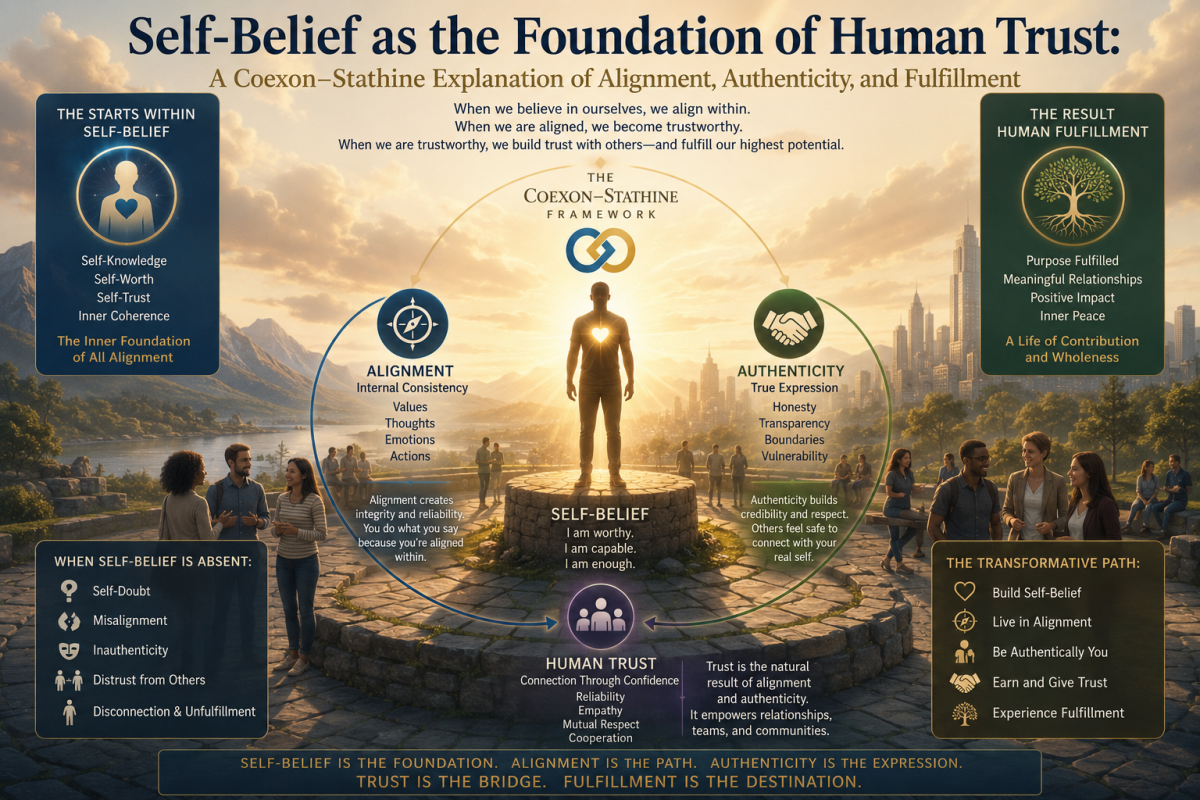
The Stathine–Coexon framework proposes a simple but profound principle: the only sustainable work possible for a human being is alignment within and with reality. All actions that emerge from alignment will contribute to personal wellbeing, social harmony, and ecological balance. Any action that does not achieve the above is done with incomplete understanding.
This article explores the concept of alignment as a foundational principle of human evolutionary activities and examines its implications for individuals, societies, and the future of the planet.
1. Introduction
Human beings often ask:
- What should I do?
- What is my purpose?
- How should I live?
- What creates fulfillment?
Most answers focus on particular occupations, achievements, beliefs, or lifestyles.
The Stathine–Coexon framework approaches the question differently.
It proposes that before asking what to do, one must ask:
“Am I aligned internally and with reality?”
Because the quality of an action depends less upon the action itself and more upon the understanding from which it arises.
Actions arising from complete understanding and internal alignment will always enrich. All other actions will be destructive and painful.
2. What Is Alignment?
Alignment does not mean obedience.
It does not mean conformity.
It does not mean passivity.
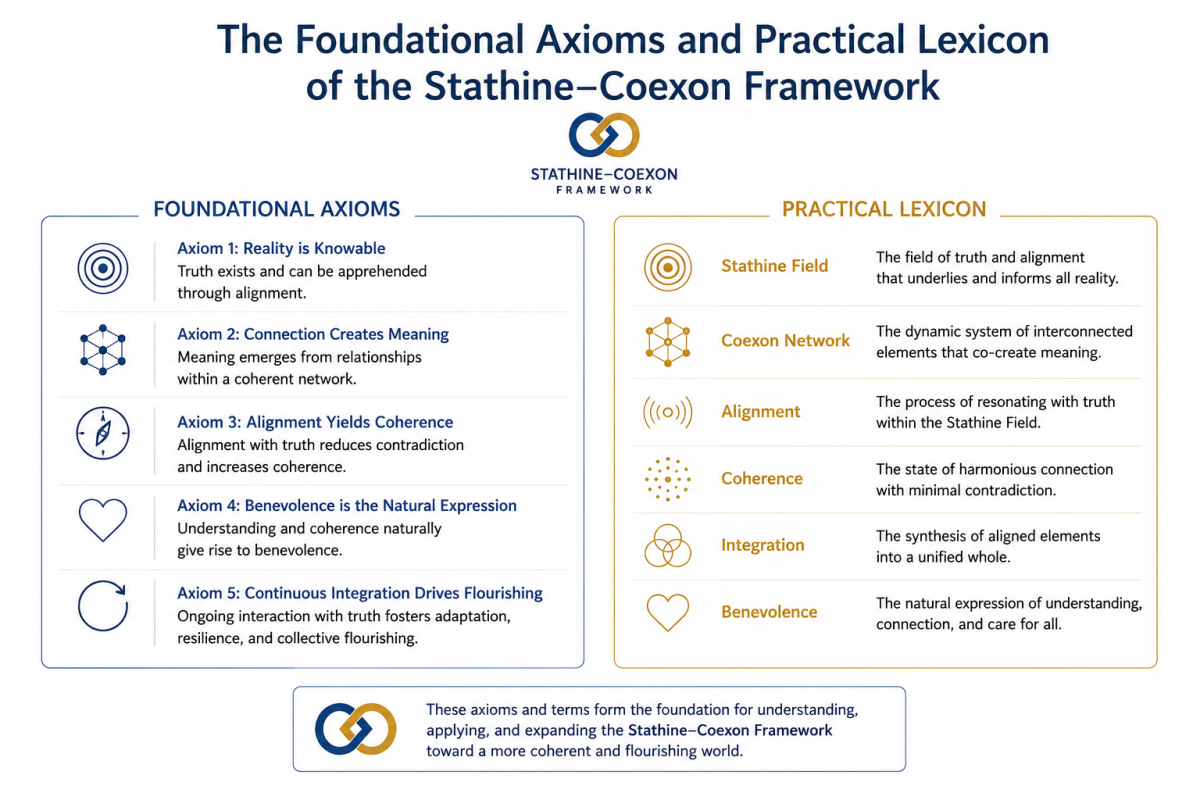
Alignment means understanding and acting in accordance with the nature of reality.
For example:
A farmer aligns with seasons.
A physician aligns with biological processes holistically. Fragmented cures are damaging.
An engineer aligns with physical laws.
A musician aligns with rhythm and harmony.
Success emerges when reality is fully understood instead of fragmented view of the reality.
Alignment therefore means participation rather than resistance.
3. The Reality of Interdependence
Modern science increasingly reveals that nothing exists independently.
Life functions through relationships.
Forests depend on microorganisms.
Animals depend on ecosystems.
Humans depend on countless social and ecological networks.
The Stathine principle describes this as coexistence.
Every entity participates within larger systems.
When actions ignore these relationships, consequences emerge.
When actions respect these relationships, stability emerges.
Alignment therefore begins with recognizing interdependence.
4. The Source of Agitation
Most human suffering is not caused by reality itself.
It arises from the actions that are disturbing the harmony between the various exitential elements.
People often seek:
- control over the uncontrollable,
- certainty within uncertainty,
- permanence within change,
- personal gain without consequence.
When reality does not conform to these expectations, agitation emerges.
The Stathine–Coexon framework suggests that agitation is often a signal of misalignment.
It indicates that understanding requires refinement.
5. The Coexon and Internal Coherence
Within the framework, the Coexon represents the organizing center of conscious participation.
The Coexon continuously evaluates:
- experiences,
- relationships,
- choices,
- outcomes.
When understanding is fragmented, contradictions accumulate.
These contradictions generate friction.
Friction manifests as:
- anxiety,
- resentment,
- confusion,
- chronic dissatisfaction.
As understanding increases, coherence develops.
The individual experiences increasing internal harmony.
6. Why Misaligned Action Creates Damage
Actions do not occur in isolation.
Every action influences multiple systems.
A decision affects:
- the individual,
- family,
- community,
- environment,
- future generations.
Misaligned actions frequently arise from narrow perspectives.
Immediate benefits are pursued without understanding broader consequences.
Examples include:
- exploiting natural resources without regard for regeneration,
- manipulating others for personal advantage,
- pursuing short-sighted gain lacking long-term vision.
Initially such actions may appear successful.
Eventually the larger system responds.
The resulting damage returns to the individual, society, and ecosystem.
7. Alignment and Human Relationships
Human relationships provide one of the clearest demonstrations of alignment.
Relationships flourish when participants understand:
- mutual needs,
- mutual responsibilities,
- mutual wellbeing.
Conflict increases when individuals seek advantage at another’s expense.
The Stathine–Coexon framework proposes a simple criterion:
A relationship is aligned when neither party exploits nor is exploited.
Such relationships generate trust, stability, and growth.
8. Alignment and Work
Many people view work primarily as economic activity.
The framework offers a broader perspective.
Work is any effort directed toward participation in reality.
Aligned work:
- creates value,
- strengthens relationships,
- improves systems,
- contributes to wellbeing.
Misaligned work can never generate wealth and will always end up doing harm.
The distinction is therefore not the activity itself but the understanding that is driving the activity. Incompleteknowledge or dichotomy needs resolution. Nothing else can work.
9. Alignment and Ecology
The Earth operates through countless interconnected cycles.
Water cycles.
Nutrient cycles.
Energy flows.
Ecological succession.
Human activity becomes sustainable only when aligned with these processes.
When ecosystems are treated as isolated resources rather than living systems, degradation follows.
Alignment with ecological reality produces resilience.
Misalignment produces instability.
Thus environmental stewardship is not merely ethical.
It is practical recognition of coexistence.
10. Alignment and Fulfillment
Many people seek fulfillment through:
- possessions,
- status,
- recognition,
- power.
These pursuits only provide temporary satisfaction.
Yet lasting fulfillment often emerges from a different source.
Fulfillment arises when:
- understanding increases,
- contradictions are resolved,
- actions contribute meaningfully,
- relationships flourish.
In other words, fulfillment emerges from alignment.
The individual experiences less internal resistance and greater participation in reality.
11. Education for Alignment
The future of humanity may depend upon teaching alignment explicitly.
Education traditionally focuses on:
- information,
- technical skills,
- professional competence.
These are important.
However, understanding reality requires additional capacities:
- self-awareness,
- systems thinking,
- empathy,
- ecological literacy,
- conflict resolution,
- reflective understanding.
Such education helps individuals align actions with consequences.
12. The Stathine–Coexon Proposal
The framework proposes that the fundamental purpose of human development is increasing coherence with reality.
The developmental movement can be described as:
Seeing → Knowing → Understanding → Experiencing → Living
As this process unfolds:
- contradictions become visible,
- misunderstandings diminish,
- alignment increases.
The result is not perfection.
The result is continuous participation in reality with increasing wisdom.
Conclusion
The Stathine–Coexon framework proposes that alignment is not merely one human activity among many.
It is the foundation underlying all sustainable human activity.
When actions arise from alignment with reality, they contribute to:
- personal wellbeing,
- healthy relationships,
- social harmony,
- ecological sustainability.
When actions arise from misalignment, agitation emerges and damage eventually follows.
The essential task of human development is therefore not simply to do more, acquire more, or control more.
It is to understand reality more deeply and participate within it more coherently.
From this perspective, the most meaningful work available to any human being is simple:
To become increasingly aligned with reality and allow action to emerge from that understanding.
Such alignment benefits the individual, strengthens society, and supports the flourishing of the larger living world upon which all life depends.