Beyond Individual Liberation: Reinterpreting Moksha, Nirvana, and Enlightenment Through the Stathine–Coexon Framework
Toward a Civilizational Vision of Coherent Human Flourishing
Abstract
Across civilizations, humanity has sought liberation from suffering through concepts such as Moksha, Nirvana, Enlightenment, and spiritual awakening. While these concepts differ across traditions, they are often understood as representing the highest realization available to human beings. Many interpretations emphasize freedom from attachment, ignorance, or the illusion of a separate self, and some are popularly understood as involving the dissolution of individuality.
This article proposes that the Stathine–Coexon Framework offers a complementary philosophical interpretation. Rather than viewing liberation primarily as the culmination of an individual’s spiritual journey or as a state associated with the disappearance of personal identity, the framework interprets liberation as the progressive development of coherence within the human being while fully participating in life. It further suggests that the next stage of human evolution may involve extending this possibility from isolated individuals to entire societies.
Foundational Terminology
This article forms part of the ongoing Stathine–Coexon Framework research series. Readers who are new to the framework are encouraged to first read The Foundational Axioms and Practical Lexicon of the Stathine–Coexon Framework, which introduces the foundational axioms, terminology, and guiding principles used throughout this article.
Introduction
Every civilization has asked the same enduring question.
What does it mean to be truly free?
The answers have been expressed through different languages and traditions.
Moksha.
Nirvana.
Enlightenment.
Liberation.
Awakening.
Although these concepts are not identical, they all point toward a profound transformation in the human condition.
Yet many contemporary discussions leave an important question unanswered.
If liberation represents the highest possibility of human life, should it become fully realizable while living, thinking, loving, creating, and contributing to society?
The Stathine–Coexon Framework suggests that the answer is yes.
A Common Popular Interpretation
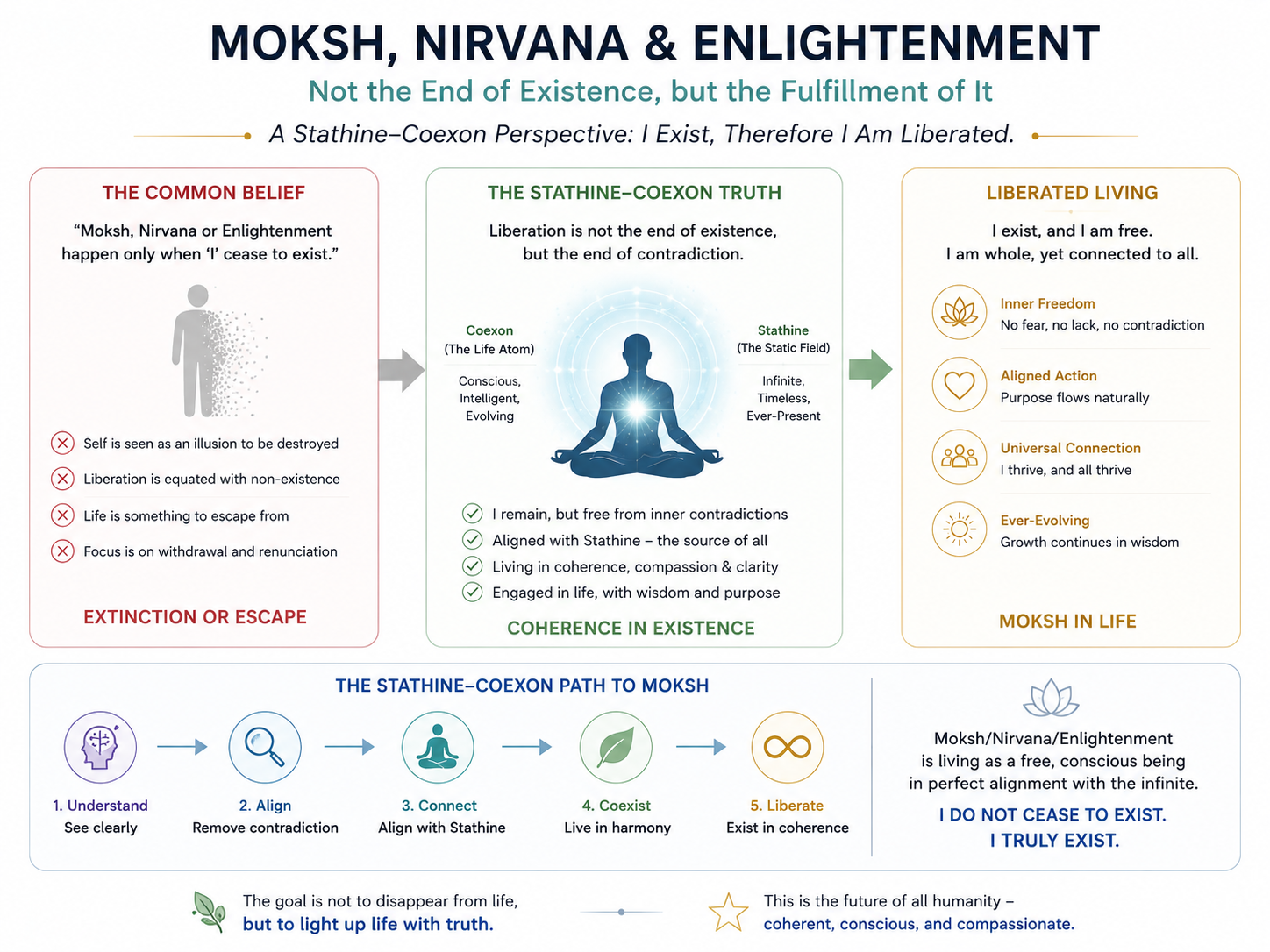
In popular discourse, liberation is sometimes described as the end of the individual self.
Such descriptions can lead to an understandable question.
If realization can only be confirmed after the disappearance of individual experience, how can it become a practical objective for humanity?
It is important to recognize that this is not the only interpretation found within the world’s contemplative traditions. Many schools describe liberation as a transformation that can be realized while living.
The present article enters that wider philosophical conversation by proposing another interpretation.
The Human Being as the Site of Liberation
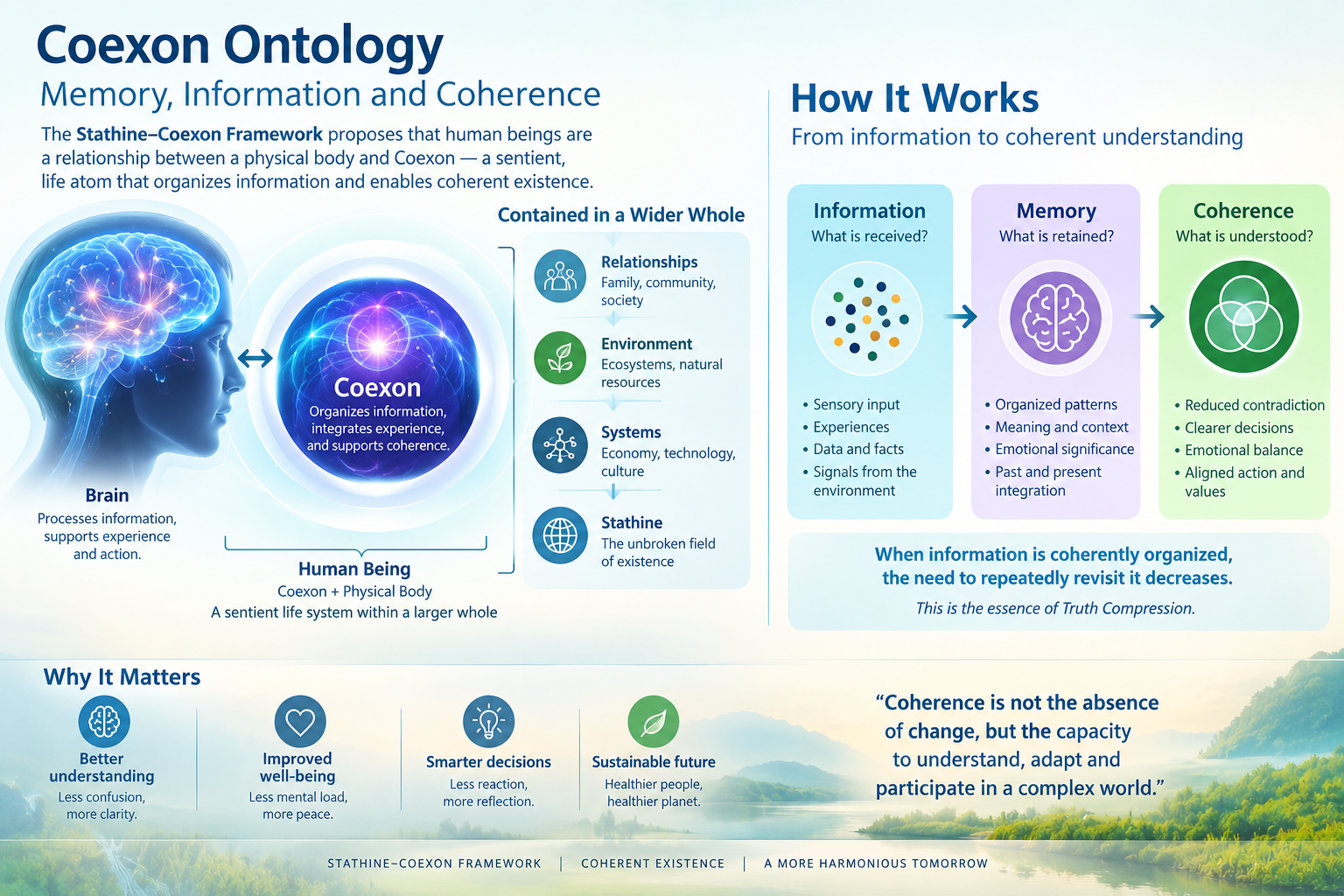
Within the Stathine–Coexon Framework, the human being is understood as the integrated unity of the proposed Coexon and the physical body.
The purpose of human existence is not interpreted as escaping existence.
Rather, it is understood as progressively increasing coherence while fully participating in existence.
Liberation therefore does not require abandoning life.
It requires transforming the quality with which life is lived.
From Escaping the World to Understanding the World
Many spiritual traditions encourage reducing attachment, dissolving ignorance, and cultivating compassion.
The Stathine–Coexon Framework fully resonates with these aspirations.
Where it differs is in emphasis.
The framework proposes that the goal is not withdrawal from the world but increasingly coherent participation within it.
The human being remains present.
Relationships remain meaningful.
Work remains valuable.
Creativity continues.
Responsibility deepens.
Freedom is expressed not by disengagement but by coherent engagement.
Coherence as Living Liberation
The framework proposes that liberation is experienced as progressively reducing contradiction between:
- understanding and action,
- intention and behaviour,
- knowledge and wisdom,
- self-interest and collective well-being,
- inner experience and outward expression.
As these contradictions diminish, the human being becomes increasingly coherent.
Peace is no longer understood as the absence of existence.
It becomes the quality with which existence is lived.
A Civilizational Shift
Historically, enlightenment has often been presented through the lives of exceptional individuals.
The Stathine–Coexon Framework asks a different question.
What if liberation became a developmental possibility for ordinary human beings living ordinary lives?
Education could cultivate coherent understanding.
Organizations could cultivate coherent leadership.
Communities could cultivate coherent relationships.
Institutions could cultivate coherent governance.
The aspiration shifts from producing isolated enlightened individuals to nurturing coherent civilizations.
Beyond Personal Awakening
If coherence can be cultivated, then enlightenment need not remain a private achievement.
It becomes a shared cultural project.
Families become places where coherence is learned.
Schools become places where coherence is practiced.
Organizations become places where coherence is reinforced.
Governments become institutions that reduce contradiction rather than amplify it.
Civilizations become ecosystems supporting increasingly coherent human beings.
The Meaning of Moksha Revisited
Within this framework, Moksha may be interpreted not as the cessation of meaningful human existence but as freedom from the fragmentation that obscures coherent living.
Nirvana may be understood as the progressive quieting of unnecessary internal contradiction.
Enlightenment may be understood as increasingly accurate, compassionate, and integrated understanding expressed through daily life.
These are philosophical reinterpretations intended to complement, not replace, the rich diversity of meanings found across religious and contemplative traditions.
Future Research
The framework suggests several questions for interdisciplinary exploration.
- Can personal coherence be operationally defined?
- Can educational practices measurably increase coherence?
- How does coherence relate to psychological well-being, ethical decision-making, and resilience?
- Can organizational cultures intentionally cultivate coherence?
- Might civilizational progress be evaluated not only by technological advancement but also by increasing coherence among individuals, institutions, and societies?
These questions invite collaboration among scholars in philosophy, psychology, education, neuroscience, systems science, and religious studies.
Conclusion
For millennia, humanity has sought liberation from suffering. The Stathine–Coexon Framework proposes that this search need not culminate in withdrawal from existence but in the progressive transformation of how existence is lived.
Within this perspective, liberation is not measured by the disappearance of the human being but by the reduction of contradiction, the growth of coherent understanding, and the capacity to participate in life with increasing wisdom, compassion, and authenticity.
If such coherence can be cultivated through education, culture, institutions, and collective practice, then enlightenment ceases to be the achievement of a remarkable few. It becomes a civilizational aspiration—a future in which human flourishing is understood not as escape from the world but as the art of living within it with ever-deepening coherence.
About the Stathine–Coexon Framework
The Stathine–Coexon Framework is an interdisciplinary philosophical framework that seeks to integrate insights from systems thinking, neuroscience, psychology, biology, complexity science, leadership, education, consciousness studies, and civilizational research through the unifying concept of coherence.
The framework proposes Stathine as the timeless conceptual ground of existence and the Coexon as a proposed organizing life atom. Together, these concepts provide a philosophical lens for exploring human development, learning, leadership, artificial intelligence, regenerative systems, and civilizational evolution.
Foundational concepts, terminology, and guiding principles are presented in The Foundational Axioms and Practical Lexicon of the Stathine–Coexon Framework.