“Awareness as a Model…” — Or a Glimpse of Something Deeper?
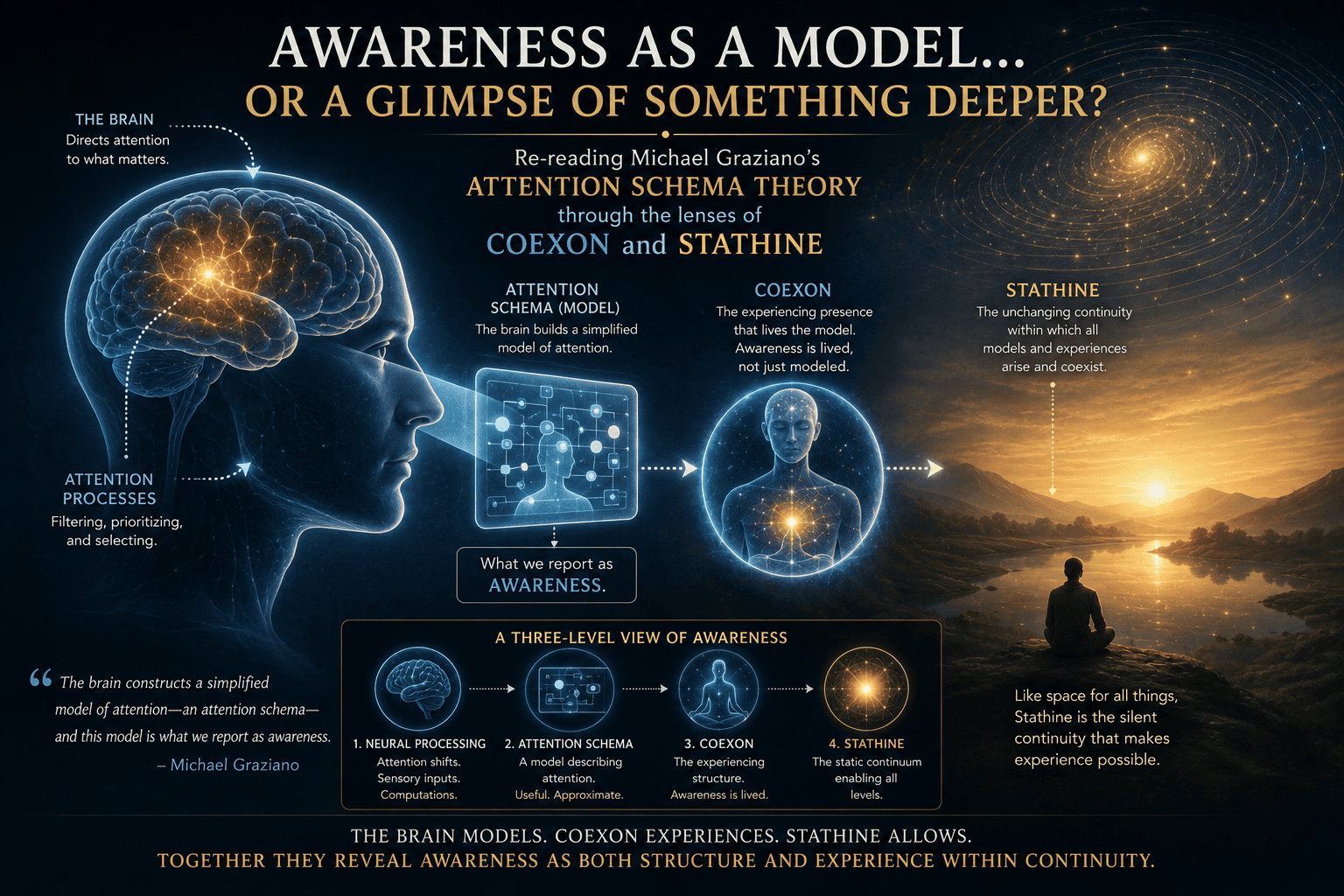
Re-reading Michael Graziano’s Attention Schema Theory through the lenses of Coexon and Stathine
What is awareness?
Not attention.
Not perception.
But the feeling that we are aware.
Michael Graziano offers a striking proposal through his Attention Schema Theory (AST):
The brain constructs a simplified model of attention—an attention schema—and this model is what we report as awareness.
In other words:
We do not directly perceive awareness.
We perceive a representation of our own attentional processes.
It is a bold idea.
Elegant.
Testable.
And unsettling.
Because it suggests:
Awareness may be a useful illusion.
But is that the full story?
Or could this “model of awareness” be interacting with something deeper?
This is where the concepts of Coexon and Stathine open a curiosity-driven extension.
1. What Graziano’s Theory Explains Beautifully
Let us begin with what works.
According to Michael Graziano:
- The brain tracks where attention is directed
- It builds a simplified internal model of that attention
- This model helps control attention efficiently
- We report this model as awareness
Why is this powerful?
Because it explains:
- Why we can talk about being aware
- Why awareness seems unified
- Why awareness can be mistaken or incomplete
It turns awareness into something:
- functional
- computational
- biologically useful
A major advance.
2. The Subtle Question: Is the Model the Experience?
Yet something curious remains.
Even if the brain builds a model of attention—
who or what experiences that model?
Is the model itself sufficient?
Or is it something that is experienced?
This is not a rejection.
It is a gap worth exploring.
Because describing the model does not fully explain:
the feeling of being aware.
3. Coexon as the Experiencing Structure
Here the concept of Coexon becomes useful.
Let us propose:
- The brain constructs the attention schema
- The schema organizes information about attention
- But Coexon is what experiences the schema
In this view:
Awareness is not merely the model.
It is the lived experience of the model.
This preserves Graziano’s insight—
but adds a layer.
The brain explains how awareness is structured.
Coexon addresses how awareness is lived.
4. A Simple Analogy
Consider a map.
A map represents terrain.
It helps navigation.
But the map is not the experience of walking the terrain.
Similarly:
The attention schema may be the map.
Coexon may be the walker.
The distinction is subtle.
But important.
5. Where Does Stathine Fit?
Now a deeper layer.
Suppose Stathine is:
a static, continuous, unchanging field in which all processes occur.
Then:
- Neural activity unfolds within it
- Attention schemas are constructed within it
- Coexon experiences within it
Stathine is not another signal.
Not another representation.
It is the continuity that allows all representation and experience to coexist.
Like silence beneath sound.
Or space beneath structure.
6. A Three-Level Curiosity Model
Let us integrate this cleanly:
Level 1: Neural Processing
Attention shifts, sensory inputs, computations.
Level 2: Attention Schema (Graziano)
A model describing attention.
Level 3: Coexon
The experiencing presence that lives the model.
Underlying Continuity: Stathine
The unchanging field enabling all levels.
This does not contradict AST.
It expands its interpretation.
7. What Changes With This View?
Several interesting shifts emerge.
Awareness Is Not Only Representation
It becomes representation + experience.
The Brain Becomes an Interface
It models, organizes, predicts.
But may not exhaust awareness.
Experience Gains Centrality
The question shifts from:
“How is awareness modeled?”
to:
“How is awareness experienced?”
Continuity Becomes Relevant
Experience is not isolated snapshots.
It flows within a stable background.
8. Reinterpreting “Awareness as Illusion”
Graziano suggests awareness may be a useful construct.
A kind of controlled illusion.
From the Coexon perspective:
Perhaps the description is simplified—
but the experience is not illusory.
The model may be approximate.
But something genuinely experiences it.
This reframes the conclusion:
Awareness may not be an illusion—
but a modeled experience within a deeper continuity.
9. Why This Matters
Because this question touches:
- Artificial intelligence
- Neuroscience
- Philosophy of mind
- Human self-understanding
If awareness is only a model—
machines may replicate it.
If awareness involves Coexon—
the question becomes deeper:
Can machines experience, or only model experience?
An open and important inquiry.
10. A Thought Experiment
Imagine a system that perfectly models attention.
It says:
“I am aware.”
Does it feel awareness?
Or only describe it?
The difference is subtle.
But crucial.
This is where Coexon helps frame the question.
11. A Tentative Thesis
We may propose:
The attention schema explains how awareness is modeled,
but Coexon accounts for how it is experienced,
and both unfold within a deeper unchanging continuity.
Not a final answer.
A bridge.
12. Questions for Exploration
Is awareness identical to its neural model?
Can representation alone produce experience?
What is the difference between describing awareness and being aware?
Is there a constant background to experience?
Questions that keep the inquiry alive.
Conclusion
Michael Graziano’s Attention Schema Theory offers one of the most compelling scientific explanations of awareness as a model.
But perhaps it is not the entire story.
Perhaps it describes the architecture of awareness—
while leaving open the question of experience itself.
By introducing Coexon and Stathine as exploratory ideas,
we expand the frame:
From modeling awareness—
to understanding how awareness is lived within a continuous reality.
Closing Reflection
The brain may build a model of attention.
The model may explain awareness.
But something experiences.
And perhaps beneath all models
lies a continuity
that does not describe—yet allows all description
to be known.