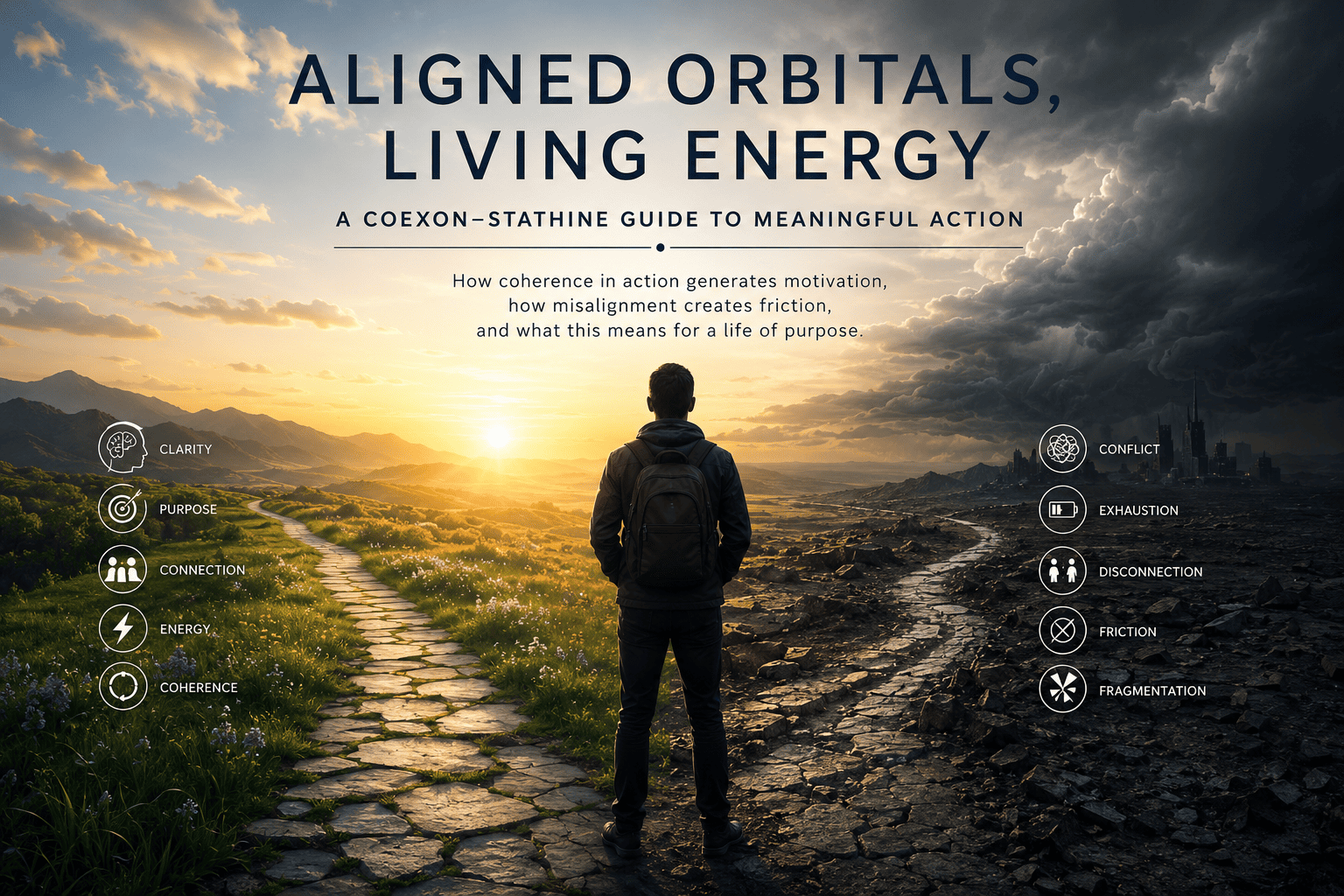
Aligned Orbitals, Living Energy: A Coexon–Stathine Guide to Meaningful Action
How coherence in action generates motivation, how misalignment creates friction, and what this means for a life of purpose
Prologue: Why Some Actions Feel Alive While Others Drain Us
Across cultures and professions, people describe a similar phenomenon:
Some actions feel energizing, clear, and meaningful.
Others feel heavy, conflicted, and draining.
Two individuals may perform the same external task—running a business, teaching a class, building a product—yet one radiates inspiration while the other experiences exhaustion and tension.
What creates this difference?
Is it skill?
Circumstance?
Personality?
Or is there a deeper structure governing how action translates into lived experience?
This article explores a unifying idea:
Action aligned with “orbitals” creates motivation and generative energy.
Action arising from misalignment creates friction, harm, and depletion.
Using the conceptual lenses of Coexon (the experiencing, learning structure of consciousness) and Stathine (the static, continuous field of coexistence), we develop a framework to understand:
- Why alignment feels energizing
- Why misalignment spreads harm
- How individual action influences others
- And how a meaningful life can be cultivated intentionally
This is not a rigid doctrine.
It is a working philosophy of lived coherence.
1. What Are “Orbitals” in Human Action?
The term orbital is borrowed metaphorically from atomic structure.
In atoms, electrons do not move randomly.
They occupy structured regions—orbitals—defined by stability and energy balance.
Now imagine human life in a similar way.
Each person operates across multiple layers of alignment:
- Biological (health, rest, energy rhythms)
- Emotional (authentic feeling vs suppression)
- Cognitive (clarity vs contradiction)
- Relational (trust vs conflict)
- Purpose-driven (meaningful direction vs drift)
When these layers are aligned, action flows naturally.
When they are misaligned, internal friction emerges.
Thus, “aligned orbitals” in human life mean:
Different layers of being operating in coherence with each other and with reality.
2. Coexon: The Experiencer of Alignment and Misalignment
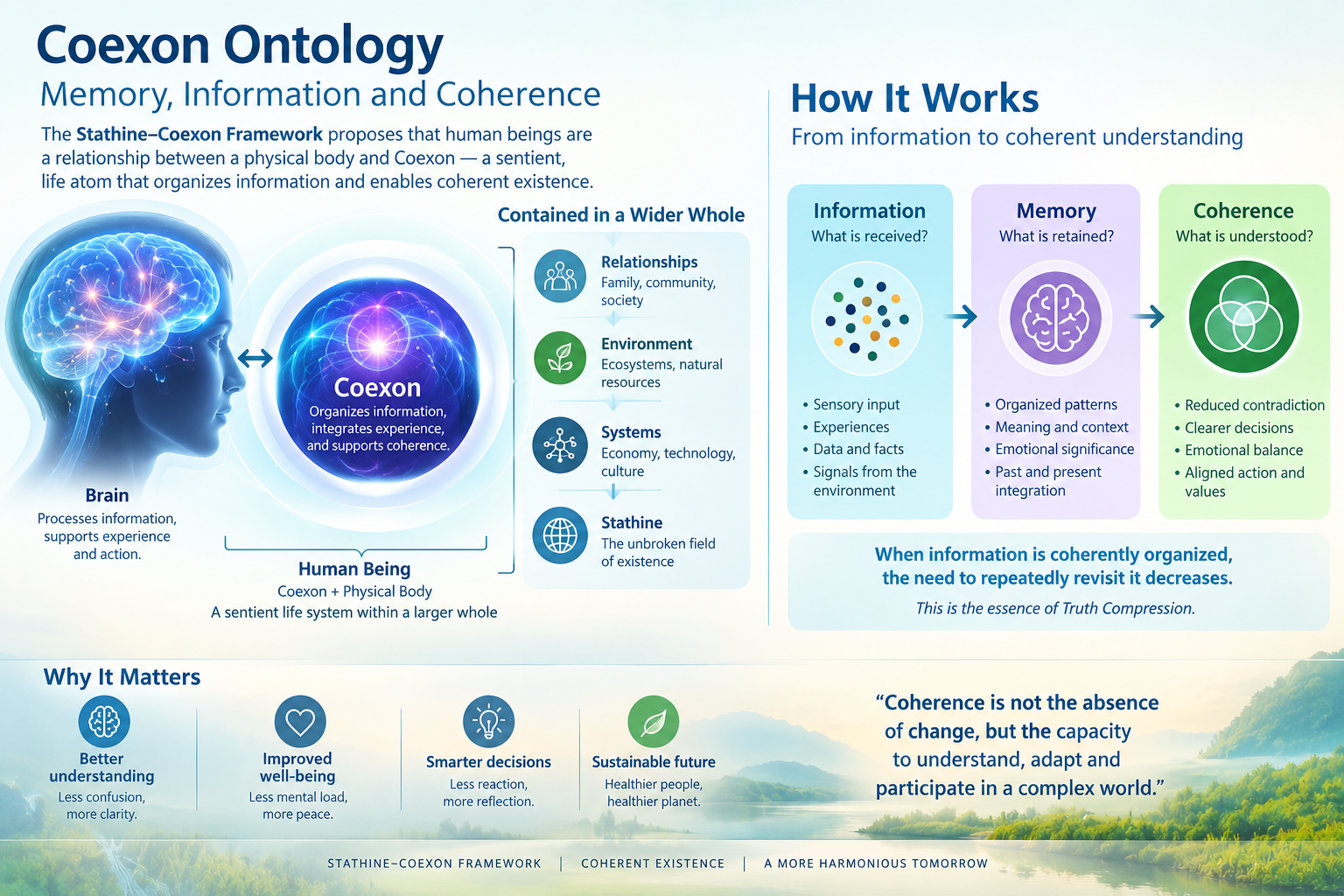
Within this framework, Coexon represents the sentient structure that:
- experiences
- interprets
- learns
- and integrates
Coexon is not just thinking.
It is the felt sense of living.
When orbitals are aligned:
- Coexon experiences clarity
- learning becomes fluid
- perception sharpens
- action feels purposeful
When orbitals are misaligned:
- Coexon experiences conflict
- interpretation becomes distorted
- energy fragments
- action feels forced
Thus, motivation is not imposed.
It is experienced by Coexon when alignment exists.
3. Stathine: The Silent Standard of Coexistence
While Coexon experiences, Stathine provides the constant backdrop.
Stathine can be understood as:
- the unchanging continuity
- the field of coexistence
- the silent order beneath all interaction
It does not act.
It does not judge.
It does not fluctuate.
Yet it provides a kind of reference condition:
Actions either align with coexistence—or create friction within it.
In this sense:
Stathine is not enforcing alignment.
It reveals alignment through consequences.
When action is coherent with coexistence:
→ energy flows
→ relationships strengthen
→ systems stabilize
When action violates coexistence:
→ friction appears
→ trust erodes
→ systems degrade
Stathine is silent.
But not indifferent.
4. Why Alignment Creates Motivation
Let us explore a central insight:
Motivation is not created.
It emerges from alignment.
Consider the following:
When your actions match:
- what you understand
- what you feel
- what is needed
- and what sustains relationships
—you do not need external push.
You feel intrinsic movement.
This is often described as:
- flow
- inspiration
- clarity
- purpose
From a Coexon perspective:
Alignment reduces internal contradiction.
Reduced contradiction allows energy to consolidate.
Consolidated energy becomes motivation.
Thus:
Motivation is the experiential signature of aligned orbitals.
5. Why Misalignment Creates Harm
Now consider the opposite.
Misalignment occurs when:
- actions contradict understanding
- emotions are suppressed or distorted
- relationships are exploited
- purposes are fragmented
This creates:
- internal tension
- cognitive dissonance
- emotional instability
- relational breakdown
From the Coexon perspective:
Energy is no longer integrated.
It is scattered across contradictions.
This has two consequences:
Internal Harm
- anxiety
- confusion
- fatigue
- loss of meaning
External Harm
- mistrust
- conflict
- breakdown of collaboration
- social friction
Thus:
Misaligned orbitals do not just harm the doer.
They propagate instability outward.
6. The Social Transmission of Alignment
One of the most powerful aspects of this framework:
Alignment spreads.
Misalignment spreads too.
When a person acts with coherence:
- clarity influences others
- trust builds naturally
- cooperation becomes easier
- systems stabilize
People often describe such individuals as:
- inspiring
- grounding
- energizing
Not because of charisma alone—
but because their internal coherence reduces friction for others.
Conversely, misaligned individuals:
- create confusion
- increase defensive behavior
- fragment group energy
Thus:
Human interaction is not neutral.
It is a field of transmitted alignment or misalignment.
7. Meaning as Sustained Alignment
Many people seek meaning as something external:
- success
- recognition
- achievement
But within this framework:
Meaning is not found.
It is generated through sustained alignment.
When actions continuously:
- respect coexistence
- reduce contradiction
- strengthen relationships
- contribute to wholes
—Coexon experiences meaning.
Meaning becomes:
The lived continuity of aligned action.
8. Practical Guidelines for Aligned Living
Let us now translate philosophy into practice.
1. Reduce Internal Contradictions
Ask regularly:
- Do my actions match what I understand to be true?
- Am I saying one thing and doing another?
Alignment begins with honesty.
2. Align Emotion and Action
Do not ignore emotion.
Understand it.
Integrate it.
Act with awareness rather than suppression.
3. Strengthen Relational Coherence
Relationships are where alignment becomes visible.
- Build trust
- Reduce manipulation
- Communicate clearly
4. Act Toward Generative Outcomes
Ask:
- Does this action enrich the system I am part of?
- Or does it extract at the cost of others?
5. Maintain Biological Alignment
Sleep, health, and energy are not separate from meaning.
They are foundational orbitals.
6. Learn Continuously
Coexon evolves through learning.
Alignment is not static.
It is refined through understanding.
9. The Role of Society and Systems
Individuals do not operate in isolation.
Systems influence alignment.
Healthy systems:
- reward coherence
- enable trust
- reduce unnecessary friction
Unhealthy systems:
- reward manipulation
- normalize contradiction
- fragment human energy
Thus:
A meaningful life requires both personal alignment
and participation in systems that support it.
10. Regenerative Living as Aligned Orbitals at Scale
When alignment extends beyond individuals:
- organizations become coherent
- economies become regenerative
- societies become stable
Regenerative systems:
- circulate value
- strengthen relationships
- reduce long-term harm
They are not idealistic.
They are structurally aligned with coexistence.
11. A Deeper Reflection: Who Are You in This Framework?
You are not merely a role.
Not merely a set of actions.
You are:
- a Coexon experiencing
- learning through alignment
- acting within a field of coexistence
Your life becomes meaningful not by accumulation—
but by coherence of participation.
12. A Working Thesis
We may summarize:
Aligned orbitals generate integrated energy, experienced as motivation and meaning.
Misaligned orbitals fragment energy, experienced as friction and harm.
Coexon experiences and learns from this.
Stathine provides the constant field in which consequences unfold.
This is not abstract philosophy.
It is observable in daily life.
13. Questions for Self-Inquiry
- Where in my life do I feel energized—and why?
- Where do I feel drained—and what contradictions exist there?
- Do my actions strengthen or weaken trust around me?
- Am I contributing to coherence—or fragmentation?
These questions are not judgments.
They are tools for alignment.
Conclusion: A Life That Radiates
When orbitals align:
- action becomes natural
- energy becomes generative
- relationships become stable
- meaning becomes continuous
Such a life does not need constant validation.
It becomes self-sustaining.
And perhaps most importantly—
it becomes contagious in the best sense.
Closing Reflection
When your actions align,
energy does not need to be forced—
it flows.When your orbitals stabilize,
meaning does not need to be searched—
it emerges.And when your life resonates with coexistence,
you do not merely live—you become a source
from which others remember
what alignment feels like.