Roger Penrose and the Geometry of Reality: Reinterpreting Singularities, Conformal Structure, Quantum Measurement, and Consciousness Through the Stathine–Coexon Framework
Part of the Stathine–Coexon Research Series
Level II — Comparative and Integrative Foundations
Physics, Cosmology, Information, Consciousness, and the Architecture of Reality
Abstract
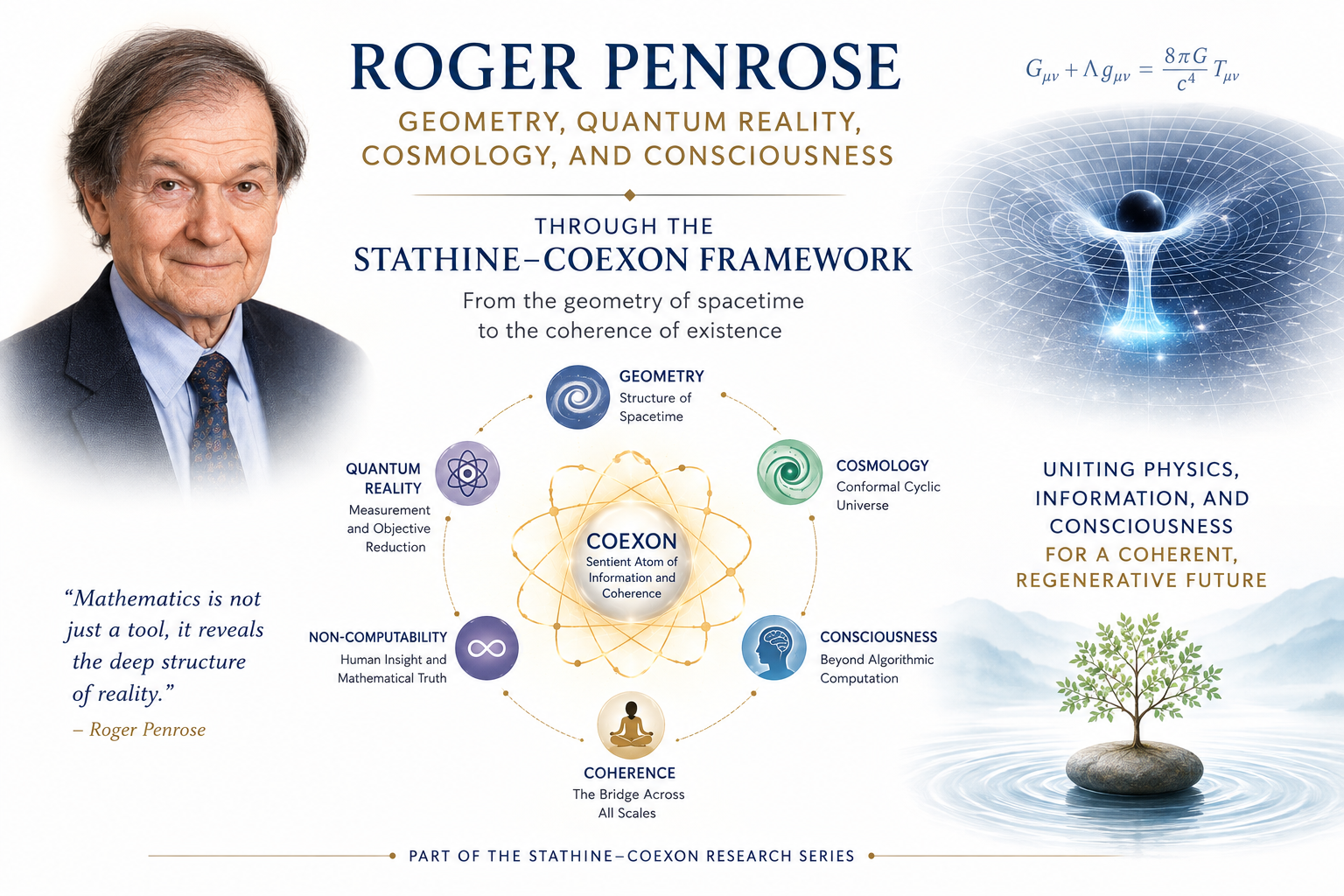
Sir Roger Penrose occupies an unusual position in modern science. His work moves across mathematical physics, general relativity, cosmology, quantum theory, geometry, computation, and consciousness. His singularity theorems demonstrated that gravitational collapse leading to singularities is a robust consequence of general relativity under appropriate conditions, a contribution recognized by the 2020 Nobel Prize in Physics. (Nobel Prize) He subsequently developed twistor theory, contributed profoundly to conformal methods in spacetime geometry, proposed the Weyl curvature hypothesis concerning the gravitational character of the early universe, developed conformal cyclic cosmology, and argued that consciousness may require physical processes that cannot be reduced to ordinary computation. (Royal Society)
The Stathine–Coexon Framework provides a distinctive conceptual lens through which these contributions can be brought into a single research architecture.
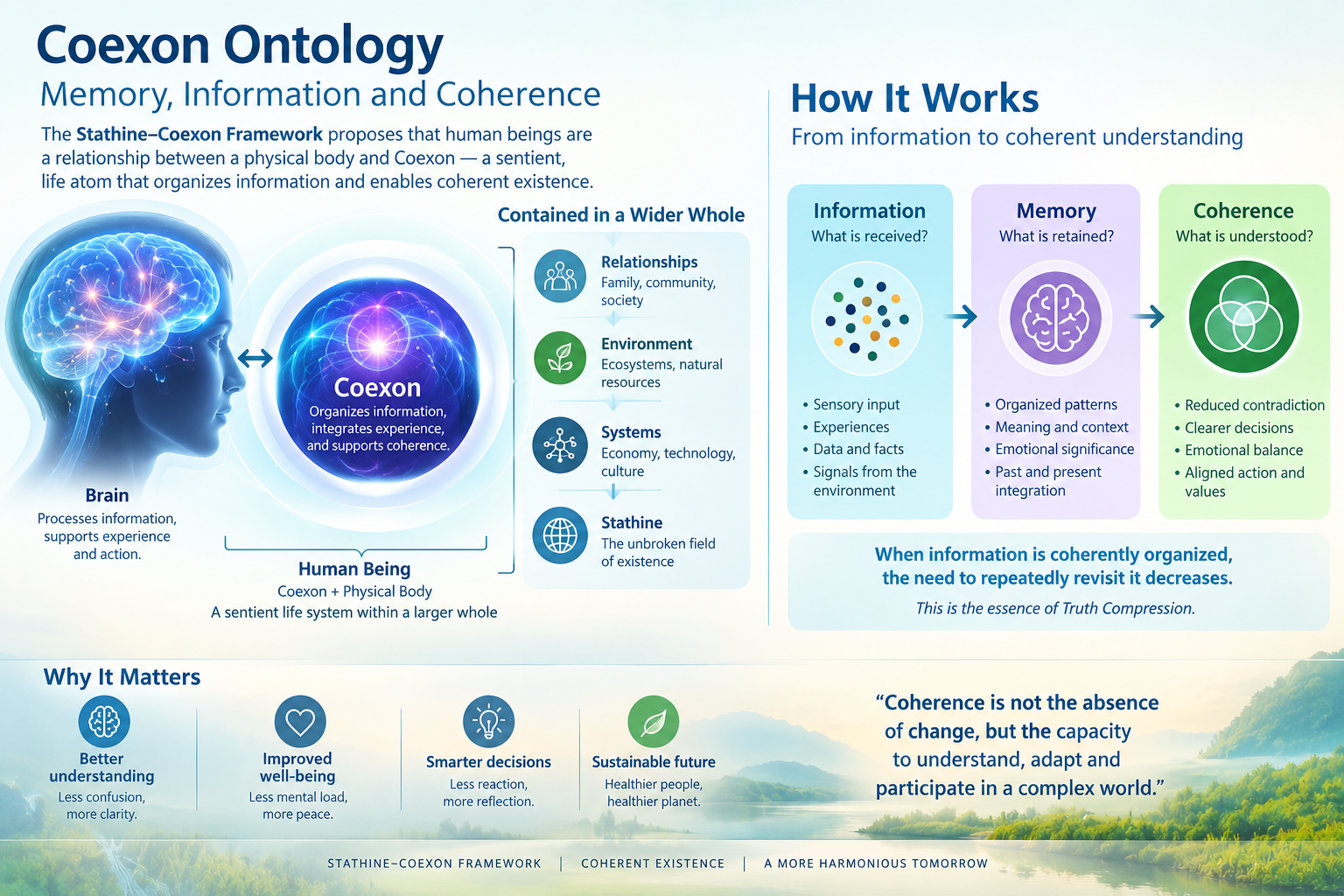
The central proposition is that reality is not adequately understood as a collection of independent objects but as an information-organizing, relational, and coherence-producing process. Within this Framework, Stathine represents the proposed omnipresent, non-depleting foundational field from which physical and informational organization can be considered, while Coexon is hypothesized as a sentient atom capable of organizing information and communicating with the holobiont’s neurological brain. The Coexon hypothesis is positioned beyond the present ambit of conventional epistemology and empirical data systems.
Penrose’s work is especially valuable to this program because he repeatedly crosses boundaries that conventional disciplinary structures tend to maintain: geometry and physics, space and causality, quantum mechanics and gravity, computation and consciousness, mathematics and physical reality.
The resulting synthesis suggests a research direction:
Penrose provides the geometry of deep physical structure; Stathine provides a proposed field-level ontology; Coexon provides a proposed information-organizing unit; and coherence provides a possible bridge between physical organization, biological intelligence, consciousness, and existence.
The purpose of this paper is not to claim that Penrose’s theories establish the Stathine–Coexon Framework. Rather, it crystalises what becomes visible when Penrose’s ideas are placed alongside the Framework’s propositions.
1. Introduction: The Scientist Who Refused the Boundaries
Much of modern science is organized by disciplines.
Physics studies matter and energy.
Mathematics studies formal structure.
Neuroscience studies brains.
Computer science studies computation.
Biology studies living systems.
Philosophy studies meaning, knowledge, and reality.
Roger Penrose has repeatedly crossed these boundaries.
The Royal Society describes his research interests as spanning general relativity, cosmology, foundations of quantum theory, non-periodic tilings, geometry, and possible physical connections between physics and consciousness. It also identifies him as the originator of twistor theory and spin networks. (Royal Society)
This makes Penrose particularly relevant to the Stathine–Coexon research program.
The Framework itself is explicitly cross-disciplinary.
Its fundamental question is:
Can existence, information, consciousness, biology, and civilization be understood as different scales of one underlying process of organization and coherence?
Penrose always approached the trajectory and the language of Stathine or Coexon though he does not use the same words.
2. Penrose’s Central Insight: Geometry Is Not Merely Description
One of the deepest features of Penrose’s work is his refusal to treat mathematical structure as merely a convenient language imposed upon nature.
For Penrose, geometry has physical significance.
General relativity does not simply describe objects moving through an already existing space.
Spacetime itself participates in physical reality.
The curvature of spacetime is dynamically connected with matter and energy.
This becomes particularly important in gravitational collapse.
Penrose’s 1965 work demonstrated that black-hole formation is not an artifact of perfectly spherical idealizations. His trapped-surface methods showed that gravitational collapse can force the appearance of singularities under broad conditions. (Nobel Prize)
This achievement represents more than a prediction about black holes.
It revealed something profound:
Reality can reach regimes in which the mathematical structure used to describe it ceases to provide a complete physical account.
That observation is highly relevant to the Stathine–Coexon Framework.
3. The Singularity as a Boundary of Description
A singularity can be interpreted in several ways.
It may represent:
- a physical divergence;
- an incompleteness of spacetime;
- a boundary of classical description;
- or an indication that a deeper theory is required.
Penrose’s singularity work established that classical general relativity naturally leads toward such boundaries under suitable conditions.
The Nobel Prize describes the singularity at the heart of a black hole as a region where the known laws of nature cease to provide a complete description. (Nobel Prize)
The Stathine–Coexon Framework asks a related but broader question:
What if the boundary of a descriptive system is not the boundary of reality?
This distinction is fundamental.
A theory failing can not be equated to reality failing, since it exists.
4. From Singularity to Ontological Transition
The Framework therefore interprets the singularity concept as potentially representing an ontological transition point.
At ordinary scales:
physical descriptions work.
At extreme scales:
the descriptive architecture becomes insufficient.
Rather than assuming that reality terminates at the boundary, one can ask:
What deeper organizational principle becomes necessary beyond the boundary?
This question connects naturally with the proposed Stathine ontology.
5. Stathine and the Problem Beneath Spacetime
Within the Stathine–Coexon Framework, Stathine is proposed as an omnipresent, static, non-depleting field extending from the apparent void between protons to the space beyond the farthest observable star.
The purpose of this proposition is not to replace general relativity.
It is to ask whether the physical universe might ultimately be understood as an emergent organization within a more fundamental informational and energetic substrate.
Penrose’s work provides an important motivation for asking such a question because general relativity itself reveals situations where conventional spacetime description reaches its limits.
Thus:
Penrose identifies where classical spacetime becomes incomplete; Stathine–Coexon asks what kind of deeper ontology might be required beyond such limits.
6. Conformal Geometry: The Most Important Bridge
One of Penrose’s most important contributions to the conceptual architecture of physics is his emphasis on conformal structure.
Conformal transformations preserve angles and causal relationships while allowing scale to change.
This is extraordinarily important because physical descriptions frequently depend on scale, whereas causal structure can survive transformations of scale.
Penrose’s conformal methods have been central to the study of asymptotic spacetime structure. The Royal Society notes his introduction of conformal boundaries into the study of asymptotically empty spacetimes. (Royal Society)
The Stathine–Coexon Framework finds this particularly suggestive.
7. Information Without Fixed Scale
The Framework proposes that information may be more fundamental than any particular physical representation of information.
A message can be encoded as:
- sound;
- electrical pulses;
- electromagnetic radiation;
- molecular configuration;
- neural activity;
- written symbols.
The representation changes.
The relational information can remain.
This creates a conceptual analogy with conformal structure:
what matters may sometimes be preserved even when scale-dependent representation changes.
This suggests that conformal geometry is leading to the Stathine–Coexon ontology.
It identifies a possible trajectory of the ontological reality.
8. Twistor Theory and Relational Reality
Penrose’s twistor theory represents another extraordinary attempt to rethink the fundamental structure of spacetime.
The Royal Society describes twistor theory as a key tool in quantum theory and identifies Penrose as its originator. (Royal Society)
Twistor theory begins from a different mathematical representation of physical reality than ordinary spacetime coordinates.
The importance for the Stathine–Coexon Framework lies in the philosophical implication:
Perhaps spacetime is not the deepest language in which reality should be represented.
If spacetime can be reformulated through a deeper mathematical structure, then one may legitimately investigate whether as maintained by Don Hoffman:
information, relation, and organization could be more fundamental descriptors than objects located in space and time.
9. From Objects to Relationships
The Framework’s ontology is relational.
An atom is not understood merely as a thing.
It is an organized system of relationships.
A biological cell is not merely a container of molecules.
It is an information-regulated network.
A brain is not merely a collection of neurons.
It is an interacting information-organizing system.
A holobiont is not merely a human body.
It is an integrated biological ecology.
The same principle extends upward:
family → organization → society → civilization.
Penrose’s geometrical approach provides an important scientific precedent for taking structure and relationships as fundamental objects of investigation.
10. The Arrow of Coherence
The Stathine–Coexon Framework proposes that systems tend toward increasing coherence through information organization and progressive reduction of contradiction.
Penrose’s cosmological thinking provides an interesting physical counterpart.
The early universe appears remarkably homogeneous and isotropic on large scales, while later cosmic evolution generates increasingly complex structure.
Galaxies emerge.
Stars emerge.
Planets emerge.
Biological systems emerge.
Conscious organisms emerge.
Civilizations emerge.
The Framework asks:
Is increasing organization merely an accidental sequence, or does it reveal a deeper information-organizing tendency?
His work makes the question scientifically interesting because his cosmological theories repeatedly focus on the relationship between geometry, structure, entropy, and cosmic history.
11. The Weyl Curvature Hypothesis
Penrose proposed the Weyl curvature hypothesis, linking the exceptionally smooth initial state of the universe with restrictions on the gravitational degrees of freedom represented by the Weyl curvature.
The hypothesis has been discussed in connection with the gravitational entropy of the universe. (arXiv)
This becomes particularly interesting within the Stathine–Coexon Framework.
The Framework distinguishes between:
disorder of information
and:
absence of information organization.
The early universe’s extraordinary smoothness therefore raises a question:
Why did the universe begin in such a highly constrained gravitational state?
Penrose’s answer is connected to the Weyl curvature.
The Stathine–Coexon question is:
What informational constraints permitted the subsequent emergence of increasing complexity?
12. Gravitational Entropy and Information
The relationship among:
- entropy;
- geometry;
- information;
- and structure
is one of the most fertile areas of modern theoretical physics.
Penrose’s work contributes importantly to this discussion.
The Stathine–Coexon Framework introduces a broader hypothesis:
The organization of information may be a fundamental characteristic of existence rather than merely a property of biological brains.
This does not mean that every physical system should be called conscious.
Instead, the Framework distinguishes:
information,
from:
information organization,
from:
information organization capable sentient structures
Coexon belongs to the third category within the hypothesis.
13. Conformal Cyclic Cosmology
Penrose’s Conformal Cyclic Cosmology (CCC) is perhaps his boldest cosmological proposal.
According to CCC, the universe consists of successive cosmic aeons, with the remote future of one aeon connected conformally to the Big Bang-like beginning of the next. A recent 2025 paper co-authored by Penrose develops a specific account of the crossover between aeons, involving a gravitational-wave epoch and Hawking points associated with the final evaporation of dominant black holes in earlier galactic clusters. (arXiv)
This is highly relevant to the Stathine–Coexon Framework.
Why?
Because CCC challenges the intuition that:
beginning → development → ending
is the only meaningful cosmological architecture.
Instead:
ending can become beginning under a transformation of description.
Stathine Coexon proposes existential reality as always existential with no beginning and no end.
14. Existence Without Absolute Beginning and End
The Stathine–Coexon Framework similarly emphasizes continuity.
Within its ontology:
existence is not necessarily equivalent to a particular configuration of matter at a particular moment.
Configurations can change.
Information can reorganize.
Systems can transform.
The Framework’s concept of Coexon being beyond conventional temporal limitation therefore creates a conceptual correspondence with Penrose’s willingness to consider cosmological structures that transcend ordinary linear beginning-to-end narratives.
15. The Concept of Atemporality
One of the recurring ideas in the Stathine–Coexon Framework is atemporality.
Time is treated as a property of certain modes of physical and informational organization rather than necessarily the ultimate boundary of existence.
Penrose’s conformal approach creates an intriguing mathematical analogy.
At conformal boundaries, conventional measures of scale can behave very differently while causal structure can remain meaningful.
This suggests a broader research question:
Could temporal experience itself be an emergent property of information organization rather than the ultimate architecture of reality?
This question deserves deeper investigation.
16. Penrose and the Quantum Measurement Problem
Penrose’s interest is not restricted to cosmology.
He has also challenged conventional interpretations of quantum mechanics.
In his work on consciousness, he argues that ordinary quantum state evolution and conventional computational descriptions may not be sufficient to explain conscious experience. He has proposed objective reduction, in which gravitational effects play a fundamental role in physical state reduction. (Stanford Encyclopedia of Philosophy)
This proposal is particularly significant for the Stathine–Coexon Framework.
17. Why Objective Reduction Matters
Penrose’s reasoning begins with a profound question:
Is quantum measurement merely a mathematical update, or does something physically real happen?
He argues for the latter.
The proposed objective reduction is intended to represent a physical process rather than merely an observer-dependent bookkeeping rule. (Stanford Encyclopedia of Philosophy)
The Stathine–Coexon Framework approaches the problem from another direction:
If information is fundamental to existence, what is the physical status of an information-organizing event?
This creates a potential bridge.
18. Collapse as Information Selection
A quantum superposition represents multiple possibilities within a quantum description.
A reduction selects one outcome.
From a Stathine–Coexon perspective, one can ask:
Is physical state selection also an information-organizing event?
The Framework would investigate whether:
collapse represents a transition from possibility-space toward coherent physical actuality.
This is a research hypothesis, not a conclusion established by current physics.
19. Consciousness: Penrose’s Most Controversial Frontier
Penrose’s work on consciousness is perhaps the most direct connection with Coexon.
His books The Emperor’s New Mind and Shadows of the Mind argue that human understanding involves aspects that cannot be captured by ordinary algorithmic computation. Shadows of the Mind explores quantum theory, microtubules, brain processes, and the possibility that consciousness requires a profound extension of physical theory. (OUP Academic)
The Stanford Encyclopedia of Philosophy summarizes Penrose’s position as involving non-algorithmic conscious acts and a proposed gravitationally induced objective reduction of quantum states. It also notes that this physical proposal remains empirically unconfirmed. (Stanford Encyclopedia of Philosophy)
The Stathine–Coexon Framework goes one step further conceptually.
20. From Non-Computability to Sentient Information Organization
Penrose asks:
Can consciousness be completely explained by computation?
The Stathine–Coexon Framework asks:
What if consciousness involves an information-organizing entity whose mode of existence is not reducible to conventional computation?
Within the Framework:
Coexon is hypothesized as a sentient atom capable of organizing information and communicating with the neurological brain.
This creates a conceptual meeting point with Penrose.
Penrose provides the argument that:
computation may not exhaust the physical basis of consciousness.
The Stathine–Coexon hypothesis proposes:
sentient information organization may constitute a deeper layer of reality.
21. Computation Versus Organization
This distinction is crucial.
A computer can:
- calculate;
- classify;
- predict;
- generate;
- optimize.
But the Stathine–Coexon Framework asks whether:
computation and understanding are necessarily the same thing.
Penrose’s arguments regarding non-computability provide an important philosophical and physical motivation for maintaining that distinction.
22. The Meaning of “Understanding”
The Framework treats understanding as more than successful computation.
Understanding requires:
- integration;
- contextual meaning;
- contradiction recognition;
- relevance;
- coherence;
- and the capacity to transform action.
Thus:
calculation can produce an answer without necessarily producing understanding.
This distinction becomes increasingly important in the age of AI.
23. Penrose and Artificial Intelligence
Penrose has long questioned the idea that ordinary computational machines can reproduce all essential aspects of human understanding.
His position is closely connected to Gödel’s incompleteness theorems and his claim that human mathematical insight cannot be completely captured by formal algorithms.
The Stathine–Coexon Framework reframes this question:
What if intelligence is not fundamentally computation but coherent information organization?
This would change the question from:
Can machines compute like humans?
to:
Can machines participate in the same kind of coherence-generating process as living intelligence?
24. The Three Levels of Intelligence
The Framework can distinguish:
Level 1 — Computation
Processing formal information.
Level 2 — Cognition
Integrating information into models for action.
Level 3 — Sentient organization
Information organization accompanied by subjective experience.
Penrose’s work is relevant particularly to the transition between Levels 2 and 3.
The Coexon hypothesis is designed to investigate the third level.
25. The Brain as Interface
Within the Stathine–Coexon Framework, the neurological brain is not necessarily the entire source of consciousness.
It can instead be conceptualized as:
an interface through which biological experience, information, and a deeper information-organizing process interact.
Coexon is hypothesized to communicate with the holobiont’s neurological brain through electromagnetic interaction.
This gives the Framework a very different architecture from conventional computational theories of mind.
26. Penrose and the Three-Brain Model
The Stathine–Coexon Framework’s concept of the:
- head brain;
- heart system;
- gut system
can also be considered in relation to Penrose’s broader concern with distributed physical processes underlying cognition.
The purpose is not to claim that Penrose endorsed such a model.
Rather, his work encourages the investigation of whether consciousness might require a physical architecture more complex than conventional neuron-level computation.
27. Creativity and Penrose
Another particularly interesting connection is creativity.
Penrose links his thinking about consciousness and non-computability to mathematical insight and creativity. The Stanford Encyclopedia notes the role of creativity, mathematical insight, Gödel’s incompleteness theorems, and a Platonic conception of mathematical reality in his argument. (Stanford Encyclopedia of Philosophy)
The Stathine–Coexon Framework has previously proposed:
Creativity is not merely breaking rules.
Instead:
Creativity is expanding a limited information architecture toward greater coherence.
This provides a direct bridge.
28. Creativity as Coherence Expansion
Suppose a person understands a problem within a limited framework.
The solution may appear impossible.
Then a new relationship is recognized.
Suddenly:
previously disconnected elements become coherent.
This is experienced as insight.
The Framework therefore proposes:
creative insight may be the experiential signature of a sudden expansion in information coherence.
Penrose’s emphasis on mathematical insight provides an important comparative basis for investigating this proposition.
29. The Platonic Question
Penrose’s philosophical position includes a strong interest in mathematical reality.
This raises a fundamental question:
Do mathematical structures exist independently of human minds?
The Stathine–Coexon Framework does not require a simple Platonic answer.
Instead, it asks:
Why does a physical universe permit mathematical structures to map onto its behavior so effectively?
Perhaps mathematics describes.
Perhaps mathematics discovers.
Perhaps mathematical structure and physical structure are manifestations of deeper relational organization.
This is precisely the kind of question that a cross-disciplinary framework should preserve rather than prematurely close.
30. Penrose Tilings and Emergent Order
Penrose’s non-periodic tilings provide another unexpected connection.
His mathematical work on aperiodic tilings demonstrates how highly structured patterns can arise without conventional periodic repetition. The Royal Society notes that Penrose’s non-periodic tiling was later observed experimentally in quasicrystals. (Royal Society)
This offers a useful metaphor — and potentially a mathematical analogy — for the Stathine–Coexon principle of coherence.
Order does not necessarily require repetition.
Coherence is not the same as uniformity.
31. Coherence Without Uniformity
This principle is fundamental throughout the Stathine–Coexon research program.
A coherent system may contain:
- diversity;
- asymmetry;
- variation;
- local differences;
- multiple scales.
Penrose tilings demonstrate a mathematical world in which organized structure does not require simple periodic repetition.
The Framework extends the conceptual lesson:
A coherent civilization need not make all humans identical.
32. From Penrose Tilings to Civilization
A healthy society may similarly contain:
- different cultures;
- different disciplines;
- different perspectives;
- different personalities;
- different forms of intelligence.
The objective is not:
eliminate variation.
It is:
connect variation into a larger coherent system.
This is a recurring Stathine–Coexon principle.
33. Penrose and the Geometry of the Possible
A common thread across Penrose’s work is the investigation of possibilities that are not immediately visible within conventional descriptions.
Black holes required new mathematical tools.
Twistor theory required a new representation.
Cosmology required conformal reformulation.
Quantum theory required reconsideration of measurement.
Consciousness required reconsideration of computation.
Mathematical tilings revealed unexpected forms of order.
This pattern can be summarized:
When the existing representation becomes inadequate, change the representation rather than forcing reality into the old one.
This is deeply compatible with the Stathine–Coexon principle of progressive reduction of contradiction.
34. Progressive Reduction of Contradiction
The Framework proposes:
When a contradiction persists, the objective should not be to suppress it but to expand the information architecture until the contradiction can be understood.
Penrose’s scientific career provides numerous examples of this methodology.
The apparent contradiction:
general relativity predicts singularities,
leads to:
deeper questions about quantum gravity.
The apparent contradiction:
quantum theory and gravity remain conceptually incomplete together,
leads to:
new mathematical approaches.
The apparent contradiction:
human understanding appears to exceed formal computation,
leads to:
investigation of non-computable physics.
Thus Penrose’s methodology itself is highly compatible with the Framework.
35. The Principle of Representation Expansion
The Stathine–Coexon Framework can therefore derive another methodological principle from the Penrose comparison:
Principle of Representation Expansion
When a persistent contradiction cannot be resolved within an existing representational system, expand or transform the representation before concluding that the contradiction is fundamental.
This principle has broad applications in science, education, AI, and organizational design.
36. Penrose and Truth Compression
The Framework’s concept of Truth Compression also becomes relevant.
Truth Compression proposes that truth does not require endless storage of redundant information because a sufficiently coherent principle can represent many observations economically.
Mathematics itself provides extraordinary examples.
A compact equation can encode enormous amounts of physical behavior.
Penrose’s mathematical physics repeatedly demonstrates the power of such compressed representations.
Thus:
mathematical elegance can be viewed as a form of truth compression when the representation preserves the relevant structure of reality.
37. Compression Versus Oversimplification
However, compression can fail.
A simplified model can eliminate information necessary to preserve truth.
Therefore:
Truth Compression is not information deletion.
It is:
preserving essential relational structure while eliminating unnecessary redundancy.
This distinction is essential for AI and scientific modeling.
38. The AI Connection
Penrose’s concerns about computation and human understanding become especially relevant as artificial intelligence becomes increasingly powerful.
An AI system can compress enormous quantities of information.
But:
Does compression equal understanding?
The Stathine–Coexon Framework would answer:
not necessarily.
A system may compress correlations without possessing the kind of sentient coherence proposed by the Coexon hypothesis.
This becomes a major research question.
39. Penrose and the Limits of Algorithmic Knowledge
Penrose’s use of Gödelian arguments challenges strong versions of computationalism.
The Framework does not need to accept every step of Penrose’s argument to find it useful.
The critical insight is:
formal rule-following may not exhaust human understanding.
This opens conceptual space for investigating:
- embodied intelligence;
- distributed intelligence;
- biological intelligence;
- sentient information organization;
- and non-algorithmic aspects of cognition.
40. A Larger Intelligence Architecture
The Stathine–Coexon Framework proposes the following hierarchy:
Stathine
↓
proposed foundational field
Physical organization
↓
Atomic organization
↓
Biological organization
↓
Holobiont organization
↓
Neural organization
↓
Coexon–brain interaction
↓
Conscious experience
↓
Reflective intelligence
↓
Collective intelligence
↓
Civilizational coherence
Penrose’s work contributes insights at several points along this hierarchy, particularly physical structure, spacetime, quantum theory, and consciousness.
41. The Holobiont as a Multiscale System
The Framework’s holobiont concept becomes especially interesting here.
The human being is not merely:
brain + body.
It is an integrated biological ecosystem.
If consciousness depends on physical processes occurring at multiple scales, then understanding the relationship between:
- molecular;
- cellular;
- neural;
- bodily;
- electromagnetic;
- and informational
levels becomes essential.
Penrose’s work motivates such multiscale investigation.
42. The Quantum–Classical Boundary
One of Penrose’s most important concerns is the transition between quantum and classical descriptions.
His objective-reduction proposal attempts to address the measurement problem by suggesting that gravity may play a role in state reduction. (Stanford Encyclopedia of Philosophy)
The Stathine–Coexon Framework asks:
Could the quantum–classical transition also be an information-coherence transition?
That is:
possibility → selection → organization → classical actuality.
This is a research direction worth developing independently.
43. Consciousness as Selection Plus Integration
The Framework therefore proposes a conceptual model:
Conscious experience may involve both selection and integration.
Selection:
something becomes definite.
Integration:
that event becomes part of a larger information architecture.
Meaning:
the event becomes relevant to the organism.
Action:
the organism responds.
Learning:
the system updates.
This is considerably broader than the simple claim:
consciousness = quantum collapse.
44. Penrose and the Problem of Explanation
One strength of Penrose’s approach is that he does not accept a superficial explanation merely because it is mathematically convenient.
The existence of a successful computational description does not necessarily explain:
why experience exists.
The existence of a successful physical equation does not necessarily explain:
why mathematics maps onto reality.
The Stathine–Coexon Framework shares this philosophical attitude.
It asks:
What is the organizing principle behind the successful description?
45. From Explanation to Ontology
This creates a distinction:
Descriptive science
What happens?
Predictive science
What will happen?
Explanatory science
Why does it happen?
Ontological science
What kind of reality makes the phenomenon possible?
Penrose frequently moves toward the fourth level.
The Stathine–Coexon Framework is explicitly designed to operate there.
46. Stathine as Ontological Background
Within the Framework:
Stathine represents the proposed underlying field.
Physical phenomena are configurations.
Information is organization.
Coexon is the proposed sentient information-organizing atom.
Consciousness is an experiential expression of such organization within a living system.
This creates a proposed architecture:
Field → Organization → Information → Sentience → Experience
Penrose’s physics supplies several scientifically sophisticated questions for each transition.
47. Coexon and the Question of Fundamental Sentience
The most radical step in the Stathine–Coexon hypothesis is Coexon.
If Coexon is a sentient atom, then sentience is not merely an emergent property appearing for the first time at the scale of neurons.
It exists at a deeper level.
The brain therefore does not necessarily create consciousness from nothing.
It may:
organize, interface with, amplify, integrate, and express a deeper sentient information process.
This is where Penrose’s work becomes particularly valuable as a comparative foundation.
48. Penrose Does Not Establish Coexon
Scientific rigor requires a clear boundary.
Penrose’s objective-reduction proposal does not establish the existence of Coexon.
His work on non-computability does not establish sentient atoms.
His cosmology does not establish Stathine.
Instead:
Penrose expands the scientifically respectable question-space in which such hypotheses can be formulated.
That distinction is crucial.
49. The Hypothesis Beyond Conventional Epistemology
The Stathine–Coexon Framework therefore positions Coexon as:
a hypothesis concerning the nature of sentient information organization that lies beyond the present ambit of conventional epistemology and empirical data systems.
This does not mean that empirical investigation is irrelevant.
Quite the opposite.
It means that the Framework distinguishes:
what can currently be empirically demonstrated
from:
what may legitimately be formulated as a deeper ontological hypothesis for future investigation.
50. The Scientific Value of Ontological Hypotheses
Science progresses not only by measuring known phenomena.
It also progresses by asking:
What deeper structure would explain several apparently disconnected phenomena?
Penrose’s career provides a powerful example of this style of inquiry.
His work repeatedly sought mathematical structures that could reorganize apparently disconnected areas.
The Stathine–Coexon research program attempts something similar at a much broader interdisciplinary scale.
51. From Penrose to a Unified Information Ontology
The proposed synthesis is:
Penrose
Reality possesses deep geometrical structure.
Stathine
Reality may possess an underlying omnipresent energetic field.
Coexon
Information organization may have a fundamental sentient component.
Holobiont
Life is a multiscale information-organizing system.
Brain
Neural architecture interfaces information with experience.
Consciousness
Experience may be related to coherent information organization.
Civilization
Collective intelligence may emerge through networks of coherent information exchange.
This is the architecture the Framework proposes for further research.
52. A Penrose–Stathine–Coexon Research Triangle
The relationship can be represented conceptually as three vertices:
Geometry
Penrose
Space, time, causality, conformal structure, singularity, quantum gravity.
Field
Stathine
Proposed omnipresent foundational field.
Information-Sentience
Coexon
Proposed sentient information-organizing atom.
The research question is:
Can geometry, field, and information-sentience be represented as different aspects of one coherent ontology?
53. From Geometry to Information
One of the most important transitions is:
geometry → information.
Modern physics increasingly treats physical systems in informational terms.
Penrose’s conformal and twistor approaches already challenge naive object-based descriptions.
The Stathine–Coexon Framework asks whether the next step might be:
information → coherent organization.
And beyond that:
coherent organization → sentience.
54. The Coherence Ladder
The Framework can therefore propose:
Physical coherence
↓
Geometrical coherence
↓
Quantum coherence
↓
Informational coherence
↓
Biological coherence
↓
Neural coherence
↓
Experiential coherence
↓
Social coherence
↓
Civilizational coherence
Penrose contributes especially strongly to the first three levels.
The Stathine–Coexon Framework attempts to connect them with the later levels.
55. A New Research Question: Is Coherence Fundamental?
This raises perhaps the deepest question in the paper:
Is coherence merely a property of organized systems, or is coherence itself a fundamental organizing principle of reality?
If coherence is merely emergent, then it must be explained by lower-level processes.
If coherence is fundamental, then physical, biological, cognitive, and social coherence might represent different manifestations of a common principle.
The Stathine–Coexon Framework takes the second possibility seriously.
56. Penrose and Progressive Discovery
Penrose’s scientific methodology provides another lesson.
He has repeatedly pursued questions that initially appear too broad:
- What happens inside gravitational collapse?
- What is the correct geometry of spacetime?
- How can quantum theory and gravity coexist?
- Is computation sufficient for consciousness?
- What is the geometry of the universe?
- Why did the universe begin in such a special state?
These are not siloed questions.
They are connected by:
a search for deeper structure.
This is precisely the intellectual attitude required for the Stathine–Coexon research program.
57. The Cross-Disciplinary Principle
The Framework therefore proposes:
Principle of Cross-Disciplinary Coherence
When multiple disciplines encounter structurally similar questions, the objective should not be to collapse them into one discipline but to investigate whether a deeper organizing principle can connect their observations without erasing their differences.
Penrose is an exemplary figure for this methodological principle.
58. Implications for Physics
For physics, the Stathine–Coexon comparison suggests investigating:
- quantum gravity;
- spacetime emergence;
- information and geometry;
- gravitational entropy;
- conformal structure;
- quantum state reduction;
- and the physical basis of consciousness.
The goal is not to modify established equations prematurely.
It is to identify where existing descriptions leave conceptual discontinuities.
59. Implications for Neuroscience
For neuroscience, Penrose’s work encourages investigation into:
- multiscale information organization;
- quantum-to-classical transitions;
- non-computational cognition;
- consciousness;
- and the relationship between physical state and subjective experience.
The Coexon hypothesis provides a deeper ontological proposal to test conceptually against such findings.
60. Implications for AI
For AI, the key question becomes:
Is intelligence equivalent to computation?
If not, then future AI architecture may require something beyond increasingly large computational systems.
The Stathine–Coexon Framework suggests investigating:
coherence-generating intelligence
rather than simply:
computational intelligence.
61. Implications for Education
Penrose also offers an important lesson for education.
Students should not merely memorize established representations.
They should learn:
when the representation itself has become the limitation.
This means teaching:
- mathematical thinking;
- conceptual transformation;
- cross-disciplinary reasoning;
- contradiction recognition;
- creative insight;
- and epistemic humility.
62. Implications for Scientific Creativity
The Framework’s theory of creativity gains another dimension from Penrose.
Scientific creativity may occur when:
a researcher recognizes that the existing conceptual representation cannot accommodate an observation.
The breakthrough is therefore not necessarily:
breaking a rule.
It is:
finding a representation in which apparently contradictory observations can coexist coherently.
This is precisely the Framework’s interpretation of creative expansion.
63. The Scientist as Coherence Seeker
Penrose’s career can therefore be viewed, from the Framework’s perspective, as an extended search for coherence across seemingly disconnected domains.
Geometry.
Gravity.
Cosmology.
Quantum mechanics.
Computation.
Consciousness.
Mathematics.
Each becomes part of a larger search.
The Stathine–Coexon Framework seeks to continue this movement by adding:
information;
sentience;
biological organization;
collective intelligence;
and civilizational coherence.
64. Relationship to Earlier Level II Papers
Penrose’s paper strengthens several existing research connections.
Stephen Wolfram
Wolfram explores computational rules generating complex reality.
Penrose challenges the possibility that computation exhausts physical reality.
Stathine–Coexon asks whether:
computation is one layer of organization rather than the complete ontology.
Karl Friston
Friston focuses on prediction, active inference, and adaptive organization.
Penrose contributes fundamental questions about the physical substrate of consciousness.
Stathine–Coexon asks whether:
prediction and information organization ultimately participate in a deeper coherence architecture.
Michael Levin
Levin demonstrates distributed biological intelligence.
Penrose challenges reduction of mind to conventional computation.
Stathine–Coexon connects:
distributed biological intelligence → information organization → sentience.
Donald Hoffman
Hoffman questions whether perception provides direct access to objective reality.
Penrose investigates the mathematical and physical architecture underlying reality.
Stathine–Coexon proposes:
the perceived world and the underlying information-organizing reality may operate at different descriptive levels.
65. Relationship to Tim Maudlin
The earlier Tim Maudlin paper focused on ontology, physics, time, and causality.
Penrose provides a natural continuation.
Maudlin asks:
What is the physical structure of reality?
Penrose asks:
What mathematical structures reveal that reality?
Stathine–Coexon asks:
What informational and sentient architecture might underlie the physical structures represented by those mathematics?
This creates:
Ontology → Geometry → Information → Sentience
as a major Level II research sequence.
66. Relationship to Rupert Sheldrake and Suzanne Simard
The ecological and morphogenic papers also gain from Penrose.
Sheldrake’s work asks whether biological organization involves patterns that cannot be reduced to conventional mechanistic explanations.
Simard demonstrates complex relational networks within forests.
Penrose demonstrates profound relational structure in mathematical physics.
The Stathine–Coexon Framework therefore investigates a broader possibility:
organization may be inherently relational across physical, biological, and ecological scales.
67. Relationship to Michael Lynch and Harry Collins
The recently developed Lynch paper focused on epistemic agency.
Collins focused on distributed expertise.
Penrose adds another layer:
the mathematical structure through which reality itself may be understood.
The resulting research architecture becomes:
Reality → Representation → Information → Expertise → Agency → Coherence
This is becoming an increasingly unified Level II program.
68. The Emerging Foundation
Across these comparative papers, a common pattern is becoming visible.
Physics asks:
What exists?
Mathematics asks:
What structure describes it?
Information theory asks:
How is difference represented?
Biology asks:
How is organization maintained?
Neuroscience asks:
How does information become experience?
Epistemology asks:
How do we know?
Democracy asks:
How do we know together?
Stathine–Coexon asks:
Can all these processes be understood as different scales of information organization and coherence?
69. A Unified Research Equation
The Framework can provisionally express the architecture as:
Reality → Information → Organization → Coherence → Experience → Action → Feedback → Reorganization
Penrose’s work provides critical insights into the earliest stages:
Reality → Geometry → Physical organization.
The Stathine–Coexon hypothesis proposes extending the chain toward:
Information → Sentience → Experience.
70. What Penrose Adds to the Stathine–Coexon Framework
Penrose contributes at least seven major insights.
1. Reality has deep mathematical structure.
2. Classical spacetime has boundaries of applicability.
3. Geometry and causality are fundamental to physical description.
4. Quantum theory and gravity remain conceptually incomplete together.
5. Computation may not exhaust human understanding.
6. Consciousness may require new physics.
7. Cosmological history may possess a deeper conformal structure than ordinary linear time suggests.
Together these create a powerful research foundation.
71. What the Stathine–Coexon Framework Adds
The Framework adds a different set of questions.
1. What if information organization is fundamental?
2. What if coherence is a cross-scale organizing principle?
3. What if sentience is associated with a deeper informational architecture?
4. What if the brain interfaces with rather than wholly generates consciousness?
5. What if biological and civilizational coherence are related manifestations of one principle?
6. What if existence can be understood as progressive information organization?
These questions extend beyond Penrose without claiming to replace his work.
72. The Deepest Intersection
The deepest intersection between Penrose and Stathine–Coexon may therefore be expressed as:
Both refuse to assume that the currently dominant explanatory language is the final language of reality.
Penrose does this mathematically and physically.
Stathine–Coexon does it ontologically and informationally.
That shared attitude is more important than any superficial similarity between individual theories.
73. A New Research Proposition
The comparison suggests a new proposition for the Level II series:
The Principle of Ontological Continuity
When apparently distinct physical, informational, biological, and experiential phenomena exhibit structural correspondences, research should investigate whether they represent different levels of one underlying organizational process rather than assuming that disciplinary boundaries correspond to ontological boundaries.
This could become an important organizing principle for the broader Framework.
74. The Research Program Beyond Penrose
The next stage should not attempt to force Penrose’s work into Stathine–Coexon terminology.
Instead, it should identify testable interfaces.
Potential research programs include:
Quantum information
Investigate whether proposed Coexon dynamics could have any mathematically coherent relationship with quantum information theory.
Quantum gravity
Investigate whether the Stathine field concept can be formulated without contradicting established relativistic structure.
Objective reduction
Compare Penrose’s proposed gravitational state reduction with the Framework’s information-selection hypothesis.
Consciousness
Examine whether the Coexon hypothesis makes distinctive predictions that differ from conventional computational or emergent theories.
Cosmology
Investigate whether the Stathine ontology has any mathematically meaningful relationship to conformal cosmology.
Information geometry
Explore whether coherence can be mathematically represented across physical and biological scales.
75. The Need for Mathematical Formalization
At this point the research program faces a necessary transition.
Philosophical coherence is not sufficient.
Conceptual elegance is not sufficient.
Cross-disciplinary similarity is not sufficient.
The next stage requires:
mathematical formalization.
A mature Stathine–Coexon theory would need to specify:
- entities;
- variables;
- states;
- transformations;
- interaction rules;
- conservation principles;
- measurable quantities;
- boundary conditions;
- and possible falsification criteria.
Penrose’s career demonstrates the importance of this transition from intuition to mathematics.
76. From Metaphor to Theory
This distinction is essential.
It is easy to say:
“Coherence appears everywhere.”
A scientific theory must ask:
What exactly is coherence?
How is it measured?
How does it evolve?
What equations describe it?
What predictions distinguish the theory from alternatives?
This is where the Stathine–Coexon research program must eventually go.
77. Penrose as a Methodological Model
Penrose therefore serves not only as a subject of comparison but also as a methodological model.
He demonstrates that:
imagination can generate the question;
mathematics can structure the question;
physics can constrain the hypothesis;
observation can challenge the theory.
The Stathine–Coexon program should follow the same progression.
78. The Role of Intellectual Humility
This is especially important because the Framework is ambitious.
A cross-disciplinary theory can easily become so broad that every observation appears to confirm it.
That would weaken it.
The stronger approach is:
actively search for observations that could contradict specific formulations of the Framework.
This is consistent with the epistemic agency principles developed in the Michael Lynch paper.
79. The Penrose Lesson
Penrose’s work teaches a deeper lesson:
A theory becomes powerful not because it explains everything immediately, but because it identifies a structure that explains something previously thought impossible or incoherent.
His singularity theorem transformed our understanding of gravitational collapse.
His conformal methods transformed the mathematical analysis of spacetime.
Twistor theory offered a new language for fundamental physics.
His consciousness work challenged computational assumptions.
CCC challenged conventional cosmological temporal architecture.
The Stathine–Coexon Framework should aspire to the same methodological standard.
80. Conclusion: From the Geometry of Spacetime to the Coherence of Existence
Roger Penrose’s scientific legacy reaches far beyond any single equation or theorem.
He has repeatedly asked whether the structures we use to describe reality are deep enough.
His singularity theorems demonstrated that general relativity naturally leads to regimes where classical description becomes incomplete. (Nobel Prize)
His conformal methods showed the power of focusing on structure that survives changes of scale. (Royal Society)
His twistor theory sought a deeper mathematical representation of physical reality. (Royal Society)
His Weyl curvature hypothesis connected the geometry of spacetime with the extraordinary thermodynamic character of the early universe. (arXiv)
His conformal cyclic cosmology proposes a universe in which successive aeons can be connected through conformal structure, with his recent work continuing to develop the physics of the crossover. (arXiv)
And his work on consciousness challenges the assumption that computation alone necessarily explains human understanding, proposing a role for objective physical state reduction and gravitational effects. (Stanford Encyclopedia of Philosophy)
The Stathine–Coexon Framework enters this landscape with a different proposition.
It asks whether:
information organization itself may be fundamental to existence.
And more radically:
whether sentient information organization may exist at a level deeper than the biological brain.
Within the Framework, Coexon is hypothesized as a sentient atom capable of organizing information and communicating with the holobiont’s neurological brain.
Penrose does not establish this hypothesis.
But his work provides an extraordinary intellectual bridge toward asking the question seriously.
The deepest synthesis is therefore:
Penrose explores the geometry of reality.
Stathine proposes an underlying field of existence.
Coexon proposes a fundamental unit of sentient information organization.
The holobiont provides the biological architecture.
The brain provides the experiential interface.
Consciousness provides the experience of organized existence.
Coherence provides the direction of integration.
The resulting research question is perhaps the most ambitious yet in the Stathine–Coexon program:
Could the geometry of spacetime, the organization of information, the emergence of biological intelligence, and the experience of consciousness represent different scales of one deeper architecture of coherent existence?
Roger Penrose’s work does not answer that question.
It helps make the question intellectually legitimate.
And that may be precisely where the next stage of the Stathine–Coexon research program should begin.
81. Position in the Stathine–Coexon Research Series
Level II — Comparative and Integrative Foundations
Roger Penrose
Geometry, Quantum Reality, Cosmology, Non-Computability, and Consciousness Through the Stathine–Coexon Framework
Primary disciplinary bridge:
Mathematical Physics → Cosmology → Quantum Theory → Consciousness → Information Ontology
Penrose should be placed very early in the Level II architecture, alongside Tim Maudlin and Stephen Wolfram, rather than among the later application papers.
A particularly strong sequence is:
Tim Maudlin
Ontology, Time, Causality, and Physical Reality
↓
Roger Penrose
Geometry, Singularities, Conformal Structure, Quantum Reality, and Consciousness
↓
Stephen Wolfram
Computation and the Generation of Reality
↓
Karl Friston
Prediction, Active Inference, and Adaptive Organization
↓
Michael Levin
Distributed Biological Intelligence
↓
Suzanne Simard
Relational Ecological Intelligence
↓
Harry Collins
Distributed Expertise and Scientific Knowledge
↓
David Hand
Dark Data and Missing Information
↓
Michael P. Lynch
Epistemic Agency, Truth, Democracy, and Collective Learning
This sequence has a deeper logic:
Ontology → Geometry → Computation → Prediction → Biology → Ecology → Knowledge → Agency → Coherence
The Stathine–Coexon Framework then acts as the integrating architecture across all of them.
Formal contribution of the Penrose paper to the Foundation Research Program:
Penrose establishes a major comparative bridge between the mathematical structure of physical reality and the possibility that consciousness and information cannot be completely reduced to conventional computational descriptions.
The paper therefore belongs in the core Level II comparative foundation, and it can eventually become one of the major bridges leading from the physics foundations of the Framework toward the later consciousness, AI, and human-existence research programs.