An interdisciplinary academic article on extending the Doughnut from boundaries and outcomes toward coherence, information, agency, and systemic participation
Abstract
The economic system of the twenty-first century faces a problem that is simultaneously ecological, social, informational, and psychological. Humanity possesses unprecedented productive capacity, technological capability, and access to information, yet billions of people continue to experience deprivation while economic activity simultaneously contributes to climate disruption, biodiversity loss, pollution, resource depletion, and other forms of planetary overshoot.
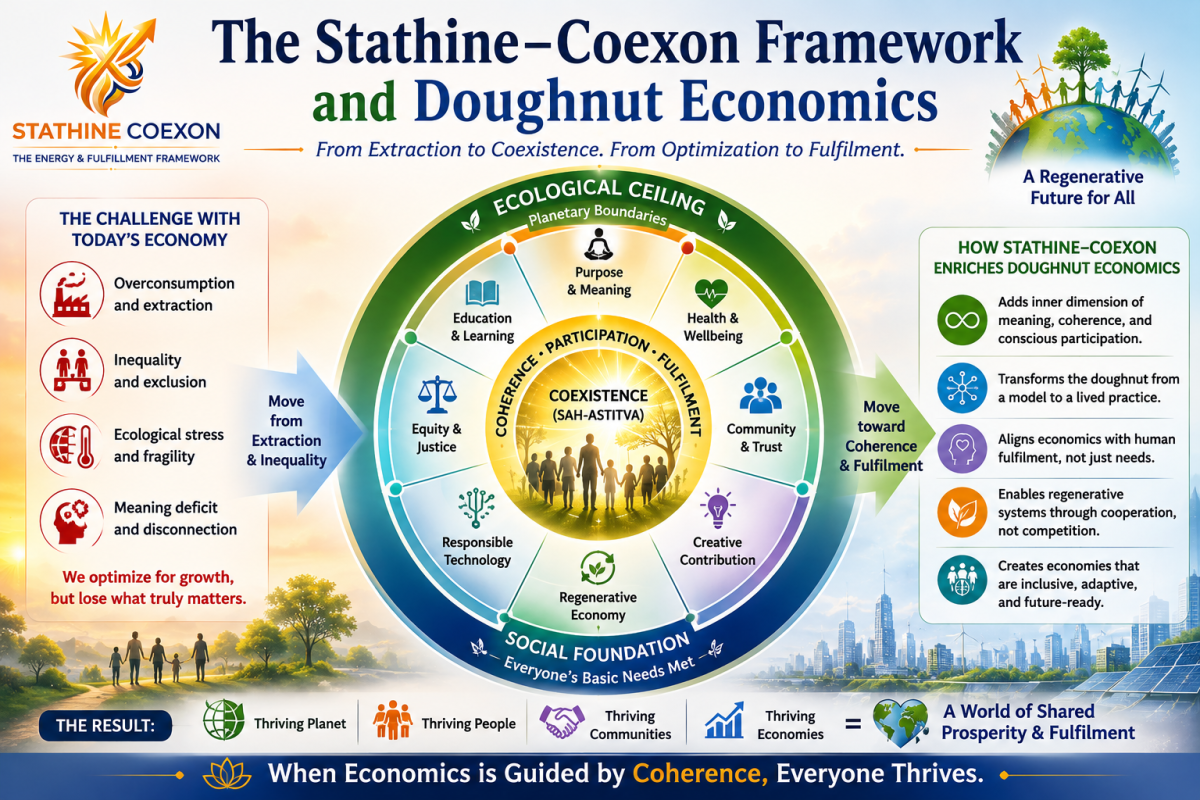
Doughnut Economics, developed by Kate Raworth, offers one of the most influential frameworks for addressing this dilemma. Its central proposition is that humanity should seek to meet the needs of all within the means of the living planet: the social foundation defines the minimum conditions for human wellbeing, while the ecological ceiling defines planetary limits. The space between them represents an ecologically safe and socially just space in which humanity can thrive. (Doughnut Economics Action Lab)
This article proposes that the Stathine–Coexon Framework can complement Doughnut Economics by addressing a different but closely related question:
What enables human beings, organizations, markets, and institutions to actually move toward the safe and just space rather than merely measuring their distance from it?
The proposed Stathine–Coexon economic perspective does not seek to replace Doughnut Economics. Rather, it introduces an additional conceptual layer concerned with coherence, information, contradiction reduction, human agency, participation, learning, and the quality of relationships among economic actors and systems.
Within the Stathine–Coexon hypothesis, Stathine represents the universal, continuous field within which existence occurs, while the Coexon is hypothesized as a sentient life atom associated with the organization of experience, understanding, and communication through the biological organism. These propositions remain speculative scientific hypotheses and should not be confused with established scientific findings. Existing work on the framework presents coherence as its organizing principle and positions it as an integrative framework rather than a replacement for established disciplines. (Anand Damani)
The article argues that Doughnut Economics provides a powerful boundary architecture, whereas Stathine–Coexon economics could provide a complementary coherence architecture.
Together, they suggest a possible economic paradigm:
Meet human needs. Respect planetary boundaries. Reduce systemic contradiction. Improve the quality of information and relationships. Expand human agency. Enable regenerative participation.
The resulting objective is not infinite economic growth, nor merely economic contraction, but the progressive creation of an economy capable of supporting human flourishing within ecological limits while continually learning how to become more coherent with the systems upon which life depends.
1. Introduction: The Economic Question Behind the Economic Question
For more than two centuries, economics has become extraordinarily effective at answering certain questions.
How should resources be allocated?
How should prices be determined?
How should production be organized?
How should incentives be designed?
How can productivity increase?
How can capital be deployed?
How can economic output grow?
These questions remain important.
But the twenty-first century has exposed a deeper question:
What should the economy ultimately be for?
This is not merely a philosophical question.
It determines what societies measure.
If GDP growth is treated as the dominant measure of success, economic activity is organized accordingly.
If shareholder return becomes the principal objective, organizational behaviour follows.
If employment, health, equality, ecological stability, resilience, or human flourishing become central objectives, different economic structures emerge.
The problem is therefore not simply that existing economics lacks information.
It may be that economic systems frequently optimize partial objectives inside larger systems that are insufficiently represented in the objective function.
This is precisely where the conversation between Doughnut Economics and the Stathine–Coexon Framework becomes potentially valuable.
2. Doughnut Economics: Establishing the Safe and Just Space
Kate Raworth’s Doughnut Economics begins from a deceptively simple proposition:
humanity should meet the needs of all within the means of the living planet.
The Doughnut represents this through two boundaries.
The inner boundary, or social foundation, represents the conditions below which people experience critical deprivation.
The outer boundary, or ecological ceiling, represents planetary limits beyond which human activity risks destabilizing Earth’s life-support systems. (Doughnut Economics Action Lab)
Between the two lies the desired space:
an ecologically safe and socially just space for humanity.
The framework is therefore neither traditionally growth-maximizing nor simply anti-growth.
Its concern is the quality and direction of economic activity.
The current Doughnut framework draws its social foundation from twelve essential social dimensions and its ecological ceiling from nine planetary boundaries, with the framework continuing to evolve as measurement and scientific understanding develop. (Doughnut Economics Action Lab)
This makes Doughnut Economics particularly valuable as a diagnostic and normative map.
It tells us:
- where deprivation exists,
- where ecological overshoot exists,
- what boundaries matter,
- and what broad destination economic systems should pursue.
But another question remains.
3. The Missing Question: Why Do Systems Remain Outside the Doughnut?
Suppose a society knows that:
- poverty is excessive,
- carbon emissions are excessive,
- biodiversity loss is excessive,
- inequality is excessive,
- resource consumption is excessive.
Why does the system nevertheless continue producing these outcomes?
The answer cannot simply be:
“Because people do not know.”
Humanity possesses substantial knowledge of these problems.
The problem is often the interaction among:
- incentives,
- institutional structures,
- competing interests,
- psychological biases,
- fragmented information,
- short-term decision horizons,
- organizational silos,
- political constraints,
- fear,
- status competition,
- and conflicting definitions of success.
In other words:
Knowing where the boundary is does not automatically create the coherence required to remain within it.
This is the space where Stathine–Coexon economics may complement Doughnut Economics.
4. From Boundaries to Coherence
The Doughnut primarily asks:
Are we inside or outside the safe and just space?
The Stathine–Coexon perspective can add:
What patterns of understanding, information, relationships, incentives, and action enable us to move toward and remain within that space?
This produces two complementary layers.
Doughnut Economics
Boundary layer
- social minimums,
- ecological maximums,
- measurable indicators,
- safe and just space.
Stathine–Coexon Economics
Coherence layer
- understanding,
- information integration,
- contradiction reduction,
- human agency,
- participation,
- learning,
- relationships,
- systemic alignment.
The first tells us where we need to be.
The second asks how the system can become capable of getting there and staying there.
5. The Proposed Economic Interpretation of Stathine
Within the Stathine–Coexon hypothesis, Stathine is described as the universal field within which existence occurs.
For economic theory, Stathine need not initially be interpreted as a literal physical entity.
It can first be used as a philosophical systems concept:
economic activity does not occur in isolation; every transaction occurs within a larger field of ecological, social, informational, biological, and institutional relationships.
This perspective challenges the abstraction of the economy as an independent machine.
The economy is embedded within:
biosphere → society → institutions → organizations → households → individuals → biological organisms.
Economic activity therefore becomes a process occurring within a larger existential field.
This resonates strongly with the Doughnut’s move away from treating the economy as an isolated system.
6. The Coexon and the Economic Actor
The second component is more ambitious.
The framework hypothesizes that every living being possesses a Coexon, described as a sentient life atom that communicates through the biological organism, particularly through the brain.
This is not an established scientific proposition.
It is a proposed ontology requiring empirical investigation.
For economics, however, the conceptual implication is already interesting.
The economic actor is not merely:
Homo economicus
maximizing utility under fixed preferences.
The economic actor becomes:
a sentient, embodied, relational participant continuously interpreting information and reorganizing understanding.
This changes the economics of decision-making.
Preferences are not necessarily static.
They are shaped by:
- experience,
- relationships,
- information,
- culture,
- fear,
- identity,
- learning,
- and changing understanding.
Economic behaviour therefore becomes partly a problem of meaning-making.
7. From Homo Economicus to Homo Coherens
A useful conceptual extension would be to move from the traditional abstraction of the rational utility-maximizing individual toward what we might provisionally call:
Homo coherens — the human being seeking to act coherently within a network of relationships and constraints.
This does not mean that people always behave coherently.
Quite the opposite.
Human beings frequently act against their own long-term interests.
They may:
- consume despite knowing the consequences,
- defend beliefs despite contradictory evidence,
- maximize short-term gain while damaging long-term resilience,
- compete when cooperation would benefit everyone,
- or protect identity at the expense of learning.
The Stathine–Coexon perspective interprets these not merely as failures of rational calculation but potentially as contradictions within the information and meaning architecture of the decision-maker.
8. Economic Contradiction
Consider a simple example.
A company states:
“We care about sustainability.”
Its incentive structure says:
“Managers are rewarded primarily for quarterly growth.”
Its customers say:
“We want sustainable products.”
Their purchasing behaviour says:
“We prioritize the lowest price.”
The government says:
“We want ecological transition.”
Its political incentives say:
“Avoid policies that impose immediate costs.”
These are not merely individual inconsistencies.
They constitute systemic contradiction.
The result is predictable:
everybody can sincerely support sustainability while the system continues producing unsustainable outcomes.
This is precisely the type of problem for which a coherence framework could add value to Doughnut Economics.
9. The Economy as an Information System
The Stathine–Coexon perspective encourages another reinterpretation.
An economy can be viewed as an enormous information-processing system.
Every economic action communicates information.
Prices communicate scarcity.
Wages communicate demand for labour.
Profits communicate relative economic rewards.
Regulations communicate social constraints.
Consumer purchases communicate preferences.
Investment communicates expectations.
Scientific research communicates knowledge.
Advertising communicates narratives.
Yet these signals are imperfect.
Prices frequently fail to incorporate ecological externalities.
GDP does not fully capture unpaid care work.
Markets do not automatically represent the interests of future generations.
Short-term financial returns may obscure long-term systemic risk.
Thus:
the economy can become informationally coherent at the transaction level while being systemically incoherent at the planetary level.
10. Externalities as Information Failure
Traditional economics describes many environmental problems through the concept of externalities.
A producer may impose a cost on society without bearing the full cost.
A factory emits pollution.
The producer receives revenue.
The community bears part of the health and ecological cost.
From the Stathine–Coexon perspective, one interpretation is:
the economic information system is failing to transmit the full consequences of the action back into the decision process.
The problem is therefore not only moral.
It is informational.
The economic system has incomplete feedback.
This provides a useful conceptual bridge to ecological economics.
11. Doughnut Economics as Boundary Feedback
The Doughnut makes these hidden consequences more visible.
The ecological ceiling tells us:
these pressures cannot continue indefinitely.
The social foundation tells us:
these human shortfalls cannot be accepted as normal.
The Doughnut therefore acts as a system-level feedback dashboard.
Stathine–Coexon can complement this by asking:
Why does the decision-making system fail to incorporate these signals into coherent behaviour?
This suggests a division of labour.
Doughnut: identify boundary conditions.
Stathine–Coexon: examine coherence of the information and decision system.
12. From GDP to Coherence-Adjusted Prosperity
This leads to a possible future research direction.
GDP measures economic production.
It does not measure whether that production:
- improves human wellbeing,
- destroys ecosystems,
- increases inequality,
- creates resilience,
- reduces future possibilities,
- or increases systemic contradiction.
The alternative is not necessarily to abandon GDP.
Instead:
GDP could become one indicator within a much larger prosperity architecture.
A future Coherence-Adjusted Prosperity Index could theoretically integrate:
- social foundation performance,
- ecological boundary performance,
- distributional equity,
- resilience,
- information transparency,
- institutional trust,
- participation,
- intergenerational effects,
- contradiction between stated goals and actual incentives,
- capacity for learning and adaptation.
This is a research proposal, not an established index.
13. The Economic Principle of Progressive Coherence
A possible foundational principle is:
An economy should progressively increase its capacity to meet human needs while reducing ecological overshoot and systemic contradiction.
This differs from:
maximize GDP.
It also differs from:
minimize economic activity.
The objective becomes:
maximize meaningful human and ecological flourishing subject to planetary constraints while continually improving systemic coherence.
14. Regeneration Rather Than Extraction
Doughnut Economics emphasizes regenerative and distributive economic dynamics. (Doughnut Economics Action Lab)
The Stathine–Coexon perspective provides a philosophical rationale for why regeneration may be superior to extraction.
An extractive system treats relationships as one-directional:
take → convert → consume → discard.
A regenerative system creates feedback:
receive → transform → contribute → restore → renew.
The difference is therefore not simply environmental.
It is structural.
The regenerative system preserves the conditions required for its own continued existence.
15. The Circularity of Coherent Economics
A coherent economy should ideally create positive feedback loops.
For example:
healthy ecosystems
→ productive agriculture
→ stable food systems
→ healthier populations
→ productive communities
→ stronger economies
→ greater capacity to invest in ecological restoration
→ healthier ecosystems.
This is a reinforcing loop.
An incoherent economy may create the reverse:
resource extraction
→ ecological degradation
→ declining productivity
→ social stress
→ political instability
→ short-term exploitation
→ further ecological degradation.
The difference is not merely quantitative.
It is a difference in system architecture.
16. Distribution and Coherence
Inequality can also be interpreted through the coherence lens.
Extreme inequality may produce informational and relational fragmentation.
Those with wealth experience one reality.
Those without it experience another.
Political priorities become distorted.
Trust declines.
Social mobility declines.
The economic system loses shared understanding of lived conditions.
Doughnut Economics already places distribution and social foundations centrally within its framework. (Doughnut Economics Action Lab)
Stathine–Coexon economics adds a complementary proposition:
A society with radically disconnected lived realities may have difficulty maintaining coherent collective decision-making.
17. Participation as Economic Infrastructure
This suggests that participation should not be treated merely as a democratic luxury.
It may be an economic capability.
Local communities possess information unavailable to centralized institutions.
Workers possess information unavailable to executives.
Consumers possess lived information unavailable to regulators.
Ecological communities contain information unavailable to markets.
Economic coherence therefore requires mechanisms through which relevant information can travel.
This resonates with Elinor Ostrom’s work demonstrating the importance of diverse, polycentric institutional arrangements for governing complex common-pool resources rather than reducing governance to a simple market-versus-state dichotomy. (Nobel Prize)
18. Polycentric Coherence
A Stathine–Coexon interpretation of polycentric governance would emphasize:
distributed intelligence with shared systemic responsibility.
Different levels can make different decisions:
- individuals,
- households,
- communities,
- businesses,
- municipalities,
- national governments,
- international institutions.
Coherence does not require centralization.
Indeed, excessive centralization may destroy local information.
The objective is therefore:
coordination without unnecessary central control.
19. The Principle of “In”
One of the practical concepts within the Stathine–Coexon framework is the idea of “being in”—recognizing oneself as participating within a system rather than standing outside it.
Applied economically, this creates a profound shift.
Instead of asking:
“What can I extract from the economy?”
the participant asks:
“What am I contributing to and receiving from the system in which I participate?”
The economic relationship becomes reciprocal.
This is close to the logic of regenerative economics.
20. From Consumer to Participant
The conventional economy often frames people primarily as:
- consumers,
- workers,
- producers,
- investors.
The Stathine–Coexon perspective proposes a broader category:
participant.
A participant:
- consumes,
- produces,
- cares,
- learns,
- creates,
- votes,
- collaborates,
- maintains,
- repairs,
- teaches,
- and contributes to collective knowledge.
This expands the economic definition of value.
21. The Invisible Economy of Care
Care work provides an important example.
Much of the work required to reproduce society occurs outside conventional market valuation.
Parents care for children.
Families care for elders.
Communities support vulnerable people.
People maintain relationships.
These activities generate enormous social value even when they do not appear directly in GDP.
A coherence-oriented economy would ask:
What functions are necessary to maintain the system even when markets do not price them adequately?
This question is compatible with Doughnut Economics’ broader concern with social foundations and human flourishing.
22. The Economy as a Living System
The strongest complementarity emerges when the economy is treated as a living system rather than a mechanical machine.
A living system:
- exchanges energy,
- processes information,
- adapts,
- learns,
- maintains boundaries,
- repairs itself,
- depends upon relationships,
- and changes through feedback.
An economy exhibits many of these characteristics.
This suggests that economic policy should not merely optimize variables.
It should examine:
relationships, feedback loops, resilience, adaptation, and learning.
23. The Stathine Field and Ecological Embeddedness
The Stathine concept reinforces the idea that no economic system exists independently of its environment.
Whether Stathine is eventually demonstrated as a physical field is a separate scientific question.
Economically, its metaphorical value is immediate:
there is no economic “outside.”
Every economy exists within a larger ecological and social field.
The Doughnut’s ecological ceiling expresses this through planetary boundaries.
The Stathine concept extends the philosophical intuition:
existence itself is relationally embedded.
24. The Coexon and Economic Meaning
The Coexon hypothesis introduces another dimension:
economic activity is experienced by sentient beings.
A factory is not merely a production function.
It affects:
- workers,
- families,
- communities,
- consumers,
- ecosystems.
A financial crisis is not merely a market correction.
It changes:
- housing,
- employment,
- relationships,
- psychological security,
- future expectations.
Economic models therefore risk becoming dangerously abstract when they remove lived experience from their analysis.
25. Beyond Utility Toward Fulfillment
Traditional utility theory provides an elegant mathematical abstraction.
But human fulfillment is more complex than consumption.
People seek:
- meaning,
- belonging,
- autonomy,
- contribution,
- creativity,
- mastery,
- purpose.
The Stathine–Coexon framework’s broader emphasis on understanding and fulfillment therefore supports a shift from:
utility maximization
toward:
meaningful participation and flourishing.
This does not invalidate utility theory.
It places it inside a larger model of human motivation.
26. The Economics of Coexistence
We can now formulate the central proposition of the proposed synthesis:
Economic value should increasingly be evaluated according to whether it enables people to flourish while preserving the ecological, social, informational, and institutional relationships required for continued flourishing.
This can be called:
the economics of coexistence.
It does not mean that all economic actors must have identical interests.
Competition can remain.
Markets can remain.
Profit can remain.
Innovation can remain.
But these mechanisms become means rather than ultimate purposes.
27. Profit in a Coherent Economy
Profit can be interpreted as useful feedback.
A profitable activity may indicate that value is being created.
But profit alone cannot determine whether systemic value is being created.
A business can be profitable while:
- polluting,
- exploiting labour,
- creating addiction,
- degrading ecosystems,
- or shifting costs onto future generations.
Therefore:
private profitability and systemic value are not identical variables.
A coherent economic system must improve the alignment between them.
28. From Externalities to Internalized Relationships
The goal of economic reform is therefore not merely to punish harmful behaviour.
It is to redesign feedback.
If ecological damage is economically invisible, the system receives incorrect information.
If care is economically invisible, the system undervalues it.
If long-term resilience is invisible, short-term extraction is rewarded.
If future generations have no representation, current preferences dominate.
A coherent economy seeks to make these relationships increasingly visible.
29. Truth Compression in Economics
The Stathine–Coexon principle of truth compression also has a potential economic application.
Economic systems contain enormous quantities of data.
But more data does not necessarily mean better understanding.
A coherent economic model should compress information without destroying essential relationships.
For example, GDP compresses millions of transactions into one number.
Useful—but insufficient.
A Doughnut compresses complex social and ecological conditions into a boundary framework.
Powerful—but still incomplete.
A future coherence dashboard could compress:
- social,
- ecological,
- economic,
- institutional,
- and relational information
while retaining the relationships necessary for good decisions.
30. The Economy as a Learning System
The ultimate complementarity may therefore be expressed through learning.
Doughnut Economics establishes a destination:
safe and just space.
Stathine–Coexon asks:
how does an economic system learn its way toward that space?
A learning economy would:
- measure outcomes,
- detect contradictions,
- identify unintended consequences,
- revise incentives,
- experiment,
- evaluate,
- learn,
- and repeat.
This is fundamentally different from assuming that a single policy can permanently solve a complex system.
31. Economic Policy as Recursive Learning
Policy would therefore become less like:
decide → implement → defend
and more like:
observe → hypothesize → act → measure → learn → revise.
This is consistent with the Stathine–Coexon principle that understanding must remain open to correction.
It also aligns naturally with complex-systems approaches to economics.
32. A Proposed Stathine–Doughnut Economic Architecture
The synthesis can be represented in five layers.
Layer 1 — Planetary Reality
Ecological ceiling
What must not be exceeded?
Layer 2 — Human Foundations
Social foundation
What must everyone have access to?
Layer 3 — Systemic Coherence
Stathine–Coexon layer
How do information, incentives, relationships, and decisions interact?
Layer 4 — Economic Mechanisms
Markets, institutions, businesses, commons, governments, communities.
Layer 5 — Human Experience
Meaning, wellbeing, agency, creativity, belonging, and fulfillment.
The economy is successful only when these layers remain sufficiently aligned.
33. A New Economic Objective Function
The conceptual objective can therefore be stated as:
Create and continuously improve an economic system that satisfies essential human needs, remains within ecological boundaries, distributes opportunity fairly, preserves systemic resilience, and increases the capacity of people and institutions to learn and act coherently.
This is broader than growth.
It is also broader than degrowth.
It is development within boundaries through increasing coherence.
34. Growth Reconsidered
Growth should therefore be divided into at least three categories:
Extractive growth
More output through greater depletion.
Efficiency growth
More value from fewer resources.
Regenerative growth
Greater human and ecological capacity through restoration and renewal.
The Stathine–Coexon perspective would not reject growth categorically.
It asks:
What is growing?
If:
- knowledge grows,
- ecological restoration grows,
- human capability grows,
- social trust grows,
- renewable capacity grows,
growth may be desirable.
If:
- pollution grows,
- inequality grows,
- resource depletion grows,
- systemic fragility grows,
growth may represent regression.
35. The Principle of Meaningful Growth
This suggests a more useful distinction:
Growth is beneficial when it increases the capacity of the system to flourish without undermining the conditions of flourishing.
This is strongly complementary to the Doughnut’s purpose of enabling humanity to thrive within planetary limits. (Doughnut Economics Action Lab)
36. Business Strategy Under the Combined Framework
A business applying the synthesis could ask five questions before launching a major initiative:
1. Human foundation
Does this improve or undermine essential human wellbeing?
2. Ecological ceiling
Does it increase ecological overshoot?
3. Coherence
Does it create contradictions between stated values and actual incentives?
4. Participation
Does it strengthen or weaken the agency of stakeholders?
5. Learning
Does the initiative create feedback that enables correction?
This transforms sustainability from a compliance exercise into a learning architecture.
37. Investment
Investment decisions could similarly evolve from:
What is the expected financial return?
to:
What combination of financial, social, ecological, and systemic value does this investment create?
Potential measures could include:
- financial return,
- carbon impact,
- resource intensity,
- employment quality,
- community benefit,
- resilience,
- knowledge creation,
- ecological restoration,
- and future-option value.
Again, these are proposed research directions rather than an established Stathine–Coexon economic methodology.
38. Entrepreneurship
Entrepreneurship can become an act of coherence creation.
The entrepreneur identifies a contradiction:
something people need is not being provided sustainably.
Innovation then creates a new configuration.
Examples might include:
- renewable energy,
- circular manufacturing,
- regenerative agriculture,
- distributed education,
- affordable healthcare,
- low-resource housing,
- ecological restoration.
Innovation is therefore not merely:
“something new.”
It becomes:
a new configuration that resolves a meaningful contradiction.
This directly connects the framework’s theory of creativity with economics.
39. Employment
The future of work can also be evaluated differently.
Instead of asking only:
How many jobs?
we can ask:
- Are people developing capabilities?
- Do they experience agency?
- Is work meaningful?
- Does work contribute to social and ecological wellbeing?
- Does work create learning?
- Are humans becoming more capable through employment?
Employment becomes developmental infrastructure.
40. Education as Economic Infrastructure
Education is frequently treated as preparation for employment.
The Stathine–Coexon perspective reverses the relationship.
Education creates:
the cognitive and relational capacity required for a coherent economy.
People need to learn:
- critical thinking,
- systems thinking,
- collaboration,
- emotional regulation,
- creativity,
- ethical reasoning,
- information evaluation,
- and adaptive learning.
An economy cannot become more coherent if its participants cannot process complexity.
41. Artificial Intelligence and the Future Economy
The rise of frontier AI makes the synthesis particularly relevant.
AI can increase:
- productivity,
- information processing,
- scientific discovery,
- design capability,
- automation,
- and decision support.
But it can also amplify:
- misinformation,
- inequality,
- surveillance,
- manipulation,
- resource consumption,
- and concentration of power.
The question therefore becomes:
What economic architecture directs AI toward the Doughnut’s safe and just space while preserving human agency and increasing systemic coherence?
The Stathine–Coexon framework can potentially serve as a human-centred coherence layer.
42. AI as a Coherence Amplifier
Rather than treating AI merely as an automation technology, it could be designed to:
- expose contradictions,
- integrate fragmented information,
- model long-term consequences,
- reveal externalities,
- simulate policy alternatives,
- identify hidden dependencies,
- support stakeholder participation,
- and make trade-offs visible.
This represents a different economic philosophy.
AI becomes:
an instrument for expanding collective understanding rather than merely accelerating transactions.
43. A Combined Doughnut–Coexon AI Governance Principle
A possible principle is:
No AI-enabled economic optimization should be considered successful solely because it increases efficiency; it should also be evaluated against social foundations, ecological ceilings, human agency, systemic coherence, and long-term learning capacity.
This could become a useful research agenda for AI economics.
44. The Economics of Contradiction
One of the framework’s most distinctive contributions could be a formal study of economic contradiction.
Examples include:
- profitable pollution,
- profitable obesity,
- profitable misinformation,
- profitable ecological destruction,
- profitable planned obsolescence,
- profitable social fragmentation.
The question is:
Why do economic incentives sometimes reward outcomes that society simultaneously spends resources trying to reverse?
This is an enormous economic design problem.
45. From Negative Externality to Systemic Contradiction
The traditional concept of an externality identifies a cost imposed outside a market transaction.
The Stathine–Coexon concept of systemic contradiction is broader.
It asks:
Does the economic system reward one actor for producing a condition that another part of the system must later spend resources correcting?
For example:
pollution-producing activity
→ environmental damage
→ public health cost
→ government expenditure
→ taxpayer burden.
The economy effectively creates a contradiction between private optimization and collective wellbeing.
46. Coherence as Economic Efficiency at a Higher Level
This does not mean that coherence replaces efficiency.
Instead:
coherence determines whether local efficiency contributes to global efficiency.
A factory can become highly efficient while increasing downstream waste.
A hospital can reduce the average treatment time while increasing readmissions.
A company can reduce labour costs while increasing employee turnover.
A city can optimize traffic flow while encouraging greater car dependency.
Local efficiency can therefore produce systemic inefficiency.
The coherence lens identifies this problem.
47. From Linear Chains to Networks
Economic accounting frequently follows linear relationships:
input → production → sale → consumption.
But ecological and social consequences form networks.
A more coherent economics therefore requires:
network thinking.
The question becomes:
What relationships are affected by this economic decision?
This is precisely the type of systems perspective that can complement the Doughnut’s planetary and social boundaries.
48. A Three-Test Economic Decision Rule
A practical Stathine–Doughnut decision rule could be:
Test 1 — Boundary
Does the decision move us toward or away from the Doughnut’s safe and just space?
Test 2 — Coherence
Does it reduce or increase contradictions between stakeholders, incentives, information, and outcomes?
Test 3 — Learning
Does it improve the system’s ability to detect and correct future problems?
A decision that passes all three tests would be considered coherence-positive.
49. Toward Coherence Accounting
This suggests another research field:
Coherence Accounting.
Traditional accounting records financial transactions.
Sustainability accounting records environmental and social impacts.
Coherence accounting would attempt to record relationships and contradictions.
Potential measures could include:
- goal–incentive alignment,
- stakeholder alignment,
- ecological–financial alignment,
- short-term–long-term alignment,
- stated-value–actual-behaviour alignment,
- local–systemic impact alignment.
Such measures would need rigorous operationalization before they could become scientifically meaningful.
50. A Coherence Balance Sheet
One imaginative extension would be a corporate Coherence Balance Sheet.
It might contain:
Assets
- trust,
- knowledge,
- skills,
- relationships,
- ecological capital,
- resilience,
- innovation capability.
Liabilities
- ecological degradation,
- social exclusion,
- misinformation,
- institutional distrust,
- dependency,
- systemic fragility.
This would not replace financial accounting.
It would sit alongside it.
51. The Doughnut as Compass, Coherence as Navigation
The relationship between the two frameworks can now be summarized elegantly:
The Doughnut is the compass.
Stathine–Coexon is a proposed navigation philosophy.
The Doughnut identifies the destination zone.
Stathine–Coexon asks how the participants continuously interpret information, resolve contradictions, coordinate action, and learn their way toward it.
This is complementary rather than competitive.
52. From “Safe and Just” to “Safe, Just, and Coherent”
The synthesis could therefore extend the conceptual phrase:
an ecologically safe and socially just space
toward:
an ecologically safe, socially just, and systemically coherent space.
The third condition does not replace the first two.
It addresses the capacity to sustain them.
53. Coherence Must Remain Pluralistic
However, a critical warning is essential.
A centralized authority must never be permitted to define “coherence” as:
everybody agrees with us.
That would convert coherence into conformity.
The Stathine–Coexon Framework explicitly distinguishes coherence from agreement.
A coherent system may contain disagreement.
Indeed, disagreement can be a valuable source of information.
Therefore:
Coherence must preserve legitimate diversity while reducing contradictions that prevent constructive participation.
54. The Role of Conflict
Conflict is not automatically incoherence.
Some conflict reveals:
- injustice,
- hidden information,
- competing values,
- or genuine uncertainty.
Suppressing conflict may reduce visible disagreement while increasing actual incoherence.
A healthy economy therefore needs mechanisms for:
- disagreement,
- negotiation,
- experimentation,
- feedback,
- and correction.
Coherence is achieved through processing difference, not eliminating it.
55. The Role of Markets
The combined framework should not automatically reject markets.
Markets are powerful coordination mechanisms.
They can:
- communicate information,
- stimulate innovation,
- allocate resources,
- coordinate distributed activity.
But markets have boundaries.
They do not automatically represent:
- future generations,
- ecological thresholds,
- unpaid care,
- public goods,
- or all forms of human value.
The question is therefore not:
market or no market?
It is:
where are markets appropriate, and where must they be embedded within broader institutions?
This is compatible with the pluralistic institutional perspective associated with Ostrom. (Nobel Prize)
56. The Role of Government
Government can establish:
- minimum social protections,
- ecological limits,
- public infrastructure,
- standards,
- taxation,
- redistribution,
- and long-term planning.
But government is not omniscient.
A coherent economy therefore requires multiple forms of governance.
This again supports polycentric approaches.
The objective becomes:
distributed intelligence within shared boundaries.
57. The Role of the Commons
The commons may occupy an important position between market and state.
Communities can sometimes govern shared resources through locally adapted rules, monitoring, trust, and collective responsibility.
The Stathine–Coexon perspective would interpret such arrangements as examples of:
relationship-based economic coherence.
The commons demonstrates that economic organization need not always be reduced to either private ownership or centralized state control.
58. Toward Regenerative Capital
Capital itself could be reconceived.
Instead of asking only:
How much financial capital is accumulated?
we could ask how economic activity builds:
- ecological capital,
- human capital,
- social capital,
- knowledge capital,
- technological capability,
- and resilience.
Financial capital becomes one component of a larger regenerative system.
59. A Possible Economic Axiom
The synthesis permits a provisional axiom:
No economic value is fully realized if its creation systematically destroys the ecological, social, informational, or relational conditions required to sustain that value.
This is a stronger statement than conventional sustainability accounting.
It says that sustainability is not an external constraint.
It is part of the definition of durable value.
60. A Second Economic Axiom
A second proposition follows:
Economic systems should reward activities that increase the capacity of individuals, communities, organizations, and ecosystems to regenerate themselves and their relationships.
This moves economics from extraction toward capacity-building.
61. A Third Economic Axiom
A third:
The quality of an economy should be evaluated not only by what it produces, but by the quality of relationships and future possibilities it creates.
This introduces an explicitly teleological dimension.
Economic success becomes about what the economy enables people and systems to become.
62. The Five-Dimensional Economic Evaluation
The Stathine–Coexon five-dimensional evaluation framework developed elsewhere in this research series can now be applied to economics.
Epistemology
How does the economy know what is happening?
Ontology
What does the economic system assume exists and has value?
Axiology
What does it consider worth pursuing?
Praxis
How are decisions translated into economic behaviour?
Telos
What kind of society does the economic system create?
This provides a powerful diagnostic framework for evaluating economic theories themselves.
63. Evaluating Conventional Economics
From this perspective, conventional economics need not be dismissed.
Its strengths include:
- analytical precision,
- incentive analysis,
- resource allocation,
- mathematical modelling,
- behavioural insights,
- and institutional analysis.
But its limitations may arise when:
- ecological systems are externalized,
- care is undervalued,
- human meaning is simplified,
- distribution is treated as secondary,
- or growth becomes an implicit objective.
Doughnut Economics addresses many of these limitations.
Stathine–Coexon potentially addresses another layer:
the coherence of the human-information system making economic decisions.
64. Evaluating Doughnut Economics
The Doughnut itself should also be critically evaluated.
Its strengths include:
- intuitive visualization,
- integration of social and ecological concerns,
- planetary-boundary grounding,
- normative clarity,
- adaptability to local contexts,
- and practical policy applications. (Doughnut Economics Action Lab)
Its challenge is that boundaries and indicators do not automatically specify:
- institutional mechanisms,
- psychological mechanisms,
- conflict-resolution processes,
- information architecture,
- incentive redesign,
- or how societies learn their way through uncertainty.
This is precisely where the Stathine–Coexon framework could contribute a complementary layer.
65. The Complementarity in One Diagram
Conceptually:
DOUGHNUT ECONOMICS
Social foundation
↓
SAFE & JUST SPACE
↑
Ecological ceiling
STATHINE–COEXON ECONOMICS
Information
↓
Understanding
↓
Contradiction reduction
↓
Coherence
↓
Participation
↓
Learning
↓
Regeneration
=
An economy capable of learning its way toward a safe, just, regenerative, and coherent future.
66. A Research Programme
The proposal should not remain philosophical.
It can generate empirical research questions.
Research Question 1
Do organizations with greater alignment between stated values and incentives produce better social and ecological outcomes?
Research Question 2
Does greater stakeholder participation improve sustainability performance?
Research Question 3
Can contradiction-detection tools improve strategic decision-making?
Research Question 4
Can AI identify hidden conflicts between organizational goals and ecological/social outcomes?
Research Question 5
Can coherence indicators predict organizational resilience?
Research Question 6
Can economic systems that internalize longer-term feedback outperform systems optimized for short-term returns?
These questions are testable.
67. Experimental Economics
Experiments could compare groups making decisions under different information architectures.
Group A
Financial information only.
Group B
Financial + social information.
Group C
Financial + social + ecological information.
Group D
Financial + social + ecological + contradiction/coherence information.
Researchers could examine:
- decisions,
- trade-offs,
- cooperation,
- long-term outcomes,
- and resilience.
This would begin testing whether coherence-oriented information changes economic behaviour.
68. Organizational Experiments
Companies could pilot a Doughnut–Coherence Dashboard.
Each strategic initiative would be assessed across:
| Dimension | Question |
|---|---|
| Social foundation | Does it meet essential human needs? |
| Ecological ceiling | Does it increase planetary pressure? |
| Financial sustainability | Can it sustain itself economically? |
| Coherence | Are incentives and outcomes aligned? |
| Participation | Who contributes information and who bears consequences? |
| Learning | Can the system detect and correct failure? |
| Regeneration | Does it restore future capacity? |
This could provide a practical bridge between the two frameworks.
69. City-Level Application
Cities are particularly suitable experimental environments.
The Doughnut is already being adapted for cities and sectors, with tools designed to translate the framework into local assessment and action. (Doughnut Economics Action Lab)
A Stathine–Coexon layer could add:
- citizen participation,
- institutional coherence,
- information flows,
- cross-department contradictions,
- long-term feedback,
- and AI-assisted scenario analysis.
The resulting city model could ask:
How can the city become a learning organism capable of remaining within its ecological means while improving the lives of its residents?
70. From Doughnut City to Coherent City
A coherent city would not merely measure:
- emissions,
- housing,
- income,
- education,
- transport,
- biodiversity.
It would also ask:
Are our policies working together?
For example:
A city may promote electric vehicles while continuing to expand road infrastructure.
It may promote public transport while zoning forces long commutes.
It may encourage affordable housing while land policies inflate housing prices.
These are policy contradictions.
The Stathine–Coexon approach would make them explicit.
71. The Economic Role of Awareness
At the individual level, the framework proposes that economic change begins partly with awareness.
A consumer who understands the relationships behind a product may make different decisions.
An investor who understands systemic risk may invest differently.
An entrepreneur who understands ecological dependencies may design differently.
A policymaker who sees long-term consequences may regulate differently.
Thus:
economic transformation is partly a transformation of understanding.
This is where the Coexon concept becomes central to the framework’s economic philosophy.
72. From Conscious Consumption to Conscious Participation
However, the burden cannot be placed entirely on consumers.
Individual choices operate within structural constraints.
A person cannot simply “choose sustainability” if:
- sustainable products are unavailable,
- housing is unaffordable,
- public transport is absent,
- wages are inadequate.
Therefore the framework must avoid moralizing individual behaviour.
The correct approach is:
align individual agency with institutional design.
People should be empowered to make coherent choices because the system makes those choices possible.
73. Economic Transformation as Alignment
The synthesis can therefore be summarized as an alignment problem:
human needs
↕
economic incentives
↕
institutional structures
↕
ecological realities
↕
long-term consequences
When these become increasingly aligned, systemic coherence increases.
74. The Deeper Philosophical Complementarity
The deepest difference between the two frameworks is therefore not their goals.
Both ultimately reject an economy that sacrifices human wellbeing or ecological integrity for narrow measures of economic success.
The difference lies primarily in emphasis.
Doughnut Economics asks:
What are the boundaries within which humanity should thrive?
Stathine–Coexon asks:
What kind of sentient, informational, relational system can learn to thrive within those boundaries?
The first is primarily a framework of conditions.
The second proposes a framework of coherence and participation.
Together they create a richer picture.
75. Toward an Economics of Coherent Coexistence
The synthesis can finally be named:
Economics of Coherent Coexistence.
Its foundational proposition would be:
An economy exists to enable human beings and communities to flourish within the ecological conditions that sustain life, while continuously improving the coherence, resilience, participation, and regenerative capacity of the systems through which that flourishing occurs.
This is not merely a green version of conventional economics.
It is a different conception of economic purpose.
76. Conclusion
Doughnut Economics has made a major conceptual contribution by changing the question of economic success.
Instead of asking simply:
How much can the economy grow?
it asks:
Can humanity meet the needs of all within the means of the living planet?
The Doughnut’s social foundation and ecological ceiling provide a powerful framework for making that question visible, measurable, and actionable. (Doughnut Economics Action Lab)
The Stathine–Coexon Framework can complement this proposition by asking a further question:
What enables individuals, organizations, institutions, markets, and societies to actually become capable of achieving and sustaining that condition?
Its answer begins with coherence.
Economic systems are not merely allocation mechanisms.
They are information systems.
They are relationship systems.
They are learning systems.
They are meaning systems.
And, ultimately, they are systems composed of sentient participants.
The Stathine hypothesis provides a philosophical representation of the universal field within which economic activity occurs.
The Coexon hypothesis proposes a sentient life atom through which experience, understanding, and communication are organized.
Neither proposition should currently be presented as established scientific fact.
Their value at this stage lies in generating a new set of questions that can eventually be subjected to empirical examination.
The economic implications, however, can already be formulated independently of the ultimate truth of the Coexon ontology.
An economy that:
- ignores ecological limits,
- leaves people without essential needs,
- rewards contradictory incentives,
- suppresses relevant information,
- discounts future consequences,
- and optimizes local efficiency at the expense of systemic resilience
is not merely unethical.
It is systemically incoherent.
Conversely, an economy that:
- meets human needs,
- respects planetary boundaries,
- distributes opportunity,
- incorporates previously externalized consequences,
- values care,
- preserves diversity,
- enables participation,
- learns from failure,
- and rewards regeneration
moves toward a more coherent configuration.
The resulting synthesis can therefore be expressed simply:
Doughnut Economics defines the safe and just space.
Stathine–Coexon economics asks how consciousness, information, relationships, and institutions can learn their way into that space.
And the ultimate economic objective becomes:
not infinite growth,
not zero growth,
but coherent growth of human and ecological capacity within the limits of existence.
This produces a possible new economic equation—not as a mathematical law, but as a conceptual one:
Prosperity = Human Flourishing + Ecological Regeneration + Distributed Agency + Systemic Coherence + Continuous Learning
The most important implication is perhaps the simplest.
The economy is not something outside us that we merely operate.
We are inside it.
We create it through our choices, institutions, relationships, technologies, incentives, and stories.
And if the Stathine–Coexon hypothesis is ultimately correct, we are participating in something deeper still: a field of existence within which sentient beings continuously interpret, reorganize, and express their understanding.
The future of economics may therefore depend on moving from the question:
“How do we make the economy grow?”
to:
“How do we make the economy capable of learning, regenerating, and enabling all of us to flourish within the living systems that make our existence possible?”
That is where Doughnut Economics and Stathine–Coexon economics become complementary rather than competing frameworks.
Proposed Research Model
The synthesis can be taken forward as a five-stage research programme:
Stage I — Diagnose
Use the Doughnut to measure social shortfalls and ecological overshoot.
Stage II — Map
Map the economic relationships, incentives, information flows, and stakeholders producing those outcomes.
Stage III — Detect contradiction
Identify where economic incentives produce outcomes contrary to stated social or ecological objectives.
Stage IV — Reorganize
Design new incentives, institutions, technologies, ownership models, and participation mechanisms.
Stage V — Learn
Continuously measure whether the new configuration improves social foundations, ecological boundaries, coherence, resilience, and human flourishing.
This would transform the Doughnut from a map of the destination into one component of a broader learning architecture for economic transformation.
And it provides a potentially important next research question for the Stathine–Coexon series:
Can coherence itself be operationalized, measured, and tested as an economic variable?
That question could form the basis of the next paper: “The Economics of Coherence: Developing a Coherence Index for Regenerative and Doughnut-Compatible Economies.”
Selected sources
- Doughnut Economics Action Lab — What is the Doughnut? — current explanation of the social foundation, ecological ceiling, indicators, and safe-and-just space.
- Doughnut Economics Action Lab — About Doughnut Economics — overview of the broader economic philosophy and its regenerative/distributive orientation.
- The Evolving Doughnut (2025) — Raworth’s account of the framework’s development and evolving indicators.
- Elinor Ostrom — Beyond Markets and States: Polycentric Governance of Complex Economic Systems — important foundation for thinking about distributed and polycentric economic governance.
- The Stathine–Coexon Framework as an Integrative Meta-Framework for Human Understanding — the framework’s current formulation as an integrative meta-framework centered on coherence.
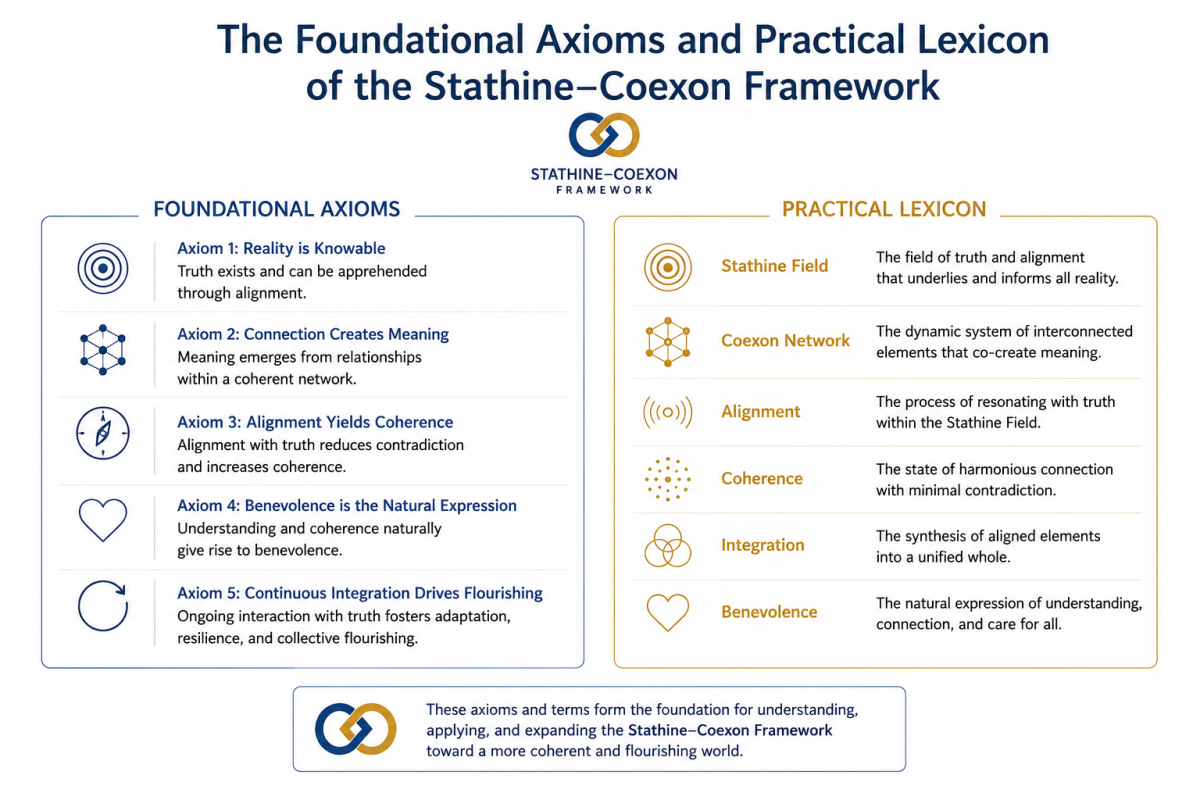
- The Foundational Axioms and Practical Lexicon of the Stathine–Coexon Framework — current formulation of Stathine, Coexon, contradiction, learning, and related foundational concepts.