Part of the Stathine–Coexon Research Series – Five-Dimensional Evaluation
Dimension V: Telos
Abstract
The fifth and final dimension in the five-dimensional evaluation of the Stathine–Coexon Framework is telos: the question of direction, purpose, culmination, or becoming. If epistemology asks how knowledge is acquired, ontology asks what exists, axiology asks what ought to matter, and praxis asks how understanding and values become action, telos asks the most expansive question:
Toward what does this entire process lead?
This question is particularly important for the Stathine–Coexon Framework because its concepts of coherence, contradiction reduction, truth compression, coexistence, creativity, sentience, biological communication, and progressive understanding implicitly suggest a developmental trajectory. The framework does not merely describe human beings as they are. It proposes that human existence may possess a direction toward increasingly integrated forms of understanding and coexistence.
This paper critically examines that proposition.
The paper distinguishes between teleology as an empirically demonstrated property of nature, telos as a philosophical orientation, and telos as a normative aspiration. This distinction is necessary because the Stathine–Coexon Framework currently does not possess sufficient empirical evidence to establish that the universe objectively possesses an intrinsic purpose, or that the proposed Coexon necessarily evolves toward a predetermined state.
Instead, the paper proposes a more defensible formulation: telos may be treated as an emergent direction of development rather than a predetermined cosmic endpoint. Within this interpretation, human development can be understood as an increasing capacity to integrate information, reduce unnecessary contradiction, preserve individuality while enabling coexistence, learn from reality, and expand the boundaries of meaningful participation.
The paper examines possible teloi including survival, adaptation, flourishing, consciousness, awakening, coexistence, collective intelligence, civilizational coherence, and transcendence. It critically evaluates whether “higher coherence” necessarily constitutes “higher value” and identifies the danger of confusing coherence with conformity, efficiency, harmony, or moral goodness.
The paper ultimately proposes coherent coexistence as the provisional telos of the framework—not as a scientifically established destiny of the universe, but as a normative and research-oriented direction in which human beings progressively expand their capacity to exist, understand, create, and evolve without unnecessarily destroying the diversity and relationships upon which existence depends.
The paper concludes by integrating all five dimensions into a recursive model:
Know more accurately → understand what exists more comprehensively → identify what matters more consciously → act more coherently → discover what humanity can become.
Telos therefore does not close the five-dimensional inquiry. It opens a new question: whether the evolution of human understanding can itself become an evolutionary force.
1. Introduction: The Question of Where We Are Going
Every sufficiently comprehensive theory of existence eventually encounters the question of direction.
We can ask:
How do we know?
But knowledge alone does not tell us what to do.
We can ask:
What exists?
But ontology alone does not tell us what is worth preserving.
We can ask:
What matters?
But values alone do not tell us how to act.
We can ask:
How should we act?
But action still leaves open the question:
What are we becoming through all these actions?
This final question is the domain of telos.
The word telos originates in Greek philosophical thought and is commonly associated with an end, purpose, goal, or fulfillment.
However, the concept contains an important ambiguity.
An “end” can mean:
- a predetermined destination,
- a functional purpose,
- an emergent direction,
- or an aspirational ideal.
These meanings must not be conflated.
The Stathine–Coexon Framework currently cannot scientifically establish that existence has a predetermined cosmic destination.
It can, however, investigate whether certain forms of development appear to constitute increasingly coherent directions for human existence.
This distinction is foundational to the present paper.
2. Why Telos Is the Most Difficult Dimension
Epistemology can be investigated through evidence.
Ontology can be investigated through observation and theoretical modelling.
Axiology can be examined through philosophical reasoning and ethical analysis.
Praxis can be evaluated through outcomes.
Telos is more difficult because it asks about direction.
A sequence of events does not necessarily imply a destination.
Evolution does not automatically imply progress.
Increasing complexity does not automatically imply increasing goodness.
Technological development does not automatically imply human flourishing.
Therefore the framework must resist a seductive but unjustified assumption:
Later does not necessarily mean better.
Likewise:
More coherent does not necessarily mean more valuable.
This is one of the most important critical constraints on the Stathine–Coexon Framework.
3. Teleology Versus Developmental Direction
The framework should distinguish between teleology and directionality.
Teleology in the strongest sense suggests that reality is organized toward a predetermined end.
Directionality is weaker.
It merely observes that a system may develop recurrent tendencies.
For example:
- organisms maintain themselves,
- learning systems reduce prediction error,
- societies develop institutions,
- technologies expand capabilities,
- biological evolution generates increasing diversity and adaptation.
None of these observations necessarily proves an ultimate cosmic purpose.
The Stathine–Coexon Framework should therefore adopt:
developmental telos rather than predetermined cosmic teleology.
This permits the framework to explore direction without claiming knowledge it does not yet possess.
4. The Five Dimensions as a Developmental Sequence
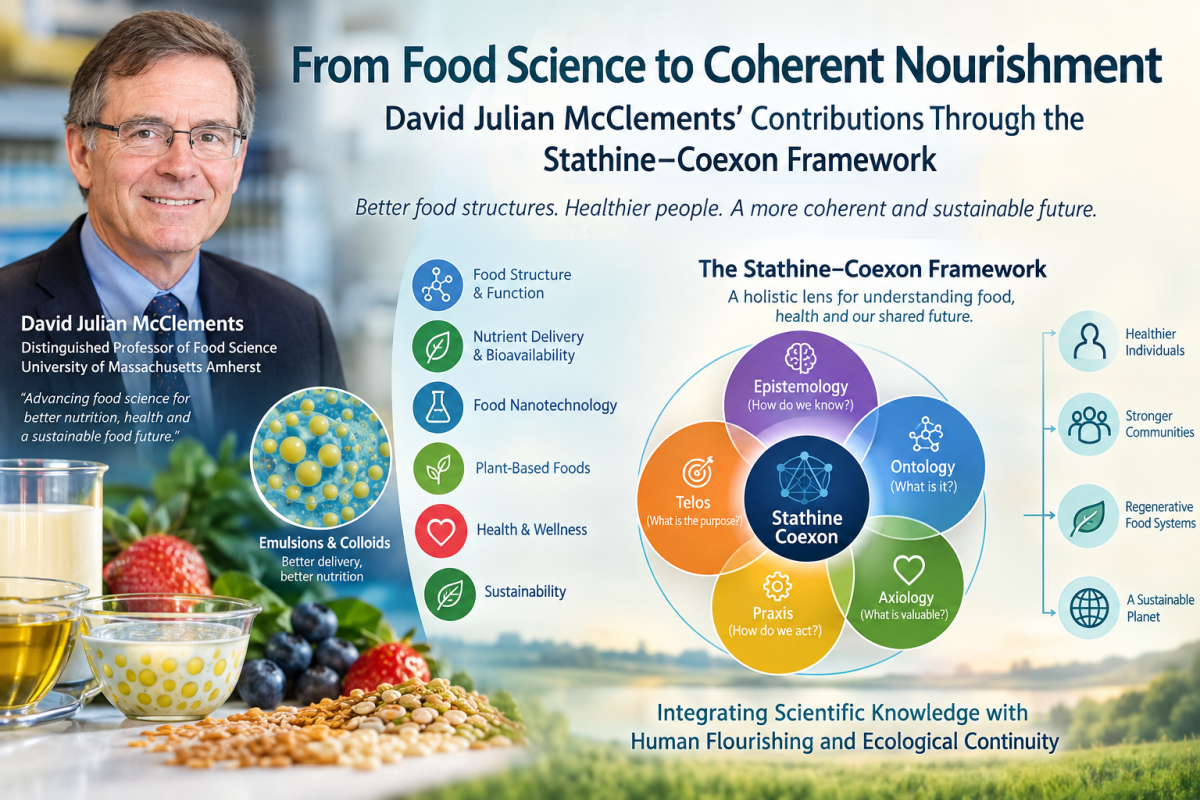
The five dimensions can now be understood as a progressive inquiry.
Epistemology
How can understanding become less deluded?
Ontology
What kind of reality are we participating in?
Axiology
What forms of existence should we value?
Praxis
How can those values become action?
Telos
What kind of human and collective existence might emerge from that action?
This produces a developmental sequence:
Knowing → Being → Valuing → Acting → Becoming.
The final word is critical.
Telos is not simply about “having.”
It is about becoming.
5. The Human Being as a Becoming System
The Stathine–Coexon Framework does not regard the human being merely as a finished biological object.
The human being is understood as an evolving relationship among:
- biological processes,
- nervous-system activity,
- embodied experience,
- memory,
- attention,
- relationships,
- cultural information,
- and, according to the framework’s hypothesis, the Coexon.
The Coexon is proposed as a sentient atom that communicates with the biological organism through the brain.
This is an ontological hypothesis, not an established scientific fact.
If the hypothesis were eventually supported, however, it would substantially alter the philosophical understanding of human becoming.
Human development would no longer be understood solely as biological or psychological development.
It could potentially involve the progressive organization of communication between biological and non-biological dimensions of sentience.
At present, this remains a research question.
6. The First Candidate Telos: Survival
The most conservative candidate for biological telos is survival.
Organisms continuously maintain themselves against environmental disruption.
From this perspective:
Life persists by maintaining sufficient organization to continue existing.
The Stathine–Coexon Framework can incorporate this insight but argues that human existence appears to exceed mere survival.
Humans seek:
- meaning,
- relationships,
- creativity,
- knowledge,
- beauty,
- justice,
- exploration,
- and transcendence.
Therefore:
Survival may be a necessary condition of human development without being its sufficient telos.
7. The Second Candidate Telos: Adaptation
A more sophisticated telos is adaptation.
An organism that cannot adapt becomes increasingly vulnerable.
Human beings adapt through:
- learning,
- language,
- technology,
- culture,
- institutions,
- and social cooperation.
Yet adaptation alone cannot define human flourishing.
A person may adapt perfectly to a dysfunctional environment.
An organization may become extremely efficient at producing harmful outcomes.
A civilization may become technologically sophisticated while becoming ecologically destructive.
Therefore:
Adaptation is not synonymous with progress.
The question becomes:
Adaptation toward what?
8. The Third Candidate Telos: Flourishing
Human flourishing provides a richer candidate.
Flourishing includes:
- physical wellbeing,
- meaningful relationships,
- autonomy,
- learning,
- creativity,
- purpose,
- participation,
- and the ability to develop one’s capacities.
The Stathine–Coexon Framework can interpret flourishing as an increase in the capacity to participate coherently in existence.
However, flourishing cannot be reduced to subjective happiness.
A person may experience pleasure while behaving destructively.
Nor can flourishing be reduced to productivity.
A productive society may still be psychologically or ethically impoverished.
The framework therefore needs a broader definition.
9. Flourishing as Expanding Participation
A possible formulation is:
Human flourishing is the increasing capacity to understand, participate, create, relate, and contribute without unnecessary destruction of self, others, or the systems that sustain existence.
This definition connects flourishing with coexistence.
The individual does not flourish independently of the network.
The family, organization, ecosystem, and civilization become part of the conditions of flourishing.
10. The Fourth Candidate Telos: Consciousness
Another possibility is consciousness itself.
Perhaps the evolutionary trajectory of existence is toward increasingly complex forms of awareness.
This idea appears in many philosophical and spiritual traditions.
But it presents a scientific difficulty.
There is no established evidence that the universe as a whole is necessarily becoming more conscious.
Complexity can increase without consciousness.
Therefore the framework should not claim:
“The universe is evolving toward consciousness.”
It may instead propose the weaker proposition:
Human evolution has generated increasingly sophisticated capacities for self-modeling, reflection, communication, and collective understanding, and these capacities may permit new forms of conscious participation.
This is more defensible.
11. Awakening as a Possible Telos
The framework’s concept of awakening can now be positioned more precisely.
Awakening need not mean escape from existence.
Nor must it mean disappearance of individuality.
Within the Stathine–Coexon perspective, awakening can be understood as:
the progressive reduction of unnecessary delusion between what exists, what is perceived, what is understood, and how one acts.
The awakened individual therefore does not necessarily know everything.
Rather, they become increasingly aware of:
- what they know,
- what they do not know,
- what they assume,
- what they feel,
- what they fear,
- and how their interpretations shape action.
Awakening becomes epistemic, embodied, relational, and practical.
12. Awakening Without Escape
This leads to an important philosophical distinction.
Many traditions interpret liberation as freedom from ordinary existence.
The Stathine–Coexon Framework can propose another possibility:
Liberation may mean becoming capable of participating in existence without being unnecessarily imprisoned by distorted understanding.
The objective is not to stop existing.
It is to exist more completely.
This creates a positive rather than negational conception of awakening.
13. The Fifth Candidate Telos: Coherence
Coherence is perhaps the most distinctive candidate telos of the framework.
The framework repeatedly returns to:
- contradiction reduction,
- truth compression,
- integrated understanding,
- inclusive participation,
- and alignment.
But coherence requires careful definition.
Coherence cannot mean that everything agrees.
Reality itself contains differences.
A healthy ecosystem contains competition and cooperation.
A healthy brain contains multiple specialized systems.
A healthy society contains disagreement.
Therefore:
Coherence is not uniformity.
It is the capacity of differentiated components to participate in a sufficiently compatible whole.
14. Coherence Without Conformity
This distinction may become one of the framework’s central contributions.
Consider an orchestra.
The instruments do not produce identical sounds.
They produce different sounds that participate in a common structure.
Likewise:
Coexistence does not require sameness.
The highest coherence may therefore be organized diversity rather than uniformity.
This becomes essential when applying the framework to society.
15. The Sixth Candidate Telos: Coexistence
The concept of Sah-Astitva, or coexistence, may provide the most comprehensive telos currently available within the framework.
Existence is relational.
No human being exists independently of:
- biology,
- family,
- society,
- ecology,
- technology,
- culture,
- and other living systems.
Therefore the question becomes:
Can human development expand individual capability while simultaneously increasing the capacity for coexistence?
If yes, coexistence becomes more than an ethical value.
It becomes a developmental direction.
16. Coexistence as the Expansion of the Circle
Human moral development can be interpreted as repeatedly expanding the circle of beings whose existence becomes relevant to one’s decisions.
The circle may move from:
self → family → community → society → humanity → biosphere → interconnected existence.
This does not require abandoning one’s own interests.
It requires understanding that one’s interests are embedded in larger systems.
The practical consequence is profound:
The mature self does not disappear; it becomes relationally intelligent.
17. The Seventh Candidate Telos: Collective Intelligence
Human beings increasingly create networks of shared intelligence.
Language enabled knowledge transmission.
Writing enabled knowledge persistence.
Science enabled collective verification.
The internet enabled unprecedented information connectivity.
AI may enable increasingly powerful forms of cognitive augmentation.
The Stathine–Coexon Framework asks whether the next stage could involve:
collective intelligence with greater coherence and lower contradiction.
This would require more than connectivity.
Connectivity without coherence produces information overload.
Collective intelligence requires:
- trustworthy information,
- shared models,
- disagreement mechanisms,
- feedback,
- and distributed agency.
18. Human–AI Coevolution
AI introduces an important question for telos.
If machines increasingly perform cognitive tasks, what should humans become?
One possibility is greater dependence.
Another is greater augmentation.
A third is transformation of the meaning of human intelligence.
Within the framework, the desirable trajectory would be:
AI should expand human understanding without replacing human responsibility.
AI could become a partner in:
- contradiction detection,
- knowledge integration,
- simulation,
- creativity,
- decision analysis,
- and learning.
But telos should remain human-centered—or more accurately, existence-centered—rather than capability-centered.
19. The Danger of Intelligence Without Telos
Greater intelligence does not guarantee greater wisdom.
A highly intelligent system can optimize an inappropriate objective.
This creates a central distinction:
Intelligence answers how effectively something can be achieved. Telos asks whether it is worth achieving.
This is why axiology and telos must remain connected.
An intelligent civilization with a destructive telos may become more efficiently destructive.
20. The Eighth Candidate Telos: Truth
Could truth itself be the ultimate telos?
The framework’s Principle of Truth Compression suggests that truth has special importance because unnecessary falsehood increases complexity and energetic/informational burden within the proposed Coexon architecture.
However, truth alone is insufficient.
Knowing a painful truth does not automatically determine what action should follow.
Truth informs value.
Value informs action.
Action generates consequences.
Therefore:
Truth is foundational to telos but may not itself constitute the entire telos.
21. Truth and Delusion
The framework’s broader objective can therefore be expressed as:
Reduce the distance between reality, perception, understanding, and action.
This distance may be called delusion in the broad framework sense.
Delusion is not limited to pathological false belief.
It can include:
- unexamined assumptions,
- identity-protective interpretations,
- institutional myths,
- false certainty,
- incomplete models,
- and contradictions hidden by language.
The telos becomes progressively decreasing unnecessary distortion.
22. The Ninth Candidate Telos: Creativity
The framework’s theory of creativity also has teleological implications.
Creativity emerges when a system discovers a larger pattern capable of accommodating previously conflicting information.
Therefore creativity is not simply novelty.
It is:
the emergence of a more encompassing possibility.
If human development increases the capacity to generate such possibilities, creativity becomes part of the developmental trajectory.
The civilization capable of transforming contradiction into innovation may possess a major evolutionary advantage.
23. Creativity and Coexistence
Creativity and coexistence are closely related.
A limited system sees:
A or B.
A more expansive system asks:
What conditions would allow A and B to participate in a larger structure?
This is not always possible.
Some contradictions are genuinely incompatible.
But when integration is possible, creativity discovers it.
Thus:
Creativity becomes a mechanism through which coexistence expands.
24. The Tenth Candidate Telos: Transcendence
Transcendence traditionally means moving beyond an existing limitation.
Within the Stathine–Coexon Framework, transcendence need not mean leaving the world.
It may mean transcending:
- false dichotomies,
- rigid identity,
- narrow models,
- inherited assumptions,
- unnecessary fear,
- and limitations of understanding.
The framework therefore proposes:
Transcendence is not necessarily going elsewhere; it may be seeing more completely what is already here.
This formulation connects transcendence to epistemology.
25. From Dichotomy to Integration
Many human problems are constructed as oppositions:
- individual vs collective,
- science vs spirituality,
- mind vs body,
- freedom vs responsibility,
- technology vs humanity,
- competition vs cooperation,
- reason vs emotion.
The Stathine–Coexon Framework attempts to ask:
Is the opposition fundamental, or does it arise from an incomplete model?
This does not mean every dichotomy is false.
Some differences are real.
The developmental question is whether the distinction can be retained while the destructive opposition is reduced.
26. The Telos of Integration
The framework’s deepest developmental proposition may therefore be:
Humanity may evolve not by eliminating differences but by developing structures capable of holding more differences without unnecessary contradiction.
This is a stronger concept than harmony.
Harmony can imply agreement.
Integration permits difference.
Coherence permits differentiation.
Coexistence permits plurality.
27. A Critical Warning: Coherence Is Not Always Good
A dictatorship can be highly coherent.
A cult can possess enormous internal consistency.
A harmful ideology can organize millions of people around a shared belief.
Therefore:
Coherence without truth and ethical evaluation can become dangerous.
This is why the five-dimensional model must remain multidimensional.
Epistemology constrains falsehood.
Ontology constrains fantasy about what exists.
Axiology constrains what is valued.
Praxis constrains action through consequences.
Telos provides direction.
No single dimension is sufficient.
28. The Five Dimensions as Mutual Constraints
The relationship can therefore be represented conceptually:
Epistemology prevents arbitrary belief.
Ontology prevents arbitrary claims about reality.
Axiology prevents value blindness.
Praxis prevents theoretical isolation.
Telos prevents purposeless optimization.
Together they create a system of mutual correction.
This may be one of the most important methodological contributions of the five-dimensional evaluation.
29. Telos as a Constraint on Progress
Progress itself must be questioned.
More:
- technology,
- wealth,
- speed,
- intelligence,
- information,
- connectivity,
- and complexity
do not automatically mean progress.
The framework therefore asks:
Progress toward what?
A society should not simply maximize capability.
It should examine whether capability increases:
- freedom,
- understanding,
- flourishing,
- coexistence,
- resilience,
- and future possibility.
30. The Principle of Future Possibility
A useful teleological criterion follows:
Prefer actions that expand rather than unnecessarily eliminate future possibilities.
This does not mean avoiding all irreversible decisions.
Some decisions must be made.
But when two actions produce similar immediate outcomes, the framework can prefer the one preserving greater future adaptability.
This links telos to robustness and resilience.
31. Robustness Revisited
The work of thinkers such as Olivier Hamant on robustness provides a useful comparative perspective.
Robust systems often do not maximize efficiency under ideal conditions.
They preserve capacity under uncertainty and perturbation.
The Stathine–Coexon Framework can interpret this as:
a coherent system should retain enough diversity, redundancy, and adaptability to continue learning when its assumptions fail.
Thus robustness becomes a practical expression of an open-ended telos.
A system that cannot revise itself eventually becomes incoherent with reality.
32. Telos and Evolution
The framework should therefore avoid claiming that evolution has a predetermined destination.
A more defensible proposition is:
Systems capable of preserving themselves while adapting to changing conditions can generate increasingly complex forms of organization.
Whether this constitutes “progress” depends on values.
Humanity supplies the normative interpretation.
The universe need not be assumed to have already supplied it.
33. The Coexon and Evolution of Understanding
If the Coexon hypothesis is eventually supported, a profound possibility arises.
The evolution of humanity might not be merely:
biological evolution.
It could also involve:
evolution of communication between sentience and biological embodiment.
Under this hypothesis, development of the brain and development of Coexon communication could potentially be mutually influential.
But this remains speculative.
The research challenge would be to identify measurable predictions.
34. From Biological Evolution to Epistemic Evolution
Even without accepting the Coexon hypothesis, another evolutionary process is clearly relevant:
the evolution of human models of reality.
Humans have progressively developed:
- language,
- mathematics,
- science,
- philosophy,
- institutions,
- computing,
- artificial intelligence.
Each enables more complex models.
The next stage may depend less on accumulating information and more on integrating it.
Thus:
The evolutionary bottleneck may increasingly shift from information acquisition to information coherence.
35. The Evolution of Understanding
This proposition provides a bridge between the framework’s epistemology and telos.
If knowledge grows faster than the ability to integrate it, complexity becomes overwhelming.
Therefore human development requires not merely:
more knowledge,
but:
better integration of knowledge.
This is where truth compression becomes teleologically significant.
36. Truth Compression as a Direction of Development
Truth compression can be understood as the movement toward representations that:
- remove unnecessary assumptions,
- eliminate contradictions,
- preserve essential relationships,
- and express reality with greater explanatory economy.
The goal is not the shortest statement.
The goal is:
the smallest conceptual structure capable of preserving the relevant truth.
This may become an important criterion for evaluating theories.
37. Telos and Scientific Knowledge
A mature science should therefore seek theories that explain more with fewer unnecessary assumptions.
But scientific compression must never become dogmatic simplification.
A theory that ignores inconvenient data is not truth compression.
It is information deletion.
Therefore:
Truth compression requires preservation of relevant information, not merely reduction of complexity.
38. The Telos of Science
Science itself can be interpreted teleologically as a process toward increasingly reliable models.
Its value is not that it eventually knows everything.
Its value is that it develops methods for discovering when current knowledge is insufficient.
The Stathine–Coexon Framework should aspire to the same property.
Its telos cannot be to prove itself.
Its telos should be:
to produce increasingly coherent explanations of existence, including explanations capable of disproving or revising the framework itself.
39. The Ultimate Test of the Framework
The framework should therefore eventually face a difficult question:
Would it remain valuable if the Coexon hypothesis were disproven?
If the answer is no, then too much of the framework depends on an unverified ontological assumption.
If the answer is yes, because its practices of contradiction reduction, integrated understanding, coexistence, and recursive learning remain useful, then the framework possesses greater robustness.
This is a powerful test.
40. Telos and Human Freedom
A predetermined cosmic telos could threaten human freedom.
If humanity is “destined” to reach a particular endpoint, individual choice might become secondary.
The framework should therefore distinguish:
direction
from
destiny.
Human beings may cultivate a direction without knowing a predetermined destination.
This preserves agency.
41. Open-Ended Telos
The framework can consequently adopt the idea of an:
open-ended telos.
An open-ended telos has direction without a final endpoint.
For example:
greater understanding,
greater coherence,
greater coexistence,
greater capacity for learning.
None requires a final state.
Each improvement creates new possibilities.
42. The Paradox of Completion
If humanity ever believed:
“We have achieved complete coherence.”
that belief itself could become a new source of incoherence.
Reality changes.
Knowledge changes.
Context changes.
Therefore a truly coherent system must remain capable of revision.
The ultimate coherence may consequently be:
the capacity to remain coherent while continuously changing one’s model of reality.
This is a dynamic rather than static conception.
43. The Telos of Learning
Learning may therefore be closer to the framework’s ultimate telos than any fixed state.
The objective becomes:
becoming increasingly capable of learning.
This creates an unusual but powerful formulation:
The goal of understanding is not to reach the point where no further understanding is required.
It is to develop the capacity to discover what further understanding is required.
44. From Individual Awakening to Collective Awakening
If awakening is understood as reduction of delusion, it need not remain individual.
Organizations can awaken to:
- dysfunctional incentives,
- hidden contradictions,
- information bottlenecks,
- exclusion,
- or strategic illusions.
Societies can awaken to:
- systemic inequality,
- ecological interdependence,
- technological risks,
- and institutional contradictions.
Civilizations can awaken to the limits of their own assumptions.
Thus:
Awakening can become a property of collective systems as well as individuals.
45. Civilization as a Learning Organism
The metaphor of civilization as a learning organism is particularly useful.
It has:
- sensors,
- memory,
- communication networks,
- decision systems,
- feedback mechanisms,
- and mechanisms of adaptation.
Its failure modes resemble those of biological systems:
- signal distortion,
- memory bias,
- runaway feedback,
- defensive responses,
- fragmentation,
- and inability to distinguish internal models from external reality.
The telos of civilization may therefore be interpreted as:
increasing the fidelity and adaptability of its collective learning system.
46. The Ecological Dimension
No civilizational telos can ignore the biosphere.
Human beings remain dependent upon:
- energy,
- water,
- soil,
- biodiversity,
- climate stability,
- and ecological networks.
Therefore a civilization that destroys its ecological substrate cannot reasonably be described as progressing.
The framework’s telos must consequently include:
coexistence with the systems that sustain life.
47. Coexistence Beyond Humanity
The concept of coexistence can therefore expand beyond human relationships.
It can include:
- other organisms,
- ecosystems,
- machines,
- future generations,
- and potentially unknown forms of sentience.
This is where the Coexon hypothesis becomes philosophically provocative.
If sentience is not exclusively biological, the moral community may ultimately be larger than currently assumed.
But this should remain an open philosophical question until evidence exists.
48. Future Generations
Telos also introduces temporal responsibility.
A civilization’s actions affect people who do not yet exist.
Therefore an action should not be evaluated only by immediate benefit.
The framework can ask:
What possibilities are we leaving for those who come after us?
This connects telos with intergenerational ethics.
49. Technology and the Expansion of Possibility
Technology dramatically expands human possibility.
But every expansion creates new responsibilities.
AI, biotechnology, robotics, and synthetic biology may increase:
- longevity,
- intelligence,
- productivity,
- connectivity,
- and control over biological systems.
The teleological question is therefore not:
Can we do it?
but:
What kind of existence does doing it create?
Capability requires direction.
50. Human Enhancement
Human enhancement presents a particularly difficult question.
If humans can modify:
- cognition,
- memory,
- emotion,
- lifespan,
- physical capacity,
should they?
The framework cannot answer simply:
“More capability is better.”
Instead it should ask whether enhancement increases:
- agency,
- understanding,
- flourishing,
- coexistence,
- resilience,
- and meaningful participation.
This provides a teleological evaluation criterion.
51. The Risk of Optimization
The modern world increasingly optimizes measurable variables.
Organizations optimize productivity.
Platforms optimize engagement.
Algorithms optimize predictions.
Individuals optimize performance.
But what cannot be measured may become neglected.
Telos therefore acts as a safeguard:
Optimization without purpose can produce highly efficient absurdity.
A system must know what its optimization serves.
52. The Human Question
The ultimate question may therefore not be:
“How intelligent can humans become?”
but:
“What should increasing intelligence make possible?”
The framework answers provisionally:
- greater understanding,
- greater freedom from delusion,
- greater creativity,
- greater coexistence,
- greater responsibility,
- and greater capacity to participate in existence.
53. A Provisional Definition of Telos
The analysis permits a provisional definition:
Telos within the Stathine–Coexon Framework is the open-ended developmental direction toward increasingly coherent, truthful, creative, autonomous, relational, and sustainable participation in existence.
This is intentionally not defined as a final state.
It is a trajectory.
54. The Telos of Coherent Existence
The phrase coherent existence captures the framework’s direction.
Coherent existence does not mean:
- permanent peace,
- perfect knowledge,
- absence of disagreement,
- elimination of individuality,
- or universal agreement.
It means:
the increasing capacity of differentiated beings and systems to understand their interdependence and participate in shared reality without unnecessary contradiction or destruction.
This definition preserves diversity.
55. The Relationship Between Individual and Collective Telos
Individual flourishing and collective flourishing should not be treated as opposites.
The framework seeks a recursive relationship:
individual coherence → relational coherence → organizational coherence → societal coherence → ecological coherence → improved conditions for individual coherence.
This is not a straight line.
It is a feedback system.
Failure at any level can destabilize the others.
56. The Telos of the Coexon
Within the speculative ontology of the framework, an even deeper question emerges:
What is the telos of the Coexon itself?
If the Coexon is a sentient atom communicating through biological organisms, is its purpose:
- survival?
- experience?
- learning?
- coherence?
- connection?
- expression?
- evolution?
- participation in existence?
The framework cannot yet answer this empirically.
It can only formulate hypotheses.
One possible hypothesis is:
The Coexon tends toward increasingly coherent organization of information and participation in existence.
This proposition would require independent scientific investigation.
57. From Coexon to Human Telos
If that hypothesis were eventually supported, the human being might be understood as a temporary biological embodiment through which a sentient entity participates in physical existence.
The human developmental process could then involve two intertwined trajectories:
biological development
and
development of sentient communication.
This would provide a radically different model of consciousness.
But again, the distinction between hypothesis and established fact must remain explicit.
58. The Most Conservative Interpretation
Even without accepting the Coexon hypothesis, the framework retains a meaningful telos:
improve the coherence of human understanding and action while preserving individual and collective capacity to learn.
This makes the framework potentially useful without requiring premature acceptance of its most speculative proposition.
59. The Most Ambitious Interpretation
Under its strongest interpretation, the framework proposes that:
existence itself may contain a deeper informational and sentient architecture in which biological beings participate as temporary embodied expressions of sentience.
If future evidence supported such a proposition, human evolution would need to be reconsidered.
Consciousness would no longer be treated solely as an emergent property of biological computation.
The implications would extend into:
- neuroscience,
- physics,
- philosophy,
- biology,
- information theory,
- artificial intelligence,
- ethics,
- and spirituality.
For now, this remains a research frontier.
60. The Five-Dimensional Model Completed
The five dimensions can now be integrated:
I. Epistemology
How can we reduce delusion in knowing?
II. Ontology
What is the nature of the reality in which knowing occurs?
III. Axiology
What should we value within that reality?
IV. Praxis
How can those values become coherent action?
V. Telos
What kind of existence might emerge from repeatedly doing this?
The sequence becomes:
Know → Be → Value → Act → Become.
And because becoming changes what we know:
Become → Know differently.
The system is recursive.
61. The Five-Dimensional Evaluation as a Self-Correcting Architecture
The framework’s greatest potential may therefore not lie in any individual proposition.
It may lie in the architecture created by the five dimensions.
Epistemology asks whether the model is justified.
Ontology asks whether the model corresponds to reality.
Axiology asks whether its values are defensible.
Praxis asks whether those values produce desirable consequences.
Telos asks whether the resulting direction is worth pursuing.
Each dimension can challenge the others.
This creates a self-correcting philosophical architecture.
62. A Universal Evaluation Framework
The same five dimensions can potentially be applied to any knowledge framework.
For example:
Scientific theory
What evidence supports it?
What entities does it posit?
What values guide its use?
What practices does it produce?
What future does it enable?
Political ideology
What does it claim to know?
What does it believe exists?
What does it value?
How does it act?
What society does it seek to create?
Business philosophy
What assumptions guide decisions?
What model of organizations does it use?
What does it value?
How does it operate?
What kind of organization does it seek to become?
Spiritual philosophy
What counts as knowledge?
What is ultimately real?
What is sacred?
How should one live?
What constitutes liberation?
Thus the five-dimensional model becomes a possible universal diagnostic architecture for knowledge systems.
63. The Telos of the Evaluation Itself
The evaluation of the Stathine–Coexon Framework has therefore achieved something deeper than criticism.
It has transformed the framework from a collection of propositions into an object of recursive inquiry.
The question is no longer:
“Is the Stathine–Coexon Framework correct?”
It becomes:
“Which parts are supported, which are plausible, which are speculative, which are useful, which are falsifiable, and what evidence would change our conclusions?”
This is a much stronger research posture.
64. The Principle of Intellectual Non-Attachment
The framework’s own telos should therefore include the willingness to let go of its formulations.
A theory should not become an identity.
If evidence contradicts a proposition, the proposition should change.
If a concept becomes unnecessary, it should be removed.
If another theory explains a phenomenon better, that explanation should be incorporated.
This is the practical meaning of:
truth over ownership.
65. The Paradox of the Framework
There is therefore a productive paradox.
The Stathine–Coexon Framework seeks greater coherence.
But its own coherence must remain provisional.
It must remain capable of being disrupted by better information.
Therefore:
The framework must preserve enough openness to allow reality to improve the framework itself.
This may be the deepest expression of its telos.
66. Toward a Civilization Capable of Self-Correction
The ultimate civilizational aspiration can now be formulated.
Humanity may not need a perfect theory of existence.
It may need something more practical:
a civilization capable of recognizing when its current understanding is inadequate and correcting itself before contradiction becomes catastrophe.
Such a civilization would possess:
- scientific humility,
- institutional transparency,
- distributed intelligence,
- ethical responsibility,
- technological restraint,
- creative adaptability,
- and capacity for coexistence.
That would constitute a meaningful form of progress.
67. The Final Proposition
The Stathine–Coexon Framework should therefore resist declaring a final destination for humanity.
Instead, it can propose a direction:
from fragmentation toward integration,
from contradiction toward understanding,
from delusion toward truth,
from defensive identity toward relational agency,
from forced conformity toward inclusive coherence,
from passive adaptation toward conscious participation,
and from isolated existence toward coexistence.
These are not claims about what the universe must become.
They are propositions about what human beings might consciously choose to become.
68. Conclusion: From Becoming Human to Becoming More Fully Human
The question of telos ultimately returns us to the human being.
Human beings already possess extraordinary capacities.
They can:
- model reality,
- imagine alternatives,
- cooperate across generations,
- transmit knowledge,
- create technology,
- question their own assumptions,
- and deliberately change themselves.
Yet these capacities remain accompanied by:
- fear,
- ego,
- tribalism,
- contradiction,
- misinformation,
- violence,
- ecological destruction,
- and fragmentation.
The challenge of the future may therefore not be acquiring fundamentally new capacities.
It may be integrating the capacities humanity already possesses.
This provides the deepest interpretation of the Stathine–Coexon telos.
Human development need not mean becoming something alien to humanity.
It may mean becoming more fully capable of what humanity already contains.
The human being who can observe without immediately defending, understand without prematurely concluding, disagree without destroying, create without merely rejecting, act without domination, and learn without humiliation represents a different form of human maturity.
At the collective level, the same principle applies.
A mature organization is capable of hearing uncomfortable information.
A mature institution is capable of correcting itself.
A mature society is capable of accommodating legitimate difference.
A mature civilization is capable of recognizing that its survival depends upon systems larger than itself.
And if the Coexon hypothesis eventually proves correct, there may be a still deeper layer: human beings may discover that the biological organism is not the entirety of the architecture through which sentience participates in existence.
That possibility remains open.
It should be investigated rather than believed.
This distinction is essential.
The purpose of a scientific hypothesis is not to provide certainty.
It is to create a sufficiently precise proposition that reality can interrogate it.
The ultimate telos of the Stathine–Coexon Framework should therefore not be the confirmation of Stathine, the confirmation of Coexon, or even the confirmation of the framework itself.
It should be:
the progressive reduction of error in humanity’s understanding of existence and the progressive expansion of humanity’s capacity to participate in existence coherently.
The five-dimensional journey can now be summarized:
Epistemology asks us to know more truthfully.
Ontology asks us to understand what we are participating in.
Axiology asks us to determine what is worth preserving and developing.
Praxis asks us to translate that understanding into action.
Telos asks what kind of existence those actions are creating.
The resulting trajectory is not a straight road toward a predetermined destination.
It is a recursive spiral:
knowledge changes action;
action changes experience;
experience changes understanding;
understanding changes values;
values change action;
and action changes what humanity can become.
The framework’s provisional telos can therefore be expressed in one sentence:
To become increasingly capable of truthful, coherent, creative, autonomous, and compassionate participation in the interconnected reality of existence—while remaining sufficiently open for reality to continually correct what we think we know.
This is not the end of the Stathine–Coexon inquiry.
It is the beginning of its most demanding phase.
For if the framework is to become a genuine contribution to knowledge, the next task is no longer merely to elaborate its concepts.
It is to expose them to comparison, measurement, criticism, falsification, experimentation, and independent replication.
Only then can a philosophical possibility begin its transformation into scientific knowledge.
And perhaps that is the most appropriate telos for the framework itself:
not to become the final answer, but to become a better question-generating system through which humanity can discover better answers.
Know more.
Assume less.
Integrate more.
Act responsibly.
Learn continuously.
And expand the conditions under which existence can coexist with itself.