A Stathine–Coexon Framework for Self-Regulation, Collective Well-Being, and Civilizational Evolution
Part of the Stathine–Coexon Research Series – Level III: Applications
Abstract
Humanity has developed numerous systems of governance to coordinate collective life, manage conflict, allocate resources, and protect human beings from harm. These systems include democracies, constitutional republics, monarchies, authoritarian states, technocracies, federations, decentralized communities, and hybrid political structures.
Although these systems differ considerably, they share a common assumption: that human behaviour must be externally regulated through laws, institutions, incentives, and enforcement.
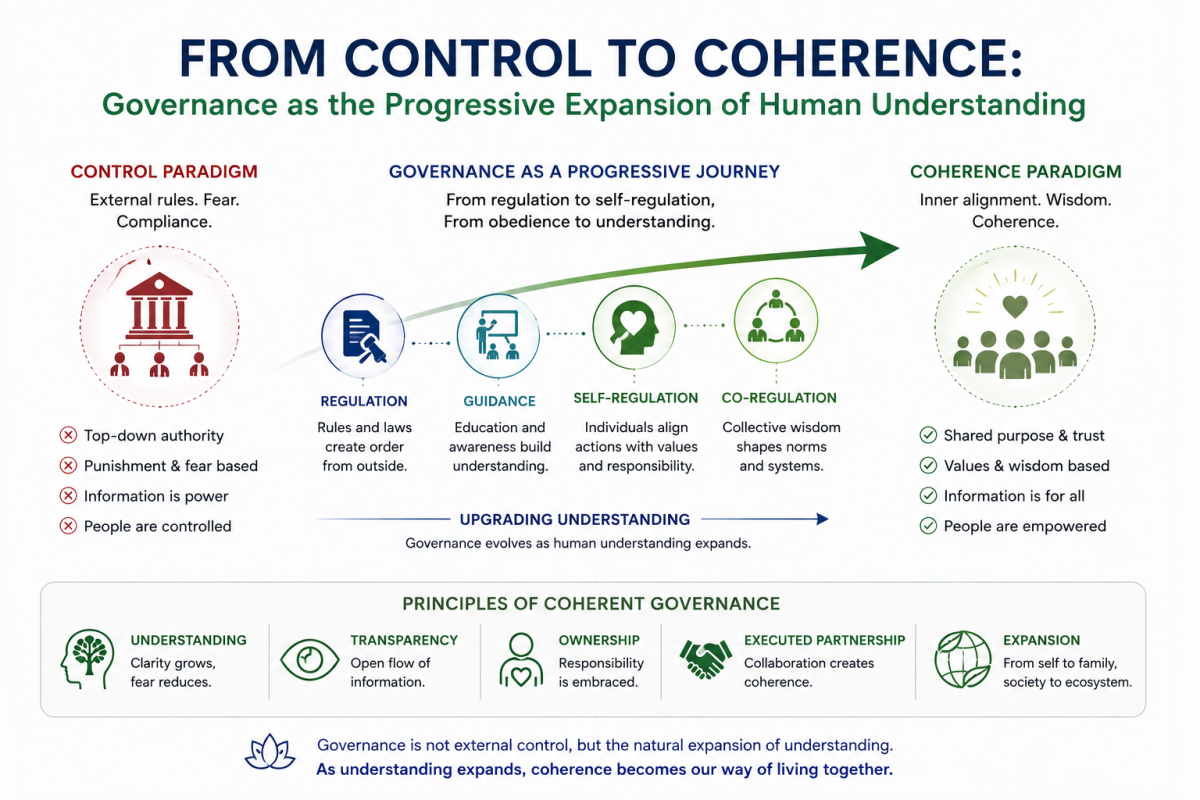
This article proposes a complementary perspective through the Stathine–Coexon Framework. It suggests that regulation may be understood not primarily as external control but as the progressive development of understanding that enables human beings to voluntarily regulate their own behaviour for the well-being of increasingly larger systems.
A human being may naturally limit immediate self-interest for the benefit of a family. With greater understanding, the circle of concern may expand to community, nation, humanity, other species, and the ecosystem itself. In this model, the deepest form of governance is not the imposition of increasingly complex external rules but the cultivation of increasingly coherent human beings capable of self-governance.
The article therefore proposes a transition from regulation as control toward regulation as developmental understanding. External governance remains necessary where destructive incoherence threatens others, but its long-term objective should be to make increasingly sophisticated self-regulation possible.
The future of governance may thus be understood as a progressive movement from externally imposed regulation toward internally developed coherence.
Foundational Terminology
This article forms part of the ongoing Stathine–Coexon Framework research series. Readers who are new to the framework are encouraged to first read The Foundational Axioms and Practical Lexicon of the Stathine–Coexon Framework, which introduces the foundational axioms, terminology, and guiding principles used throughout this article.
This article builds particularly upon the framework’s concepts of coherence, orderliness, progressive reduction of contradiction, and the relationship between individual and collective existence.
1. Introduction: The Problem of Governance
Human beings have always needed to coordinate their existence.
They must decide:
- how resources are shared,
- how conflict is resolved,
- how harm is prevented,
- how collective decisions are made,
- how future generations are protected.
The traditional answer has been governance.
Governance establishes rules.
Rules establish boundaries.
Institutions enforce those boundaries.
This approach has enabled human civilization to expand beyond the limitations of small communities.
Yet it creates a fundamental problem.
The more complex a society becomes, the more rules it requires.
The more rules it requires, the greater the possibility that human beings become dependent upon external control.
This raises a deeper question:
Could the future of governance involve not more external regulation, but greater understanding that makes external regulation progressively less necessary?
The Stathine–Coexon Framework proposes that this may be one of the central directions of human development.
2. Regulation and Understanding
Regulation is commonly understood as something imposed from outside.
A government creates a law.
An institution creates a policy.
An authority creates a restriction.
An individual is expected to obey.
This represents external regulation.
However, human beings also possess another form of regulation.
A parent may sacrifice personal convenience for the well-being of a child.
A family member may limit personal consumption because resources are shared.
A citizen may pay taxes because public infrastructure benefits everyone.
A person may protect a forest despite receiving no immediate personal benefit.
In each case, behaviour is regulated by understanding.
The individual recognizes that personal existence is connected to larger systems.
This creates the central proposition of this article:
As understanding expands, the natural circle of self-regulation expands.
3. The Expanding Circle of Concern
Human development may be understood as the expansion of the circle within which the individual recognizes consequences.
A simplified developmental sequence may be represented as:
Self
↓
Family
↓
Community
↓
Nation
↓
Humanity
↓
All living systems
↓
Ecosystem
This sequence does not imply that every human being develops in exactly the same way.
Nor does it suggest that concern for one level must disappear when concern for another emerges.
Rather, each expanding level can include the previous one.
The individual does not stop caring about the self upon caring for the family.
The family does not become irrelevant upon caring for the community.
The community does not disappear upon recognizing humanity.
The circle expands.
The system of concern becomes more inclusive.
4. Self-Regulation as a Natural Human Capacity
Self-regulation is not an artificial invention.
It is already present in ordinary human life.
A person may:
- control anger to protect a relationship,
- postpone gratification to support a family,
- work beyond immediate personal need to secure a child’s future,
- limit personal consumption to preserve shared resources.
The motivation may initially be emotional attachment.
However, attachment can gradually develop into understanding.
The person begins to recognize:
My well-being is connected to the well-being of the larger system.
This is a profound transition.
The individual does not necessarily need to be forced to act for the larger system.
Understanding itself begins to regulate behaviour.
5. From External Rules to Internal Understanding
External rules are often necessary when understanding is insufficient.
A child may require external boundaries because the consequences of certain actions are not yet understood.
A society may require laws because individuals or institutions may knowingly harm others.
However, external regulation can be understood as a temporary substitute for insufficient internal coherence.
The long-term objective should therefore be:
To transform external regulation into internal understanding wherever possible.
For example:
External Regulation
Do not pollute because the law prohibits it.
Greater Understanding
Do not pollute because the ecosystem is part of the system that sustains your own existence.
The second form of regulation creates no resistance.
It does not depend entirely upon surveillance.
It does not require constant punishment.
It becomes self-sustaining.
6. The Developmental Hierarchy of Regulation
The Stathine–Coexon Framework proposes a developmental hierarchy.
Level 1: External Enforcement
Behaviour is regulated primarily through:
- punishment,
- surveillance,
- legal consequences,
- authority.
This may be necessary when understanding is low or destructive behaviour is intentional.
Level 2: Social Regulation
Behaviour is influenced by:
- family expectations,
- community norms,
- reputation,
- belonging.
The individual begins to recognize relational consequences.
Level 3: Internal Ethical Regulation
The individual develops personal principles.
Behaviour becomes guided by:
- conscience,
- responsibility,
- empathy,
- understanding.
External enforcement becomes less necessary.
Level 4: Systemic Understanding
The individual understands interdependence.
Personal actions are recognized as affecting:
- family,
- community,
- society,
- humanity,
- ecosystems.
Self-regulation becomes increasingly inclusive.
Level 5: Coherent Participation
The individual no longer experiences collective well-being as entirely separate from personal well-being.
The individual understands:
I exist within the system, and the system exists through my participation.
Regulation becomes participation in coherence.
7. Governance as the Development of Understanding
This leads to a fundamental redefinition of governance.
Traditional governance asks:
What rules should people obey?
Developmental governance asks:
What understanding do people need in order to regulate themselves wisely?
This changes the role of institutions.
Education becomes central.
Public communication becomes central.
Scientific literacy becomes central.
Transparent information becomes central.
The objective of governance becomes not simply the enforcement of behaviour but the development of citizens capable of understanding consequences.
8. The Family as the First Governance System
The family represents one of the earliest examples of expanding self-regulation.
A parent may give up personal comfort for a child.
A sibling may share resources.
A family member may take responsibility for an elderly relative.
These actions often occur without formal laws.
The relationship itself creates understanding.
The individual recognizes:
The well-being of the family is connected to my own.
This principle can progressively expand.
The challenge of civilization is to extend this understanding beyond biological family.
9. From Family to Humanity
Many human conflicts emerge because the circle of emotional identification remains narrow.
A person may sacrifice for family while exploiting strangers.
A community may protect its members while harming another community.
A nation may seek prosperity while damaging global ecosystems.
The Stathine–Coexon Framework proposes that civilizational progress involves expanding the capacity for identification and understanding.
The question becomes:
Can humanity learn to experience the well-being of increasingly larger systems as relevant to its own existence?
This does not require the elimination of individuality.
It requires the recognition of interdependence.
10. Ecosystem Understanding
The final expansion of the circle may be ecological.
Human beings depend upon:
- air,
- water,
- soil,
- biodiversity,
- climate stability,
- ecological cycles.
Yet these systems often appear separate from daily human experience.
The individual may therefore damage the ecosystem without immediately experiencing the consequences.
The challenge is not merely to impose environmental regulations.
It is to develop sufficient understanding that ecological protection becomes an expression of self-preservation and collective responsibility.
The transition is therefore:
Nature is something outside me.
↓
I depend upon nature.
↓
I am part of nature.
↓
The well-being of the ecosystem is connected to my own existence.
At this stage, ecological responsibility becomes increasingly self-regulating.
11. The Stathine–Coexon Interpretation of Governance
Within the framework, governance may be understood as a process of enabling increasingly coherent relationships.
The function of governance is therefore not simply to control behaviour.
It is to:
- expand understanding,
- reduce destructive contradiction,
- protect vulnerable systems,
- create conditions for self-regulation,
- coordinate actions beyond the capacity of individuals.
This suggests a new definition:
Good governance is the progressive development of a society’s capacity for self-governance through increasing understanding of interdependence.
External regulation remains necessary.
However, it should serve a developmental purpose.
12. External Regulation as Scaffolding
A useful analogy is education.
A child initially requires external guidance.
Over time, the child develops understanding.
Eventually, the child can make decisions independently.
The external structure has served its purpose.
Governance may operate similarly.
External regulation should function as scaffolding.
It should:
- Prevent immediate harm.
- Establish minimum standards.
- Protect vulnerable individuals and systems.
- Provide information.
- Develop understanding.
- Enable increasing self-regulation.
The objective is not permanent dependence upon external control.
The objective is increasing internal capacity.
13. When External Regulation Remains Necessary
The framework does not suggest that all external regulation should disappear.
Some behaviours may cause severe harm even when understanding exists.
Individuals or institutions may knowingly pursue destructive self-interest.
External regulation may therefore remain necessary for:
- violence,
- exploitation,
- fraud,
- corruption,
- deliberate environmental destruction,
- coercive domination.
However, even in these cases, regulation should ideally address the underlying conditions that produce destructive behaviour.
Punishment alone may suppress behaviour.
Understanding may transform behaviour.
The most coherent governance systems may therefore combine:
Protection + education + accountability + rehabilitation where possible.
14. The Optimal Level of Regulation
The central question is therefore not:
Should humanity be regulated?
The question is:
How much external regulation is necessary given the current level of collective understanding?
A society with high internal coherence may require fewer external controls.
A society with low trust and high destructive behaviour may require stronger external structures.
This produces a developmental principle:
As collective understanding increases, the need for coercive regulation should progressively decrease.
This does not mean that rules disappear.
It means that the relationship between rules and human behaviour changes.
Rules increasingly become:
- shared agreements,
- minimum protections,
- coordination mechanisms.
They become less dependent upon constant coercion.
15. A New Governance Equation
The relationship may be expressed conceptually as:
External Regulation Required ∝ Destructive Incoherence − Internal Understanding
As understanding increases, the need for external regulation decreases.
As destructive incoherence increases, protective regulation becomes more necessary.
The long-term objective is therefore:
Increase understanding → increase self-regulation → reduce unnecessary external control.
This is the central developmental pathway proposed by the framework.
16. Governance at Multiple Scales
The same principle applies at every level.
Individual
Understanding leads to self-regulation.
Family
Mutual understanding reduces internal conflict.
Community
Shared understanding reduces the need for coercion.
Nation
Informed citizens improve democratic self-governance.
Humanity
Understanding interdependence enables global cooperation.
Ecosystem
Understanding ecological dependence encourages regenerative participation.
The same principle repeats at increasing scales.
17. Democracy as Collective Self-Regulation
Democracy can be understood as an attempt to transform external rule into collective self-governance.
The citizen is not merely governed.
The citizen participates in governance.
However, democracy functions effectively only when citizens possess sufficient understanding to make informed collective decisions.
Democratic development therefore depends upon:
- education,
- reliable information,
- critical thinking,
- dialogue,
- tolerance of disagreement.
A democracy without understanding can become vulnerable to manipulation.
A democracy with increasing understanding can become increasingly self-regulating.
18. Expertise and Understanding
Scientific and technical expertise also plays an important role.
Individuals can understand all events that affect them.
No need to understand every complex system.
A person needs to know how to travel on a plane.And not need to know how every machine works.
Society therefore develops specialized knowledge.
However, expertise cannot become an alternative to public understanding.
The goal should be:
Experts develop knowledge; institutions translate knowledge; citizens develop sufficient understanding to participate meaningfully.
This creates a bridge between expertise and everyday living.
19. Artificial Intelligence as an Understanding Multiplier
Artificial intelligence may become a powerful instrument for expanding human understanding.
It could help individuals understand:
- the consequences of choices,
- complex systems,
- environmental impacts,
- economic relationships,
- policy trade-offs.
The future possibility is not merely an AI that tells people what to do.
It is an AI that helps people understand:
If I do this, what happens to the larger system?
Such systems could transform regulation.
Instead of prohibiting behaviour without explanation, technology could make consequences visible.
Understanding could then become the foundation of self-regulation.
20. Toward a Coherent Civilization
A coherent civilization would not necessarily be one in which every person behaves identically.
It would be one in which individuals increasingly understand the consequences of their actions across multiple levels of existence.
A person could remain unique.
A community could remain culturally distinct.
A nation could retain political autonomy.
Yet all could recognize their participation in larger systems.
This is not uniformity.
It is nested coherence.
21. The Backward-Compatible Civilizational Upgrade
Humanity need not abolish existing governance systems.
The transition can occur progressively.
Existing institutions can evolve from:
- punishment toward education,
- secrecy toward transparency,
- control toward understanding,
- centralized authority toward distributed intelligence,
- fixed regulation toward adaptive regulation.
The transformation is therefore backward-compatible.
The existing structures become increasingly capable of developing self-regulating citizens and institutions.
22. Future Research Questions
The framework suggests several questions.
- Can the development of systemic understanding be measured?
- Does greater understanding reduce dependence upon external regulation?
- What forms of education most effectively expand the circle of concern?
- Can citizens be trained to understand ecological and global interdependence?
- Can artificial intelligence accelerate the development of systemic understanding?
- What level of external regulation is optimal at different stages of societal development?
These questions may provide opportunities for research in psychology, education, governance, systems science, and artificial intelligence.
23. Conclusion
The future of governance may not be determined by whether humanity chooses more regulation or less regulation.
The deeper question is whether humanity can develop sufficient understanding that external regulation becomes progressively less necessary.
A human being may naturally regulate personal behaviour for the benefit of the family.
With expanding understanding, the circle of concern may extend to the community.
Then to the nation.
Then to humanity.
Then to the ecosystem upon which all human existence depends.
The progression can be expressed as:
Self-interest
↓
Family well-being
↓
Community well-being
↓
Human well-being
↓
Ecological well-being
This is not the destruction of the individual.
It is the expansion of the individual’s understanding of participation.
The Stathine–Coexon Framework therefore proposes that the highest form of governance may ultimately be the development of human beings capable of increasingly sophisticated self-governance.
External regulation may remain necessary as protection and scaffolding.
But its ultimate purpose should be to cultivate the understanding that makes unnecessary control progressively obsolete.
The future of humanity may therefore lie not in becoming more heavily regulated, but in becoming more deeply understanding.
The most advanced civilization may be the one in which human beings require the least external control because they possess the greatest understanding of their participation in the whole.
About the Stathine–Coexon Framework
The Stathine–Coexon Framework is an interdisciplinary philosophical framework that seeks to integrate insights from systems thinking, neuroscience, psychology, biology, complexity science, leadership, education, consciousness studies, governance, and civilizational research through the unifying concept of coherence.
The framework proposes Stathine as the timeless conceptual ground of existence and the Coexon as a proposed organizing life atom. Together, these concepts provide a philosophical lens for exploring human development, learning, leadership, artificial intelligence, regenerative systems, governance, and civilizational evolution.
Foundational concepts, terminology, and guiding principles are presented in The Foundational Axioms and Practical Lexicon of the Stathine–Coexon Framework.