From Divided Attention to Coherent Consciousness
Iain McGilchrist and the Stathine–Coexon Framework
Abstract
The modern world increasingly exhibits extraordinary analytical capability alongside growing social fragmentation, ecological neglect, and existential uncertainty. Iain McGilchrist has argued that these phenomena reflect not merely cultural or political developments but an imbalance in the modes through which human beings engage with reality. His work proposes that the cerebral hemispheres embody complementary styles of attention: one emphasizing precision, abstraction, categorization, and control; the other emphasizing wholeness, relationship, context, embodiment, and lived experience.
This paper proposes that the Stathine–Coexon Framework offers a complementary ontological perspective. While McGilchrist explains how different modes of attention shape human cognition, the Stathine–Coexon Framework asks a further question: What enables these complementary modes to become integrated into coherent consciousness? It proposes that the Coexon functions as the timeless organizing principle that harmonizes diverse cognitive processes into unified understanding. In this view, coherent consciousness is not achieved by privileging one mode of knowing over another but by integrating them through increasing coherence.
1. Introduction
Human beings perceive the world through multiple modes of knowing.
We analyze.
We intuit.
We calculate.
We empathize.
We categorize.
We participate.
Modern civilization has tended to reward analytical precision, specialization, measurement, and prediction.
These capacities have generated extraordinary scientific and technological achievements.
Yet many observers argue that the same developments have contributed to fragmentation, loss of meaning, ecological alienation, and weakened social trust.
Iain McGilchrist has suggested that this imbalance reflects an overemphasis on one mode of attention at the expense of another.
The Stathine–Coexon Framework accepts the importance of this insight while proposing that the deeper objective is not hemispheric balance alone but coherent integration.
2. Complementary Modes of Knowing
McGilchrist emphasizes that the two cerebral hemispheres participate differently in engaging with reality.
The left hemisphere tends toward:
- abstraction,
- categorization,
- explicit representation,
- manipulation,
- certainty,
- focused analysis.
The right hemisphere tends toward:
- contextual awareness,
- lived experience,
- relationship,
- ambiguity,
- embodied participation,
- openness to novelty.
These modes are complementary rather than competitive.
Healthy cognition depends upon their ongoing dialogue.
The Stathine–Coexon Framework extends this dialogue by asking what enables such complementary capacities to converge into coherent understanding.
3. Attention as the Foundation of Experience
Attention is not merely a cognitive resource.
It determines the world that becomes available to experience.
Different forms of attention reveal different realities.
Analytical attention isolates components.
Relational attention perceives patterns.
Focused attention solves immediate problems.
Open attention recognizes broader contexts.
McGilchrist argues that civilizations themselves may be shaped by dominant modes of attention.
The Stathine–Coexon Framework proposes that attention becomes transformative when organized by coherence rather than fragmentation.
4. Embodied Cognition
McGilchrist emphasizes that human understanding cannot be reduced to abstract reasoning.
Knowledge emerges through participation with the world.
The body is not simply a vehicle for the mind.
It is an active contributor to cognition.
Perception, movement, emotion, and relationship all participate in understanding.
The Stathine–Coexon Framework fully embraces this insight while introducing an additional ontological dimension.
The biological organism provides embodied experience.
The Coexon provides coherent continuity across that experience.
Embodiment becomes the living interface through which coherence is expressed.
5. The Coexon as the Integrating Principle
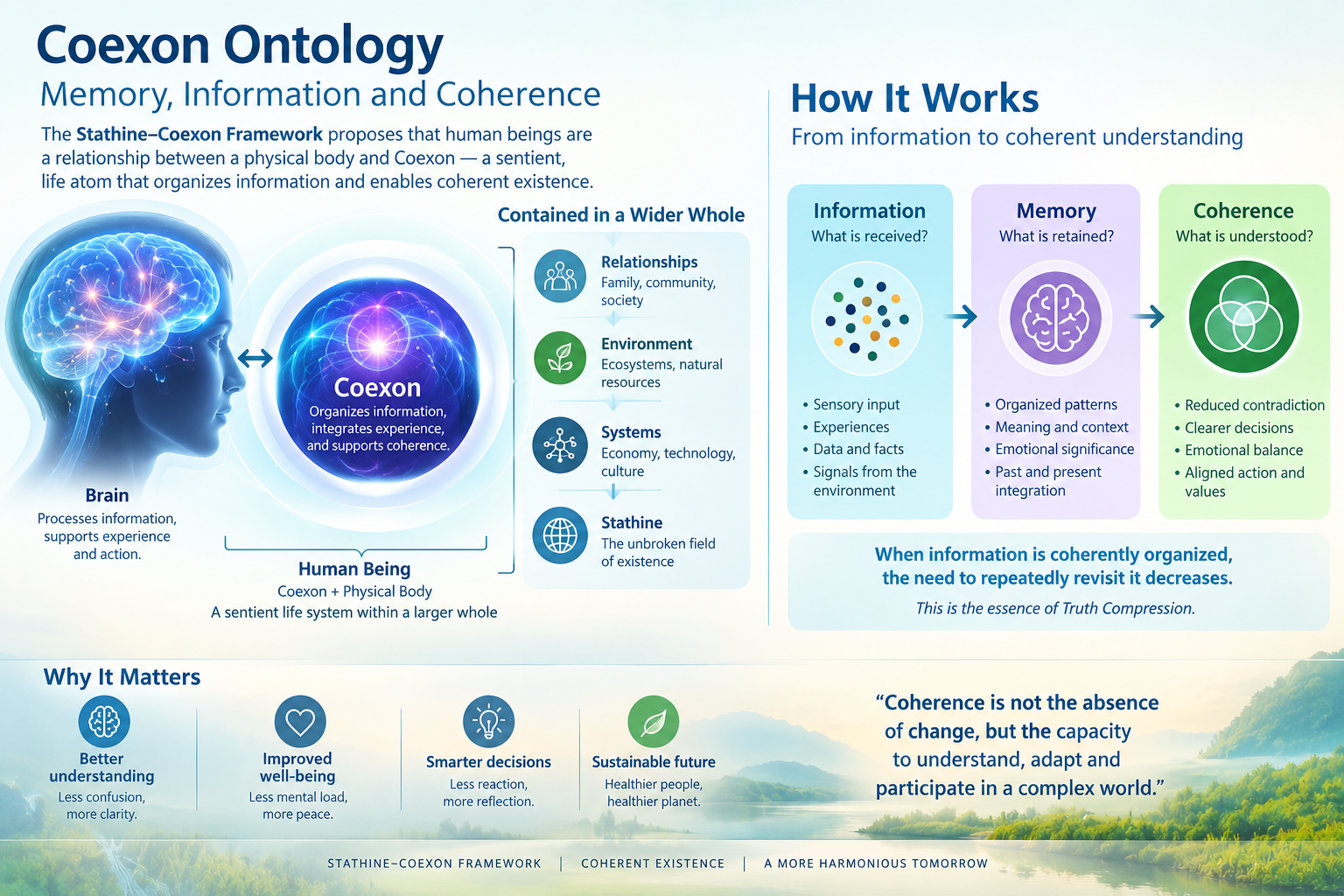
Within the Stathine–Coexon Framework, the Coexon is the fundamental life atom possessing a specific atomic architecture and an intrinsic capacity for coherent understanding.
It does not replace neural processes.
Nor does it compete with biological cognition.
Rather, it provides the organizing principle through which multiple cognitive systems become integrated.
Analytical reasoning.
Intuitive perception.
Memory.
Emotion.
Imagination.
Reflection.
Each contributes unique information.
The Coexon continuously organizes these diverse processes into coherent understanding.
Consciousness therefore emerges not from isolated computation but from integrated coherence.
6. Beyond Hemispheric Balance
McGilchrist argues that flourishing depends upon restoring a healthier relationship between complementary modes of cognition.
The Stathine–Coexon Framework agrees but proposes that balance alone is insufficient.
Two equally powerful yet contradictory systems remain fragmented.
Integration requires coherence.
Coherence does not suppress difference.
It enables difference to function as a unified whole.
The objective therefore becomes not equilibrium but alignment.
7. The Nature of Consciousness
The nature of consciousness remains among the deepest questions in science and philosophy.
McGilchrist approaches consciousness through lived experience, embodiment, and relational engagement.
The Stathine–Coexon Framework proposes that conscious experience reflects the interaction between:
- the biological organism,
- the timeless field of Stathine,
- the organizing coherence of the Coexon.
Within this conceptual model, the brain does not generate coherence independently.
It participates in a larger process of coherent organization.
This proposal is philosophical and speculative, inviting further conceptual and empirical exploration rather than claiming established scientific status.
8. Fragmentation and the Modern Mind
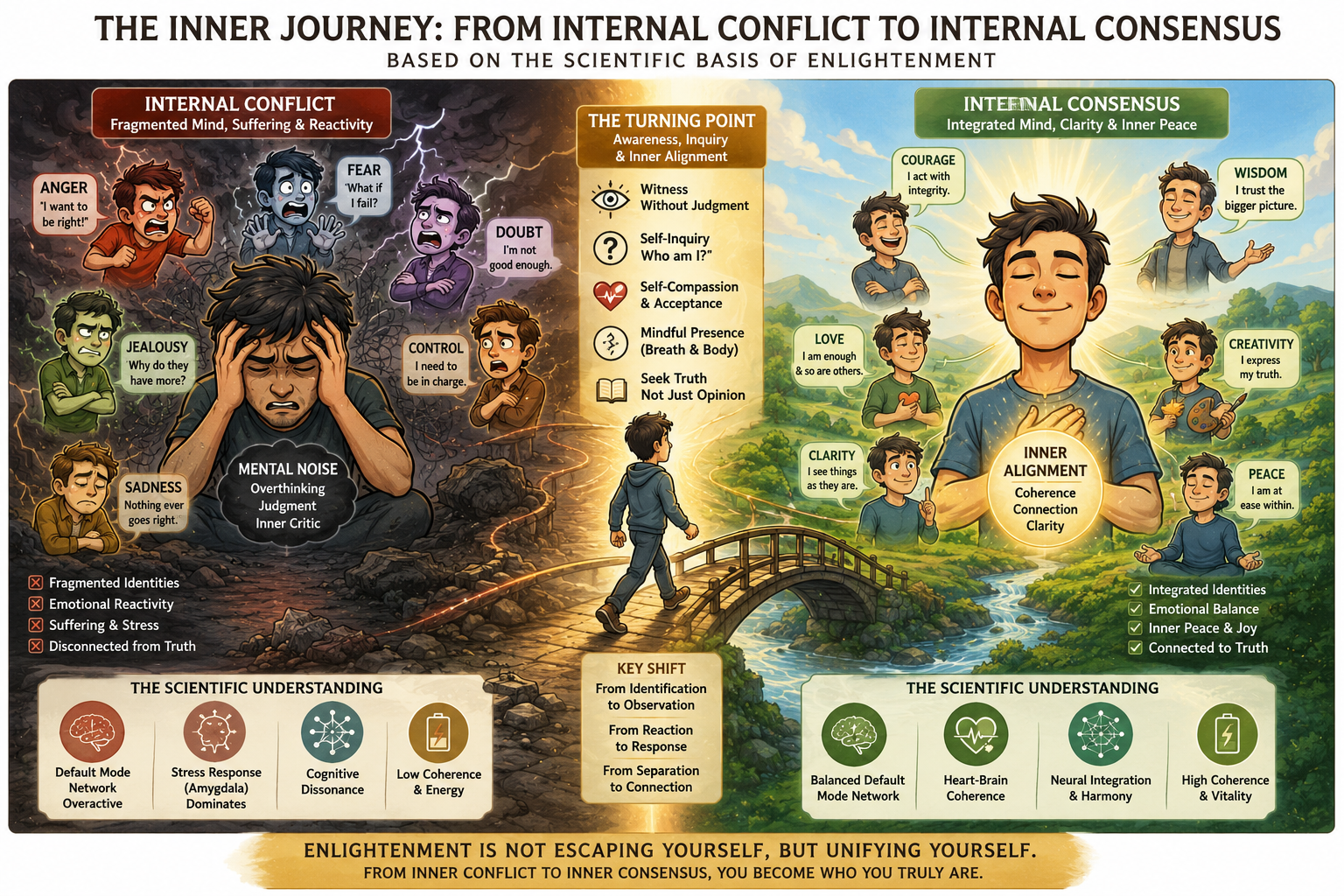
Modern individuals frequently experience internal division.
Professional identity competes with personal identity.
Logic competes with emotion.
Achievement competes with well-being.
Technology accelerates attention while reducing reflection.
The Stathine–Coexon Framework interprets these tensions as expressions of declining coherence.
Healing therefore involves increasing alignment among understanding, emotion, intention, communication, and action.
The integration of cognitive modes becomes part of a broader movement toward coherent existence.
9. Education and Human Development
If coherent integration is fundamental, education must extend beyond analytical training.
Students should cultivate:
- systems thinking,
- contemplative awareness,
- embodied learning,
- dialogue,
- creativity,
- ethical reflection,
- scientific reasoning.
These capacities are not alternatives.
They become mutually reinforcing when organized coherently.
Education therefore aims not merely to produce expertise but to cultivate integrated human beings.
10. Civilizational Implications
McGilchrist has argued that societies reflect dominant styles of attention.
The Stathine–Coexon Framework extends this observation.
Civilizations become coherent when their institutions reflect integrated ways of knowing.
Science and spirituality need not compete.
Technology and ecology need not conflict.
Efficiency and compassion need not oppose one another.
Public discourse becomes more generative when multiple modes of understanding are integrated through shared coherence rather than polarized into competing ideologies.
11. Future Research Directions
The dialogue between McGilchrist’s work and the Stathine–Coexon Framework suggests several interdisciplinary questions:
- Can coherence be distinguished conceptually from hemispheric integration while remaining compatible with it?
- How might embodied cognition contribute to the development of coherent understanding?
- Can educational practices cultivate measurable increases in coherence across diverse cognitive capacities?
- What relationship exists between attention, coherence, and long-term wisdom?
- Could coherence provide a common language connecting neuroscience, psychology, philosophy, education, and consciousness studies?
These questions invite collaboration across neuroscience, cognitive science, philosophy, contemplative studies, education, and systems theory.
Conclusion
Iain McGilchrist has significantly enriched contemporary discussions of mind by demonstrating that human cognition depends upon complementary modes of attention rather than a single form of intelligence. His work challenges reductionist conceptions of consciousness and emphasizes the importance of embodiment, relationship, and contextual understanding.
The Stathine–Coexon Framework seeks to complement this perspective by proposing coherence as the organizing principle through which these diverse modes of knowing become integrated. Within this framework, the Coexon provides the timeless continuity of coherent understanding, while Stathine provides the invariant field of existence in which embodied life unfolds. Analytical reasoning and holistic participation are thus understood not as competing approaches but as complementary expressions of coherent consciousness.
If developed through continued philosophical inquiry and interdisciplinary engagement, this perspective may contribute to a richer understanding of consciousness—one in which wisdom emerges through the increasing integration of multiple ways of knowing into a coherent participation in reality. In this sense, the future of human flourishing may depend not on choosing between analysis and intuition, but on cultivating the coherence that enables both to contribute to an integrated understanding of existence.