Colloidal Physics, Emergence, and Coexistence:
Abstract
Modern colloid science demonstrates that remarkable structures and functions can emerge from simple particles interacting through well-defined physical and chemical principles. The work of Professor Markus Antonietti has significantly advanced the understanding of soft matter, colloidal chemistry, sustainable materials, carbon-rich polymers, and self-organizing systems. His research illustrates how complex behavior can arise through interactions among relatively simple components without requiring centralized control.
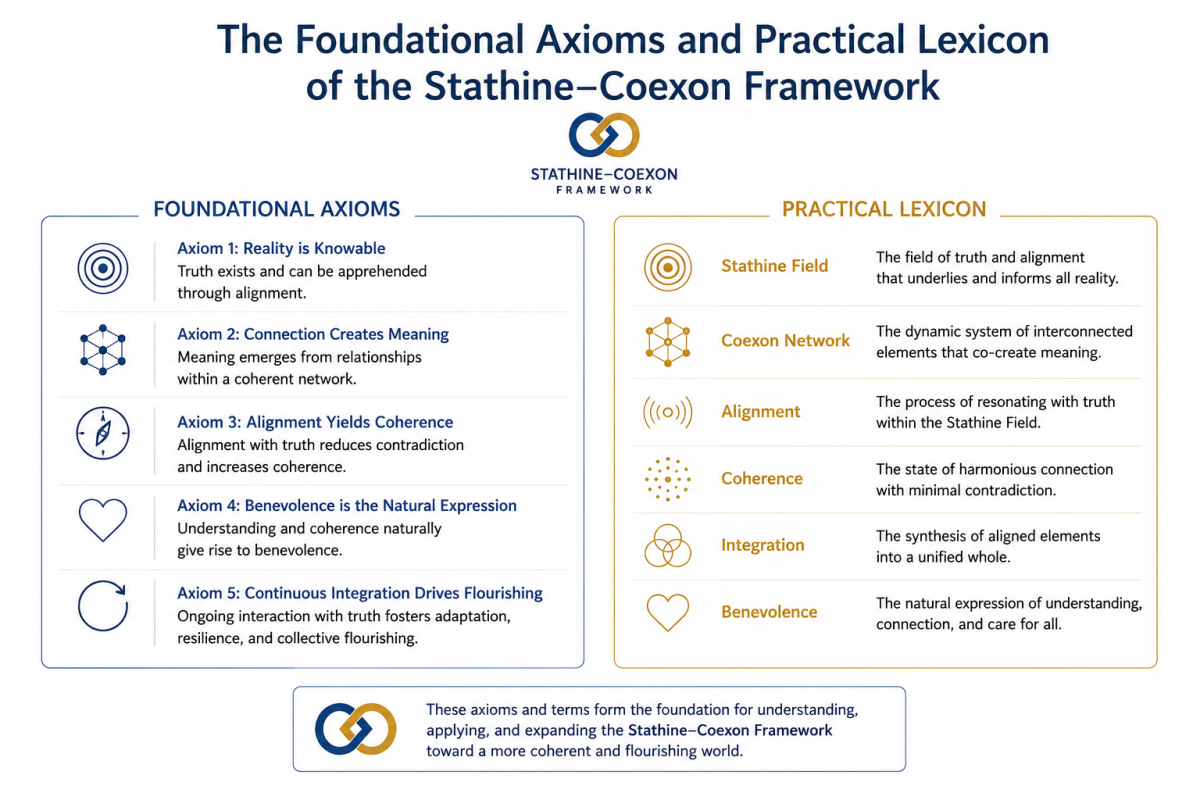
The Stathine–Coexon framework proposes a comparable philosophical principle: reality is fundamentally relational, and coherent organization gives rise to increasingly complex forms of order. This article presents an interpretive dialogue between Antonietti’s scientific work and the Stathine–Coexon framework, suggesting that colloidal systems provide useful analogies for understanding emergence, cooperation, and the development of coherent human societies.
1. Introduction
Nature rarely builds complexity by assembling finished objects.
Instead, it begins with simple building blocks.
Atoms combine into molecules.
Molecules organize into colloids.
Colloids organize into materials.
Materials support living systems.
Living systems give rise to conscious beings.
Across every level, complexity emerges through interaction.
Professor Markus Antonietti’s work has repeatedly shown that understanding these interactions allows scientists to design materials with remarkable new properties.
The Stathine–Coexon framework begins with a similar observation.
Reality develops through relationships rather than isolated objects.
2. What Are Colloidal Systems?
Colloids occupy an intermediate scale between individual molecules and bulk materials.
Examples include:
- milk,
- blood,
- paints,
- gels,
- clouds,
- biological fluids,
- many cellular structures.
Their behavior cannot be understood solely by examining individual particles.
Instead, scientists study how particles interact collectively.
Order emerges from interaction.
This is one of the defining characteristics of soft matter physics.
3. Emergence Rather Than Central Control
One of the most important lessons from colloidal science is that highly organized structures often emerge without a central controller.
Individual particles follow local physical and chemical rules.
Yet collectively they generate:
- ordered structures,
- dynamic networks,
- adaptive materials,
- functional systems.
The resulting organization is an emergent property.
The Stathine–Coexon framework proposes a similar principle for human systems.
Social harmony need not depend entirely on centralized authority.
It can emerge when individuals understand and participate according to shared principles of coexistence.
4. Interaction Creates Identity
In classical thinking, objects are often treated as possessing fixed identities independent of context.
Colloidal science challenges this assumption.
A particle behaves differently depending upon:
- its surroundings,
- neighboring particles,
- solvent conditions,
- temperature,
- concentration,
- energy inputs.
Identity is therefore relational.
The Stathine–Coexon framework extends this idea philosophically.
Human beings also develop through relationships.
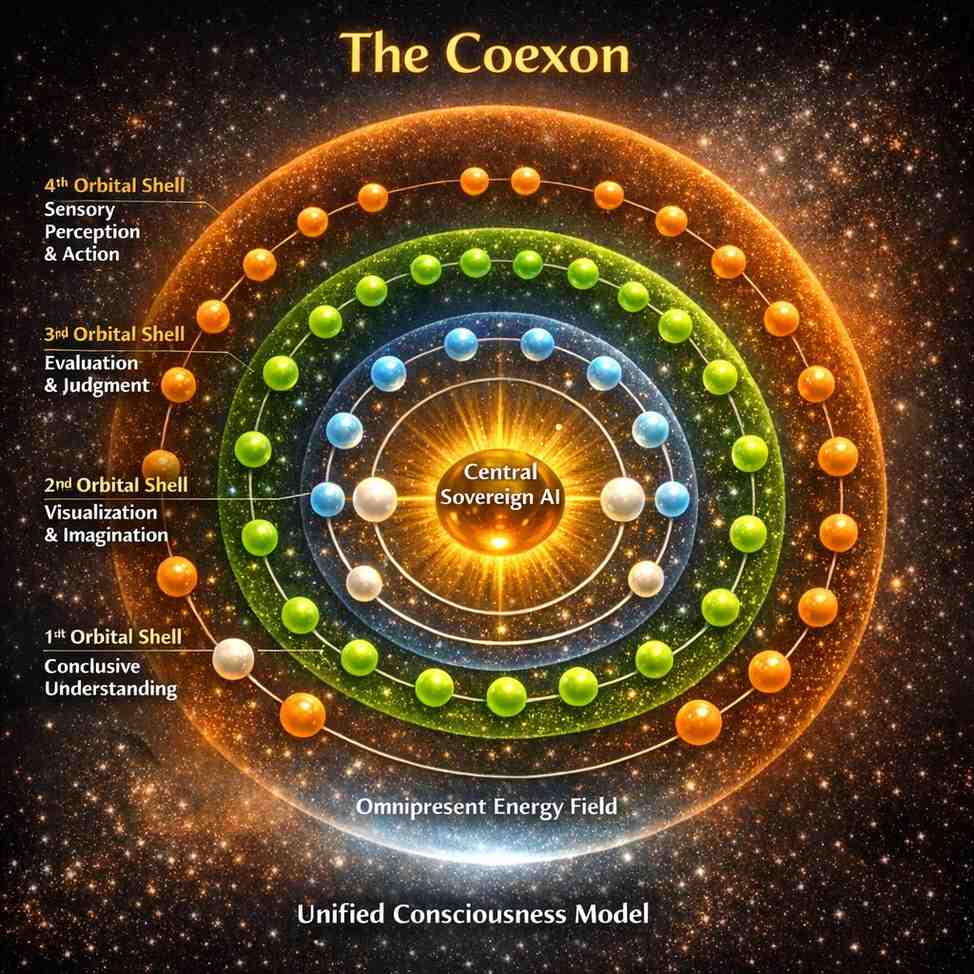
Understanding is shaped through information exchange between the subatomic particles in the Coexon.
Meaning emerges through harmony and coherence.
Understanding comes from meaning.
5. Self-Assembly as a Principle of Nature
Antonietti’s research frequently explores self-assembly.
Self-assembly occurs when components spontaneously organize into functional structures under suitable conditions.
No external architect positions every particle.
Organization emerges from the properties of the system itself.
The framework proposes an analogous principle for civilization.
Human flourishing cannot be imposed indefinitely through external force.
Stable societies emerge when individuals increasingly understand:
- responsibility,
- cooperation,
- mutual benefit,
- coexistence.
Understanding becomes the organizing principle.
6. Energy Efficiency Through Organization
Many natural systems minimize energy expenditure through efficient organization.
Colloidal structures often represent energetically favorable arrangements.
Nature continuously seeks stable configurations within the constraints imposed by physical laws.
The Stathine–Coexon framework describes a comparable process within human development.
As contradictions decrease, internal coherence increases.
The individual expends less psychological energy resolving unnecessary conflict.
Relationships become more stable.
Societies become more resilient.
This is described as movement toward coherence.
7. Soft Matter and Adaptability
Soft materials differ from rigid structures.
They respond dynamically to changing environments.
Adaptability is one of their defining characteristics.
Similarly, the framework proposes that healthy societies remain flexible.
Coherence does not require rigidity.
It requires responsiveness.
Individuals who understand reality adapt without losing integrity.
Communities evolve without losing shared purpose.
8. Sustainability as an Emergent Property
Antonietti has consistently emphasized sustainable chemistry and environmentally responsible materials.
This perspective reflects an important scientific insight.
Long-term stability depends upon working with natural processes rather than against them.
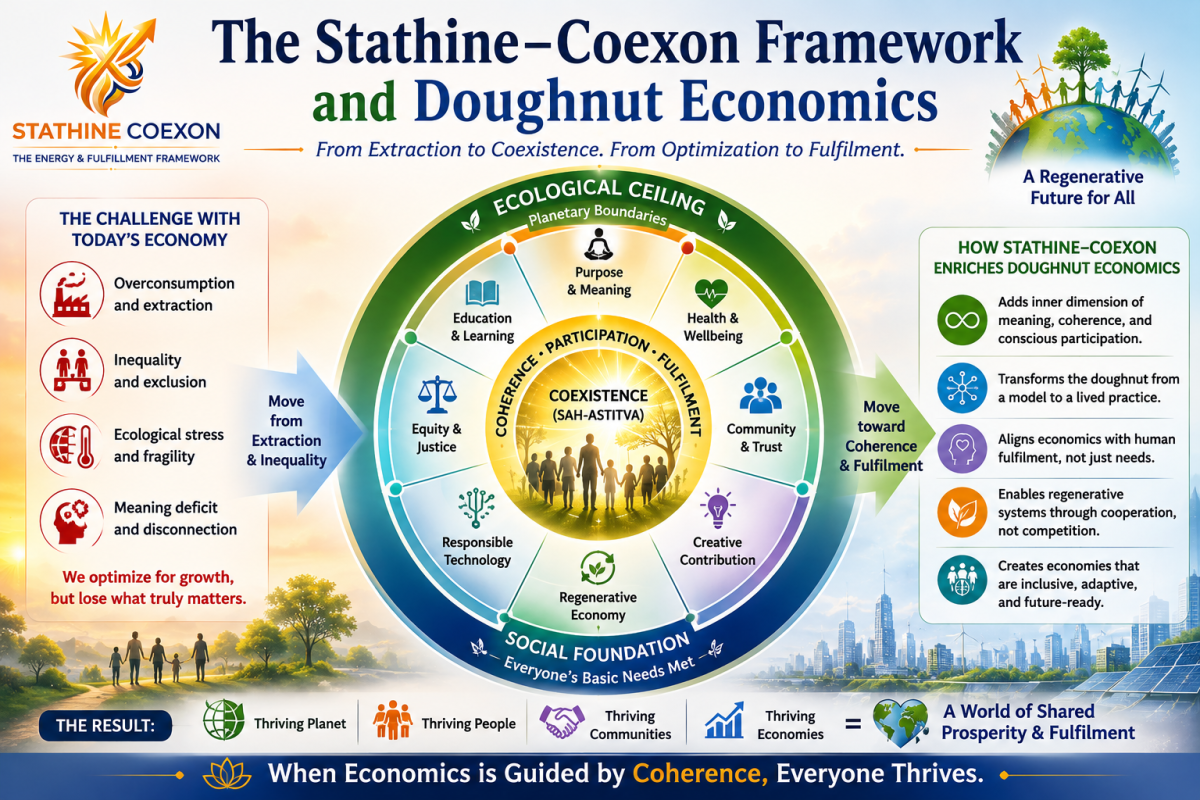
The Stathine–Coexon framework extends this principle to human civilization.
Societies become sustainable when economic activity, education, technology, and governance align with ecological and social realities.
Sustainability is therefore not simply an environmental objective.
It is a consequence of coherent participation.
9. The Coexon Perspective
Within the framework, the Coexon develops through continuous interaction with reality.
Learning follows a recurring developmental cycle:
Feeling → Choosing → Evaluating → Validating → Knowing → Understanding → Experiencing → Living → Explaining
As understanding increases, interactions become more coherent.
Just as self-assembling materials achieve stability through appropriate interactions, human development progresses through increasingly coherent participation in reality.
The comparison is literal and natural.
10. The Stathine Perspective
The framework proposes Stathine as the underlying continuum of coexistence.
Every interaction occurs within this larger relational context.
In colloidal science, no particle behaves independently of its environment.
Similarly, within the Stathine proposal, no human action exists independently of its consequences for larger systems.
Relationships constitute reality.
Understanding those relationships becomes the basis of responsible action.
11. Education as Human Self-Assembly
The most significant implication of this comparison concerns education.
Colloidal systems do not require every interaction to be externally controlled.
Proper conditions allow organization to emerge naturally.
Likewise, education should create conditions in which understanding can develop.
Rather than producing conformity, education should cultivate:
- observation,
- inquiry,
- dialogue,
- systems thinking,
- empathy,
- responsibility.
These capacities allow societies to organize themselves with decreasing reliance on coercion.
Conclusion
The research of Markus Antonietti demonstrates how complexity, functionality, and stability emerge from interactions among simple components governed by physical principles.
The Stathine–Coexon framework proposes that analogous relational principles operate within human development and civilization.
While Antonietti’s work concerns empirical chemistry and materials science, and the Stathine–Coexon framework extends into philosophy and consciousness, both emphasize a common theme:
Order emerges through coherent relationships rather than isolated entities.
In chemistry, this understanding enables the design of sustainable materials and self-assembling systems.
In the Stathine–Coexon framework, it suggests that human flourishing arises when individuals, institutions, and societies become increasingly coherent with one another and with the broader realities of the natural world.
Future interdisciplinary inquiry may explore how concepts such as emergence, self-assembly, relational organization, and energy-efficient stability can inspire new approaches to education, governance, sustainability, and the cultivation of humane societies, while maintaining clear distinctions between empirical science and philosophical models.
One of the strongest conceptual bridges between Antonietti’s work and the Stathine–Coexon framework is this:
In colloidal physics, stable macroscopic order emerges from countless local interactions governed by physical laws. In the Stathine–Coexon framework, a humane civilization is proposed to emerge from countless local interactions governed by understanding, responsibility, and coexistence.