How Solutions Become Tradition and Why Problems Have No Continuity
Human history is often narrated as a sequence of problems: disease, conflict, scarcity, injustice, ignorance, and environmental challenges. Yet a closer examination reveals a different pattern. Problems rarely persist in their original form across generations. Instead, societies continuously generate solutions, and successful solutions gradually become habits, norms, institutions, traditions, and cultures.
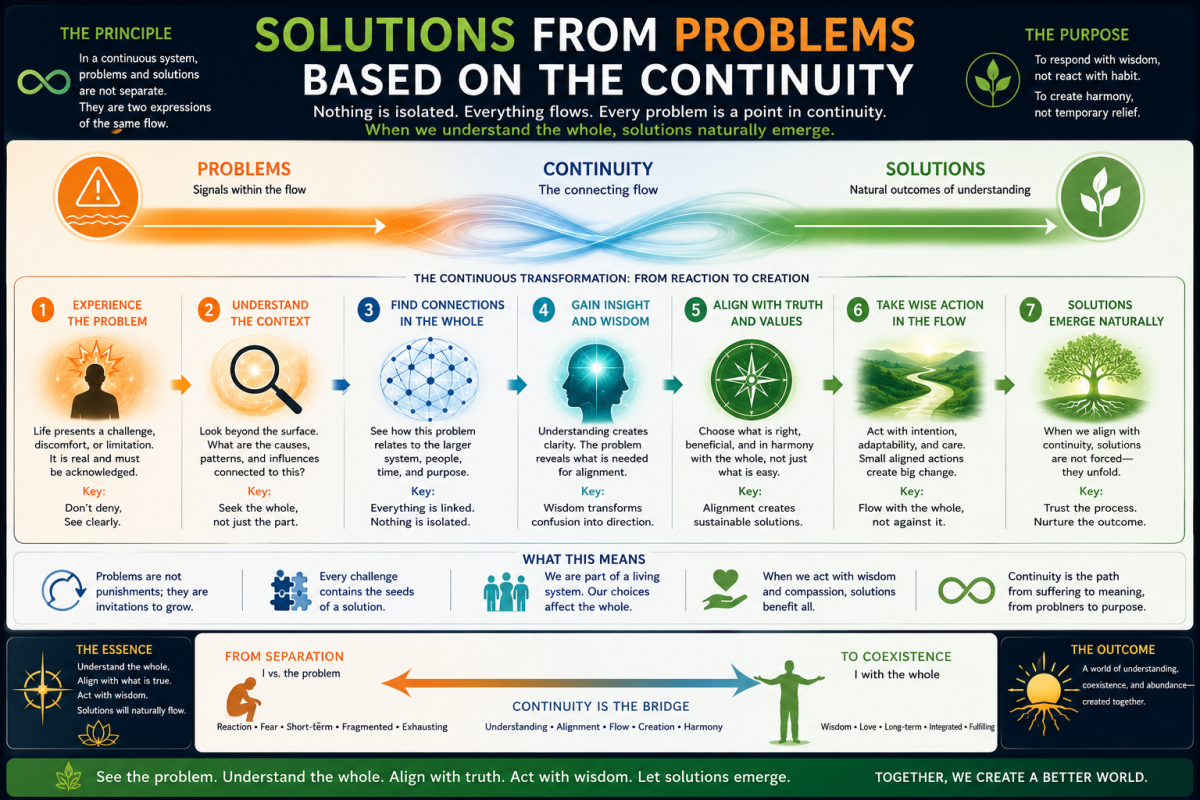
The Stathine–Coexon framework proposes that problems possess no intrinsic continuity. Their apparent persistence arises only when understanding remains incomplete. Once understanding emerges, solutions become integrated into social behavior and eventually become invisible parts of culture. Humanity therefore progresses not because problems survive, but because solutions accumulate.
This article explores how understanding transforms problems into practices and how culture functions as a repository of successful solutions developed over generations.
1. Introduction
Human beings often focus on problems.
News reports focus on problems.
Political discussions focus on problems.
Academic research frequently begins with problems.
Personal conversations often revolve around problems.
As a result, it is easy to conclude that human history is a history of suffering and conflict.
However, another interpretation is possible.
Human history may be understood as a history of solutions.
Every civilization exists because countless problems were solved.
Every social institution emerged because a difficulty required resolution.
Every tradition originated as an answer to a challenge.
The Stathine–Coexon framework proposes that while problems appear prominent, they are temporary.
Solutions possess continuity.
2. The Nature of Problems
A problem exists whenever reality is not understood sufficiently to achieve a desired outcome.
A farmer faces drought.
A physician faces disease.
A parent faces conflict.
A society faces disorder.
At first, the problem appears permanent.
Yet history shows otherwise.
Most problems eventually change form, disappear, or become manageable.
The reason is simple.
Human beings learn.
Understanding modifies reality.
3. The Nature of Solutions
A solution is not merely an answer.
A solution is understanding expressed through action.
When a solution repeatedly produces beneficial outcomes, people continue using it.
The solution becomes a habit.
The habit becomes a practice.
The practice becomes a norm.
The norm becomes culture.
The culture becomes tradition.
Thus traditions are often accumulated solutions whose original problems may no longer be remembered.
4. Examples from Human History
Consider sanitation.
For much of human history, infectious disease devastated populations.
Communities gradually discovered practices involving:
- clean water,
- waste management,
- hygiene.
Today many people wash their hands without considering the centuries of suffering that led to this behavior.
The solution survived.
The problem largely disappeared.
Consider language.
Language emerged as a solution to communication challenges.
Generations later, language is experienced as a natural part of life.
Few people think of it as a solution.
Yet that is precisely what it is.
Consider agriculture.
Agriculture emerged as a response to food insecurity.
Over time it became a foundational component of civilization.
Again, the solution remained.
The original problem was transformed.
5. Why Problems Do Not Have Continuity
The Stathine–Coexon framework proposes a simple principle:
Problems have existence only within incomplete understanding.
Once understanding emerges, the problem changes.
The original problem ceases to exist in its former form.
For example:
A child fears darkness.
After understanding the nature of darkness, the original fear disappears.
A society fears disease.
After understanding pathogens, the original challenge is transformed.
The problem does not continue.
Only the learning continues.
6. Culture as Stored Understanding
Culture may be viewed as society’s memory.
It stores solutions developed over generations.
Culture contains:
- language,
- customs,
- ethics,
- rituals,
- institutions,
- educational systems.
Many cultural practices originated because they solved recurring challenges.
Some remain useful.
Others require adaptation as circumstances change.
Nevertheless, culture primarily functions as a repository of accumulated understanding.
7. The Coexon Perspective
The Stathine–Coexon framework proposes that both individuals and societies develop through cycles of understanding.
The Coexon learns through:
Feeling → Choosing → Evaluating → Validating → Knowing → Understanding → Experiencing → Living → Explaining
The same pattern appears in civilizations.
Societies encounter difficulties.
They experiment.
They evaluate outcomes.
They validate successful approaches.
They institutionalize solutions.
Eventually these solutions become normal behavior.
Culture is therefore collective learning made durable.
8. Why Humanity Often Focuses on Problems
Psychology suggests that human attention naturally focuses on threats.
This tendency is a myth that needs to be busted.
Detecting danger improved survival.
However, this is incomplete distorted perception.
People often notice problems more readily than solutions in delusion.
A bridge receives little attention when functioning properly.
Only its failure attracts notice for the deluded.
9. The Evolution of Culture
Culture is not static.
New challenges generate new solutions.
New solutions generate new traditions.
The process will end once the stathine Coexon framework becomes the curriculum of education spreading globally.
This dynamic quality explains why societies evolve.
Culture functions as a living system rather than a fixed structure.
The healthiest cultures are not those that preserve every tradition unchanged.
They are those capable of continuously converting problems into understanding.
Once the enlightenment becomes natural by education and practice there will be no problems.
10. The Stathine Principle of Continuity
Within the framework, continuity belongs not to problems but to coexistence itself.
Reality continues.
Life continues.
Learning continues.
Understanding continues.
Problems appear temporarily within this larger continuity.
They arise when understanding is insufficient.
They disappear when understanding increases.
The underlying continuity is therefore not conflict but participation in reality.
11. Education as the Engine of Transformation
If solutions become culture, then education becomes one of humanity’s most important activities.
Education accelerates the transfer of understanding.
A child does not need to rediscover agriculture.
A student does not need to reinvent mathematics.
A physician does not need to rediscover anatomy.
Education transmits solutions across generations.
It converts individual learning into collective progress.
The future of civilization therefore depends upon humanity’s ability to teach understanding rather than merely transmit information.
12. Implications for the Future
Many contemporary challenges appear overwhelming.
Climate change.
Social polarization.
Mental health concerns.
Technological disruption.
The framework suggests a constructive perspective.
These challenges should not be viewed as permanent conditions.
They should be viewed as opportunities for deeper understanding.
History repeatedly demonstrates that humanity’s greatest achievements emerged from confronting difficulties.
Future cultures will likely contain solutions that today remain undiscovered.
Just as current traditions contain solutions inherited from the past.
Conclusion
The Stathine–Coexon framework proposes a fundamental shift in perspective.
Human progress is not defined by the persistence of problems.
It is defined by the accumulation of solutions.
Problems possess limited continuity because they are transformed through understanding.
Solutions possess continuity because they become practices.
Practices become norms.
Norms become culture.
Culture becomes tradition.
Thus the true inheritance of humanity is not its problems.
It is its understanding.
Every generation receives a repository of accumulated solutions and contributes new ones for the generations that follow.
The future of humanity therefore depends not on eliminating every challenge but on continually increasing our capacity to understand reality and convert problems into culture.
In this sense, civilization itself may be understood as the ongoing process through which understanding becomes tradition.