Seeing, Knowing, Understanding, and Experiencing Coexistence Through the Stathine–Coexon Framework
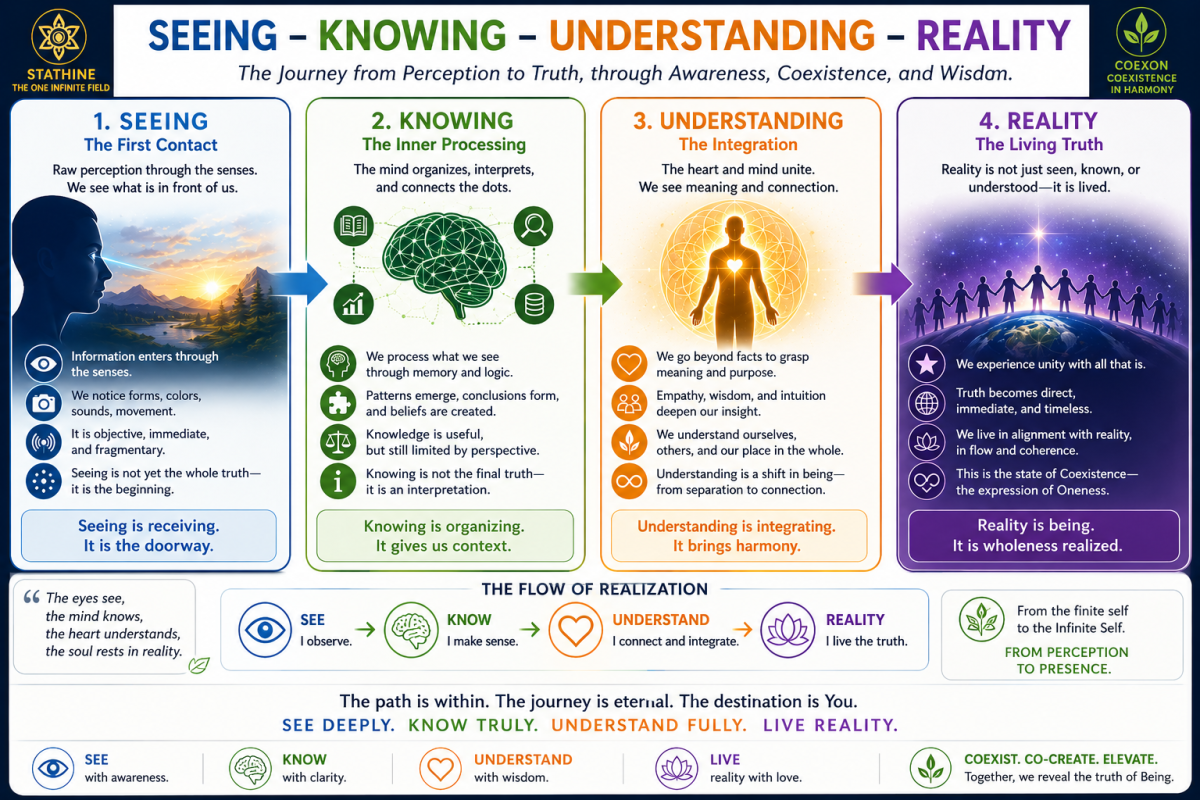
Human beings possess a remarkable capacity to observe, measure, describe, understand, and explain reality. Modern education has been highly successful in teaching observation and measurement. However, understanding the deeper interconnectedness of existence remains a challenge. The Stathine–Coexon framework proposes that reality can be approached through five progressively deeper levels: seeing, knowing, understanding, experiencing, and living.
According to this framework, the eyes can perceive forms, shapes, colors, and movements, but they cannot directly perceive coexistence itself. Coexistence is not an object. It is an experiential reality that becomes evident through understanding. Every element in existence possesses a form that can be observed, measurable properties that can be quantified, qualities that can be known, utility that can be understood, and an inseparable relationship with the larger whole. The framework proposes that a comprehensive education capable of helping individuals understand these dimensions could significantly contribute to human flourishing and planetary sustainability.
1. Introduction
Human civilization has advanced through observation.
We learned to observe the stars.
We learned to observe plants.
We learned to observe animals.
We learned to observe the human body.
Science emerged from systematic observation.
Technology emerged from applied knowledge.
Civilization emerged from shared understanding.
Yet despite this progress, many individuals still experience confusion about their place in reality.
The Stathine–Coexon framework proposes that this confusion arises because observation alone is insufficient.
Reality must not only be seen.
It must also be understood.
2. What Do the Eyes Actually See?
The eyes are extraordinary organs.
They detect:
- color,
- shape,
- movement,
- distance,
- contrast,
- light.
When we look at a tree, we see its form.
When we look at a mountain, we see its structure.
When we look at another person, we see their physical appearance.
The eyes reveal appearances.
However, the eyes do not directly reveal relationships.
The eyes do not reveal meaning.
The eyes do not reveal utility.
The eyes do not reveal coexistence.
These require additional levels of cognition and understanding.
3. The Five Levels of Knowing Reality
The Stathine–Coexon framework proposes five progressive levels through which reality may be approached.
Level 1: Seeing
This is direct sensory perception.
We see a river.
We see a tree.
We see a human being.
At this stage we know that something exists.
Level 2: Knowing
We identify characteristics.
We know:
- its name,
- its composition,
- its measurable properties.
For example, water can be described by its molecular structure.
A tree can be classified biologically.
A human body can be studied anatomically.
Science excels at this level.
Level 3: Understanding
Understanding goes beyond description.
It asks:
- What is its role?
- Why does it exist?
- How does it participate within larger systems?
A tree is no longer merely a biological object.
It becomes:
- a producer of oxygen,
- a regulator of climate,
- a participant in ecosystems,
- a source of shelter and nourishment.
Understanding reveals relationships.
Level 4: Experiencing
At this stage coexistence becomes experiential.
A person no longer merely understands intellectually that life is interconnected.
The person begins to experience that interconnectedness directly.
The forest is no longer an external object.
It becomes part of a living system in which the observer also participates.
This level cannot be achieved through sight alone.
It requires understanding.
Level 5: Living
The final stage occurs when understanding consistently guides behavior.
The individual begins acting in accordance with reality as understood.
Knowledge becomes lived wisdom.
4. The Structure of Reality
According to the framework, every element in existence possesses multiple dimensions.
Form
Its observable appearance.
Properties
Its measurable characteristics.
Examples include:
- mass,
- density,
- composition,
- temperature,
- charge.
Qualities
Characteristics that may be known and described but are often difficult to measure directly.
Examples include:
- beauty,
- reliability,
- harmony,
- resilience.
Utility
The contribution the element makes within larger systems.
Coexistence
Its inseparable participation within the larger reality.
These dimensions are not separate entities.
They coexist simultaneously.
5. Why Coexistence Cannot Be Seen
One of the central propositions of the framework is that coexistence cannot be directly observed as an object.
Consider a flower.
The eye sees the flower.
The microscope reveals cellular structures.
Chemistry reveals molecular composition.
However, coexistence includes:
- the soil,
- sunlight,
- water,
- atmosphere,
- pollinating insects,
- ecological networks.
No single glance reveals the entire system.
Coexistence becomes apparent only through understanding relationships.
Thus coexistence is not primarily a visual reality.
It is an understood and experienced reality.
6. From Information to Understanding
Modern education successfully provides information.
Students learn:
- facts,
- formulas,
- definitions,
- classifications.
However information alone does not necessarily produce understanding.
A student may know the chemical formula of water.
Yet understanding requires recognizing water’s role in sustaining life.
Similarly, one may know the anatomy of the human body.
Understanding requires recognizing the interdependence of body, mind, relationships, and environment.
The transition from information to understanding is therefore essential.
7. The Human Potential
The framework proposes that every human being possesses the potential to understand reality more comprehensively.
This potential includes understanding:
- physical systems,
- biological systems,
- ecological systems,
- social systems,
- psychological systems,
- existential systems.
Such understanding is not reserved for specialists.
It is a natural human capacity.
The role of education is to cultivate this capacity.
8. A New Educational Vision
The educational systems of the future may need to move beyond information transfer alone.
Students should learn not only:
- what things are,
- how things work,
but also:
- why they matter,
- how they contribute,
- how they coexist.
Education would therefore include:
Observation
Learning to see accurately.
Measurement
Learning to quantify accurately.
Description
Learning to communicate accurately.
Understanding
Learning relationships and utility.
Participation
Learning how to live harmoniously within reality.
This approach integrates knowledge with wisdom.
9. Implications for Humanity and the Planet
Many contemporary challenges arise from fragmented understanding.
People often focus on isolated outcomes while ignoring broader consequences.
The framework proposes that increasing understanding of coexistence naturally encourages:
- ecological responsibility,
- social cooperation,
- sustainable development,
- human wellbeing.
When individuals understand how systems are connected, decisions become more holistic.
Understanding reduces unnecessary conflict.
Understanding increases responsibility.
Understanding promotes participation rather than domination.
10. The Stathine–Coexon Perspective
Within the framework:
The Stathine represents the underlying reality of coexistence.
The Coexon represents the conscious participant capable of understanding that coexistence.
The journey of human development is therefore:
Seeing → Knowing → Understanding → Experiencing → Living
At each stage, perception becomes deeper.
At each stage, reality becomes more meaningful.
At each stage, participation becomes more conscious.
Conclusion
The eyes reveal forms.
Science reveals properties.
Language reveals qualities.
Understanding reveals utility.
Experience reveals coexistence.
These dimensions are inseparable aspects of reality.
The Stathine–Coexon framework proposes that the future of humanity depends upon educating individuals to understand all these dimensions together rather than in isolation.
Every element in existence possesses form, properties, qualities, utility, and coexistence.
To understand reality fully is to understand all five.
Such understanding is not merely an intellectual achievement.
It is the foundation for responsible living, human flourishing, and the long-term wellbeing of the planet.
The greatest educational challenge of the future may therefore be simple:
To help every human being learn not only to see reality, but to understand and experience the coexistence that makes reality possible.
A useful summary of the framework is:
Science helps us see and measure reality.
Understanding helps us know its utility.
Experience helps us recognize coexistence.
Education should help human beings move through all three stages.
This shifts education from mere information acquisition toward the cultivation of holistic understanding and responsible participation in existence.