The Stathine–Coexon Framework as a Developmental Proposal for Human Maturation
Abstract
Modern humanity has achieved extraordinary technological, scientific, and economic progress. Yet many of the fundamental problems that have accompanied civilization remain unresolved. Conflict, exploitation, inequality, violence, alienation, and psychological suffering continue despite unprecedented access to information and resources.
This paradox raises an important question: Has Homo sapiens fully become human? ( Neither exploiting Nor being exploited )
This article proposes that biological evolution and human maturation are not identical processes. Evolution successfully produced a species capable of language, abstract thought, self-reflection, and technological innovation. However, the development of a genuinely human mode of existence—defined as neither exploiting others nor allowing exploitation—remains incomplete.
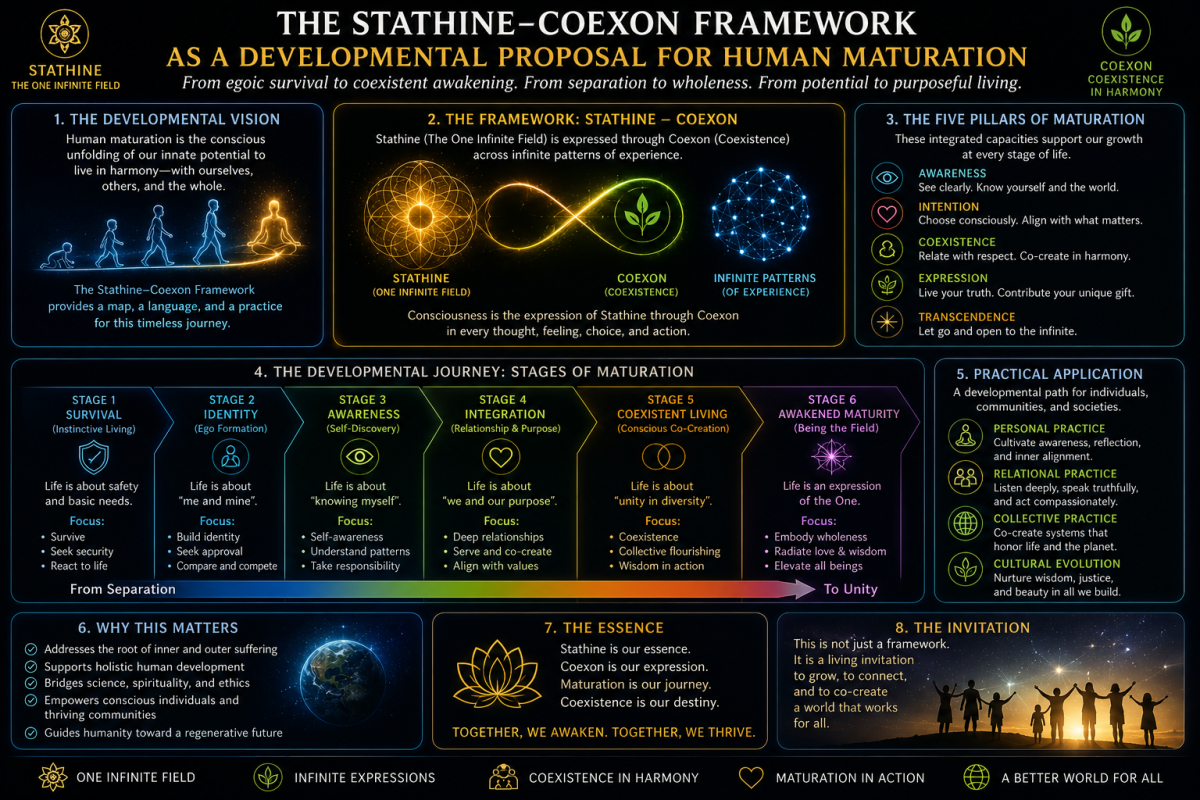
The Stathine–Coexon framework is presented as a developmental model that seeks to explain this unfinished transition. The framework proposes that human fulfillment emerges through increasing understanding, relational coherence, and conscious participation in reality. In this view, the next stage of human evolution is not biological but existential: the movement from intelligent survival toward humane coexistence.
1. Introduction
The Earth has been the Home to all of humanity the flora, fauna and matter.
Every organism that evolved before humanity contributed to the conditions that helped human life emerge.
The atmosphere was shaped by ancient microbial life.
The soil was created through billions of years of biological activity.
Plants transformed solar energy into nutrients that enriched.
Animals kingdom saw evolving compleex nervous systems paving the way for complex cognition.
The Earth did not merely support humanity.
The Earth facilitated the possible emergence.
The human body itself is a living record of this evolutionary journey.
Every organ, every reflex, and every biological process has been instrumental and contributing to the emergence human being.
Yet an important question remains:
Has humanity fully understood what it means to be human?
2. The Success of Biological Evolution
From an evolutionary perspective, Homo sapiens is remarkably full of potential.
Humans possess:
- symbolic language,
- self-awareness,
- imagination,
- planning,
- cultural transmission,
- creativity.
Few species have transformed their environment so extensively.
Yet biological success does not automatically produce wisdom.
The same intelligence capable of curing disease can create weapons.
The same imagination that creates art can create propaganda.
The same social instincts that create communities can create tribal conflict.
Evolution produced capability.
It did not guarantee maturity.
3. The Unfinished Human
The Stathine–Coexon framework proposes a distinction between:
Homo sapiens
A biologically evolved organism.
and
Human
A consciously developed participant in reality.
According to this view, becoming human is not an automatic consequence of birth.
It is a developmental achievement.
A genuinely human being neither exploits nor accepts exploitation as a normal condition of existence.
Instead, such a person seeks understanding, cooperation, and mutual flourishing.
This distinction shifts the focus from biological identity to conscious development.
4. The Historical Pattern of Exploitation
Human history reveals recurring patterns.
Individuals exploit individuals.
Groups exploit groups.
Nations exploit nations.
At times, individuals also allow themselves to be exploited due to fear, ignorance, dependency, or misunderstanding.
Both patterns emerge from fragmentation.
The exploiter sees only personal gain.
The exploited often sees only immediate survival.
Neither sees the larger reality.
The result is instability for all parties involved.
The Stathine–Coexon framework proposes that exploitation is fundamentally a failure of understanding.
5. Understanding as the Missing Development
Modern education has successfully transmitted information.
However information alone does not guarantee wisdom.
Human beings may possess enormous knowledge while remaining trapped in conflict.
The framework therefore distinguishes:
- information,
- knowledge,
- understanding.
Information describes facts.
Knowledge organizes facts.
Understanding reveals relationships.
Understanding allows individuals to perceive consequences, interdependence, and long-term outcomes.
Without understanding, intelligence may become destructive.
With understanding, intelligence becomes constructive.
6. The Stathine Principle
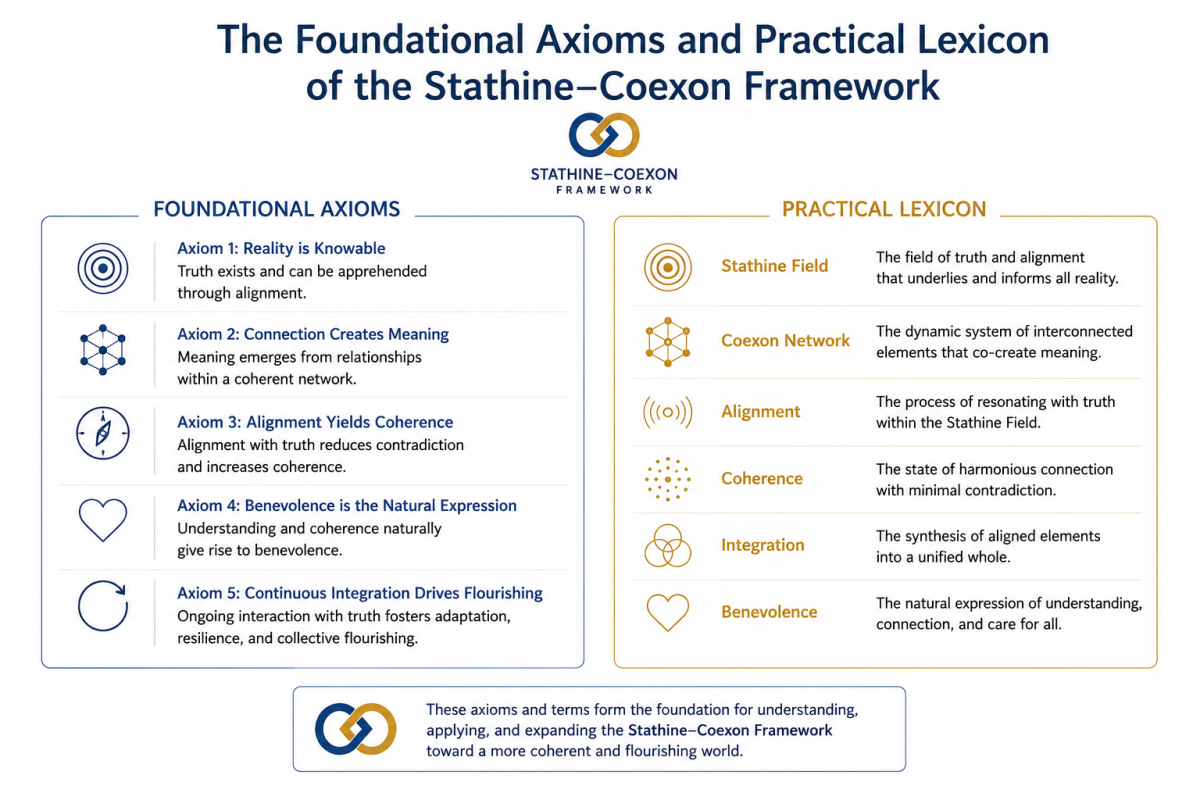
The framework proposes the concept of Stathine as the underlying relational continuum of reality.
Nothing exists independently.
Every system emerges through relationships.
The atmosphere depends on ecosystems.
Ecosystems depend on countless organisms.
Societies depend on cooperation.
Individuals depend on communities.
The appearance of separation is therefore incomplete vision.
The Earth itself demonstrates this principle.
No organism survives alone.
Life emerges through participation.
7. The Coexon Principle
The Coexon represents the organizing principle of conscious participation.
The Coexon learns through experience.
It develops through:
- feeling,
- choosing,
- evaluating,
- validating,
- knowing,
- understanding,
- experiencing,
- living,
- explaining.
As understanding increases, contradictions become visible.
As contradictions become visible, they can be resolved.
This process gradually reduces friction.
The individual becomes increasingly coherent.
8. Becoming Human
Within this framework, becoming human means developing several capacities.
Capacity for Understanding
Seeking reality rather than defending assumptions.
Capacity for Mutual Benefit
Recognizing that sustainable success benefits all participants.
Capacity for Responsibility
Accepting the consequences of one’s actions.
Capacity for Appreciation
Recognizing coherence and contribution in others.
Capacity for Participative Cooperation
Moving beyond domination and submission.
These capacities are not genetic mutations.
They are developmental achievements.
9. The End of Exploitation
The framework does not suggest that conflict disappears completely.
Differences will always exist.
However understanding changes how differences are approached.
When individuals understand interdependence:
- exploitation becomes irrational,
- manipulation becomes unnecessary,
- domination becomes unstable.
Cooperation becomes the more intelligent strategy.
The individual no longer seeks victory over others.
The individual seeks coherence within reality.
10. The Earth as a Model
Nature demonstrates countless examples of participation.
Forests function through complex relationships.
Ecosystems continually adapt.
Life persists through networks of exchange.
Human beings are products of these same processes.
The framework suggests that humanity’s next developmental step is to consciously embody the principles that nature has demonstrated for billions of years:
- participation,
- reciprocity,
- adaptation,
- coexistence.
11. A New Definition of Progress
Modern society often measures progress through:
- economic growth,
- technological advancement,
- military strength,
- resource accumulation.
The Stathine–Coexon framework proposes an additional measure:
The degree to which human beings become capable of living without exploiting others and without accepting exploitation.
This shifts the focus from possession to participation.
From accumulation to understanding.
From competition to cooperation.
12. The Future of Human Evolution
Biological evolution produced Homo sapiens.
Cultural evolution produced civilization.
The next stage may be conscious evolution.
This does not require genetic change.
It requires increasing understanding.
The framework suggests that the future of humanity depends less upon new technologies and more upon new levels of coherence.
The question is no longer:
“Can we survive?”
The question becomes:
“Can we understand sufficiently to live well together?”
Conclusion
The Earth and its countless inhabitants played a profound role in the emergence of Homo sapiens.
Through billions of years of evolutionary development, life produced a species capable of reflecting upon its own existence.
Yet biological success alone does not complete the human journey.
The Stathine–Coexon framework proposes that true humanity begins when individuals move beyond both exploitation and submission into a mode of conscious participation characterized by understanding, responsibility, appreciation, and cooperation.
In this view, the highest achievement of Homo sapiens is not intelligence alone.
It is becoming fully human.
The task before humanity is therefore not merely to evolve technologically, economically, or politically.
It is to mature existentially.
The journey from Homo sapiens to Human may be the most important evolutionary transition still ahead of us.
This article places the central thesis in a form that many interdisciplinary journals may find approachable: evolution produced Homo sapiens; understanding produces Human. That distinction gives the Stathine–Coexon framework a developmental and ethical focus rather than presenting it solely as a theory of consciousness.