From Feeling to Understanding and Back to Feeling
Abstract
Human life is often understood as a collection of events, actions, and experiences. However, beneath these events lies a repeating cycle through which consciousness interacts with reality. This paper proposes a simple model of the human experience cycle:
Feeling → Choosing → Evaluating → Validating → Knowing → Understanding → Experiencing → Living → Explaining → Feeling
This cycle repeats throughout life. Each repetition has the potential to increase understanding and reduce confusion. The Stathine–Coexon framework views this cycle as the natural process through which consciousness learns about reality and develops greater coherence.
Introduction
Every human being wants to understand life.
We want to know:
- What is happening?
- Why did it happen?
- What should I do next?
Science studies the external world.
Psychology studies behavior.
Philosophy studies meaning.
Yet all human beings share a common process.
We feel.
We choose.
We learn.
We explain.
Then we feel again.
Life is a cycle.
Understanding this cycle helps us understand ourselves.
1. Feeling: The Beginning of the Cycle
Every experience begins with a feeling.
A child feels hunger.
A student feels curiosity.
A parent feels concern.
An artist feels inspiration.
A scientist feels wonder.
Feelings are the first signals of interaction with reality.
Before language develops, feelings already exist.
Before theories develop, feelings already exist.
Feeling is the starting point of consciousness.
2. Choosing: The Response
After feeling comes choice.
The organism responds.
The child cries.
The student studies.
The parent acts.
The scientist investigates.
Choice transforms feeling into action.
Without choice, feeling remains passive.
Choice creates movement.
3. Evaluating: Comparing Results
Every action creates an outcome.
The outcome may match expectations.
It may also differ from expectations.
The human mind naturally evaluates.
Questions appear:
- Did this work?
- Did it help?
- Did it solve the problem?
Evaluation is essential for learning.
Without evaluation, growth is impossible.
4. Validating: Testing Reality
Evaluation leads to validation.
Validation asks:
Is my conclusion correct?
Many beliefs fail at this stage.
Reality becomes the final judge.
A person may believe something strongly.
Reality may show otherwise.
Validation protects us from illusion.
Science depends upon validation.
Wisdom also depends upon validation.
5. Knowing: Building Knowledge
Validated experiences become knowledge.
Knowledge is accumulated understanding.
We learn:
- fire burns,
- water quenches thirst,
- kindness builds trust,
- cooperation improves outcomes.
Knowledge gives stability.
It allows future choices to improve.
Human civilization itself is built upon accumulated knowledge.
6. Understanding: Connecting Knowledge
Knowledge alone is not enough.
Many people know facts.
Fewer understand them.
Understanding emerges when separate pieces connect together.
Knowledge says:
“Fire burns.”
Understanding says:
“Fire burns because of combustion.”
Knowledge stores information.
Understanding reveals relationships.
Within the Stathine–Coexon framework, understanding reduces contradiction.
The more reality is understood, the less confusion remains.
7. Experiencing: Living the Understanding
Understanding must eventually be lived.
A person may understand compassion intellectually.
Only experience reveals its depth.
A person may understand cooperation intellectually.
Only participation reveals its power.
Experience transforms abstract understanding into lived reality.
At this stage, knowledge becomes embodied.
8. Living: Becoming the Understanding
As experiences accumulate, understanding becomes part of life.
Actions become more natural.
Less energy is spent on conflict.
Less energy is spent on confusion.
Life begins reflecting understanding.
The person does not merely know reality.
The person participates in reality.
This is a deeper stage of development.
9. Explaining: Sharing Understanding
Human beings naturally share what they learn.
Parents teach children.
Teachers teach students.
Scientists publish discoveries.
Artists create expression.
Philosophers share insights.
Explaining is the transmission of understanding.
Civilization advances because understanding is shared.
Knowledge survives through communication.
10. Returning to Feeling
After explaining, the cycle is not complete.
New situations arise.
New questions emerge.
New feelings appear.
The cycle begins again.
Feeling leads to choosing.
Choosing leads to evaluation.
Evaluation leads to validation.
Validation leads to knowledge.
Knowledge leads to understanding.
Understanding leads to experience.
Experience leads to living.
Living leads to explaining.
Explaining leads to new feelings.
The cycle continues throughout life.
The Coexon Interpretation
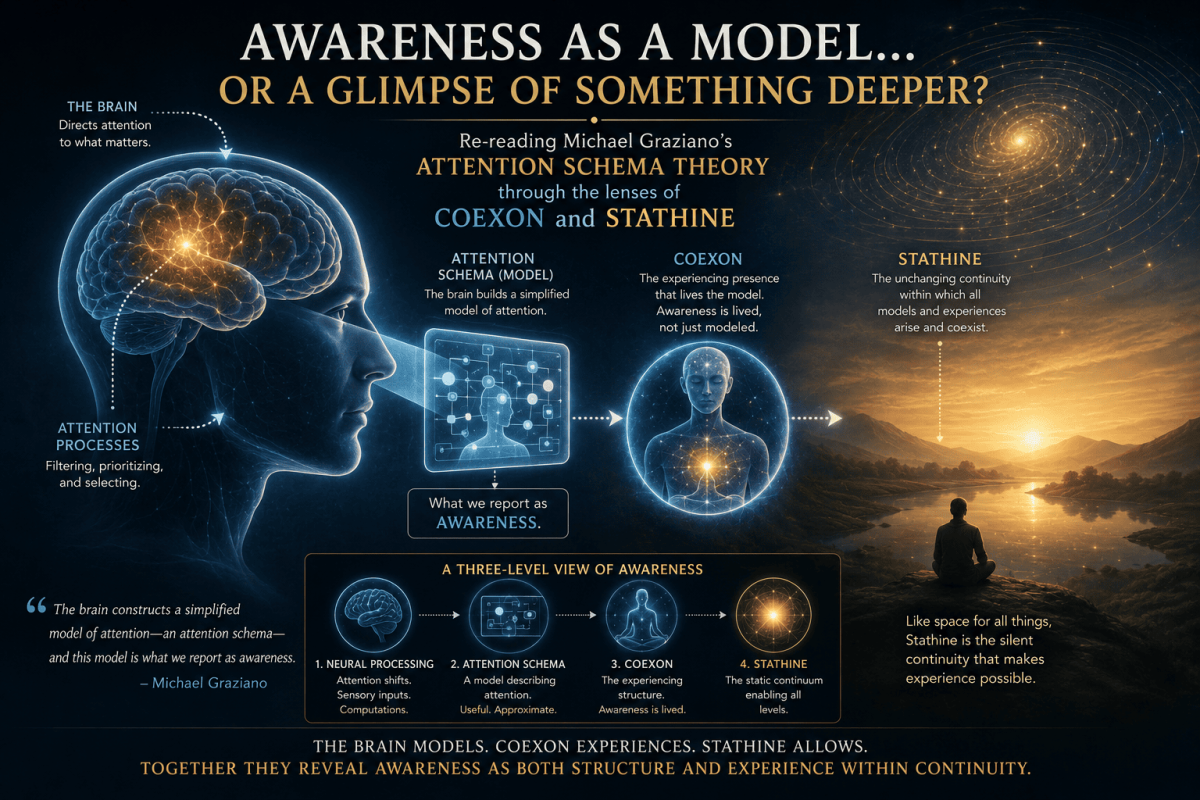
The Stathine–Coexon framework views this cycle as the natural movement of consciousness.
The Coexon develops coherence through repeated cycles of interaction with reality.
Each cycle can produce:
- greater understanding,
- reduced contradiction,
- improved relationships,
- deeper participation in life.
Confusion appears when the cycle is interrupted.
For example:
- feeling without understanding,
- choosing without evaluation,
- knowledge without validation,
- explanation without experience.
Harmony emerges when the entire cycle functions properly.
The Purpose of the Cycle
Many people search for the purpose of life.
The framework proposes a simple answer.
The purpose is not merely survival.
It is not merely accumulation.
It is not merely achievement.
The purpose is increasing understanding through participation in reality.
Each cycle provides an opportunity to learn.
Each learning reduces confusion.
Each reduction in confusion increases peace.
As understanding grows, life becomes less about defending beliefs and more about discovering reality.
Conclusion
Human life can be understood as a repeating cycle:
Feeling → Choosing → Evaluating → Validating → Knowing → Understanding → Experiencing → Living → Explaining → Feeling
This cycle operates within every individual and across entire civilizations.
The Stathine–Coexon framework proposes that consciousness develops through repeated movement around this cycle.
The journey begins with feeling.
It returns to feeling.
Yet each cycle has the potential to deepen understanding.
In this way, life becomes an ongoing process of learning reality, participating in reality, and sharing that understanding with others.
The cycle never truly ends.
It simply becomes more conscious, more coherent, and more complete.