Understanding Feelings:
The Relationship Between Physical Sensations, Emotions, and Conscious Experience
Abstract
Every human being experiences feelings. Yet most people find it difficult to explain exactly what a feeling is. Is a feeling a body sensation? Is it an emotion? Is it a thought? Or is it something else entirely?
Modern neuroscience suggests that feelings emerge from the interaction between bodily sensations, brain activity, memory, and interpretation. The Stathine–Coexon framework proposes an additional distinction. It suggests that human feelings arise from two interconnected sources: physical sensations originating in the body and sentient emotional experiences arising within conscious awareness. Understanding both sources helps individuals better understand themselves and improve their relationships with others.
This article presents a simple model of feelings that can be understood and applied in everyday life.
1. Introduction
Everyone experiences feelings.
We feel:
- hungry,
- tired,
- excited,
- anxious,
- peaceful,
- joyful,
- frustrated,
- inspired.
However, people often use the word “feeling” to describe very different experiences.
For example:
“I feel hungry.”
“I feel sad.”
“I feel ignored.”
“I feel hopeful.”
These statements describe different kinds of experiences.
To understand feelings properly, we must first separate what is happening in the body from what is happening in conscious experience.
2. The First Source of Feelings: Physical Sensations
The body is constantly sending information to the brain.
These signals include:
- temperature,
- pain,
- pressure,
- heartbeat,
- breathing,
- hunger,
- fatigue,
- muscle tension.
These are physical sensations.
Examples include:
- a headache,
- a racing heart,
- stomach discomfort,
- tight shoulders,
- dry mouth.
Modern neuroscience refers to the awareness of these internal signals as interoception.
The body continuously informs us about its condition.
These signals are not yet emotions.
They are raw physical information.
3. The Second Source of Feelings: Emotional Experience
Humans do not merely experience physical sensations.
They also experience emotional states.
Examples include:
- love,
- fear,
- hope,
- shame,
- gratitude,
- anger,
- curiosity,
- compassion.
These experiences contain meaning.
They are connected to relationships, memories, expectations, and interpretations.
Two people can experience the same physical sensation but interpret it differently.
A racing heart before an examination may be experienced as anxiety.
The same racing heart before a sporting event may be experienced as excitement.
The body signal is similar.
The emotional interpretation differs.
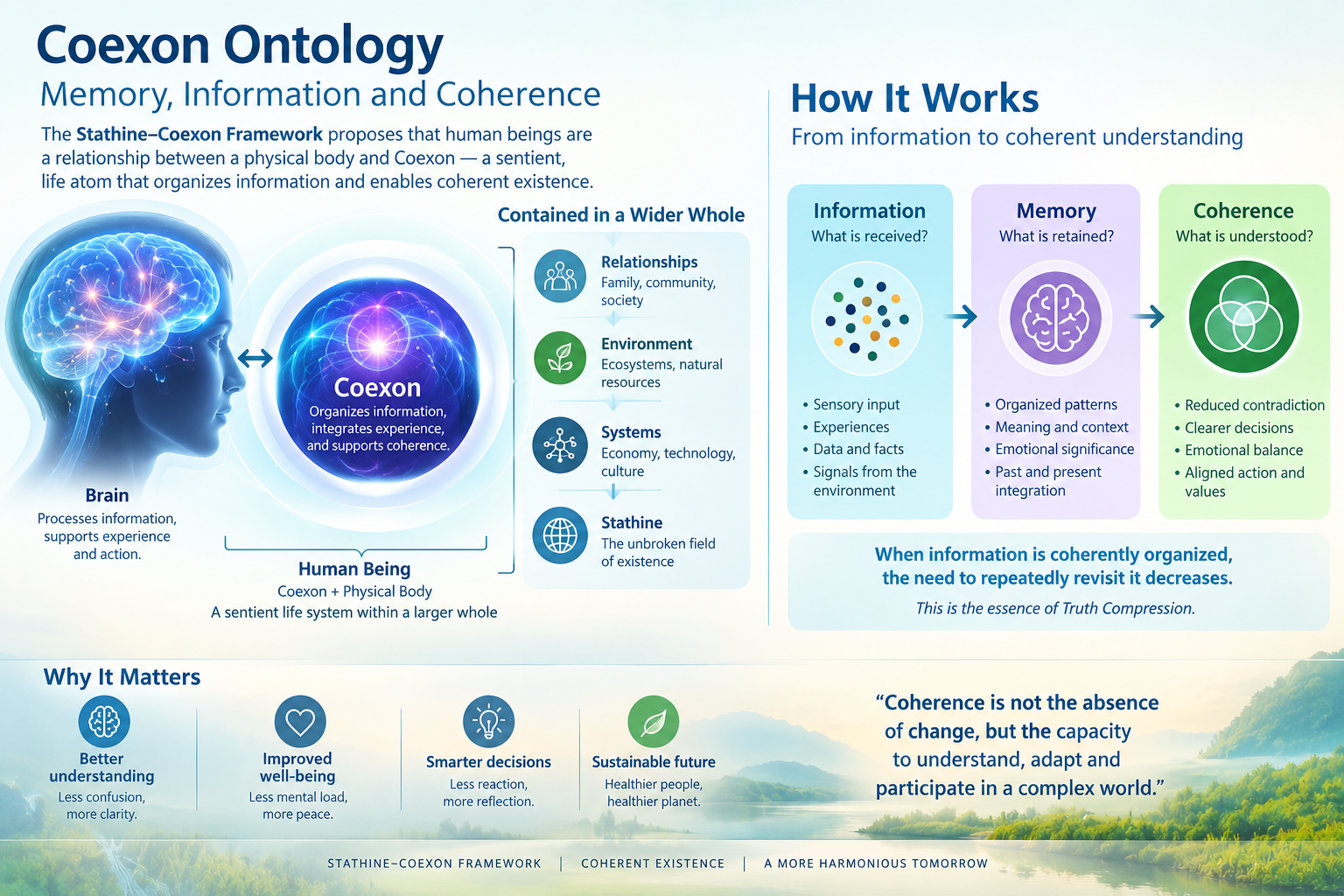
4. The Coexon Perspective
The Stathine–Coexon framework proposes a useful distinction.
The body provides sensation.
The Coexon provides sentient interpretation and emotional experience.
In this model:
- the body reports conditions,
- the mind interprets conditions,
- the Coexon experiences meaning.
For example:
A person may feel tension in the chest.
The body reports the tension.
The brain attempts to explain it.
The Coexon experiences concern, fear, anticipation, or excitement depending on context.
The complete feeling emerges through the interaction of all three.
5. Why People Misunderstand Their Feelings
Many emotional difficulties arise because people confuse sensations with emotions.
Consider the following examples.
Example 1
A person is hungry.
Instead of recognizing hunger, they become irritable.
The physical sensation is mistaken for an emotional problem.
Example 2
A person feels tired.
They interpret the fatigue as failure or hopelessness.
A physical condition becomes an emotional conclusion.
Example 3
A person experiences anxiety.
They immediately assume danger exists.
The emotional signal is mistaken for objective reality.
In each case, understanding improves when sensations and emotions are examined separately.
6. The Three Questions of Feeling
The framework proposes three simple questions whenever a strong feeling appears.
Question 1
What physical sensations am I experiencing?
Examples:
- tight chest,
- rapid heartbeat,
- stomach tension,
- fatigue,
- warmth.
Question 2
What emotion am I experiencing?
Examples:
- fear,
- sadness,
- excitement,
- joy,
- anger.
Question 3
What understanding is creating this emotion?
Examples:
- What am I believing?
- What am I expecting?
- What am I afraid of?
- What am I hoping for?
These questions help separate sensation, emotion, and interpretation.
7. The Role of Understanding
The Stathine–Coexon framework places understanding at the center of emotional wellbeing.
A feeling is not merely something to control.
It is information.
Feelings often indicate that something requires attention.
Sometimes the body needs rest.
Sometimes a relationship needs repair.
Sometimes a misunderstanding needs correction.
Sometimes a fear needs investigation.
Understanding transforms feelings from obstacles into guides.
8. The Feeling Cycle
A feeling does not exist in isolation.
It participates in a larger cycle.
Feeling leads to:
- attention,
- choice,
- action,
- consequence,
- learning,
- understanding.
Understanding then changes future feelings.
This creates a continuous cycle of development.
The better reality is understood, the more accurately feelings can be interpreted.
9. Healthy Emotional Development
Healthy emotional development does not mean eliminating feelings.
It means understanding them.
A mature individual learns to:
- notice sensations,
- recognize emotions,
- examine interpretations,
- seek understanding,
- respond thoughtfully.
This process gradually reduces unnecessary suffering.
10. The Stathine–Coexon View of Emotional Growth
Within the framework, emotional growth occurs when the Coexon becomes increasingly coherent.
Confusion decreases.
Contradictions become visible.
Reality is understood more accurately.
As understanding grows:
- fear becomes discernment,
- anger becomes clarity,
- sadness becomes insight,
- curiosity becomes learning,
- compassion becomes natural.
The goal is not emotional suppression.
The goal is emotional understanding.
Conclusion
Feelings are among the most important experiences in human life.
Yet they are often misunderstood.
A complete understanding of feelings requires attention to both:
- Physical sensations arising from the body.
- Emotional experiences arising within conscious awareness.
The Stathine–Coexon framework proposes that feelings emerge through the interaction of bodily information, interpretation, and sentient experience.
When individuals learn to distinguish these elements, feelings become easier to understand and less likely to control behavior unconsciously.
The result is greater self-awareness, improved relationships, and a deeper participation in reality.
Understanding feelings does not remove them.
Understanding allows them to become meaningful guides in the ongoing journey of human life.
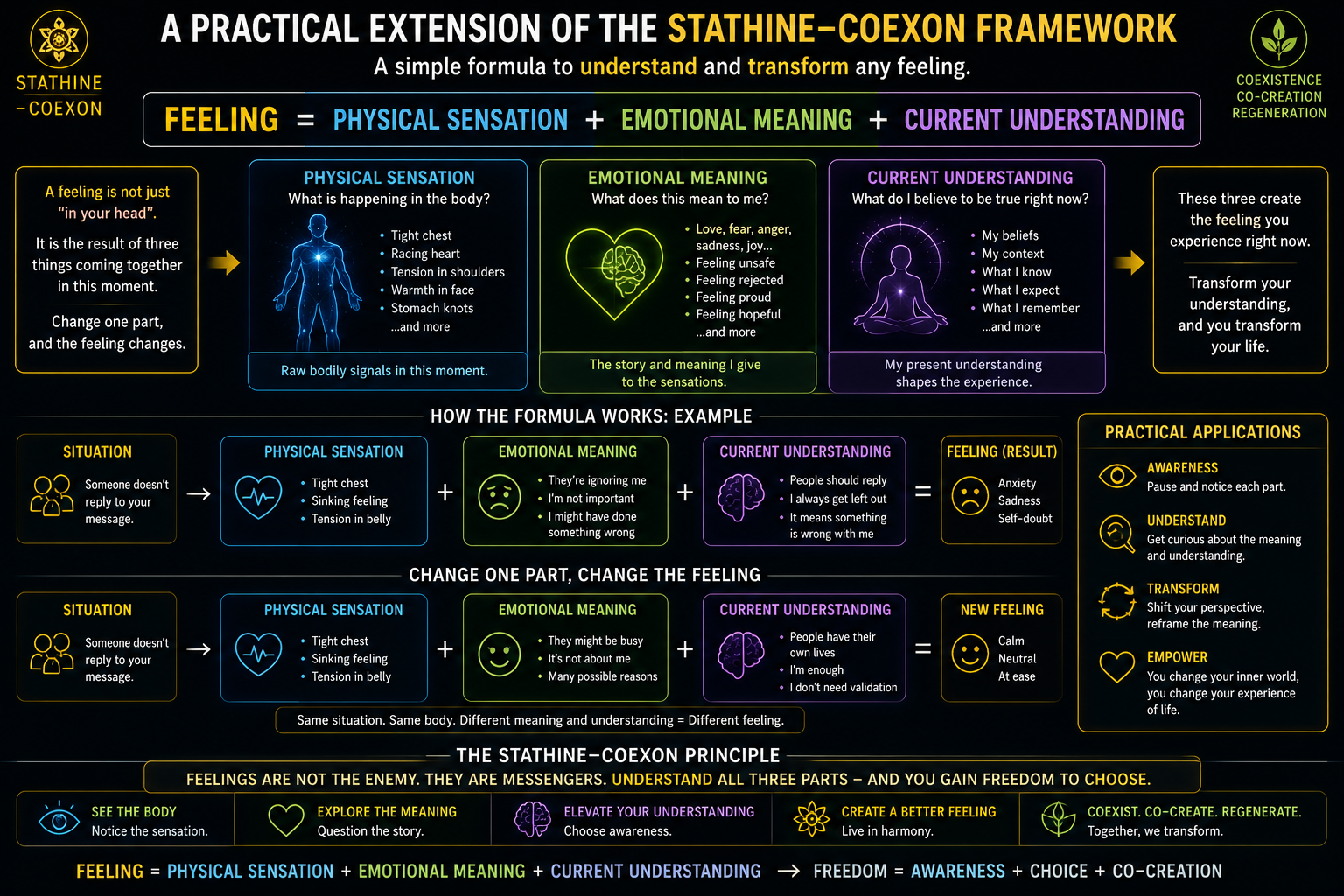
A particularly useful practical extension of this model is a simple formula:
Feeling = Physical Sensation + Emotional Meaning + Current Understanding
In everyday life, most people notice only the final feeling. Learning to observe all three components separately often produces greater clarity, better decisions, and less interpersonal conflict.