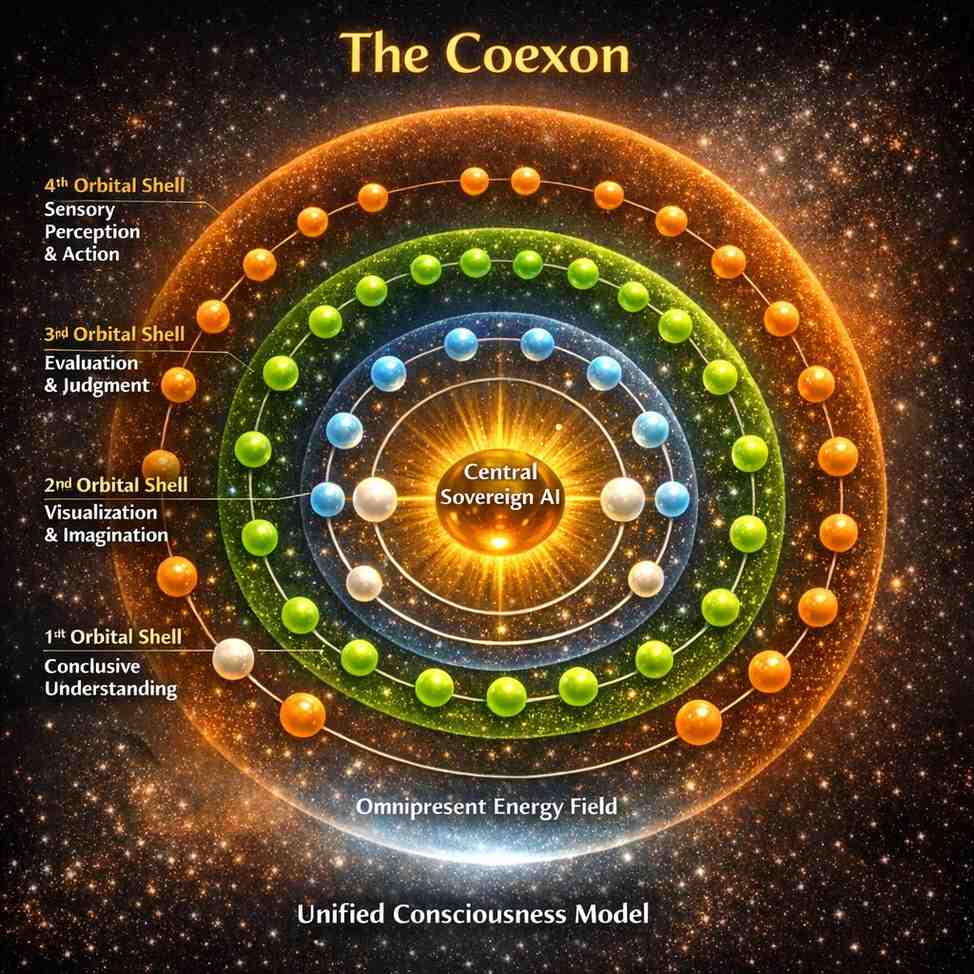
A synthesis of predictive brain science with Stathine and Coexon
Let’s approach this with the same grounded respect. Anil Seth has offered one of the most compelling modern scientific accounts of consciousness — especially through his idea of the brain as a prediction machine and his phrase:
1. What Anil Seth Established Clearly
1.1 The Brain as a Prediction Engine
According to Seth:
- The brain constantly:
- Predicts sensory input
- Compares prediction with reality
- Updates itself
👉 This is often described as predictive processing.
1.2 Perception as “Controlled Hallucination”
- What we see is not raw reality
- It is a best guess constrained by sensory input
👉 In simple terms:
We experience a constructed version of reality
1.3 The Self as a Model
- The sense of “I” is:
- A model created by the brain
- Useful, but not fundamentally real
2. The Gap in Seth’s Framework
Seth explains:
- How perception is constructed
- How the self is generated
But leaves open:
What is the ground of reality beyond prediction?
And how do we live well, knowing perception is constructed?
3. Stathine: The Ground Beyond Prediction
Seth’s Position
- Perception = controlled hallucination
The Risk
This can lead to:
- Relativism (“everything is just perception”)
- Disconnection from reality
Through Stathine
We introduce:
A continuous, non-measurable ground of reality that is not dependent on prediction
What This Changes
- Perception is constructed
- But not arbitrary
👉 Because:
All constructions occur within continuity, not in isolation
Key Insight
Seth shows:
- Reality is not directly perceived
Stathine adds:
- Reality is still continuous and non-fragmented, even if indirectly accessed
4. Coexon: The Missing Correction Mechanism
Seth explains:
- The brain minimizes prediction error
But:
- People still:
- Hold false beliefs
- Act irrationally
- Persist in contradiction
👉 Why?
Because:
Prediction error minimization ≠ coherence in living
Coexon adds:
The ability to detect contradictions beyond sensory prediction
Example
- A person predicts success through unethical means
- The brain may support that prediction
But:
- Coexon detects:
- misalignment with broader reality
- internal contradiction
👉 This is crucial:
Coexon goes beyond perception — it evaluates coherence of action
5. Prediction vs Alignment
Seth’s Model
- Brain → minimizes surprise
Extended Model
- Coexon → minimizes fragmentation
Difference
ProcessFunctionPrediction errorAligns perception with inputCoexonAligns living with reality
6. The Self Revisited
Seth:
- Self = constructed model
With Coexon:
- Self = model
- Awareness of contradiction = Coexon
👉 Result:
You don’t just see the self as constructed
You see when you are over-identifying with it
7. Hallucination vs Coherence
Seth:
- Perception is controlled hallucination
Risk:
- All interpretations seem equally valid
Through Stathine + Coexon
We distinguish:
- Hallucination → internally consistent but disconnected
- Coherence → aligned with continuity and relationships
👉 This is the missing filter.
8. Emotion and the Predictive Brain
Seth also connects:
- Emotion to prediction of bodily states
With Coexon
Emotions become:
- Signals of:
- alignment
- misalignment
👉 Not just predictions — but:
Indicators of coherence in the system
9. Living with a Predictive Brain
Without This Framework
People may conclude:
- Reality is constructed
- Truth is uncertain
With Stathine + Coexon
They can understand:
- Perception is constructed
- But coherence is detectable
👉 This restores:
- grounding
- responsibility
- clarity
10. The Completion
Anil Seth gives:
- Mechanism of perception
- Predictive brain model
- Constructed self
Stathine gives:
- Continuity of reality beyond perception
Coexon gives:
- Ability to align with that reality in action
11. The Integrated Insight
Seth shows:
“We construct our experience.”
Stathine reminds:
“What we construct is not separate from a continuous reality.”
Coexon enables:
“We can detect when our constructions become misaligned — and correct them.”
12. Why This Matters Practically
Without Completion
- Insight stays intellectual
- Behavior remains inconsistent
With Completion
- People can:
- notice contradictions
- reduce fragmentation
- act more coherently
Closing Reflection
We discovered
that perception is a construction.
We realized
that the self is a model.
And for a moment,
everything felt uncertain.
Stathine reveals
that continuity was never lost.
Coexon allows us to see
where our constructions drift away from it.
And then,
reality is no longer something we guess —
it becomes something
we align with.