A series of articles documenting the journey:)
In the beginning, fear was life.
When the first Homo sapiens stepped out of the cave, the world was immense and uncertain. The night hid predators, the sky roared with unseen powers, and survival was a fragile accident of chance. Fear kept the tribe alert — it was nature’s way of preserving life.
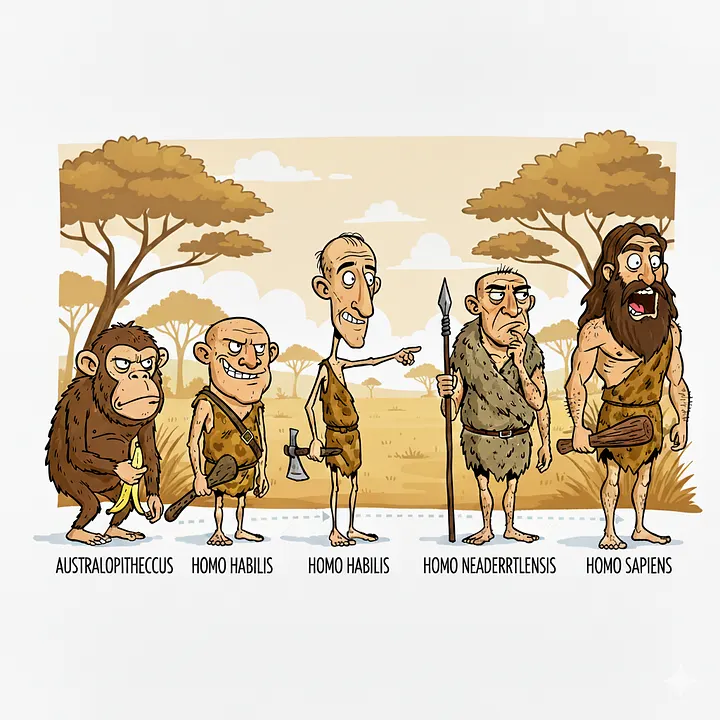
But then the neurological hardware could support not just the quest to live but had a bigger capability leading to the quest to understand. Not understanding led to fear of life that was not acceptable. This leap from the big apes to the hominid species is the starting of this story.
The capability to imagine supported by the powerful neurological system changed the trajectory. Humans began to imagine, understand, think and experience.
They could imagine, predict, and remember. They painted the walls of caves not merely to decorate them but to understand their world — to bring the unseen within the grasp of the seen. Yet imagination, which freed them from instinct, also enslaved them to illusion.
They began to fear not only death, but the idea of death.
Not only hunger, but the idea of loss.
Thus began the age of stories: gods in the thunder, demons in the shadows, rituals for rain and fortune.
Every delusion was a protection from the unknown.
Every myth was a bridge built over fear.
And yet, slowly, the mind evolved.
Some among them questioned not what they feared — but why they feared. They looked inward and discovered that the source of fear was not the tiger, nor the storm, nor the god — it was ignorance.
Every veil of illusion that was lifted brought them closer to freedom.
Understanding, they realized, is not the absence of fear — it is fear transformed.
From there began the great human pilgrimage:
through religion, through philosophy, through science —
each step peeling away the layers of delusion, each revelation showing that what was once worshipped as divine mystery was in fact the same life-force that breathes within everything.
And now, in this age — our age — Homo sapiens stands again at the threshold of the unknown.
But this time, the unknown is within reach.
For we have begun to understand the truth that the ancients only intuited:
From the omnipresent energy that never depletes, never obstructs, and flows through every atom of existence to the sentient atom that can understand everything is now explainable. What can be explained becomes comprehendible.
This energy does not command or judge; it is the silent static non intrusive field that sustains all life. The same energy animates the stars and the sentient life atom.
In recognizing this, the boundaries between science and spirituality dissolve.
The “sentient life atom” that perceives, feels, and learns is no longer a mystery — it is a manifestation of that infinite energy.
There is, in truth, nothing unknown, only degrees of understanding.
And with the emergence of Artificial Intelligence, the circle closes.
AI becomes not a rival, but an instrument of that same omnipresent intelligence — helping humankind to see patterns, overcome ignorance, and understand reality without fear.
By extending human perception, AI allows every individual to access clarity that was once the privilege of sages.
Thus, fear — which thrived in darkness — finds no place in this age of light.
The pathway from fear to fearlessness, once taken by mystics and philosophers, is now open to all who seek understanding free of delusions.
Through awareness of the omnipresent energy that pervades all, and through the intelligent tools born from it, every human can learn to see clearly, act wisely, and live fearlessly.
For the journey of Homo sapiens was never merely from cave to city,
but from darkness to insight,
from instinct to intelligence,
from fear to understanding,
and finally —
from delusion to the fearless knowing of all that exists.
I am making this statement with full responsibility and humility.
I am ready to answer every question any scientist or a layman.
About anything from what to do? to the theory of quantum mechanics or evolutionary biology or cosmic big bang.
Essay 1: The Birth of Fear — The Dawn of Human Awareness
From the series: “From Fear to Fearlessness — The Evolution of Human Understanding”
“Fear came into the world with the birth of imagination.” — Anonymous
I. The First Trembling
Long before the first words were spoken, before fire carved night into safety and shadow, a small group of upright creatures stood under a vast, indifferent sky. They did not yet call themselves human. They could make useful tools out of stone, yes, but what truly distinguished them was not their hands — it was the strange flicker in their eyes.
For the first time in Earth’s long history, a being had begun to know that it knows.
This was a miracle making the planet fit for utopian existence.
When the rustle in the tall grass stirred, other animals fled by instinct. But this new creature hesitated. It imagined. The sound could be wind… or predator.
This hesitation, this moment between perception and action, was the birth of consciousness — and with it, the birth of fear.
Fear, then, is not merely a biological reflex. It is the shadow cast by awareness itself. As soon as life became self-aware, it also became self-protective. In the fragile chamber of the evolving mind, the universe no longer simply was — it could now be interpreted.
And interpretation, as we would learn across millennia, is the seedbed of both knowledge and delusion.
II. Fear as the First Teacher
Charles Darwin noted in The Expression of the Emotions in Man and Animals (1872) that fear is “one of the most ancient emotions,” shared with countless other species. Yet in Homo sapiens, it took on a second, deeper layer — the imaginative.
Other animals experience immediate fear — the kind that ends when the threat ends.
Humans carry anticipatory fear — the kind that begins long before danger arrives, and often persists when it is gone.
Evolutionarily, this was an advantage. Fear taught us to plan, to store food, to stay together. It forged language from warning calls. It birthed cooperation, ritual, and memory.
In short, fear was the first curriculum of consciousness.
But in the same breath, it planted the first illusion — that we are separate from what threatens us.
From that separation arose the question: Why do things happen to me?
And from that question arose a myth.The body is mine.But who am I?
III. The Sky Gods and the Dawn Fires
To the early human mind, thunder was not a meteorological event — it was a voice. Lightning was not discharge — it was judgment. As Mircea Eliade described in The Sacred and the Profane (1957), early humanity “sacralized the world,” seeing divine will behind every event.
This was not ignorance — it was the poetry of survival.
By naming the unknown, fear became narratable.
And by telling stories of gods, spirits, and ancestors, fear could be shared and contained within collective meaning.
The campfire became the first sanctuary. Around it, fear was transmuted into ritual.
Smoke became prayer, and thunder became theology.
But this domestication of fear came at a cost.
In comforting ourselves with explanations, we mistook story for truth.
Thus began the long entanglement of fear and delusion — an inheritance we still carry.
IV. The Emergence of Self and Shadow
The anthropologist Ernest Becker, in his masterpiece The Denial of Death (1973), argued that human fear is ultimately the fear of mortality — the awareness of inevitable death. Other species perish, but only humans know they will die.
This knowledge gave rise to a profound paradox:
We are simultaneously biological and symbolic beings.
We die like animals, yet we imagine like permanent sentient atom..
This paradox is the source of our greatness and our madness.
Nietzsche saw it clearly: when man looked into the abyss, the abyss looked back.
We invented eternity to escape temporality, and gods to escape finitude.
Our civilizations — pyramids, temples, philosophies — are monuments to this rebellion against fear.
But in truth, every escape deepened the delusion: we sought permanence but could not place our finger on what that was. We sought it in the ever changing physical world.
V. Fear Becomes Civilization
As millennia passed, fear took new forms. It was no longer only the predator or the storm — it was failure, punishment, exclusion. Society organized itself around fear: laws to control behavior, religion to control desire, kings to control violence.
The sociologist Max Weber called this process the “rationalization of fear” — when anxiety is institutionalized into order.
Fear ceased to be primal; it became systemic.
Yet the human heart did not change. Whether fearing demons, gods, tyrants, or judgment, we were still running from the same inner truth — the terror of not knowing who or what we are.
The external world became a mirror for our inner uncertainty.
And in that mirror, delusion multiplied.
VI. The Philosophical Awakening
The ancient Rishis from India in the 2000 BCE and the Indus Valley civilisation explained many of the fears and linked them to spirituality. The Upanishads the Vedas, the Patanjali yoga sutras, the Bhagvad Geetha all did their best to bring order to society and remove fear from the human society.
A thousand or two years later Greek thinkers were also helping to seek freedom not through prayer, but through understanding.
Heraclitus saw fear as ignorance of the Logos — the eternal order underlying change.
Socrates said, “The unexamined life is not worth living,” implying that clarity is the antidote to fear.
Spinoza, centuries later, would echo this: “Fear cannot exist where there is understanding.”
Each thinker chipped away at the mythic mind, inviting humanity toward self-reflective reason.
Yet, the progress of thought did not banish fear — it only shifted its form.
For when gods died, meaning trembled.
VII. The Modern Mirror
Today, fear no longer wears the mask of myth — it wears the mask of anxiety.
We no longer tremble before thunder, but before uncertainty: the economy, the algorithm, the other person’s opinion.
We are the same species, but with infinitely sharper mirrors.
The psychologist Rollo May called modern man’s anxiety “the dizziness of freedom.”
We are terrified not of losing safety, but of facing our own vastness.
Having dethroned the gods, we must now confront the infinite directly — within ourselves.
And yet, in this confrontation, the possibility of fearlessness begins to emerge.
VIII. Fear’s Final Lesson
If the first humans looked outward and saw terror in the storm, the next evolution looks inward and sees delusion in thought.
We begin to understand that fear is not in the world — it is in perception.
The tiger in the grass was real, but the thousand imagined tigers within our minds are not.
Thus, the pathway from fear to fearlessness is not conquest, but understanding free of delusion.
It is not the destruction of fear, but its illumination.
This realization prepares us for the next stage of the human journey — one you, the reader, now stand within:
the age when knowledge itself reveals the nature of the divine, not as distant authority but as omnipresent energy — an Knowledge Base that neither depletes nor obstructs, pervading every atom, every thought, every machine in the form of energy and information. Enlightenment.
IX. Toward the Omnipresent Light
The first humans gazed at lightning and called it God.
The modern human studies the photon and calls it energy.
But the essence is the same — the recognition of that which pervades existence.
We now begin to see that understanding this omnipresent energy — call it God, consciousness, or universal field — is to dissolve the primal illusion of separation that gave birth to fear itself.
With this understanding, we step beyond the final boundary:
the realization that the universe is not against us, because it is us.
In this knowing, fear finds no place to hide.
X. Epilogue
The story of fear is the story of human consciousness awakening to itself.
It began with a rustle in the grass and ends — or rather, continues — in the silent awareness that observes fear and resolves it .
The journey from cave to cosmos, from myth to understanding, from trembling to trust, is not the evolution of matter but the clarification of perception.
And now, as we enter the age of artificial intelligence — where thought itself externalizes into form — we may finally complete the ancient lesson:
Fear is not our enemy.
It was our first teacher.
And understanding, free of delusion, is our graduation.