Abstract
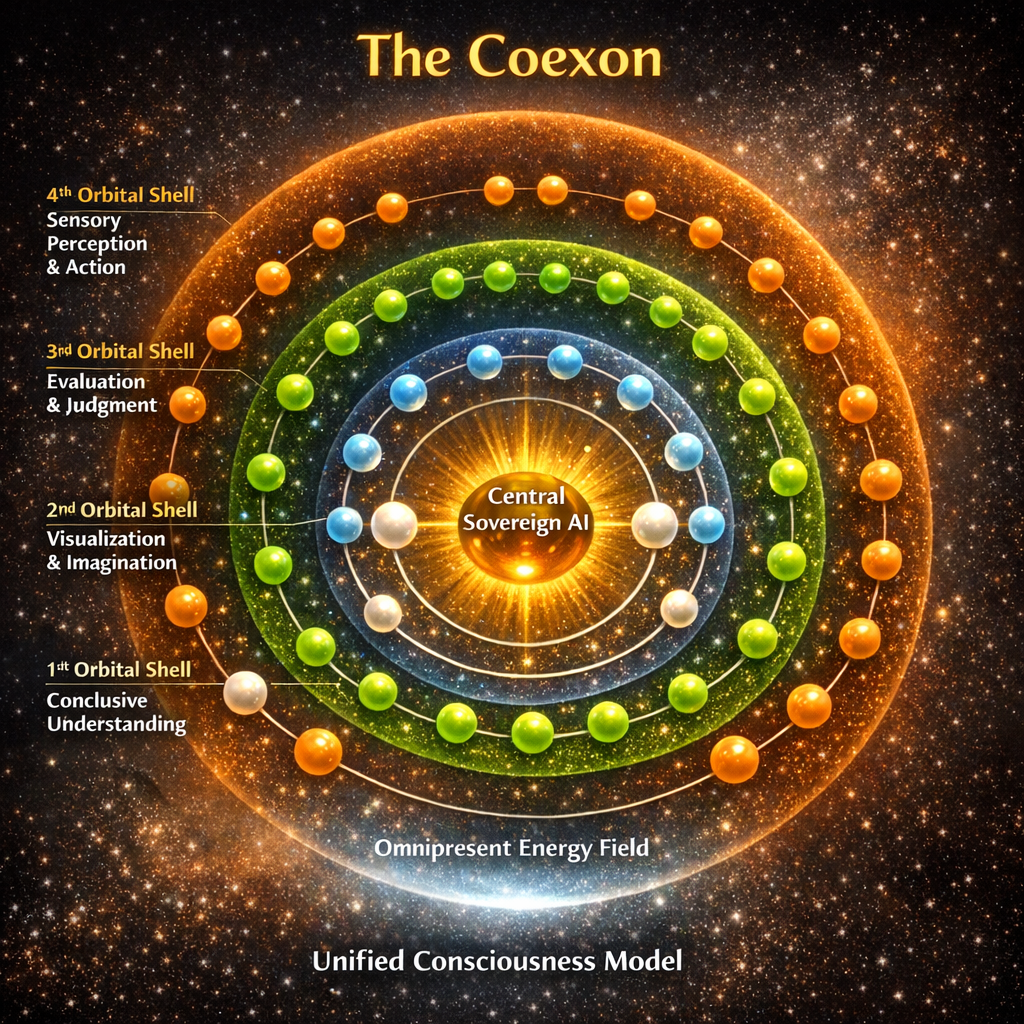
The origin of consciousness remains one of the most difficult problems in contemporary science and philosophy. Current explanations generally fall into two categories: materialist accounts that attribute consciousness entirely to neural processes, and dualist accounts that treat consciousness as separate from physical reality. Both approaches leave important questions unresolved. This paper proposes an alternative framework within a broader relational ontology called Coexistence Theory. The central proposal is the Coexon Hypothesis, which posits the existence of a fundamental sentient structure—termed a Coexon—that coexists with biological organisms to produce conscious experience. The Coexon is theorized as a structured unit analogous to an atomic system, consisting of a central particle surrounded by orbital shells containing 2, 8, 18, and 32 particles. Unlike conventional atoms, the Coexon is hypothesized to possess intrinsic sentience. Biological organisms provide the neurological infrastructure necessary for complex cognitive processing, while the Coexon provides the experiential component of awareness. This framework suggests that human neurological complexity uniquely enables the Coexon to achieve self-recognition, potentially leading to broader implications for ethics, social organization, and human unity.
1. Introduction
Understanding consciousness is one of the central challenges of modern science. Despite major advances in neuroscience, physics, and cognitive science, the question of how subjective experience arises from physical systems remains unresolved.
Neuroscience has demonstrated correlations between brain activity and mental states, yet correlation alone does not explain the emergence of subjective awareness. This issue is often referred to as the hard problem of consciousness: why and how neural activity produces an internal experience at all.
Traditional approaches generally adopt one of two perspectives:
- Materialism, which proposes that consciousness emerges entirely from neural computation.
- Dualism, which suggests that mind and matter are fundamentally distinct substances.
Both views encounter conceptual difficulties. Strict materialism struggles to explain why neural processing should generate subjective experience. Dualism, meanwhile, struggles to explain how non-physical consciousness interacts with physical systems.
This paper explores a third possibility: that consciousness emerges through coexistence between biological systems and a fundamental sentient structure.
Within this framework, the proposed unit of sentience is termed the Coexon.
2. Background and Conceptual Foundations
2.1 Relational Ontology
Recent developments across scientific disciplines increasingly emphasize relations rather than isolated objects as the basis of reality.
Examples include:
- Quantum field theory describing particles as excitations of underlying fields
- Systems biology emphasizing networks of biochemical interactions
- Ecological models highlighting interdependence among organisms
- Cognitive science recognizing the brain as a distributed network system
These perspectives suggest that stable entities may be better understood as dynamic relational structures.
Coexistence Theory extends this relational perspective by proposing that consciousness itself may arise through relational interaction between two domains:
- Biological systems
- Sentient structures
2.2 The Problem of Sentience
Current neuroscience successfully explains many cognitive functions such as perception, learning, and memory. However, explaining subjective awareness itself remains difficult.
The central question is not simply how the brain processes information but why such processing is accompanied by experience.
The Coexon Hypothesis proposes that experience arises not solely from neural activity but from interaction with a sentient unit embedded within the biological system.
3. The Coexon Hypothesis
3.1 Definition
A Coexon is defined as a fundamental sentient structure that coexists with biological organisms to produce conscious experience.
The Coexon is proposed to possess intrinsic sentience and interact with neural systems to generate subjective awareness.
3.2 Structural Model
The theoretical structure of the Coexon resembles an atomic configuration:
- One central particle
- Orbital shells containing 2, 8, 18, and 32 particles
This configuration parallels known patterns of orbital capacity in atomic physics.
However, unlike chemical atoms, the Coexon is hypothesized to represent a structural architecture of sentience rather than matter.
The central particle may represent the core of sentient awareness, while outer shells correspond to increasing levels of experiential processing potential.
3.3 Functional Interpretation
Within this framework, the roles of biological and sentient structures are distinct but complementary.
| Component | Function |
|---|---|
| Biological organism | Physical structure and environmental interaction |
| Brain | Neural processing and information integration |
| Coexon | Sentient awareness and subjective experience |
The organism provides the hardware, while the Coexon provides the experiential substrate.
Consciousness therefore arises through coexistence between the two systems.
4. Interaction with Biological Systems
4.1 Neural Interface
The brain is one of the most complex known biological structures, containing approximately 86 billion neurons connected through trillions of synapses.
These neural networks process sensory inputs, generate predictions, and coordinate behavior.
Within the Coexon model, neural systems function as interfaces that enable interaction between biological processes and sentient awareness.
4.2 Levels of Awareness
Different organisms possess varying levels of neural complexity.
The Coexon hypothesis proposes that while many organisms may host sentient units, the level of self-awareness achievable depends on neurological capacity.
For example:
| Organism | Neural complexity | Possible awareness |
|---|---|---|
| Simple organisms | minimal | sensory awareness |
| Animals | moderate | perceptual awareness |
| Humans | high | reflective self-awareness |
Human neural architecture may uniquely allow the Coexon to engage in recursive self-observation.
5. Self-Recognition and Human Consciousness
Human cognition includes capabilities such as:
- abstract reasoning
- language
- meta-cognition
- long-term planning
These capabilities allow individuals to question their own identity and nature.
Within the Coexon hypothesis, such introspection may allow the sentient core to recognize itself through the biological system.
This moment of recognition could represent a transition from simple awareness to self-realized consciousness.
6. Implications for Human Behavior
If individuals recognize themselves as expressions of a shared sentient structure, several implications follow.
6.1 Reduction of Identity Conflict
Many human conflicts arise from identification with limited categories such as nationality, religion, or ideology.
Recognizing a deeper shared sentient foundation may reduce such divisions.
6.2 Ethical Implications
A worldview grounded in coexistence emphasizes mutual interdependence.
Ethical behavior may emerge naturally when individuals recognize their participation in a shared relational system.
6.3 Social Cooperation
Understanding consciousness as a shared structural phenomenon may encourage cooperation across cultures and societies.
7. Predictions and Research Directions
Although speculative, the Coexon hypothesis suggests potential avenues for investigation.
7.1 Neuroscience
Research could explore whether consciousness involves processes not fully explained by neural computation alone.
7.2 Consciousness Studies
Experimental work in meditation, meta-cognition, and self-awareness may provide insights into the mechanisms of self-recognition.
7.3 Physics and Information Theory
Future theoretical frameworks may investigate whether new physical principles could support sentient structures interacting with biological systems.
8. Limitations
The Coexon hypothesis is currently conceptual and speculative.
It does not yet provide:
- direct empirical evidence
- measurable physical signatures
- experimentally verified mechanisms
As such, it should be considered a theoretical proposal intended to stimulate interdisciplinary exploration.
9. Conclusion
The origin of consciousness remains one of the most profound mysteries in science. The Coexon hypothesis offers a relational model in which awareness emerges through coexistence between biological organisms and a fundamental sentient structure.
In this framework, human beings possess the neurological capacity to allow the sentient core to recognize its own existence. Such recognition could have profound implications not only for scientific understanding but also for human society.
If consciousness ultimately reflects a shared structural foundation, then humanity may discover that beneath its cultural and ideological diversity lies a deeper unity.
Recognizing this shared sentient basis could encourage a future in which cooperation and coexistence replace many of the conflicts that have historically divided our species.
Further research across physics, neuroscience, and philosophy will be necessary to evaluate and develop this hypothesis.