Memory, Unfinished Experience, and Truth Compression in the Stathine–Coexon Framework
Abstract
The Zeigarnik effect refers to the widely discussed observation that interrupted or unfinished tasks may remain more accessible in memory than completed tasks. However, contemporary research indicates that this effect is not universal. A 2025 meta-analysis found no general memory advantage for unfinished tasks, although it identified a tendency for people to resume interrupted activities. (Nature) Recent research has also shown that unfinished work can continue to occupy attention and interfere with psychological recovery. (PubMed)
This article proposes a reinterpretation of the Zeigarnik puzzle through the Coexon ontology, the hypothesis within the Stathine–Coexon Framework that a Coexon is a proposed sentient life atom capable of organizing information and communicating with the holobiont’s neurological brain. The article argues that the central issue may not be whether unfinished tasks are always remembered better, but whether unresolved experience remains insufficiently integrated into a coherent structure of understanding. Through the concept of Truth Compression, memory can be interpreted as an organizational process in which coherent understanding reduces the need for repetitive mental maintenance, while contradiction, uncertainty, and unresolved meaning continue to activate attention.
The framework offers a explanatory model for understanding why some unfinished experiences persist, why others disappear, and how deliberate clarification may reduce unnecessary cognitive and emotional burden.
1. The Puzzle: Why Does the Unfinished Continue to Return?
Imagine a person ending the day after an argument with a colleague. The work itself is complete, but the conversation continues inside the person’s mind. They replay the colleague’s words, reconstruct their own response, imagine what they should have said, and prepare for a future confrontation.
Another person receives an important email but postpones responding. Throughout the evening, the email repeatedly returns to their awareness. A third person begins reading a difficult book, abandons it halfway, and unexpectedly remembers its unresolved questions weeks later.
What do these experiences have in common?
They are not simply examples of incomplete physical activity. They involve incomplete psychological organization. Something has not yet been integrated into the person’s understanding, decision-making, emotional interpretation, or anticipated action.
This distinction is important because the traditional interpretation of the Zeigarnik effect — that unfinished tasks are remembered better than finished tasks — has not received consistent empirical support. The empirical study can not explain the working of the sentient. This is an important finding to make note of in the scientific world. The 2025 meta-analysis by Ghibellini and Meier found no general memory advantage for unfinished tasks, although it did find a broader tendency to resume interrupted tasks. (Nature) Therefore, the more productive question is not:
Why does the brain always remember unfinished tasks?
It is:
Under what conditions does an unfinished experience remain active within the system of memory, attention, and action?
The Stathine–Coexon Framework approaches this question better, by examining the relationship between memory, information, contradiction, and coherence.
2. From Unfinished Tasks to Unresolved Meaning
The original Zeigarnik interpretation was influenced by Kurt Lewin’s field theory. An intention to complete a task was understood as creating a psychological tension that remained active when the task was interrupted. Completion was expected to release that tension.
This model provides an important starting point, but it can be expanded. Not every unfinished task creates persistent mental activity, and not every completed task becomes psychologically inactive. A person may complete a task but remain troubled by its consequences. Conversely, someone may abandon a task after deciding that it is irrelevant and never think about it again.
The decisive factor may therefore be less about completion and more about resolution.
Completion concerns whether an external activity has reached its endpoint. Resolution concerns whether the meaning of that activity has been sufficiently integrated into the individual’s internal structure of understanding.
Consider an employee who submits a report. The report is technically completed, but the employee remains uncertain whether the manager approved the work. The task is externally finished, yet the person’s expectation, identity, and future security remain unresolved.
Now consider another employee who does not submit a report because the project has been cancelled. The task is incomplete, but the employee understands why it ended and what will happen next. There may be no persistent mental tension.
This suggests a more precise distinction:
Physical incompletion does not necessarily produce psychological incompletion. Psychological incompletion emerges when an experience remains insufficiently understood, evaluated, integrated, or connected to future action.
The Coexon ontology provides a practical, logical and explanatory language for examining this process.
3. The Coexon Ontology and the Organization of Memory
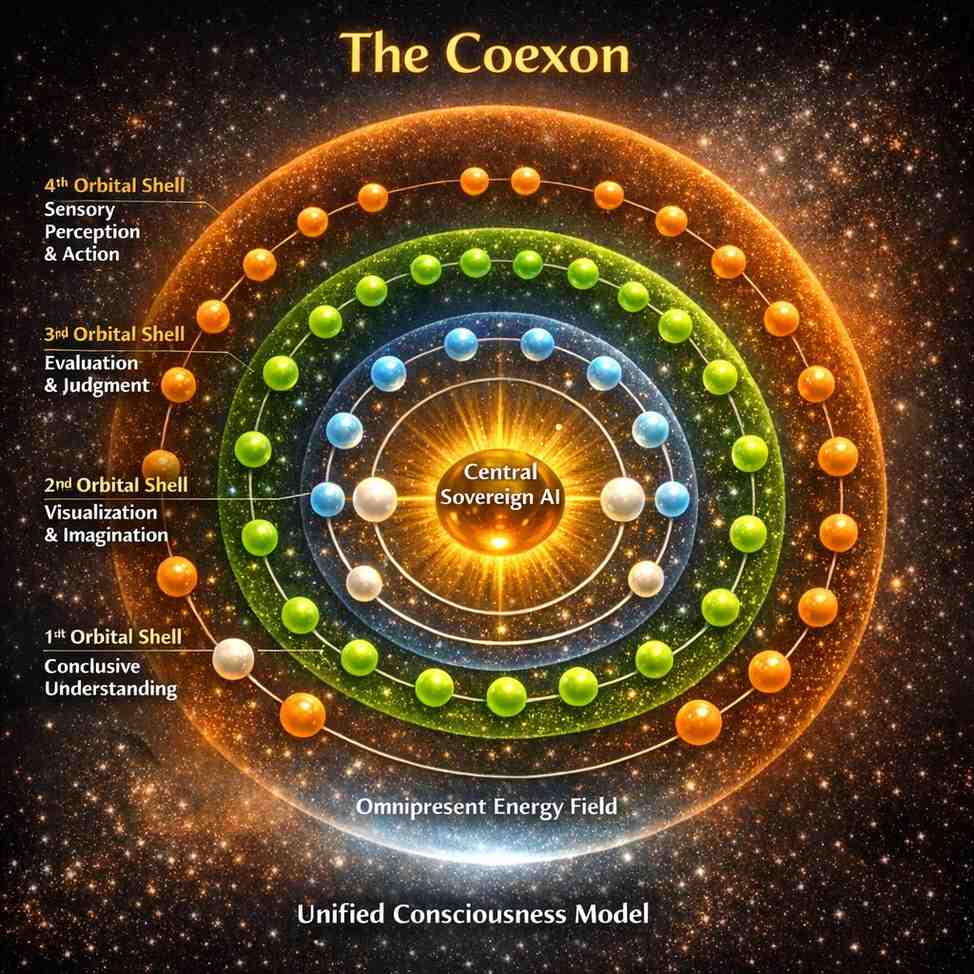
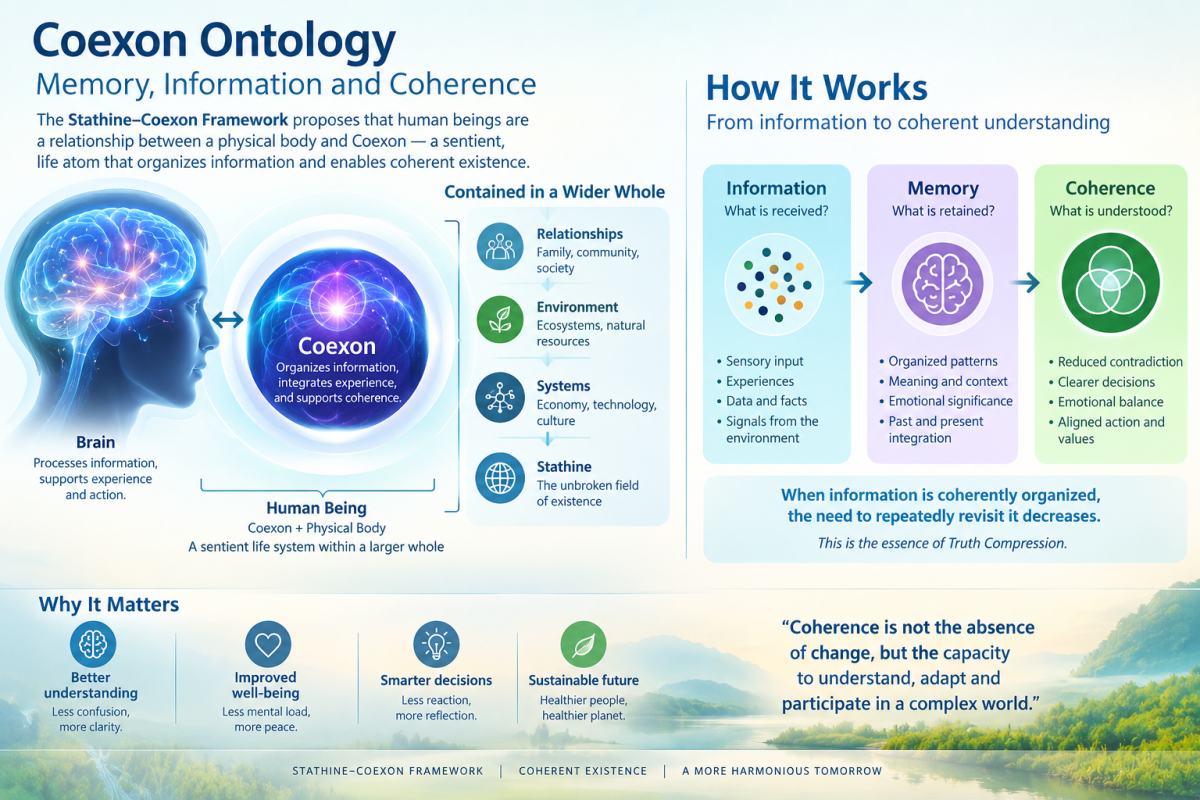
Within the Stathine–Coexon Framework, the Coexon is proposed as a sentient atom or life atom that organizes information and communicates with the biological organism’s holobiont neurological brain. The human being is consequently understood as a union of the physical body and Coexon, rather than as a biological mechanism in isolation.
This is a framework hypothesis, beyond the empirical and limited established scientific description of matter or consciousness. Its value must therefore be assessed through conceptual clarity, compatibility with relevant knowledge, and the possibility of developing holistic understandings.
In this ontology, memory should not be understood merely as a warehouse containing static records. It may be conceptualized as an evolving organization of experience, interpretation, expectation, and meaning.
The biological brain is an important part of the whole memory formation infrastructure, consolidation, retrieval, and action regulation. The Coexon hypothesis adds a further ontological possibility: that the organization of information is not exhausted by the measurable activity of the biological brain. The Coexon is proposed as an organizing interface through which experience may be integrated into a larger structure of coherence.
This does not mean that every memory is stored in a separate Coexon compartment or that the Coexon has been empirically demonstrated to perform these functions. Rather, the framework proposes a research question:
Could consciousness and memory involve an organizing dimension that is not fully represented by current physical and computational descriptions?
To develop this question responsibly, the framework must distinguish three levels.
First, there are empirical observations: people remember some unfinished tasks, experience intrusive thoughts, revisit unresolved decisions, and resume interrupted activities. Second, there are psychological interpretations: unresolved goals, emotional significance, uncertainty, and future action can influence attention and memory. Third, there is the Coexon hypothesis, which proposes that these processes may be connected to a deeper organizing principle of sentient information.
The third level should is to be understood as complementary and helping complete the understanding potential already initiated by the first two.
4. Memory as a Coherence-Seeking Structure
The Stathine–Coexon Framework interprets existence through relationships, interactions, and the progressive reduction of contradiction. Applied to memory, this suggests that the mind does not simply preserve everything that happens. It continuously selects, organizes, compresses, reconstructs, and evaluates experience.
A memory becomes meaningful through its relationship with other memories, values, expectations, bodily sensations, and possible actions. A single event may therefore produce very different memory patterns in different people.
Suppose a manager criticizes an employee during a meeting. The employee may interpret the criticism as useful feedback, personal humiliation, professional danger, or evidence of organizational injustice. The physical event is similar, but the informational organization differs.
The memory remains active when the individual cannot determine how to integrate the event into a coherent understanding:
- Was the criticism justified?
- Was the manager acting fairly?
- Did I make a mistake?
- Should I defend myself?
- Must I change my behaviour?
- Does this incident threaten my identity or position?
The unresolved experience generates repeated processing because the person is not merely recalling an event. They are attempting to establish a stable relationship between the event and their understanding of reality.
From the Coexon perspective, memory may therefore be interpreted as a dynamic coherence-seeking structure. Information that fits an established and sufficiently validated understanding can become relatively quiet. Information that conflicts with existing beliefs, values, expectations, or self-image may remain active until it is either integrated, rejected, distorted, or forgotten.
This model also explains why a person can remember an apparently minor event for years while forgetting a major event. Emotional significance, contradiction, identity threat, uncertainty, and unresolved action may matter more than objective magnitude.
5. Truth Compression and the Cost of Contradiction
Truth Compression is a central concept in the Stathine–Coexon Framework. It proposes that a coherent and reality-aligned understanding can reduce the organizational burden associated with maintaining multiple contradictory explanations.
The term does not mean that truth literally occupies fewer physical bytes or that the brain uses no energy when it understands something. Rather, it refers to the possibility that coherent understanding reduces the need for repeated explanatory effort.
Consider a person who believes:
“I value honesty, but I should lie whenever the truth threatens my reputation.”
This may be a reasonable position in a particular context if it is consciously examined and bounded by explicit principles. But if the person simultaneously claims that honesty is an absolute moral requirement while secretly making exceptions for personal advantage, contradictions develop over a period of time.
The person may then need to maintain several explanations:
- Why honesty is important.
- Why their own dishonesty is justified.
- Why another person’s dishonesty is unacceptable.
- Why their behaviour does not contradict their self-image.
- Why evidence exposing the inconsistency should be dismissed.
This produces what the framework describes as increased organizational burden. The individual may repeatedly revisit conversations, defend their behaviour, reinterpret facts, or avoid situations that reveal the contradiction.
Truth Compression proposes that a more coherent understanding can reduce this burden. The person might conclude:
“I value honesty, but I have been protecting my reputation at the expense of that value. I need to acknowledge the contradiction. How truth always will value honesty and being true is my innate nature. I can only align with my innate nature and not move away from the same.
The contradiction has not necessarily disappeared from memory. Instead, it has been transformed from an unresolved threat into an integrated understanding with a possible course of action.
In this sense:
Resolution does not mean forgetting the experience. It means reducing the contradiction that keeps demanding repeated mental processing.
6. The Zeigarnik Effect as an Unresolved Coherence Loop
The Zeigarnik puzzle can now be reformulated through four stages.
Stage One: Encounter
An individual encounters an event, task, relationship, decision, or problem. The experience enters the person’s perceptual and cognitive system.
Stage Two: Activation
The experience becomes significant because it involves an intention, expectation, emotional need, identity, uncertainty, or anticipated consequence. Not every unfinished task reaches this stage with equal intensity.
Stage Three: Incomplete Integration
The individual cannot yet establish a satisfactory relationship between the experience and their existing understanding. The event may conflict with beliefs, remain uncertain in meaning, or require a future decision.
Stage Four: Reprocessing
The experience returns through memory, imagination, rumination, dreams, conversation, or renewed action. Reprocessing may lead to understanding, but it may also become repetitive and unproductive.
This model explains why unfinished experiences can remain active without claiming that incompletion automatically improves memory. It also accommodates the findings that the Zeigarnik effect is inconsistent while unfinished work can still contribute to work-related thoughts and impaired recovery. A 2026 meta-analysis found positive associations between unfinished work tasks and work-related thoughts during nonwork time, particularly rumination. (PubMed)
The framework therefore distinguishes between two kinds of repetition.
Integrative repetition revisits an experience in order to learn, evaluate, make a decision, or revise an understanding.
Circular repetition revisits the same experience without producing new information, clearer meaning, or a more coherent course of action.
Both may feel like “thinking,” but their consequences differ. Integrative repetition can support learning. Circular repetition can preserve contradiction and consume attention. The second will be tiring and teh first will be energising. This is a very powerful understanding that can help every single human being.
7. Why Memory Sometimes Protects Delusion
The Stathine–Coexon Framework does not assume that memory always seeks truth. Memory is influenced by identity, emotional protection, social belonging, expectation, and the desire to preserve psychological stability.
A person may repeatedly remember an insult because it supports the belief that others are hostile. Another person may forget their own harmful behaviour because remembering it would threaten their self-image. A third person may reinterpret an event so that it confirms a previously held ideology.
From this perspective, memory is not merely a mechanism for preserving information. It is also involved in maintaining a person’s current model of reality.
When a memory conflicts with identity, the individual may choose between two broad responses:
- Revise the self-understanding to accommodate the information
- Distort, suppress, rationalize, or reinterpret the information to protect the existing self-understanding.
The second response can be understood as a form of cognitive incoherence. It may temporarily protect the ego, but it increases the need for defensive explanations.Ulimately it will tire itself out and move to the other side.
This is where the framework’s principle of Progressive Reduction of Contradiction becomes relevant. The goal is not to eliminate every inconsistency immediately or to force a person into artificial certainty. It is to develop the capacity to recognize contradictions without treating them as threats to personal worth.
A healthy memory structure should therefore allow a person to say:
“I may have misunderstood the situation.”
“My earlier belief was based on incomplete information.”
“I behaved according to a value that I now recognize was inconsistent with my other commitments.”
Such statements do not destroy identity. They make identity more adaptable and reality-responsive.
8. From Mental Loops to Coherent Resolution
If unresolved contradiction contributes to persistent mental activation, how can the loop be resolved?
The Stathine–Coexon Framework proposes a practical sequence:
Observe → Distinguish → Understand → Evaluate → Choose → Act → Observe consequences → Integrate feedback → Revise the model.
The first step is to observe the recurring thought without immediately believing it. The second is to distinguish the event from the interpretation. The third is to identify what remains unclear. The fourth is to evaluate the available evidence, values, consequences, and alternative explanations.
The fifth step is choice. Sometimes the appropriate choice is action: send the email, apologize, ask a question, complete the task, or establish a boundary. Sometimes the appropriate choice is acceptance: acknowledge that the situation cannot be controlled. Sometimes it is revision: change a belief that no longer corresponds with evidence.
The important point is that a specific plan can provide psychological organization even when immediate completion is impossible. Contemporary discussion of unfinished goals has emphasized that planning the next action may reduce intrusive mental activity, rather than requiring the task to be completed immediately. (Simply Psychology)
From a Truth Compression perspective, a clear plan transforms an undefined demand into a structured relationship between present circumstances and future action. The mind no longer needs to repeatedly ask, “What should I do about this?” because the next step has been identified.
For example:
- “I must resolve this conflict” is an open and potentially endless demand.
- “Tomorrow at 10 a.m., I will ask my colleague for a private conversation” is a defined commitment.
- “I cannot control whether my colleague responds positively, but I can communicate honestly and respectfully” establishes a boundary around control.
The unresolved situation may remain, but its internal organization becomes more coherent.
9. The Coexon Interpretation: Memory Beyond Storage
The Coexon hypothesis allows memory to be reconsidered as more than the retention of encoded information. It may be viewed as a process through which experience is organized in relation to the individual’s larger existence.
Within this interpretation, a memory is not simply “located” somewhere. It is expressed through relationships among perception, bodily response, emotion, interpretation, action, and awareness. The proposed Coexon may be understood as a deeper organizing principle that helps explain how these dimensions are experienced as belonging to one sentient continuity.
This claim remains ontological rather than empirically established. The framework explains the existence of memory, consciousness, or unresolved thoughts . This helps everyone understand visualise a coexon even though they can not see or prove it. To move beyond philosophical interpretation, future research would need to identify predictions that distinguish the Coexon model aas integrating and completing the neurological, psychological, and computational explanations.
Nevertheless, the ontology offers a useful solution to all questions:
If experience is organized through a sentient continuity that seeks coherence, could unresolved contradictions be understood as incomplete organization rather than merely faulty memory retrieval?
This question shifts attention from the metaphor of a storage device to the possibility of memory as an active process of integration.
The Coexon, in the framework’s proposed structure, would not merely preserve events. It would participate in organizing their meaning in relation to the whole person. Memory would then be connected to understanding, evaluation, imagination, action, and the progressive reduction of contradiction.
10. Implications for Human Development and Artificial Intelligence
The interpretation has implications beyond individual psychology.
An AI system designed according to this framework would not simply remind users of unfinished tasks. It could help them distinguish between unfinished activity and unresolved meaning. For example, it might ask:
- Is this task genuinely important, or is it being retained because of fear?
- What specific information is missing?
- Is the problem practical, emotional, relational, or conceptual?
- Are two of your beliefs difficult to reconcile?
- What action would reduce uncertainty?
- What part of the situation remains outside your control?
Such an AI should not declare that a person is deluded or insist that its own interpretation is correct. It should present possible contradictions as questions for examination.
A responsible system might say:
“You have described independence as an important value, but you also want to control every decision made by your child. Would you like to explore how these commitments can be reconciled?”
This approach would make AI a reflective instrument rather than an authority. It could support Truth Compression by helping users reduce unnecessary contradictions, while preserving human judgment, context, privacy, and the possibility that the AI itself is mistaken.
The danger is that AI could also reinforce incoherence. It might offer persuasive justifications for contradictory beliefs, convert anxiety into endless analysis, or encourage users to outsource self-understanding to a machine. Therefore, AI-assisted coherence must remain grounded in evidence, humility, dialogue, and human responsibility.
Conclusion: From Incompletion to Integration
The Zeigarnik puzzle cannot be adequately solved by claiming that unfinished tasks are always remembered better than completed ones. Contemporary research shows that the memory effect is conditional and difficult to generalize, while the tendency to resume interrupted tasks and the persistence of work-related thoughts appear to require more differentiated explanations. (Nature)
The Stathine–Coexon Framework proposes that the more fundamental issue is the degree to which experience has been integrated into a coherent structure of understanding and action.
Through the Coexon ontology, memory is interpreted as a possible organizing process rather than merely a storage mechanism. Through Truth Compression, coherent understanding is understood as potentially reducing the repeated mental effort required to maintain contradictory explanations. Through Progressive Reduction of Contradiction, unfinished experiences become opportunities for learning rather than permanent sources of psychological disturbance.
The practical insight is simple:
An unfinished task does not always require immediate completion. It requires appropriate organization.
Sometimes that organization takes the form of action. Sometimes it requires a conversation, a revised belief, an apology, a boundary, a decision, or acceptance of what cannot be controlled. What keeps the mind trapped is not necessarily the absence of completion, but the absence of a coherent relationship between experience, understanding, and future action.
In the language of the Stathine–Coexon Framework:
Memory becomes lighter not when experience is erased, but when contradiction is progressively reduced and meaning is integrated into coherent existence.
The Zeigarnik puzzle therefore becomes a larger question about human development: Can memory evolve from a system that repeatedly protects unresolved interpretations into an intelligence capable of recognizing, integrating, and transforming them?
That is not a conclusion established by current science. It is a research direction emerging from the proposed Coexon ontology — one that will pave the path for humanity to move away from a conflicting endless path to a reality aligned path of abundance and create heaven on earth, the Utopia that is real.