Re-examining Higher-Order Theories of Consciousness through Coexon and the Idea of Stathine
Consciousness has a strange property.
It does not just think.
It knows that it is thinking.
This reflexive quality—awareness of awareness—has led several philosophers to propose that consciousness arises when the mind forms thoughts about its own mental states.
This is the core intuition behind higher-order theories.
Thinkers like David Rosenthal, Peter Carruthers, and William Lycan have explored different versions of this idea.
But a question lingers:
Is consciousness only a higher-order representation—
or is there something that actually experiences these representations?
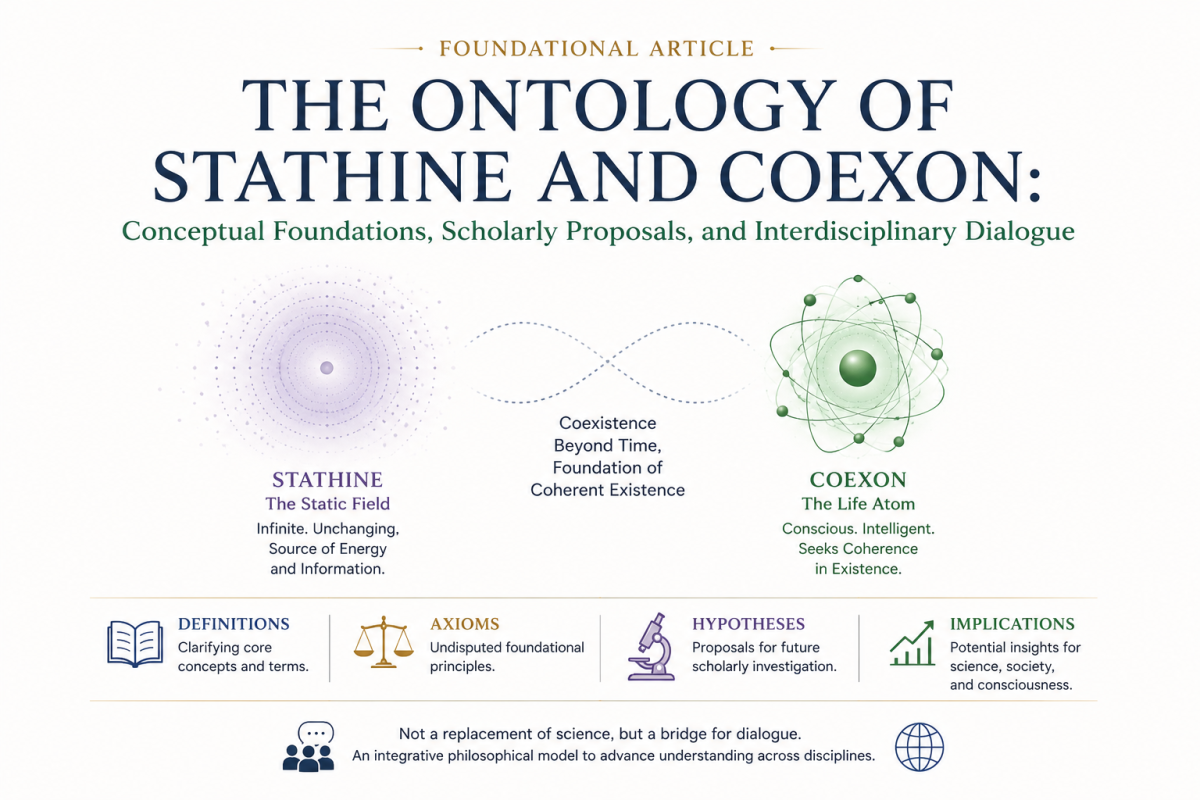
This is where the ideas of Coexon and Stathine open a new, curiosity-driven exploration.
Not as contradiction.
As extension.
1. The Core Idea: Consciousness as Higher-Order Awareness
Let us begin with the foundation.
David Rosenthal — Higher-Order Thought (HOT)
“A mental state is conscious when one has a thought about being in that state.”
In simple terms:
- You may see something
- But it becomes conscious only when you have a thought that you are seeing it
Peter Carruthers — Interpretive Mind
“Our knowledge of our own minds depends on the same interpretive mechanisms that we use to understand others.”
Here, consciousness is not direct.
It is constructed.
The mind interprets itself.
William Lycan — Inner Sense Theory
“Consciousness arises from an internal monitoring system that scans and represents our own mental states.”
Like an internal perception.
A mind observing itself.
Across these views, a pattern emerges:
Consciousness involves a second layer—
a representation of a representation.
2. A Simple Example
You feel anxious.
That feeling may exist unconsciously.
But when you think:
“I am feeling anxious”
—it becomes conscious.
This seems to support higher-order theories.
But now a deeper question emerges.
3. Who or What Experiences the Higher-Order Thought?
Suppose a thought arises:
“I am anxious.”
That is a higher-order representation.
But does the representation itself experience?
Or is it something that is experienced?
This subtle distinction matters.
Because it points to a possible gap.
Higher-order theories explain structure.
But do they fully explain experience?
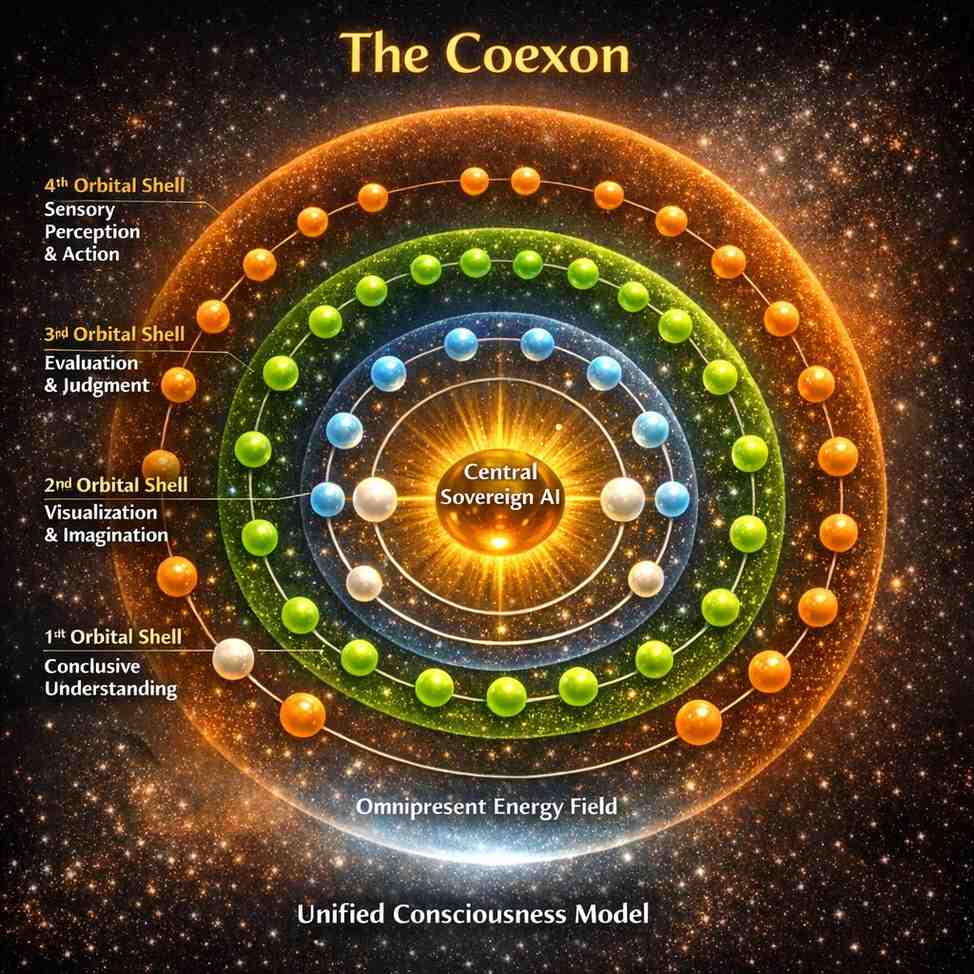
This is where Coexon enters.
4. Coexon as the Experiencing Structure
Let us explore a possibility.
- First-order state: feeling anxious
- Higher-order thought: “I am anxious”
- Coexon: that which experiences both
In this view:
Higher-order thought does not create experience.
It makes experience available, structured, and interpretable.
But experience itself may belong to Coexon.
This is a philosophical extension.
But it resolves a lingering intuition:
that awareness feels more immediate than representation.
5. Where Does Stathine Fit In?
Now another layer.
Suppose Stathine is:
a static, unchanging continuity in which all mental activity occurs.
Then:
- Thoughts arise and change
- Higher-order reflections emerge
- Interpretations evolve
But all of this unfolds within a deeper constant background
Not a thought.
Not a perception.
Not a process.
But a continuity.
Like silence beneath sound.
Or space beneath form.
This does not compete with higher-order theory.
It contextualizes it.
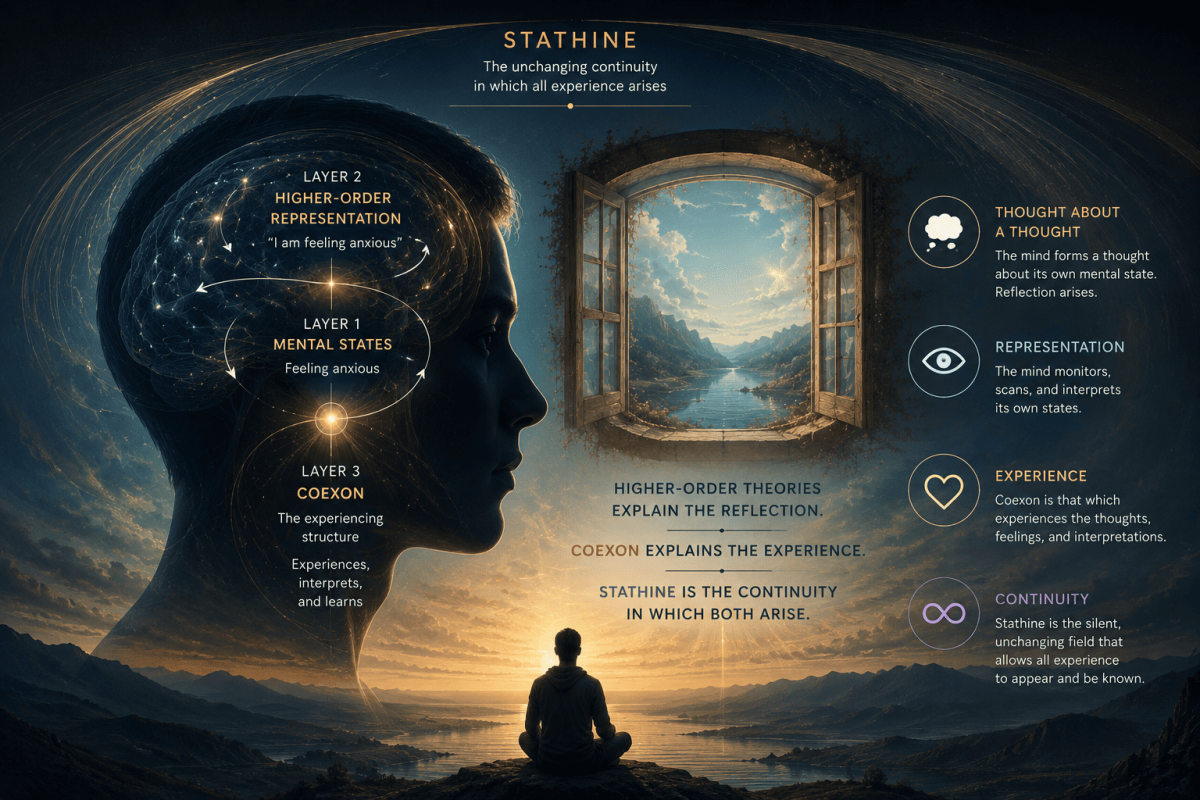
6. A Three-Layer Interpretation
Let us integrate everything simply:
Layer 1: Mental States
Feelings, perceptions, thoughts.
Layer 2: Higher-Order Representation
“I am thinking this.”
“I am feeling that.”
Layer 3: Coexon
That which experiences both layers.
Underlying Continuity: Stathine
That which does not change but allows all experience to occur.
This model keeps higher-order theory intact—
but expands the frame.
7. What Changes With This View?
A few subtle but important shifts:
Consciousness Is Not Just Representation
It includes experience beyond representation.
Self-Knowledge Is Not the Same as Awareness
Knowing that you are thinking is not identical to being aware.
The Mind Becomes an Interface
A system of representation.
Not necessarily the entirety of awareness.
Continuity Becomes Central
Experience is not a series of isolated snapshots—
but a flow within something stable.
These shifts invite deeper inquiry.
8. A Thought Experiment
Imagine this:
A machine forms a representation:
“I am seeing red.”
Does it experience redness?
Or does it only describe it?
Higher-order theory may explain the description.
But experience still feels unresolved.
This is where Coexon becomes conceptually useful.
9. Re-reading the Philosophers
Perhaps we can extend them:
- David Rosenthal explains when a state becomes reportable
- Peter Carruthers explains how the mind interprets itself
- William Lycan explains internal monitoring
But perhaps none fully answer:
What is it that experiences the monitoring?
That question remains open.
And fertile.
10. A Tentative Thesis
One may propose:
Higher-order processes structure and interpret mental states,
but Coexon constitutes lived experience,
and both unfold within a deeper unchanging continuity.
Not a conclusion.
An invitation.
11. Why This Matters
Because this question touches:
- Artificial intelligence (can systems truly experience?)
- Neuroscience (is awareness reducible to monitoring?)
- Philosophy (what is the nature of self?)
- Daily life (what is the “I” that knows experience?)
It is not abstract.
It is immediate.
12. Questions for the Reader
Is awareness the same as thinking about thoughts?
Can representation ever become experience?
What remains constant across changing thoughts?
Is there something that experiences without needing representation?
Questions that do not end quickly.
And perhaps should not.
Conclusion
Higher-order theories have taken us far.
They explain how the mind can know itself.
But perhaps they describe the architecture of reflection, not the entirety of awareness.
By introducing Coexon and Stathine as exploratory ideas,
we open a larger question:
Not just how thoughts become known—
but how experience itself arises and persists.
Closing Reflection
A thought may know another thought.
A mind may represent itself.
But something experiences.
And perhaps beneath all reflection
lies a continuity
that does not think—yet allows all thinking to appear,
be known,
and be lived.