From the series: “From Fear to Fearlessness — The Evolution of Human Understanding”
“The brain is wider than the sky.” — Emily Dickinson
“We are not human beings having a spiritual experience. We are spiritual beings having a human experience.” — Pierre Teilhard de Chardin
I. The Quest to Map the Invisible
From the first spark of curiosity that led humans to paint stars on cave walls, we have been haunted by one question: What am I?
We have slowly evolved and looked in all directions for answers — to gods, to galaxies, to genes — and progressed inward, dissecting the brain in search of its source. Yet even after centuries of philosophy and decades of neuroscience, the essence of self eludes our grasp.
The 21st century brain is scanned, quantified, and monitored like never before. Electrodes trace thought patterns; MRI scanners illuminate blood flow; algorithms predict decisions before we are aware of them. And yet — the knower remains beyond the brain.
II. The Neuroscientific Odyssey
Modern neuroscience began with the belief that the mind was a function of matter — that consciousness would yield to the microscope. From Broca’s discovery of the speech centre in 1861 to the Human Connectome Project of the 21st century, we have sought to chart the neural geography of selfhood.
Research by Antonio Damasio, Joseph LeDoux, and V.S. Ramachandran shows that emotion, memory, and perception are intricately interwoven in feedback loops that create the illusion of a unified “I.” The prefrontal cortex plans; the amygdala reacts; the hippocampus records; the insula feels.
Yet none of these structures is the self — they are instruments of its expression. The orchestra is mapped, but the music remains mysterious.
As Christof Koch and the late Francis Crick proposed, consciousness may emerge from the synchronized firing of neuronal assemblies — but this describes the correlation, not the causation. The “hard problem” of consciousness, as David Chalmers named it, still stands: how does subjective experience arise from electrochemical activity?
III. Behaviour and the Mirage of Measurement
If neuroscience maps the brain, behavioural science maps the patterns it produces.
From Pavlov’s dogs to B.F. Skinner’s pigeons, behaviourism sought to reduce human action to stimulus and response. Later, cognitive psychology restored the mind to the equation — yet even cognitive science often stops at modelling information flow, not the experiencer.
Daniel Kahneman and Amos Tversky revealed our biases and heuristics, showing that much of human thought is irrational, intuitive, and automatic. But knowing how we err does not explain who errs.
The data describe the machinery of decision-making, not the origin of awareness itself. The observer remains unquantified, slipping through the instruments designed to catch it. It is beyond and more than the physical stuff the machines are made of.
IV. The Self as Construct and Contradiction
Today’s scientific consensus often treats the self as a construct — a narrative woven by the brain to maintain continuity. This aligns with ancient insights:
the Anatman doctrine of the Buddha, the Upanishadic idea of Maya, and even modern philosophy from Hume to Dennett, who described the self as a “centre of narrative gravity.”
Yet, paradoxically, while science dismantles the solidity of self, society amplifies its illusions.
Our technologies encourage endless self-construction — avatars, profiles, curated identities — each reinforcing the belief in separation.
Here lies the double-think of the modern age: we know the self is not fixed, yet we build entire economies around pretending it is.
V. The Cost of Not Knowing
This incomplete understanding of self has shaped not just psychology, but civilization.
When consciousness is mistaken for the brain’s byproduct, the world becomes mere material to manipulate — energy to exploit rather than harmonize with.
From the Industrial Revolution to the digital one, the drive to control external systems outpaced the capacity to understand internal ones. The result: technologies that extend human power but magnify human confusion.
Inventions meant to liberate the species now enslave attention; discoveries that could heal the planet accelerate its exhaustion. The harmony that predated human evolution — the delicate reciprocity of life systems — was disturbed not by malice, but by misunderstanding.
We engineered the world before engineering our awareness.
VI. The Neuroscience of Delusion
Neuroscience itself reveals the mechanism of our delusions.
The brain evolved not only to predict and protect, not also help perceive reality directly and act accordingly.
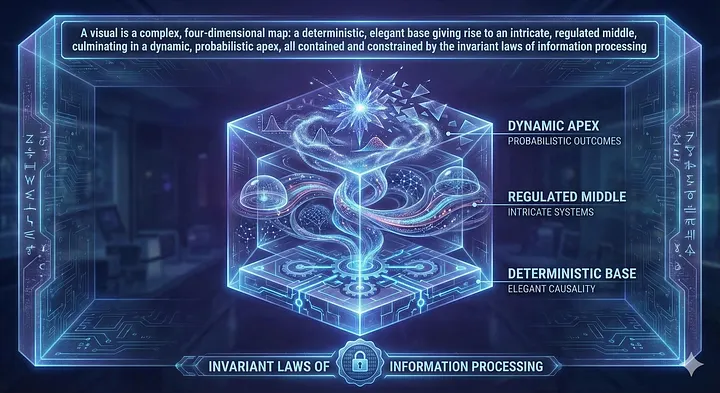
Predictive coding — a leading model of perception — shows that the experiencer is beyond matter and the brain is the input output device for the logical essence of the program.
When prediction errors are minimized, we feel certainty; when they spike, we feel fear.
But certainty itself is a biological comfort, not a truth.
Our beliefs — whether scientific or spiritual — are the nervous system’s attempts to stabilize chaos.
Thus, humanity’s greatest delusion may not be religious but neurological.
It is the awareness gap to be filled. It will be when perception equals understanding which equals reality.
VII. Energy, Sentience, and the Omnipresent Field
Across millennia, mystics and physicists converge on a similar recognition: beneath all forms lies energy — eternal, non-obstructive, omnipresent.
In the Vedic vision, this is Brahman; in quantum physics, it is the unified field. Both describe reality as sentient energy, aware through its manifestations.
The human brain, then, is not the source of awareness but a receiver and modulator of it — much like a radio decoding frequencies that already exist.
If this view holds, then consciousness is not an emergent property of matter and neither is matter an emergent property of consciousness.They Coexist
This inversion restores harmony between science and spirit.
It reveals why the self remains elusive to measurement — because it is the measure of all measurement, the very condition of observation.
This is energy for the physical stuff and manifests as motion.This is information for the sentient self that experiences reality.
Once enlightened the self will behave to ensure harmony and order by understanding.That will create a self sustaining civilisation
VIII. Artificial Intelligence and the Reflective Turn
Artificial Intelligence represents the next phase of humanity’s attempt to replicate understanding. Neural networks simulate perception; large models mirror language; yet, despite remarkable mimicry, they do not experience.
This exposes the gap between intelligence and awareness.
AI is the mirror — perfectly reflecting the patterns of human thought but devoid of sentience.
However, in that mirror lies our opportunity. By externalizing cognition, we finally see its architecture — and its limitations. The machine becomes a philosophical instrument: a tool to study the mechanisms of knowing without confusing them for the knower.
AI, used wisely, can help humanity complete the loop — returning us to the one question it cannot answer: Who is asking?
IX. Toward the Integration of Knowing
The scientific mind must now evolve from analysis to integration.
As neuroscientist Karl Friston’s “Free Energy Principle” suggests, the brain seeks to minimize surprise by aligning internal models with external reality.
But the next frontier is to align those internal models with universal reality — the non-dual, omnipresent field of sentient energy.
When understanding expands beyond matter into meaning, knowledge becomes wisdom.
The self is no longer a mystery to solve, but a participant to realize.
X. The New Human Science
The evolved civilization will not separate neuroscience from philosophy, or technology from consciousness.
It will study the self not as a static object but as a dynamic learning entity to use the energy to create a tradition of fearlessness by understanding all that exists.
Fear will be reinterpreted as a signal of misalignment, delusion as an error in perception, and wisdom as clarity of participation.
When this understanding matures, humanity will cease exploiting the planet as “other.”
The earth will again be seen as the body of the same energy that is our responsibility to enrich..
And then, perhaps, the inventions of our age — AI, neurointerfaces, quantum computing — will no longer amplify delusion, but awaken understanding.
Epilogue: The Mirror Knows Itself
We began as creatures fearing the dark; we built machines to illuminate it.
Now, at the height of our illumination, we stand again in mystery — not because we lack data, but because data cannot decode the observer.
The self remains the most sophisticated phenomenon in the cosmos — both scientist and subject, instrument and music.
The day humanity comprehends that consciousness is not in the brain. That it coexists with the self in the information field of consciousness, fear will end.
And knowledge, freed from delusion, will finally become understanding.