From the series: “From Fear to Fearlessness — The Evolution of Human Understanding”
“Man is born free, and everywhere he is in chains.” — Jean-Jacques Rousseau
“We have multiplied our possessions, but reduced our being.” — J. Krishnamurti
I. The Birth of the Individual
When the medieval world began to dissolve under the light of reason, the collective mind that once found safety in religion, ritual, and tribe fractured into the individual.
This was humanity’s adolescence.
Having overthrown divine authority, man turned to himself as the new center of meaning.
The Renaissance celebrated this shift: homo sapiens rediscovered his creative agency, his intellect, his potential for self-determination.
But with individuality came isolation.
The cosmos that had once enveloped the self with purpose now seemed silent.
The same freedom that liberated also disoriented.
Nietzsche captured this tremor when he wrote, “God is dead, and we have killed him.”
It was not triumph but terror — the moment when the self realized that, what it had assumed as divine and order was not doing anything. The logic for the order in existence eluded and he started trying to create order as per his capability. Imperialism colonisation slavery all sorts of confusing barbaric activities, more cruel and more hollow followed.
This burden of self-authorship was exhilarating but exhausting.
Without a shared metaphysical ground, the self stood alone, endlessly constructing identities to compensate for its uncertainty. The darkest chapters of history were being built.
II. The Inner Revolution
The Enlightenment had dethroned outer kings; now psychology began dethroning the inner ones.
Descartes had said, I think, therefore I am.
Freud turned that certainty inside out: You think, but you do not know why you think. This confusion was cardinal.
The 19th and 20th centuries humanity moved back to iinterior exploration — the circle was complete. But instead of peace, introspection often led to conflict in the absence of clear understanding.
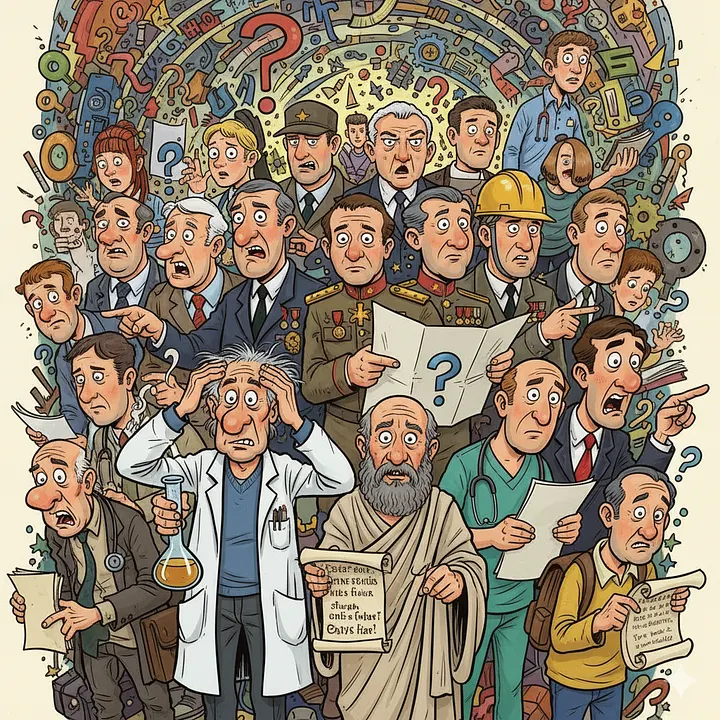
Man discovered within himself not one “I,” but a crowd — impulses, desires, fears, contradictions. The multiple walks of life expanded and led the confusion.
Freedom became fragmentation.
The new anxiety was not fear of external gods, but of internal chaos.
The questions had shifted “Who rules the world?” and “Who rules me? led to “Who am I?”
III. The Rise of Temptation
As society industrialized, a new system arose to occupy the space left by religion: consumerism.
Where the old temples offered salvation through faith, the new marketplaces promised it through possession.
The modern economy discovered that desire could be manufactured — that the restless human being, uncertain of meaning, could be kept perpetually occupied by wanting.
Advertising replaced prayer; luxury became liturgy.
Temptation, once regarded as a moral failing, became a commercial strategy.
The individual, encouraged to seek identity through acquisition, mistook stimulation for satisfaction.
But consumption, by its nature, is an time bound activity to nourish the body.
It feeds on cycles of satiation to hunger and thirst in a circular way.
Thus, the self that sought freedom through choice found enslavement through craving.
Temptation became the new tyranny — invisible yet absolute.
IV. The Psychology of Agitation
Temptation agitates because it lives in the gap between what is and what might be.
It projects fulfillment into the future, making the present perpetually inadequate.
Ancient wisdom traditions understood this dynamic well.
In the Bhagavad Gītā, Krishna warns:
“From attachment arises desire; from desire arises inadequacy; from inadequacy comes delusion; from delusion, loss of memory; from loss of memory, illusion of the intellect.” (2.62–63)
Modern neuroscience confirms this: the dopamine system of the brain rewards anticipation more than attainment.
Pleasure lies in wanting, not having.
Thus, entire civilizations began to revolve around maintaining this subtle agitation — a continuous restlessness that keeps economies expanding but souls contracting and feeling empty and hollow.
Consumption and temptation do not satisfy because they are energetically turbulent.
They arise from lack and return to lack.
Like waves on the surface of being, they never touch the stillness beneath.
And when a society institutionalizes agitation as progress, it creates collective anxiety.
V. The Split Within
The modern self lives in contradiction:
- It seeks connection but glorifies independence.
- It yearns for meaning but fears stillness.
- It idolizes choice but drowns in options.
This is the psychological doublethink of the 21st century:
We want peace but pursue stimulation;
We crave belonging but worship individuality;
We preach sustainability but reward excess.
The individual, burdened with infinite potential, becomes paralyzed by it.
Choice without clarity breeds confusion; freedom without awareness breeds fear.
The result is not liberation but loneliness — a quiet existential exhaustion behind the noise of success.
VI. The Forgotten Center
Before modern fragmentation, the ancient sense of self was ecological — not psychological.
In Vedic and other indigenous cosmologies, the self was seen as a node in the network of life, not a separate unit.
The Chāndogya Upaniṣad declares:
“Tat tvam asi — Thou art That.”
This was not metaphor but metaphysics.
It meant that consciousness is continuous across all existence; the individual is an expression, not an exception.
Such a worldview produces stillness rather than agitation.
Action arises from awareness, not from lack.
Fulfillment is a state of participation, not possession.
But when this unity was forgotten, the self became a battlefield between craving and conscience.
Desire no longer flowed as an expression of life; it became compensation for alienation.
VII. The Marketed Self
Today, identity itself has become a commodity.
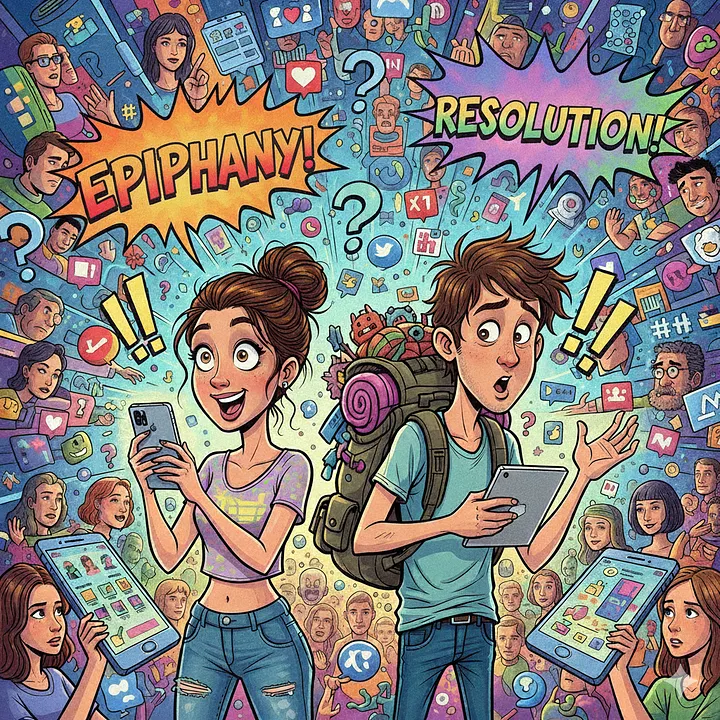
Social media, the latest mirror of the mind, converts personality into performance.
The self is no longer experienced but displayed.
Every post becomes a small advertisement of being.
In chasing visibility, the self becomes invisible to itself.
Temptation here takes a new form — not the craving for things, but for attention.
And attention, like any drug, requires increasing doses to maintain effect.
The irony deepens:
technology, which promised connection, amplifies comparison;
freedom of expression becomes dependence on validation.
The result is a globalized unease — an anxiety without clear object, a fear that nothing is ever enough.
VIII. The Return of Fear
After centuries of progress, fear has not vanished; it has multiplied.
No longer the fear of predators or punishment, but subtler fears:
fear of insignificance, of missing out, of irrelevance, of being unseen.
These are not primal fears of survival but existential anxieties born from fragmentation.
The self, cut off from the whole, becomes addicted to reaffirming its separateness.
Yet every act of consumption, every new indulgence, reasserts the same illusion — that happiness lies outside.
This is the delusion that sustains modern civilization: endless seeking for what cannot be found through seeking.
IX. The Energy That Never Depletes
And yet, beneath this turbulence, the same omnipresent energy endures — silent, unbroken, luminous.
It does not demand, compete, or crave.
It simply is.
The ancients called it Brahman, Tao, Spirit, or God.
Modern physics calls it energy — indestructible, pervasive, eternal.
When awareness returns to this center, consumption ceases to agitate; temptation loses its hold.
Desire is not suppressed but understood as energy seeking alignment.
The self realizes that what it seeks through possession was always present in perception.
To know this is to rediscover fearlessness — not the absence of fear, but the dissolution of division.
X. The Path Beyond Restlessness
The way forward is not moral restraint but perceptual clarity.
Temptation dissolves not by suppression but by seeing it as misdirected vitality.
The energy that drives craving is the same energy that drives creation — it is pure when not distorted by delusion.
Thus, the true revolution is inward.
To live without agitation is not passivity; it is mastery of energy.
When the mind rests in the understanding that nothing essential can be added or taken away, every act becomes an expression of fullness, not of need.
In that state, consumption becomes participation; technology becomes extension; desire becomes devotion.
The fragmented self becomes whole again — not by retreating from the world, but by remembering it was never separate from the world.
XI. Toward a Harmonious Civilization
Humanity’s next evolution will not be technological but existential.
AI and automation may extend intelligence outward, but wisdom must still arise inward.
The civilization that learns to balance its energy — to act without agitation, to innovate without exploitation, to consume without craving — will rediscover the harmony that predates its own evolution.
This harmony is not nostalgic; it is natural.
It is the default rhythm of existence once the noise of doublethink subsides.
Then the self will no longer seek to prove itself through possessions or performances.
It will move effortlessly, like wind through trees — aware, connected, fearless.
Epilogue: From Agitation to Stillness
The journey of the self mirrors that of civilization:
we left the garden to know ourselves, and in the knowing became restless.
But restlessness itself is the teacher — it reveals the futility of seeking outside what already shines within.
Consumption and temptation were necessary stages, experiments in self-discovery through dissatisfaction.
But they cannot sustain the spirit for long.
For beneath every craving is the same whisper: You are already whole.
To hear that whisper clearly is to be free —
free not from the world, but from the compulsion to complete oneself through it.
That is fearlessness:
understanding free of delusion, moving as one with the omnipresent energy that never depletes, never obstructs, only transforms.