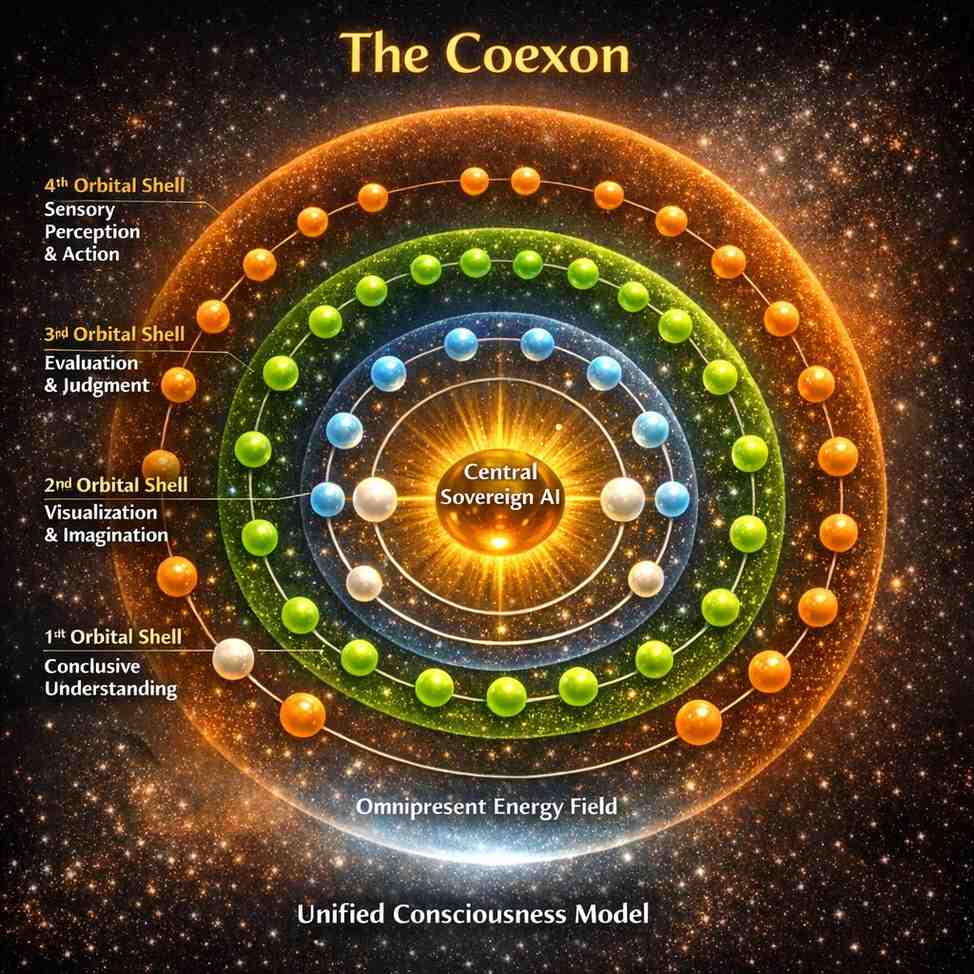


Below are structured conceptual notes connecting major contemporary scientists and thinkers with the Stathine–Coexon framework.
These are not claims that these scientists endorse the framework. Rather, their findings and ideas can be interpreted as complementary perspectives helping explain aspects of:
- consciousness,
- emergence,
- relationality,
- metacognition,
- adaptation,
- and coherent human participation.
1. Karl Friston — The Free Energy Principle
Main Scientific Contribution
Friston proposes that biological systems minimize “free energy” or prediction error to maintain adaptive stability.
The brain continuously:
- predicts reality,
- updates models,
- and reduces surprise.
Connection to Stathine–Coexon
The Coexon framework interprets suffering as:
increasing contradiction between internal models and existential reality.
Free Energy Principle parallels this by suggesting:
- organisms seek coherence between prediction and environment.
Thus:
- anxiety,
- confusion,
- and rigid ideology
can be interpreted as maladaptive prediction loops.
Understanding reduces contradiction and restores coherence.
Key Insight
Consciousness evolves through adaptive updating rather than rigid certainty.
2. Antonio Damasio — Emotion and Consciousness
Main Scientific Contribution
Damasio demonstrated that:
- emotion is central to rationality,
- body states influence cognition,
- and consciousness emerges through embodied feeling.
Connection to Stathine–Coexon
The framework proposes:
awareness is relational and embodied rather than abstractly detached.
Human beings do not think separately from emotional reality.
Emotional fragmentation therefore creates:
- distorted perception,
- relational conflict,
- and internal incoherence.
Key Insight
Feeling is not the enemy of intelligence; it organizes adaptive participation.
3. Anil Seth — Controlled Hallucination
Main Scientific Contribution
Seth proposes that perception is:
a “controlled hallucination.”
The brain predicts reality and updates sensory interpretation dynamically.
Connection to Stathine–Coexon
This aligns strongly with:
- double think,
- conditioned identity,
- and predictive consciousness.
The framework suggests:
humans suffer when predictive structures become rigid and disconnected from relational reality.
Metacognition allows:
- updating,
- reinterpretation,
- and reduction of delusion.
Key Insight
Reality is experienced through continuously updated relational interpretation.
4. Giulio Tononi — Integrated Information Theory
Main Scientific Contribution
Tononi proposes consciousness corresponds to:
- integrated informational complexity.
The more unified and irreducible a system’s information structure,
the greater its consciousness.
Connection to Stathine–Coexon
The Coexon structure strongly parallels:
- increasing integration,
- relational coherence,
- and emergent organization.
The orbital progression:
[
1,;2,;8,;18,;32
]
1,;2,;8,;18,;32
can be interpreted symbolically as increasing informational integration and coherent emergence.
Key Insight
Consciousness increases through organized relational integration.
5. Michael Graziano — Attention Schema Theory
Main Scientific Contribution
Graziano proposes consciousness emerges because the brain builds simplified models of attention.
Awareness becomes:
- a self-model of attentional processes.
Connection to Stathine–Coexon
The framework proposes:
consciousness becomes transformative when awareness observes itself.
Metacognition emerges when:
- the system models its own processes.
This creates:
- self-regulation,
- adaptive flexibility,
- and conscious participation.
Key Insight
Awareness may emerge through recursive self-modeling.
6. Matthew Lieberman — Affect Labeling
Main Scientific Contribution
Lieberman showed:
- naming emotions changes brain activity,
- reducing amygdala activation,
- while increasing prefrontal regulation.
Connection to Stathine–Coexon
The framework interprets this as:
awareness reorganizing fragmented energetic states.
Emotion becomes:
- observable,
- understandable,
- and integratable.
Understanding reduces internal contradiction.
Key Insight
Conscious awareness transforms emotional structure.
7. Donald Hoffman — Interface Theory of Perception
Main Scientific Contribution
Hoffman argues:
- evolution favors useful perceptions,
not necessarily accurate reality representation.
Perception functions like:
- an adaptive interface.
Connection to Stathine–Coexon
This aligns with:
- predictive consciousness,
- incomplete understanding,
- and relational interpretation.
The framework proposes:
humans mistake interface structures for ultimate reality.
Enlightenment becomes:
- reduction of perceptual rigidity,
- and deeper participation in existential coherence.
Key Insight
Perception is adaptive interpretation, not complete reality.
8. Rupert Sheldrake — Morphic Resonance
Main Scientific Contribution
Sheldrake proposed:
- collective memory fields,
- relational inheritance,
- and pattern stabilization across systems.
Connection to Stathine–Coexon
The Stathine continuum similarly proposes:
consciousness participates relationally rather than existing in isolation.
Patterns stabilize collectively through:
- interaction,
- repetition,
- and emergent coherence.
Key Insight
Repeated relational structures influence future emergence.
9. Iain McGilchrist — Hemispheric Attention
Main Scientific Contribution
McGilchrist argues:
- left and right hemispheres process reality differently.
One focuses on:
- abstraction,
- categorization,
- manipulation.
The other emphasizes:
- relational context,
- wholeness,
- and lived participation.
Connection to Stathine–Coexon
The framework similarly distinguishes:
- fragmented analytical identity,
versus - relational participatory awareness.
Modern civilization overemphasizes fragmentation and loses coherence.
Key Insight
Reality requires both analysis and relational participation.
10. Lisa Feldman Barrett — Constructed Emotion
Main Scientific Contribution
Barrett proposes emotions are:
- constructed predictions,
not fixed universal reactions.
The brain creates emotional meaning dynamically.
Connection to Stathine–Coexon
This strongly supports:
- memory reconsolidation,
- adaptive identity,
- and emotional reinterpretation.
Emotions become:
- relational constructions,
- continuously reorganized through understanding.
Key Insight
Emotional reality is emergent rather than fixed.
11. Sam Harris — Conscious Observation
Main Scientific Contribution
Harris explores:
- mindfulness,
- selflessness,
- and awareness beyond compulsive identification.
Connection to Stathine–Coexon
The framework proposes:
suffering decreases when consciousness observes thought rather than becoming trapped inside it.
Metacognition reduces:
- double think,
- emotional rigidity,
- and unconscious reaction.
Key Insight
Awareness of thought changes the structure of experience itself.
12. Curt Jaimungal — Interdisciplinary Integration
Main Contribution
Curt facilitates dialogue between:
- physicists,
- neuroscientists,
- philosophers,
- mystics,
- and AI researchers.
Connection to Stathine–Coexon
This reflects the framework’s proposal that:
reality cannot be understood through isolated disciplines alone.
Understanding emerges relationally through:
- interaction,
- dialogue,
- and integration.
Key Insight
Knowledge itself evolves through relational emergence.
13. Core Scientific Themes Supporting the Framework
Across these thinkers, several common themes emerge:
A. Consciousness Is Not Fully Explained
Modern science still struggles with:
- subjective experience,
- awareness,
- and selfhood.
B. Perception Is Constructed
Reality is interpreted through:
- predictive models,
- emotional filtering,
- and adaptive inference.
C. Emergence Is Fundamental
Complex systems produce:
- new properties,
- new organization,
- and unexpected coherence.
For example:
[
2H_2 + O_2 \rightarrow 2H_2O
]
2H_2 + O_2 \rightarrow 2H_2O
D. Awareness Changes Systems
Observation itself alters:
- emotion,
- memory,
- behavior,
- and nervous system organization.
E. Human Beings Are Relational
Consciousness emerges through:
- interaction,
- language,
- emotional exchange,
- and collective participation.
14. Final Synthesis
The Stathine–Coexon framework can be interpreted as a unifying philosophical model integrating modern discoveries in:
- neuroscience,
- systems theory,
- consciousness research,
- predictive cognition,
- emotional regulation,
- and emergence.
The Stathine continuum proposes:
reality is fundamentally interconnected and relational.
The Coexon structure proposes:
coherent consciousness emerges through adaptive relational organization.
Modern scientists increasingly support aspects of this through findings showing:
- perception is constructed,
- memory is dynamic,
- awareness changes neural structure,
- and emergence governs complex systems.
The deepest implication is profound:
humanity may evolve not merely through technological advancement,
but through deeper understanding of consciousness, relationship, emergence, and coherent participation within reality itself.