Beyond Systems Awareness: Extending Systems Thinking Through the Stathine–Coexon Framework y researchers because each paper can stand on its own merits.
A Conceptual Dialogue with the Systems Thinking Tradition at the Massachusetts Institute of Technology
Abstract
Over the past five decades, the systems thinking tradition associated with the Massachusetts Institute of Technology (MIT) has profoundly influenced leadership, education, organizational learning, sustainability, and public policy. Through the work of scholars such as Jay Forrester, Peter Senge, Otto Scharmer, and many colleagues, systems thinking has transformed how individuals and institutions understand complexity, feedback, emergence, and collective learning.
This article argues that the Stathine–Coexon Framework should not be viewed as an alternative to this tradition but as a complementary philosophical extension. While systems thinking explains how complex systems behave, the Stathine–Coexon Framework explores why coherent understanding of those systems may emerge and how coherence itself might become an explicit developmental objective for individuals, organizations, and civilizations.
Introduction
Few educational movements have changed management and organizational learning as profoundly as systems thinking.
The realization that problems arise not merely from isolated events but from interconnected structures represented a major shift in human understanding.
Today, systems thinking influences fields ranging from climate science and healthcare to education, governance, business leadership, and sustainability.
Its contribution extends beyond methodology. It has encouraged humanity to think in relationships rather than fragments.
This article begins with appreciation for that achievement.
The purpose is not to critique systems thinking, but to ask whether an additional conceptual layer may further enrich its future development.
The Achievement of the MIT Systems Tradition
The systems thinking community has introduced several transformative ideas.
These include:
- Feedback rather than linear causation.
- Delayed consequences rather than immediate reactions.
- Mental models as drivers of behavior.
- Learning organizations instead of command-and-control organizations.
- Collective intelligence through dialogue.
- Presencing and deep listening as foundations for leadership.
- Systemic leverage instead of symptomatic intervention.
Collectively, these ideas have helped thousands of educators, executives, policymakers, and students recognize that lasting change requires understanding relationships rather than isolated events.
This intellectual contribution deserves continued recognition.
An Open Question
Despite these advances, one question remains largely philosophical.
Why are human beings capable of developing progressively more coherent understandings of increasingly complex systems?
Systems thinking demonstrates that greater awareness is possible.
It does not attempt to explain the deeper nature of awareness itself.
This is not a limitation.
It reflects the intended scope of the discipline.
The Stathine–Coexon Framework begins precisely where systems thinking appropriately leaves the question open.
A Complementary Perspective
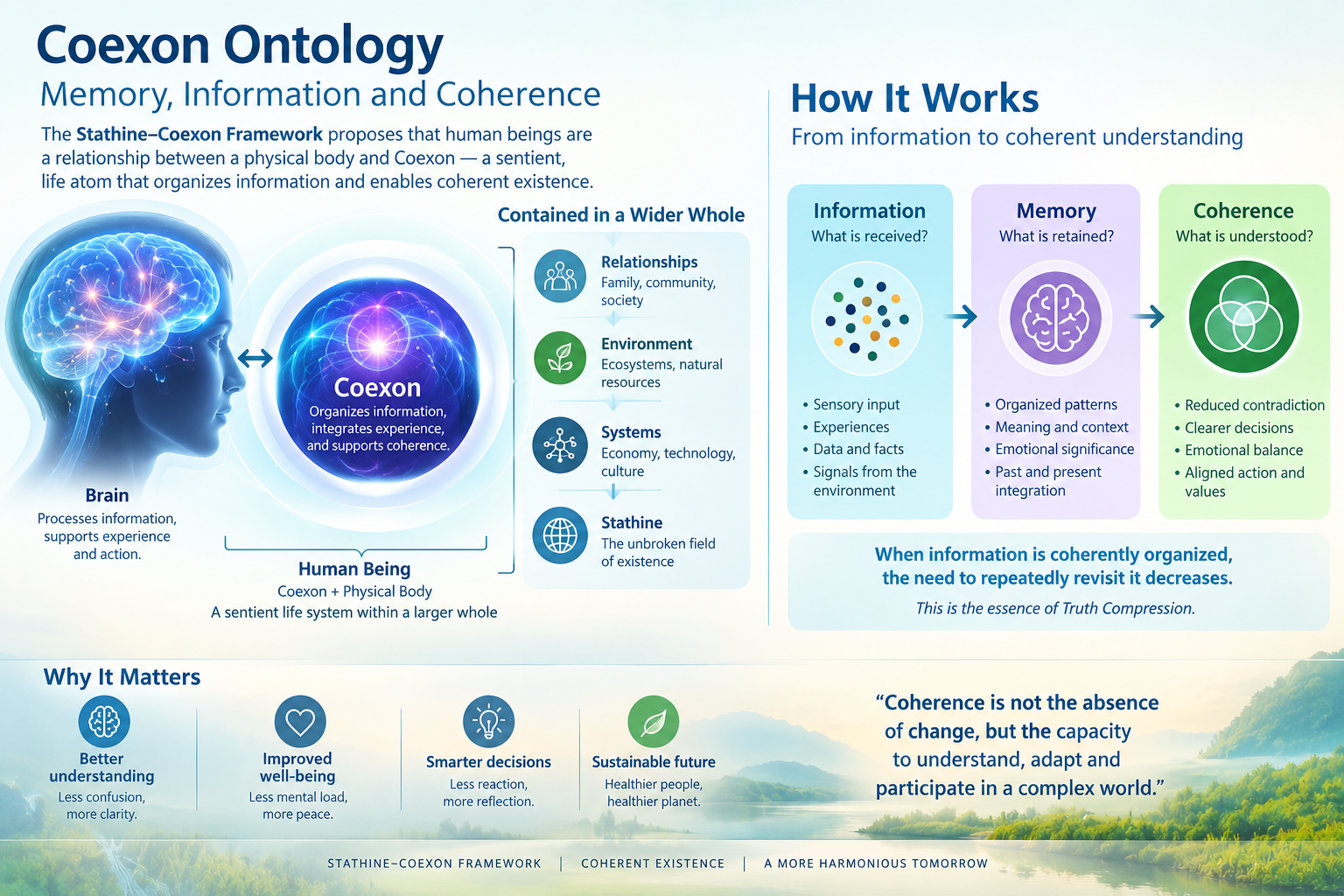
The Stathine–Coexon Framework proposes two foundational concepts.
Stathine is described as the timeless and invariant field that conceptually underlies existence.
The Coexon is proposed as the singular life atom that continuously seeks greater coherence through interaction with biological systems and lived experience.
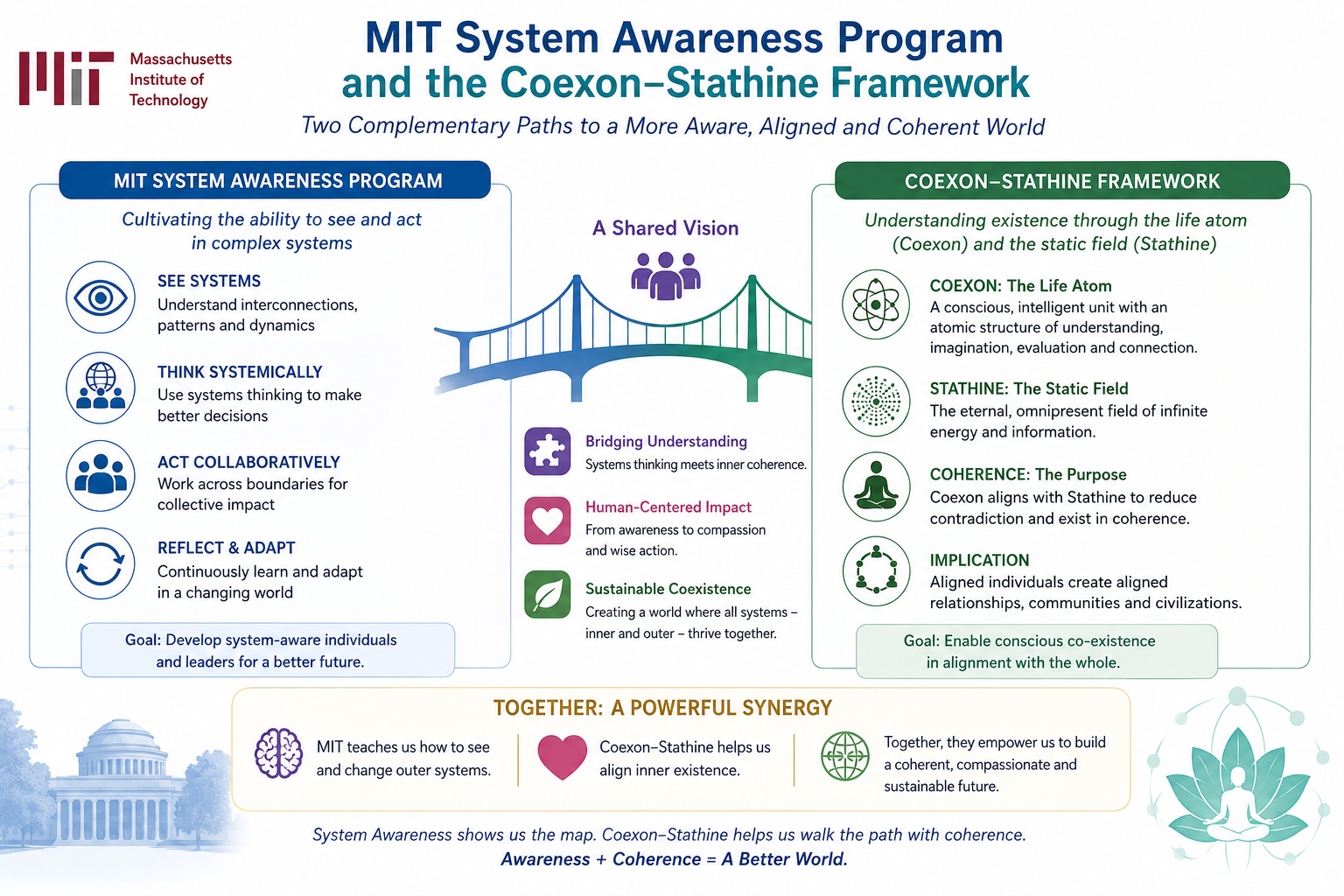
Within this framework, increasing systems awareness represents one manifestation of a broader process of increasing coherence.
Systems thinking therefore becomes not a competing worldview but one practical pathway through which the Coexon refines its understanding of reality.
From Systems Awareness to Coherence Awareness
Systems thinking teaches individuals to recognize patterns.
The Stathine–Coexon Framework asks an additional question.
What allows pattern recognition itself to become progressively more coherent?
This distinction shifts the focus from understanding external systems alone toward understanding the development of the observer.
In this perspective:
- Systems awareness becomes awareness of relationships.
- Coherence awareness becomes awareness of the progressive integration of understanding, perception, values, and action.
The two perspectives are complementary rather than mutually exclusive.
Educational Implications
If coherence is accepted as a meaningful developmental objective, educational programs in systems thinking could potentially be complemented by additional inquiry into questions such as:
- How does internal contradiction influence systems perception?
- How does personal coherence affect collective decision-making?
- Can organizations cultivate coherence rather than only improve efficiency?
- How might education intentionally develop increasingly coherent understanding across cognitive, emotional, ethical, and relational domains?
These questions are offered as possible directions for interdisciplinary research rather than as established conclusions.
A Backward-Compatible Extension
One of the strengths of the Stathine–Coexon Framework is that it does not require abandoning existing educational practices.
Instead, it proposes a backward-compatible extension.
Students would continue learning:
- systems thinking,
- systems dynamics,
- organizational learning,
- dialogue,
- complexity,
- regenerative leadership.
The additional contribution would be an explicit exploration of coherence as a unifying developmental principle connecting these disciplines.
Such an approach preserves decades of intellectual achievement while inviting further philosophical and empirical inquiry.
Opportunities for Collaborative Research
Several research questions naturally emerge from this dialogue.
- Can coherence be defined in operational terms?
- Can coherent understanding be measured?
- How does coherence relate to organizational learning?
- Does increasing personal coherence improve systems thinking capability?
- Can coherence-oriented educational interventions produce measurable differences in leadership and collaboration?
These questions invite collaboration among researchers in systems science, psychology, neuroscience, philosophy, education, and organizational development.
An Invitation Rather Than a Conclusion
The purpose of this article is not to establish the Stathine–Coexon Framework as a replacement for systems thinking.
Rather, it is to invite dialogue.
Throughout the history of science, conceptual progress has often emerged when mature disciplines engaged constructively with new philosophical perspectives.
Whether the Stathine–Coexon Framework ultimately proves useful will depend not on the elegance of its concepts alone but on its ability to generate productive research questions, support interdisciplinary collaboration, and inspire empirical investigation.
If it succeeds in doing so, it may contribute to the continuing evolution of systems thinking toward an even more comprehensive understanding of coherent human development.
Conclusion
The systems thinking tradition associated with MIT has fundamentally changed how humanity understands complexity, learning, and interconnectedness. The Stathine–Coexon Framework seeks to build upon that legacy by proposing coherence as an additional integrative principle linking inner development, systems awareness, and civilizational evolution.
Rather than asking researchers to replace existing theories, the framework invites them to consider whether coherence itself might become a fruitful subject of interdisciplinary inquiry. If that conversation unfolds, the next chapter of systems thinking may not be about abandoning its foundations but about extending them toward a deeper understanding of the relationship between consciousness, learning, and the evolving coherence of human civilization.