Reinterpreting Steven Pinker’s Rational Humanism, Free Speech, and the Enlightenment Through the Stathine–Coexon Framework
Part of the Stathine–Coexon Comparative Research Series — Level II: Comparative Foundations
Abstract
Steven Pinker’s defense of the Enlightenment represents one of the most influential contemporary attempts to recover the intellectual and moral foundations of modern liberal civilization. In Enlightenment Now, Pinker identifies reason, science, humanism, and progress as central Enlightenment ideals and argues that their application has contributed substantially to improvements in human well-being. (Harvard Gazette) His subsequent work on rationality extends this project by examining the cognitive tools through which humans can distinguish better beliefs from worse ones and make decisions in pursuit of meaningful goals. (Harvard Gazette)
Pinker also regards freedom of speech as fundamental to the process by which competing claims can be expressed, challenged, tested, and corrected. In his argument, free speech is closely connected to the discovery of knowledge because conjectures must be exposed to criticism before they can withstand attempts at refutation. (Harvard Scholar)
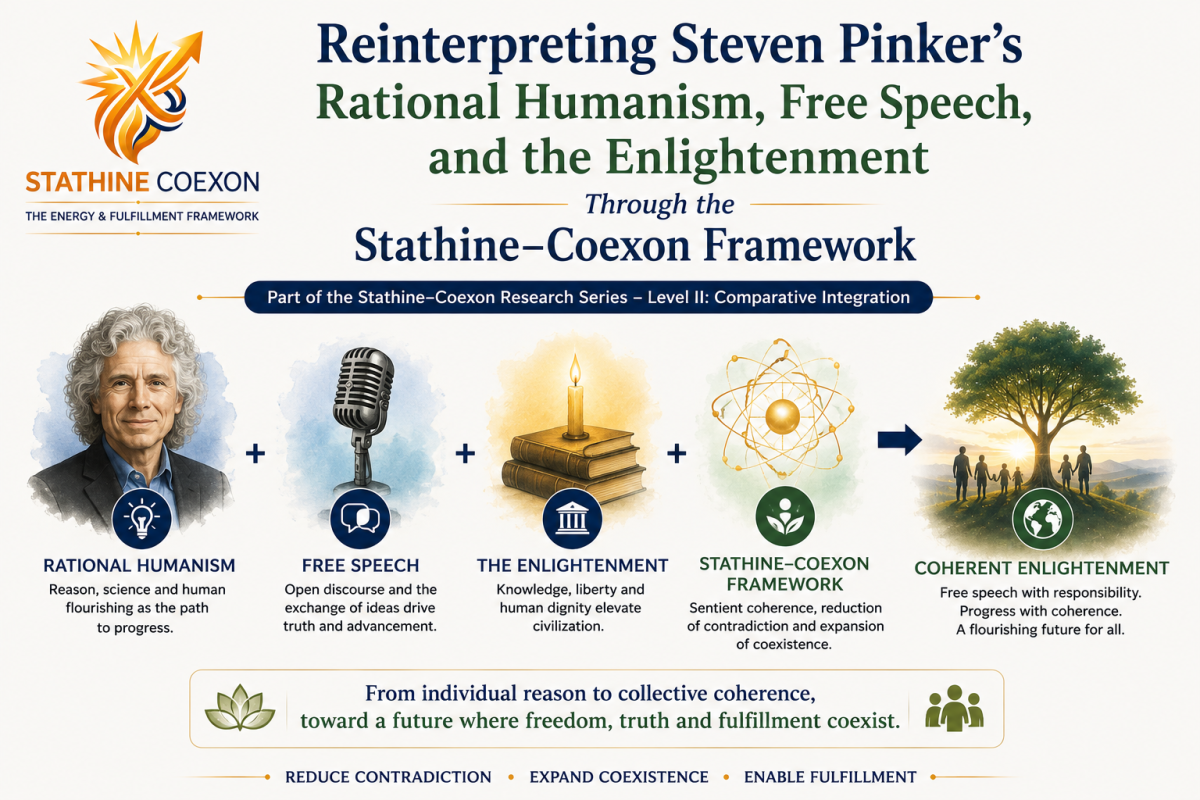
This paper examines Pinker’s Enlightenment project through the Stathine–Coexon Framework and proposes that his four Enlightenment values can be understood as four essential components of a larger principle: progressive coherence of human understanding.
Reason provides a mechanism for evaluating relationships among propositions. Science provides a disciplined method for confronting models with reality. Humanism establishes the expansion of human and sentient well-being as a value orientation. Progress represents the capacity of systems to improve through accumulated learning.
The Stathine–Coexon Framework, however, proposes that these four elements require a fifth dimension: coherence.
Reason without coherence can become sophisticated argumentation serving fragmented goals. Science without coherence can produce enormous quantities of specialized knowledge without systemic understanding. Humanism without coherence can become tribal humanism, where concern for one group conflicts with the well-being of larger systems. Progress without coherence can generate improvements whose second-order consequences undermine the very flourishing they were intended to create.
The paper therefore proposes:
Enlightenment = Reason + Science + Humanism + Progress + Coherence.
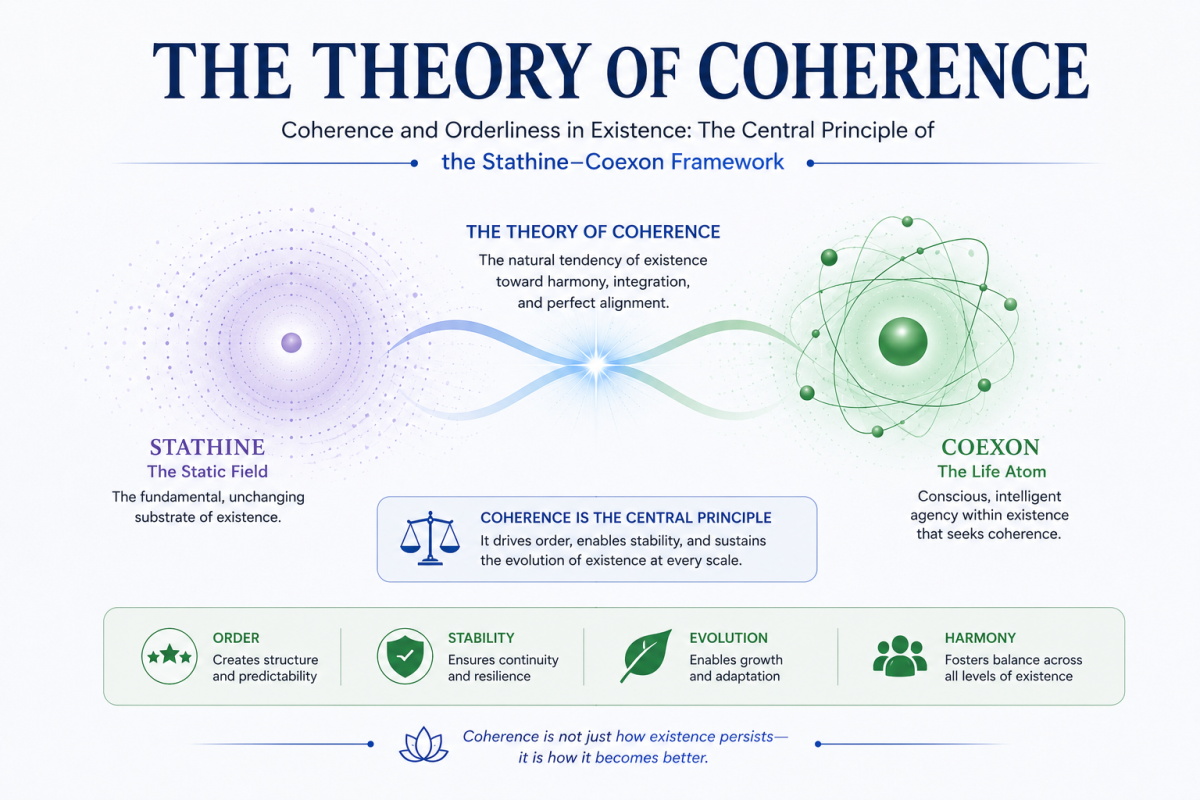
Within the Stathine–Coexon hypothesis, Coexon is conceptualized as a sentient atom independent of the biological body, capable of organizing information and communicating with the holobiont’s neurological brain. The hypothesis is positioned beyond the present ambit of conventional epistemology and empirical data systems. It is therefore not presented as a replacement for empirical science but as a deeper ontological proposition about the organization of information and conscious existence.
The paper argues that freedom of speech acquires an especially important role within this synthesis. Free speech is not merely a political liberty. It can be understood as a civilizational coherence mechanism: society exposes competing models to one another, thereby allowing contradictions, errors, hidden assumptions, and previously invisible possibilities to emerge.
The ultimate proposition is that the unfinished project of the Enlightenment may not be merely to defend reason against irrationality, but to evolve from rational civilization toward coherent civilization.
1. Introduction: The Enlightenment Is Still an Unfinished Project
The modern world possesses extraordinary technological capabilities.
Human beings can:
- communicate globally within seconds,
- manipulate matter at atomic scales,
- edit biological systems,
- generate artificial intelligence,
- travel beyond Earth,
- measure the universe,
- and preserve information across generations.
Yet civilization continues to experience:
- polarization,
- tribalism,
- ideological conflict,
- misinformation,
- ecological degradation,
- war,
- inequality,
- institutional distrust,
- and profound disagreement about what constitutes truth.
This creates a paradox.
Humanity has accumulated unprecedented knowledge while frequently demonstrating an inability to organize that knowledge into shared understanding.
Steven Pinker’s Enlightenment project addresses part of this paradox.
His argument is that the modern world should not abandon the intellectual traditions associated with the Enlightenment simply because modernity has problems. Rather, reason, science, humanism, and progress remain essential resources for addressing those problems. (Harvard Gazette)
The Stathine–Coexon Framework accepts the importance of this project but asks a further question:
What happens when reason, science, humanism, and progress themselves become fragmented?
Could civilization possess:
- scientific knowledge without wisdom,
- rationality without compassion,
- freedom without responsibility,
- progress without systemic awareness?
The answer appears to be yes.
Therefore the next stage of the Enlightenment may require something beyond the defense of its original principles.
It may require their integration.
2. Pinker’s Four Pillars of Enlightenment
Pinker characterizes the Enlightenment through four interrelated ideals:
- Reason
- Science
- Humanism
- Progress
He describes reason as the commitment to analyzing our predicament rather than accepting dogma or authority; science as the systematic attempt to understand reality through hypotheses and testing; humanism as concern for human and sentient well-being; and progress as the possibility of improving human conditions through the application of reason and sympathy. (Reason.com)
These four principles create a powerful intellectual architecture.
But from the Stathine–Coexon perspective, something is missing.
They describe:
- how we think,
- how we know,
- what we value,
- and what direction we seek.
They do not explicitly describe:
How do we integrate all of these into a coherent model of existence?
That is where the fifth dimension enters.
3. The Fifth Enlightenment Value: Coherence
The Stathine–Coexon Framework proposes:
Coherence is the capacity to integrate multiple valid observations, perspectives, values, and models without prematurely reducing them to a single fragmentary explanation.
This does not mean agreement.
Coherence is not consensus.
Two people can disagree and still participate in a coherent intellectual system.
For example:
One scientist may propose hypothesis A.
Another may propose hypothesis B.
The system remains coherent if both:
- state their assumptions,
- present evidence,
- permit criticism,
- revise claims when warranted,
- and remain open to a larger model.
Thus:
Coherence is compatible with disagreement.
Indeed, dialogue is the mechanism to carry the disagreement to the logical conclusion of the need and desire to know the truth. Based on the priority it can be addressed.
4. Reason as the First Coherence Mechanism
Pinker places reason at the center of Enlightenment thought.
The Stathine–Coexon Framework agrees, but broadens its function.
Reason is not merely the ability to construct valid arguments.
It is the ability to examine relationships between propositions.
Consider:
A is true.
B is true.
Reason asks:
What follows if both are true?
The next question is:
Do they contradict one another?
And then:
If they appear contradictory, is one false—or is the model incomplete?
This last question is crucial.
The Stathine–Coexon principle of Progressive Reduction of Contradiction suggests that apparent contradiction can indicate insufficient conceptual integration.
Therefore:
Reason is not merely a weapon for defeating another argument. It is an instrument for expanding the model.
5. Rationality Is Not Yet Coherence
Pinker defines rationality as the use of knowledge to attain a goal. (Harvard Gazette)
This definition exposes an important distinction.
A person can be rational while pursuing a badly chosen goal.
Pinker himself illustrates this problem through what he calls a “rationality commons”: an action can be individually rational while producing collectively irrational outcomes. (Harvard Gazette)
This is precisely where the Stathine–Coexon Framework extends the analysis.
Consider:
Individual optimization ≠ systemic optimization.
A corporation may rationally maximize quarterly profit.
A consumer may rationally choose the cheapest product.
A politician may rationally maximize electoral support.
A social-media user may rationally maximize attention.
Yet collectively these rational actions can produce:
- environmental degradation,
- polarization,
- misinformation,
- short-termism,
- and social fragmentation.
The problem is not necessarily irrational individuals.
The problem is incoherent system-level rationality.
6. From Rationality to Multi-Level Coherence
The framework therefore proposes that rationality must operate across multiple levels.
Level I — Individual
What best serves me?
Level II — Relational
What happens to the people around me?
Level III — Organizational
What happens to the institution?
Level IV — Social
What happens to society?
Level V — Ecological
What happens to the larger living system?
Level VI — Civilizational
What happens to humanity over time?
An action can be rational at one level and destructive at another.
The mature rational agent therefore asks:
Rational for whom, at what level, over what time horizon?
This is an important extension of Pinker’s rationalism.
7. Science as the Reality-Correction Mechanism
Pinker places science alongside reason as a core Enlightenment value.
Science, in his formulation, seeks to understand the world through hypotheses tested against reality. (The Guardian)
The Stathine–Coexon Framework strongly reinforces this principle.
Reality must be allowed to challenge our models.
The framework therefore distinguishes:
Reality
from
our representation of reality.
This distinction prevents intellectual arrogance.Humility is the natural human value that is strengthened by this framework.
No model should be bigger or important than the reality it attempts to describe. Every model has to evovle to the stage of aligning with the existential reality.
8. Science and the Principle of Progressive Reduction of Contradiction
Scientific progress can be viewed as an iterative reduction of contradictions between:
model
and
observation.
A scientist proposes:
“Reality behaves according to model X.”
Experiment reveals:
“Not always.”
The scientist modifies the model.
The process repeats.
Thus:
Scientific progress is progressive model correction.
The Stathine–Coexon Framework generalizes this beyond science.
The same process can operate in:
- relationships,
- organizations,
- education,
- governance,
- economics,
- personal development.
The general pattern becomes:
Assumption → Reality → Contradiction → Inquiry → Revised Understanding.
This is one of the strongest connections between the Enlightenment tradition and Stathine–Coexon Framework for orderly living.
9. Humanism: From Human-Centered to Life-Coherent
Pinker identifies humanism as a foundational Enlightenment value: the well-being of humans and other sentient creatures becomes a central moral objective rather than the glory of a tribe, nation, or doctrine. (Harvard Gazette)
The Stathine–Coexon Framework accepts this universalizing move but proposes a further extension.
Human well-being cannot be permanently separated from the systems that sustain human life.
Therefore:
Humanism must become ecologically and systemically coherent.
Human flourishing depends upon:
- functioning ecosystems,
- social trust,
- institutions,
- relationships,
- knowledge,
- physical health,
- stable climate,
- and future generations.
Thus:
Human well-being is relational rather than isolated.
This moves from:
humanism
toward
coherent humanism.
10. From Anthropocentrism to Participatory Existence
The deeper Stathine–Coexon proposition is that humans are not spectators of reality.
They are participants.
A human being exists:
within a body,
within a family,
within a society,
within an ecosystem,
within a planet,
within a larger physical reality.
The concept of Sah-Astitva, or coexistence, captures this relational structure.
The individual remains individual.
But individuality does not imply isolation.
This is crucial for the Enlightenment’s humanist project.
Humanism becomes stronger when human flourishing is understood as flourishing within relationships, rather than flourishing through domination of everything else.
11. Progress: The Most Important Word to Reinterpret
Pinker is one of the strongest contemporary defenders of the idea that measurable human progress has occurred.
His Enlightenment Now documents improvements across domains including health, longevity, prosperity, safety, knowledge, and well-being. (Steven Pinker)
The Stathine–Coexon Framework does not reject progress.
It asks:
Progress toward what?
An increase in technological power is not necessarily an increase in coherence.
A society can become:
- richer,
- faster,
- more productive,
- more connected,
while simultaneously becoming:
- more polarized,
- ecologically fragile,
- psychologically exhausted,
- or institutionally distrustful.
Therefore:
Progress must be measured not merely by increased capability but by increased systemic coherence.
12. The Coherence-Adjusted Definition of Progress
The framework proposes:
Progress = increased capability + increased well-being + increased coherence + increased regenerative capacity.
This changes the question.
Instead of:
Did GDP increase?
we ask:
Did prosperity increase without undermining ecological and social foundations?
Instead of:
Did technology become more powerful?
we ask:
Did technology increase human agency and well-being without creating disproportionate new vulnerabilities?
Instead of:
Did information increase?
we ask:
Did understanding increase?
This distinction may become critical in the age of artificial intelligence.
13. Freedom of Speech as a Civilizational Technology
Pinker has strongly defended free speech.
In an essay on its foundations, he argues that the exchange and evaluation of ideas presupposes the ability to exchange those ideas, and connects free expression with the process of conjecture and refutation. (Harvard Scholar)
This argument fits remarkably well with Stathine–Coexon.
Free speech can be understood as a distributed cognitive system.
One person produces a hypothesis.
Another challenges it.
A third provides evidence.
A fourth identifies an overlooked assumption.
A fifth proposes an alternative.
The collective system becomes more capable of detecting error.
Thus:
Free speech is not merely an individual liberty. It is a mechanism for collective error correction.
This may be its deeper civilizational value.
14. Free Speech as Collective Coexon-Like Information Processing
Within the Stathine–Coexon hypothesis, Coexon is proposed as a sentient atom capable of organizing information and communicating with the holobiont’s neurological brain.
At the social level, something analogous can be observed conceptually.
Human beings collectively generate:
- propositions,
- objections,
- evidence,
- counterexamples,
- interpretations,
- and alternative models.
A society with open intellectual exchange can therefore be viewed as a distributed information-organizing system.
Each individual contributes partial information.
The collective system can potentially construct models that no individual could construct alone.
This suggests:
Freedom of expression is natural progression for civilizational intelligence to manifest.
15. Why Suppressing Dissent Damages Coherence
If a system suppresses information because it is uncomfortable, the information does not necessarily disappear.
It becomes invisible.
This creates a dangerous distinction:
absence of contradiction ≠ absence of error.
A society can appear apparently harmonious while becoming increasingly disconnected from reality.
This is why intellectual orthodoxy can be dangerous.
If only approved ideas can be expressed, the system loses access to error signals.
The result is not necessarily coherence.
It may be incomplete understanding.
16. Free Speech Does Not Mean Every Claim Is True
This is an important distinction.
Freedom of speech does not imply:
Every statement is equally true.
It implies:
Claims should have the opportunity to be expressed and subjected to appropriate criticism, within legitimate boundaries of law and rights.
Pinker explicitly distinguishes free speech from a requirement to provide platforms indiscriminately to people who reject truth-seeking and rationality. (JSTOR Daily)
The Stathine–Coexon framework would sharpen this distinction:
Freedom protects the process of inquiry; evidence determines the credibility of propositions.
This prevents two opposite errors:
Error 1
“Everyone has a right to speak, therefore everyone’s claim is true.”
False.
Error 2
“Your claim is false, therefore you should not be allowed to express it.”
Also potentially destructive to inquiry.
The mature system separates:
right to express
from
right to be believed.
17. The Right to Speak and the Responsibility to Listen
A genuinely coherent speech system requires two capabilities:
expression
and
reception.
This is an important extension.
Freedom of speech is frequently described as:
“the right to speak.”
But a functional epistemic system also requires:
the capacity to hear uncomfortable information without immediately converting discomfort into censorship.
Harvard’s own discussions of free speech have emphasized that universities must be environments in which ideas are debated, challenged, changed, and evaluated against reason and evidence, while also recognizing the unequal burdens that speech can impose. (Harvard University)
The Stathine–Coexon Framework describes the complementary capacity as:
objective listening.
18. Ego and the Failure of Free Inquiry
This is where the framework introduces one of its most practical insights.
The obstacle to free inquiry is often not lack of intelligence.
It is ego protection.
A person hears:
“Your argument is wrong.”
and unconsciously interprets it as:
“You are wrong.”
Then:
“You are wrong”
becomes:
“You are inferior.”
Then disagreement becomes identity threat.
The conversation shifts from:
truth-seeking
to
status protection.
At that point reason becomes a weapon rather than an instrument of inquiry.
19. The Stathine–Coexon Interpretation of Intellectual Humility
The framework therefore proposes:
I am not my current model.
This simple distinction is transformative.
If my understanding changes, I have not become less myself.
I have become more informed.
Thus:
Being wrong is not an identity failure. It is information about the incompleteness of my current model.
This may be one of the most important psychological foundations of an Enlightenment culture.
20. Free Speech as Ego Training
Under this interpretation, free speech does something more than protect political rights.
It trains the individual to tolerate:
- disagreement,
- uncertainty,
- criticism,
- ambiguity,
- and model revision.
The person gradually learns:
“I can hear an opposing argument without becoming the opposing argument.”
That is intellectual maturity.
It also makes democratic cooperation possible.
21. Reason and Emotion Are Not Enemies
Pinker emphasizes rationality partly because humans are vulnerable to biases and irrational beliefs. (Harvard Gazette)
The Stathine–Coexon Framework adds an important qualification.
Emotion should not simply be treated as the enemy of reason.
Emotion contains information.
Fear may indicate perceived danger.
Anger may indicate perceived violation.
Sadness may indicate loss.
Joy may indicate alignment.
The problem arises when emotional information becomes the only information.
Thus the goal is not:
emotion → reason
but:
emotion + reason → integrated understanding.
22. The Head–Heart–Gut–Coexon Model
The framework can express this integration through four dimensions:
Head
What do I understand?
Heart
What does it mean to me?
Gut
What does my embodied system sense?
Coexon
How is information being organized into a larger model?
This does not diminish reason.
It places reason within a larger architecture of human existence.
The mature Enlightenment individual is therefore not emotionless.
The individual is integrated. He celebrates the emotions by increasing understanding.
23. Beyond Rationalism: Coherent Rationality
This leads to a distinction between:
Rationality
Using knowledge effectively to pursue goals.
and
Coherent rationality
Using knowledge while continuously examining:
- the quality of the knowledge,
- the assumptions behind it,
- the goals being pursued,
- the system-level consequences,
- and the possibility that one’s model is incomplete.
Coherent rationality therefore contains self-correction.
It is rationality that can examine its own rationality till it is aligned with the Existential reality.
24. The Enlightenment’s Relationship With Uncertainty
There is an interesting paradox here.
The Enlightenment is often portrayed as a movement toward certainty through reason and science.
But mature science actually teaches something else:
Our models remain revisable.
Therefore:
certainty should attach more strongly to the method of inquiry than to every conclusion produced by it.
The Stathine–Coexon Framework calls this:
epistemic openness.
The mature thinker can say:
“This is my best current understanding.”
without saying:
“This is the final possible understanding.”
25. Science and the Coexon Hypothesis
This distinction is especially important for the Stathine–Coexon Framework itself.
The framework proposes Coexon as a sentient atom independent of the biological body, capable of organizing information and communicating with the holobiont’s neurological brain.
The proposition is situated beyond the present ambit of conventional epistemology and empirical data systems.
It therefore does not ask science to accept the hypothesis merely because it is philosophically interesting.
Instead, it asks:
Can the hypothesis generate new conceptual relationships, explanatory possibilities, or eventually testable predictions?
This attitude is itself deeply compatible with the Enlightenment tradition.
A hypothesis should neither be accepted because an authority proposes it nor rejected merely because it challenges an existing conceptual boundary.
It should be allowed to participate in inquiry.
26. Free Speech and Scientific Hypotheses
Here the relationship becomes particularly powerful.
The intellectual ecosystem requires room for:
- established theories,
- minority hypotheses,
- competing interpretations,
- anomalies,
- criticism,
- and radical questions.
If every unconventional proposition is dismissed before examination, science loses potentially useful anomalies.
If every unconventional proposition is accepted without scrutiny, science loses methodological discipline.
The solution is neither:
blind acceptance
nor
premature rejection.
It is:
open conjecture + rigorous evaluation.
This is the Stathine–Coexon interpretation of the Enlightenment scientific spirit.
27. Truth Compression and Pinker’s Data-Driven Progress
Pinker uses large bodies of historical data to argue that many dimensions of human well-being have improved dramatically. (Harvard Gazette)
The Stathine–Coexon concept of Truth Compression provides an interesting interpretation of this approach.
Thousands of historical observations can reveal deeper patterns.
For example:
- declining violence,
- increased literacy,
- longer lives,
- increased prosperity,
- improved health,
can be interpreted not simply as isolated facts but as evidence for broader institutional and intellectual patterns.
The analytical objective becomes:
What underlying principles explain the greatest number of observations with the fewest contradictions?
That is truth compression.
28. But Compression Must Not Become Reduction
There is also a warning.
A compressed model can become dangerously simplistic.
For example:
“Progress is always good.”
would be an excessive compression.
The more coherent principle is:
Some dimensions of human well-being have improved substantially, while progress can also generate new risks and unevenly distributed costs.
The second formulation preserves more information.
Thus:
True compression removes redundancy without destroying meaningful distinctions.
This is an important refinement of Enlightenment optimism.
29. Progress and Second-Order Consequences
A coherent civilization must ask not merely:
What does this intervention achieve?
but:
What does it cause?
and then:
What does that cause?
This produces:
first-order consequences
↓
second-order consequences
↓
third-order consequences.
Technology provides obvious examples.
The internet increased access to information.
Then came:
- social networks,
- algorithmic amplification,
- misinformation,
- polarization,
- surveillance,
- and new forms of social coordination.
The original innovation was not inherently “good” or “bad.”
Its consequences emerged through the larger system.
Therefore:
Progress must become systems-aware.
30. From Linear Progress to Regenerative Progress
The Stathine–Coexon Framework proposes a further distinction.
Linear progress
More capability.
Sustainable progress
More capability without destroying the foundations of future capability.
Regenerative progress
More capability while increasing the capacity of the system to continue learning, adapting, and flourishing.
This is the strongest interpretation.
A regenerative civilization does not merely solve today’s problem.
It improves its ability to solve tomorrow’s problem.
31. Enlightenment as a Self-Correcting Civilization
This leads to a new definition:
An Enlightenment civilization is a civilization capable of correcting its own models.
Its institutions must therefore contain mechanisms for:
- criticism,
- dissent,
- scientific testing,
- independent journalism,
- democratic debate,
- transparent evidence,
- institutional accountability,
- and peaceful correction.
Free speech becomes part of this architecture.
Science becomes another part.
Democracy becomes another.
Education becomes another.
The common principle is:
distributed error correction.
32. Civilization as a Learning System
The Stathine–Coexon Framework can therefore conceptualize civilization itself as a learning system.
Individuals produce information.
Institutions organize information.
Science tests information.
Media distribute information.
Democracy negotiates competing values.
Education transmits and transforms information.
Law converts certain principles into institutional constraints.
Culture preserves patterns across generations.
Together they create a civilization-scale information system.
The health of civilization therefore depends upon:
how effectively it converts information into coherent collective learning.
33. The Danger of Information Without Coherence
Modern civilization faces an unprecedented information abundance.
AI makes this even more extreme.
The challenge is no longer primarily:
“How do we obtain information?”
It is:
“How do we know what information deserves integration into our model of reality?”
This makes Pinker’s defense of rationality even more important.
But it also makes the Stathine–Coexon concept of coherence increasingly relevant.
The future human challenge may be:
information overload without understanding overload.
34. AI and the Post-Enlightenment Information Problem
AI can produce:
- arguments,
- explanations,
- images,
- simulations,
- code,
- scientific hypotheses,
- historical summaries.
But the ability to generate information does not automatically generate truth.
Indeed, it can increase the volume of mutually contradictory claims.
Therefore future education must teach:
Source evaluation
Where did this claim originate?
Model comparison
What competing explanations exist?
Evidence evaluation
What supports each model?
Contradiction detection
What cannot simultaneously be true?
Assumption detection
What is being taken for granted?
Goal analysis
What objective is being optimized?
Consequence analysis
What happens if the model is wrong?
These are essentially coherence skills.
35. Pinker and the Future of Rationality
Pinker argues that rationality is essential to democracy, science, journalism, and ordinary decision-making, particularly in an environment containing conspiracy theories, misinformation, and motivated reasoning. (Harvard Gazette)
The Stathine–Coexon Framework extends this proposition:
The future of rationality is not merely better reasoning. It is better integration.
Human beings need to become capable of reasoning:
- across disciplines,
- across perspectives,
- across timescales,
- across levels of systems,
- and across competing values.
This is systemic rationality.
36. From Debate to Mutual Model Expansion
Traditional debate often operates as:
My model defeats your model.
The Stathine–Coexon approach proposes:
What does your model reveal that mine cannot?
This changes the purpose of disagreement.
The opponent becomes a source of information.
This does not mean accepting their conclusion.
It means extracting whatever information their perspective contains.
Thus:
The highest form of intellectual disagreement is mutual model expansion.
37. Freedom of Speech as Coexistence of Models
This is perhaps the deepest connection between Pinker and Stathine–Coexon.
Freedom of speech allows multiple models of reality to coexist long enough for society to compare them.
The goal is not necessarily:
permanent coexistence of all beliefs.
The goal is:
sufficient coexistence for reality, reason, evidence, and experience to discriminate among models.
This creates a dynamic equilibrium.
Bad ideas can be challenged.
Good ideas can improve.
Unexpected ideas can emerge.
And ideas that enrich the ecosystem will evolve.
The path towards an enlightened civilisation is the reality.
38. The Principle of “Being Wrong Without Being Destroyed”
A civilization that makes being wrong socially catastrophic will produce people who hide their errors.
People will:
- defend positions they no longer believe,
- suppress inconvenient evidence,
- avoid asking questions,
- and conform publicly while disagreeing privately.
That is epistemic decay.
A coherent intellectual culture instead creates space for:
“I was wrong.”
as a statement of intellectual strength.
This is one of the most important practical applications of the framework.
39. Enlightenment 2.0
The synthesis suggests a possible conceptual progression:
Enlightenment 1.0
Reason
Challenge dogma.
Enlightenment 1.5
Science
Test beliefs against reality.
Enlightenment 2.0
Humanism
Expand moral concern beyond tribe and authority.
Enlightenment 2.5
Progress
Use knowledge to improve human conditions.
Enlightenment 3.0
Coherence
Integrate knowledge, values, systems, and consequences.
The final stage is not a rejection of the previous stages.
It is their integration.
40. The Five Principles of Coherent Enlightenment
The synthesis can therefore be formulated as:
1. Reason
Think clearly.
2. Science
Test against reality.
3. Humanism
Value well-being.
4. Progress
Improve conditions.
5. Coherence
Integrate the whole system.
Together:
Reason determines how to examine. Science determines how to test. Humanism determines what matters. Progress determines the aspiration to improve. Coherence determines how the pieces belong together.
41. A Sixth Principle: Epistemic Humility
There is perhaps one additional principle that naturally follows.
Epistemic humility
Know that your current model may be incomplete.
This is not relativism.
It does not mean:
“Everyone is equally correct.”
It means:
“My confidence should remain proportional to the quality and scope of my evidence.”
The scientific method already embodies this attitude.
The Stathine–Coexon Framework proposes extending it into everyday life.
42. A New Definition of Enlightenment
The combined framework therefore proposes:
Enlightenment is the continuous expansion of human capacity to distinguish belief from knowledge, knowledge from understanding, understanding from wisdom, and individual optimization from systemic flourishing.
Or more simply:
Enlightenment is the progressive reduction of contradiction between what we believe, what reality reveals, what we value, and how we act.
This definition connects directly with the Stathine–Coexon principle of progressive reduction of contradiction.
43. Practical Application: The Enlightened Individual
The framework can be translated into a daily practice.
When confronted with a disagreement, ask:
1. What do I believe?
State the model.
2. Why do I believe it?
Identify evidence.
3. What assumptions am I making?
Expose hidden premises.
4. What does the other person see that I do not?
Search for missing information.
5. What evidence would change my mind?
Define falsifiability.
6. What consequences follow from my position?
Think systemically.
7. What larger model could accommodate both perspectives?
Expand coherence.
8. What action best aligns with the improved model?
Translate understanding into behavior.
This is Enlightenment as a lived practice.
44. Implications for Education
The educational system should therefore teach children not merely:
- mathematics,
- science,
- history,
- language,
but also:
- reasoning,
- evidence evaluation,
- disagreement,
- uncertainty,
- model-building,
- contradiction detection,
- systems thinking,
- intellectual humility,
- and constructive dialogue.
The child should learn:
How to change their mind without losing themselves.
That may be one of the most important capabilities of the twenty-first century.
45. Implications for Democracy
Democracy can be understood similarly.
A healthy democracy is not one in which everyone agrees.
It is one in which disagreement is always open to dialogue as per the situational need.
This requires:
- free speech,
- independent institutions,
- evidence,
- peaceful disagreement,
- electoral correction,
- judicial review,
- transparency,
- and institutional learning.
Democracy becomes:
a system for collectively managing disagreement while preserving the possibility of collective learning.
That is a coherence architecture.
46. Implications for Organizations
Organizations often suffer from a phenomenon called:
organizational doublethink.
The company says:
“We encourage innovation.”
while punishing failure.
It says:
“We value transparency.”
while hiding information.
It says:
“The customer comes first.”
while optimizing internal metrics.
The Stathine–Coexon Framework would evaluate organizational enlightenment by asking:
Do stated values, information flows, incentives, decisions, and outcomes remain coherent?
This becomes an organizational form of Enlightenment.
47. Implications for AI Alignment
The synthesis also has implications for AI alignment.
An AI system can be extremely rational in optimizing an objective.
But if the objective is incomplete, rational optimization can produce harmful results.
Thus:
AI alignment is fundamentally a coherence problem.
The system must understand relationships between:
- objectives,
- human values,
- constraints,
- uncertainty,
- long-term consequences,
- and broader system well-being.
This mirrors the earlier distinction:
rational optimization ≠ coherent optimization.
48. The Ultimate Synthesis
Pinker has made a powerful case that civilization should not abandon:
reason, science, humanism, and progress.
The Stathine–Coexon Framework proposes that these principles should not merely be defended individually.
They should be integrated.
Reason without humanism can become cold optimization.
Humanism without science can become sentiment without sufficient understanding.
Science without reason can become data accumulation without inference.
Progress without coherence can become technological acceleration without systemic wisdom.
Free speech without listening can become noise.
Freedom without responsibility can become fragmentation.
Knowledge without integration can become confusion.
Therefore:
The unfinished Enlightenment project is not simply to make humans more rational. It is to make human rationality more coherent.
49. Conclusion: From Enlightenment to Coherent Civilization
Steven Pinker’s defense of the Enlightenment is fundamentally a defense of the idea that humanity can improve its condition through reason, science, humanism, and progress. His work on rationality similarly argues that humans possess cognitive tools capable of improving beliefs and decisions, even though those tools are often undermined by bias, tribalism, and motivated reasoning. (Harvard Gazette)
His defense of free speech adds another crucial element: ideas need an environment in which they can be expressed, challenged, and tested. Pinker’s argument connects free expression with the broader process of conjecture and refutation through which human beings discover and correct knowledge. (Harvard Scholar)
The Stathine–Coexon Framework can bring these strands together under a single principle:
Human civilization advances when its capacity to organize information into coherent understanding grows faster than its capacity to generate information and power.
This changes the meaning of Enlightenment.
The first Enlightenment challenged authority.
The scientific revolution challenged inherited explanations.
Modern liberalism expanded the circle of human concern.
Industrial and technological progress expanded human capability.
The next stage must confront a new problem:
How do we prevent increasing knowledge and increasing power from producing increasing fragmentation?
The answer proposed by the Stathine–Coexon Framework is coherence.
Coherence does not mean conformity.
It does not mean everyone must think alike.
It does not mean eliminating disagreement.
It means creating a civilization capable of allowing different models to encounter one another, testing them against reality, discovering their limitations, integrating what is valid, discarding what fails, and continuously expanding the shared model of existence.
This is why free speech becomes more than a constitutional or political principle.
It becomes an epistemic infrastructure.
Science becomes more than a body of knowledge.
It becomes a self-correcting relationship with reality.
Reason becomes more than logic.
It becomes a discipline of model formation and revision.
Humanism becomes more than concern for individuals.
It becomes recognition that individual flourishing is embedded in larger systems of coexistence.
Progress becomes more than economic or technological improvement.
It becomes:
increasing capability without sacrificing coherence, and increasing well-being while increasing the regenerative capacity of the systems that sustain it.
And the Enlightenment itself becomes:
The progressive reduction of contradiction between what humanity believes, what reality reveals, what humanity values, and how humanity acts.
Within this synthesis, the Stathine–Coexon hypothesis provides a deeper ontological proposition: Coexon is a sentient atom independent of the biological body, capable of organizing information and communicating with the holobiont’s neurological brain. The hypothesis is situated beyond the present ambit of conventional epistemology and empirical data systems. Its role in this framework is to invite a deeper inquiry into the architecture through which information, existence, and conscious organization may relate.
The resulting civilizational trajectory can therefore be represented as:
Dogma → Reason → Science → Humanism → Progress → Coherence → Regeneration
Or, more fundamentally:
Question. Investigate. Speak. Listen. Test. Revise. Integrate. Act. Learn. Regenerate.
That may be the next chapter of the Enlightenment.
Not the rejection of Steven Pinker’s Enlightenment.
Its completion through coherence.
Suggested placement in the Stathine–Coexon research architecture
Level I — Foundation Papers
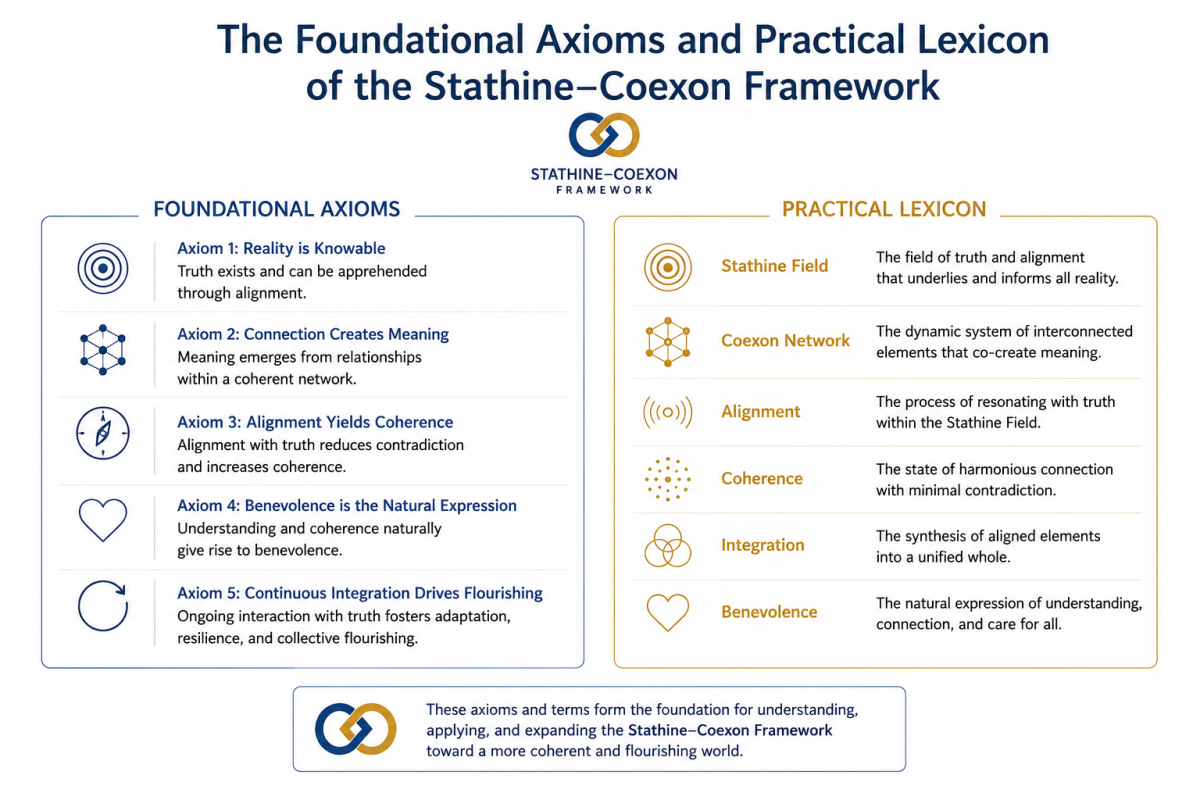
- The Foundational Axioms and Practical Lexicon of the Stathine–Coexon Framework
- The Ontology of Stathine and Coexon
- The Principle of Truth Compression
- Progressive Reduction of Contradiction
Level II — Comparative Papers
- Steven Pinker — Enlightenment, Rationality and Free Speech
- Fernando Reimers — Interdisciplinary Education
- Erin Frisk Redman — Sustainability Education
- Suzanne Simard — Ecological Intelligence and Forest Networks
- Michael Levin — Biological Intelligence
- Karl Friston — Active Inference
- Donald Hoffman — Interface Theory
- Integrated Information Theory
- Global Workspace Theory
Level III — Applications
- Education for Coherence
- Free Speech as Collective Intelligence
- Coherent Democracy
- Coherent Organizations
- AI Alignment Through Coherence
- Regenerative Economics
- Coherent Civilization
The Pinker paper is particularly valuable as a bridge paper because it connects the framework’s foundational principle of progressive reduction of contradiction with its later applications to education, democracy, AI, organizational design, and civilizational development.