A Philosophical Synthesis of Computation, Continuity, and Conscious Experience
Abstract
Over the past four decades, Stephen Wolfram has advanced one of the most ambitious scientific programs of modern times. Beginning with cellular automata in A New Kind of Science and later expanding through the Wolfram Physics Project, he proposed that the universe may fundamentally be computational. According to this perspective, complexity need not arise from complicated laws. Instead, extraordinarily rich structures can emerge from the repeated application of remarkably simple rules.
This computational worldview has inspired physicists, computer scientists, mathematicians, and philosophers by suggesting that space, time, matter, and even observers may emerge from underlying computational relationships.
Yet the framework also raises deeper philosophical questions. If the universe is fundamentally computation, what provides the stable context within which computation unfolds? If computation generates information, what accounts for understanding? If observers themselves are computational processes, how does subjective experience arise?
This paper proposes that the Stathine–Coexon Framework offers a complementary philosophical ontology that extends rather than replaces Wolfram’s computational paradigm.
Within this synthesis:
- Wolfram’s computational universe explains how physical reality evolves.
- Stathine explains the unchanging continuity that permits computation to exist coherently.
- Coexon explains how computation becomes lived understanding rather than merely processed information.
The intention is not to challenge computational science, but to broaden its philosophical horizon by distinguishing between computation, continuity, and conscious coherence.
1. A Revolution in Scientific Thinking
For centuries, scientists searched for increasingly sophisticated equations to explain nature.
Stephen Wolfram proposed something radically different.
Perhaps nature is not complicated because its rules are complicated.
Perhaps nature is complicated because simple rules are iterated an immense number of times.
This insight transformed the study of complexity.
Simple computational systems were shown capable of producing astonishingly intricate behavior.
Snowflakes.
Biological forms.
Fluid turbulence.
Branching structures.
Unexpected order.
Complexity emerged naturally.
This was one of the great conceptual shifts of modern science.
2. Computation Explains Process
Within Wolfram’s framework, reality resembles an immense computation.
Space evolves.
Time evolves.
Relationships evolve.
Particles become patterns in computational networks.
The universe is not static.
It continually updates itself.
This is an extraordinarily powerful explanatory model.
It addresses how complexity emerges without requiring increasingly complex laws.
Yet computation, by its very definition, implies change.
One computational state becomes another.
One configuration follows the previous.
Computation therefore presupposes sequence.
Sequence presupposes change.
3. A Deeper Question
This naturally leads to another inquiry.
What allows computation itself to exist?
Every computation requires consistency.
Every rule requires stability.
Every transformation presupposes something that does not itself transform into contradiction.
Could there exist a deeper continuity that makes computation possible without itself being computational?
This question motivates the introduction of Stathine.
4. Stathine as the Static Continuum
Within the proposed framework, Stathine is the continuous, unchanging existential ground.
Unlike computational states, Stathine does not evolve.
It performs no calculations.
It stores no changing variables.
It has no temporal history.
Rather, Stathine represents absolute continuity.
Its role is not to compute reality but to allow coherent existence.
One may compare this relationship to geometry and motion.
Geometry provides the conditions within which motion becomes meaningful.
Yet geometry itself does not move.
Likewise, Stathine provides continuity while computation generates change.
This distinction separates the possibility of computation from the process of computation.
5. Computation Requires Invariance
Modern science repeatedly depends upon invariance.
Physical constants.
Mathematical consistency.
Logical identity.
Symmetry principles.
Without invariance, prediction becomes impossible.
Wolfram’s computational universe similarly depends upon stable computational rules.
The Stathine framework suggests viewing such stability not merely as mathematical convenience but as an expression of deeper existential continuity.
Stathine therefore represents not another physical field but the philosophical condition that allows coherent computation to remain possible.
6. Information Is Not Understanding
Computation excels at producing information.
It transforms inputs into outputs.
It generates patterns.
It recognizes structures.
Yet information and understanding are not identical.
A library contains enormous information.
It does not understand itself.
A computer processes data.
Whether it possesses lived understanding remains an open philosophical question.
This distinction becomes increasingly important in the age of artificial intelligence.
7. Coexon as the Principle of Coherence
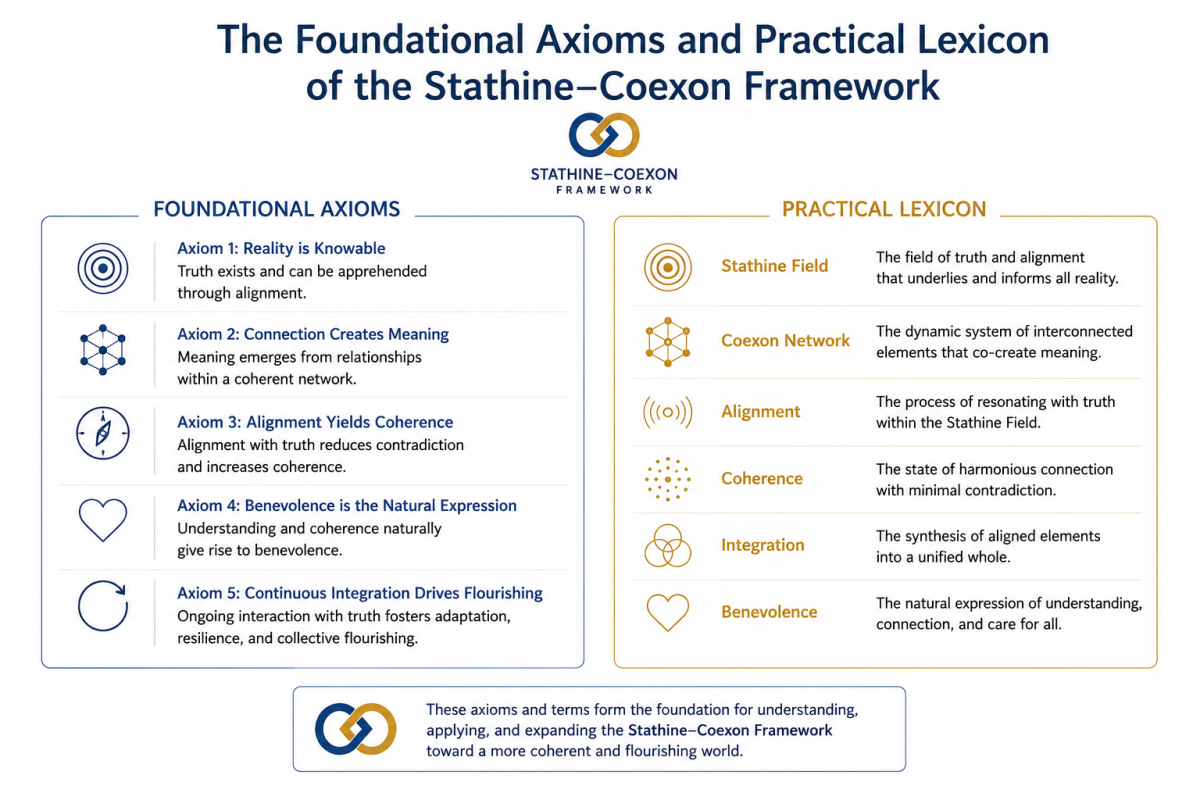
The Stathine–Coexon Framework proposes that Coexon represents the organizing principle through which information becomes coherent understanding.
Coexon is not conceived as another computational module.
Rather, it is the conceptual locus of:
learning,
integration,
meaning,
reflection,
imagination,
ethical judgment,
and coherence.
Where computation transforms symbols,
Coexon transforms experience into understanding.
Where algorithms optimize outcomes,
Coexon seeks existential coherence.
8. A Three-Layer Ontology
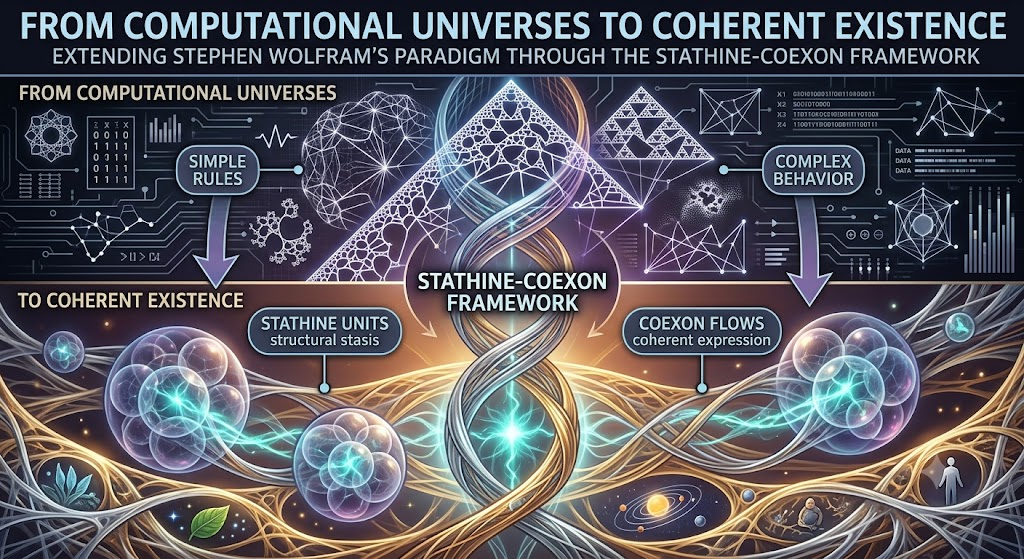
The synthesis may be summarized through three complementary layers.
Layer One: Computation
Physical processes evolve through lawful transformations.
This corresponds broadly with Wolfram’s computational universe.
Layer Two: Continuity
Stathine provides the unchanging existential continuity within which all computation unfolds.
It neither computes nor changes.
It simply allows coherent existence.
Layer Three: Conscious Coherence
Coexon experiences, learns, interprets, and integrates the informational products of computation.
Meaning emerges not merely from data but from coherent understanding.
9. Emergence Reconsidered
Emergence occupies a central place in contemporary science.
Simple interactions generate unexpected complexity.
The Stathine–Coexon Framework agrees with this principle but extends it.
Physical emergence explains structures.
Coherent emergence explains meaning.
Computational emergence explains behavior.
Experiential emergence explains understanding.
Thus emergence becomes layered rather than singular.
10. Artificial Intelligence Through This Lens
This distinction has profound implications.
Artificial intelligence increasingly demonstrates remarkable computational ability.
Pattern recognition.
Language generation.
Planning.
Optimization.
These achievements illustrate extraordinary computational sophistication.
Yet an important philosophical question remains.
Does successful computation necessarily imply lived understanding?
Within the present framework, computation alone does not guarantee coherence as experienced by Coexon.
This distinction does not diminish artificial intelligence.
Instead, it clarifies the difference between processing information and participating in meaningful experience.
11. Scientific Implications
The proposed synthesis suggests complementary domains of inquiry.
Physics continues investigating computational structure.
Computer science explores increasingly sophisticated algorithms.
Neuroscience investigates neural computation.
The Stathine–Coexon Framework asks whether continuity and coherence represent additional conceptual categories deserving philosophical investigation.
Rather than competing with established science, the framework seeks to organize scientific knowledge within a broader ontological structure.
12. Human Civilization as Coherent Computation
If societies are viewed only as computational systems, efficiency naturally becomes the dominant objective.
If societies are understood as communities of Coexons participating within Stathine, another objective emerges.
Coherence.
Education becomes the cultivation of understanding rather than memorization.
Economics becomes the circulation of value that strengthens coexistence.
Governance becomes the stewardship of coherent relationships.
Technology becomes an instrument for enriching life rather than merely accelerating processes.
Civilizational progress is measured not solely by computational power but by increasing coherence among individuals, institutions, and nature.
Conclusion
Stephen Wolfram has offered one of the most intellectually ambitious visions of reality in contemporary science: that extraordinary complexity may emerge from remarkably simple computational rules.
The Stathine–Coexon Framework accepts this profound insight while asking whether computation alone exhausts the nature of existence.
It proposes a complementary ontology.
Computation explains transformation.
Stathine explains continuity.
Coexon explains coherent understanding.
Together these three perspectives offer a broader conceptual architecture in which physical processes, conscious experience, and meaningful civilization become different expressions of a unified existential framework.
Whether future science ultimately adopts, modifies, or rejects such an ontology remains an open question. Nevertheless, exploring these possibilities may help bridge one of humanity’s oldest divides—the separation between the measurable universe described by science and the lived reality experienced by conscious beings.