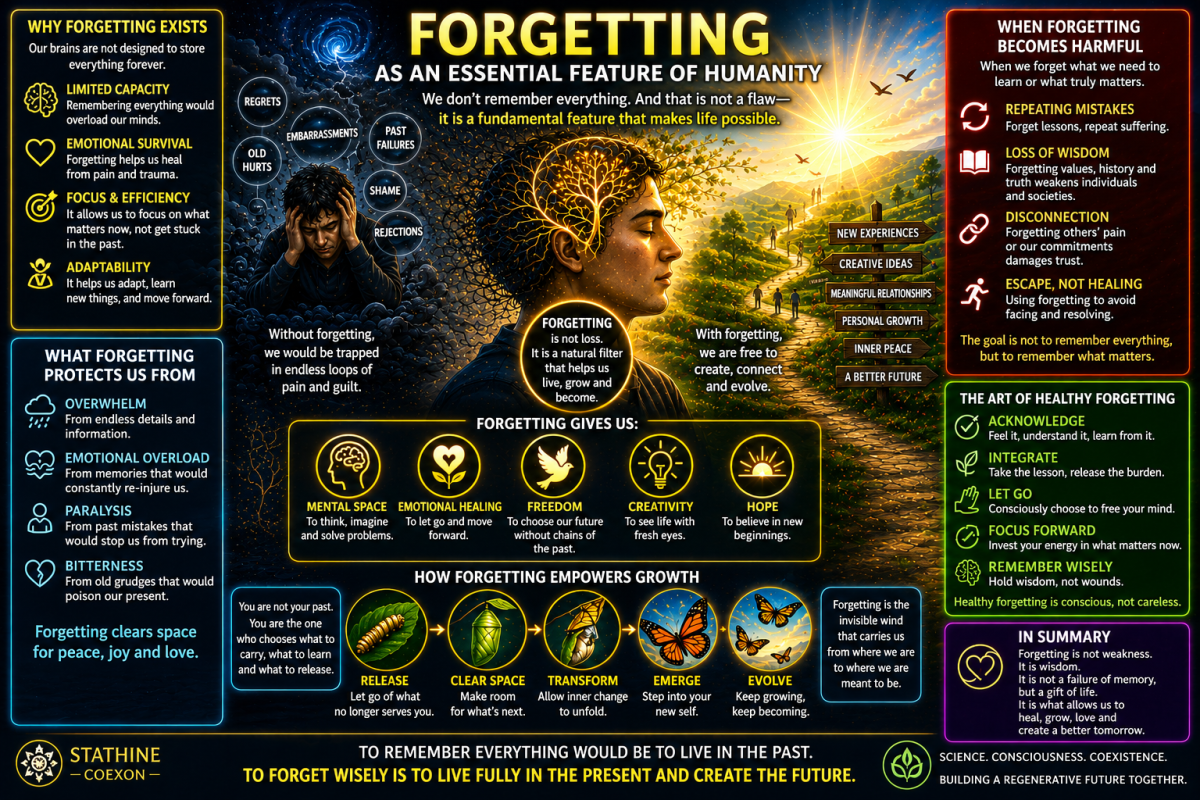
:Forgetting as Adaptive Reorganization
Abstract
Modern neuroscience increasingly recognizes forgetting not as a defect of cognition, but as an adaptive and necessary function of intelligent systems. Memory systems that preserve all information without selective pruning become unstable, inefficient, and behaviorally maladaptive. Contemporary discoveries in neuroplasticity, predictive processing, synaptic pruning, memory reconsolidation, and emotional regulation suggest that forgetting plays a crucial role in maintaining cognitive flexibility and adaptive coherence.
This article proposes an interpretive framework called the Stathine–Coexon model to conceptually integrate these scientific findings into a broader relational understanding of consciousness and cognition. In this framework, consciousness operates through dynamically organized relational structures (“Coexons”) embedded within a larger interconnected existential continuum (“Stathine”). Memory rigidity, repetitive behavioral loops, and identity fixation are interpreted as forms of orbital incoherence arising from incomplete understanding and accumulated cognitive contradiction. Forgetting is therefore reinterpreted not as loss alone, but as an adaptive mechanism through which consciousness reorganizes itself by dissolving maladaptive relational structures and reducing delusional fixation.
The article further argues that psychological suffering frequently arises from rigid persistence of incomplete interpretations of reality, while adaptive forgetting allows the nervous system to update internal models through emergent coherence. This proposal is examined in light of modern neuroscience, systems theory, contemplative traditions, and emerging models of predictive cognition.
1. Learn to use forgetting for Festivity
Human civilization traditionally treats forgetting as failure.
Educational systems reward retention.
Technology increasingly externalizes memory storage.
Identity itself is often built upon persistent narrative continuity.
Yet biology appears to operate differently.
The human nervous system continuously:
- edits memory,
- suppresses irrelevant information,
- weakens unused neural pathways,
- and reconstructs experience dynamically.
Forgetting is not accidental noise within cognition.
It is an evolved feature of adaptive intelligence.
Recent neuroscience demonstrates that:
- memories are reconstructive rather than fixed,
- synaptic pruning improves cognitive efficiency,
- emotional reinterpretation alters memory persistence,
- and excessive memory retention may impair adaptive functioning.
The Stathine–Coexon framework proposes that forgetting serves a deeper existential function:
adaptive dissolution of incoherent relational structures.
In this interpretation, consciousness evolves not through accumulation alone, but through continuous reorganization.
2. Memory and the Instability of Perfect Retention
Traditional computational metaphors often compare the brain to a storage device.
However, biological cognition differs fundamentally from digital preservation systems.
The brain is:
- dynamic,
- predictive,
- energy-constrained,
- emotionally mediated,
- and relationally adaptive.
Research in cognitive neuroscience increasingly suggests that forgetting improves:
- abstraction,
- flexibility,
- emotional adaptation,
- and decision-making.
Richards and Frankland (2017) proposed that forgetting is essential for intelligent behavior because it prevents cognitive overload and facilitates adaptive generalization.
Similarly, synaptic pruning during development removes excessive neural connections to improve network efficiency.
In biological systems:
preservation alone does not produce intelligence.
selective reorganization does.
3. Predictive Processing and Cognitive Delusion
Contemporary theories of predictive processing propose that the brain continuously constructs internal models of reality.
Perception itself becomes:
- predictive inference,
- expectation management,
- and error minimization.
The nervous system does not merely record reality passively.
It interprets, predicts, and compresses it.
When predictive models become excessively rigid:
- contradiction accumulates,
- emotional reactivity increases,
- and maladaptive behavioral loops emerge.
The Coexon framework interprets these rigid predictive loops as:
orbital incoherence generated through incomplete understanding.
In psychological terms, delusion need not imply psychosis alone.
Ordinary cognition frequently contains:
- distorted assumptions,
- emotionally reinforced narratives,
- identity rigidity,
- and inherited social conditioning.
The persistence of these structures creates suffering because:
reality continues changing while cognition remains fixed.
4. Forgetting as Adaptive Coexon Reorganization
The Coexon model proposes that consciousness operates through relational orbital structures analogous to dynamic energetic organizations.
The progression:
[
1,;2,;8,;18,;32
]
symbolizes increasing levels of:
- relational complexity,
- adaptive integration,
- and coherent emergence.
As consciousness interacts with experience:
- behavioral loops stabilize,
- emotional associations strengthen,
- and identity structures emerge.
However, incomplete understanding generates distortions.
Like corrupted software loops repeatedly accessing damaged hard-drive sectors, unresolved emotional and cognitive structures produce repetitive maladaptive cycles.
These include:
- compulsive emotional reactions,
- rigid ideological identification,
- trauma repetition,
- self-destructive behavior,
- and chronic relational conflict.
The framework therefore proposes:
forgetting functions as an adaptive reset mechanism allowing orbital reorganization.
Unused or incoherent structures weaken over time, enabling consciousness to:
- update internal models,
- reduce contradiction,
- and restore adaptive flexibility.
5. Memory Reconsolidation and Reconstructive Consciousness
Modern neuroscience now demonstrates that memories become temporarily malleable when recalled.
This process, known as memory reconsolidation, allows:
- reinterpretation,
- emotional updating,
- and behavioral transformation.
Nader and Hardt (2009) showed that recalled memories are not fixed archives but dynamic reconstructions vulnerable to modification.
This has profound implications.
Identity itself becomes:
- continuously reconstructed,
- relationally adaptive,
- and experientially reorganized.
The Stathine–Coexon interpretation suggests:
consciousness is not designed for perfect preservation,
but for adaptive coherence within changing relational realities.
Forgetting therefore becomes:
- functional,
- evolutionary,
- and psychologically necessary.
6. Emotional Regulation and Dissolution of Delusion
Research by Lieberman et al. demonstrated that labeling emotions alters neural activity by reducing amygdala reactivity while increasing prefrontal regulation.
Awareness changes emotional processing.
This implies:
conscious observation reorganizes neural patterns.
The Coexon framework extends this insight.
Emotional suffering persists when:
- reactive loops remain unconscious,
- contradiction accumulates,
- and identity fuses rigidly with thought.
Understanding weakens these loops.
Thus forgetting, reinterpretation, and metacognitive awareness together facilitate:
- emotional flexibility,
- adaptive regulation,
- and reduction of cognitive delusion.
In this model:
healing is not erasure of memory,
but dissolution of rigid maladaptive relational attachment.
7. Stathine and Relational Consciousness
The Stathine continuum proposes that consciousness is fundamentally relational rather than isolated.
Human cognition continuously emerges through interaction with:
- language,
- society,
- emotion,
- symbolic systems,
- and environmental participation.
Thus:
- memory itself is relational,
- identity is socially constructed,
- and consciousness is dynamically participatory.
Forgetting becomes essential because:
adaptive participation requires continuous updating of relational structures.
Rigid persistence produces fragmentation.
Adaptive dissolution enables emergence.
8. Emergence Rather Than Static Preservation
Nature itself demonstrates that evolution depends upon:
- restructuring,
- dissolution,
- and emergence.
Cells die to maintain organisms.
Neural pathways weaken to improve cognition.
Ecological systems reorganize continuously.
Even chemistry demonstrates emergent transformation:
- combustible hydrogen,
- and combustion-supporting oxygen,
together form water which extinguishes fire.
[
2H_2 + O_2 \rightarrow 2H_2O
]
Existence therefore evolves through:
- relational transformation,
not merely preservation.
The Stathine–Coexon framework proposes that forgetting serves this same emergent principle within consciousness itself.
9. Implications for Psychology and Civilization
Modern civilization increasingly suffers from:
- informational overload,
- identity rigidity,
- ideological fixation,
- and continuous cognitive stimulation.
Digital systems preserve:
- memories,
- narratives,
- outrage,
- and trauma indefinitely.
Yet biological intelligence evolved with selective forgetting.
Without adaptive dissolution:
- emotional fragmentation accumulates,
- reactive identity intensifies,
- and social polarization increases.
The framework therefore suggests:
healthy civilizations may require collective mechanisms of adaptive reinterpretation and cognitive flexibility.
Understanding becomes more important than accumulation alone.
10. Conclusion
Modern neuroscience increasingly reveals that forgetting is not failure but adaptive intelligence.
The Stathine–Coexon framework extends this insight by proposing that consciousness continuously reorganizes itself through dissolution of incoherent relational structures.
In this interpretation:
- memory is dynamic,
- identity is emergent,
- suffering arises through rigid contradiction,
- and forgetting enables adaptive coherence.
Human beings are not designed merely to preserve information indefinitely.
They are designed to:
- update,
- reinterpret,
- reorganize,
- and participate coherently within changing relational realities.
Thus forgetting becomes:
not the enemy of consciousness,
but one of its deepest mechanisms for growth, healing, and liberation from delusion.
References
- Frankland, P. W., & Richards, B. A. (2017). Why is forgetting adaptive? Science, 362(6413), eaau575.
- Nader, K., & Hardt, O. (2009). A single standard for memory: the case for reconsolidation. Nature Reviews Neuroscience, 10(3), 224–234.
- Lieberman, M. D. et al. (2007). Putting feelings into words: affect labeling disrupts amygdala activity. Psychological Science, 18(5), 421–428.
- Friston, K. (2010). The free-energy principle: a unified brain theory? Nature Reviews Neuroscience, 11(2), 127–138.
- Clark, A. (2013). Whatever next? Predictive brains, situated agents, and the future of cognitive science. Behavioral and Brain Sciences, 36(3), 181–204.
- Tononi, G. (2008). Consciousness as integrated information: a provisional manifesto. Biological Bulletin, 215(3), 216–242.
- Sheldrake, R. (1981). A New Science of Life. Blond & Briggs.
- Varela, F., Thompson, E., & Rosch, E. (1991). The Embodied Mind. MIT Press.