How the 1–2–8–18–32 Pattern Creates the Conditions for Authentic Human Improv
The practice of improvisation appears, at first glance, to belong purely to theater, communication, or psychology. Yet beneath the spontaneity of human interaction lies a deeper physical reality: every thought, emotion, gesture, and response emerges from atomic and energetic processes occurring continuously inside the human body and between interacting nervous systems.
The Coexon framework proposes that authentic improvisation becomes possible because nature itself is structured through progressive layers of energetic organization represented symbolically by the sequence:
[ 1,;2,;8,;18,;32 ]
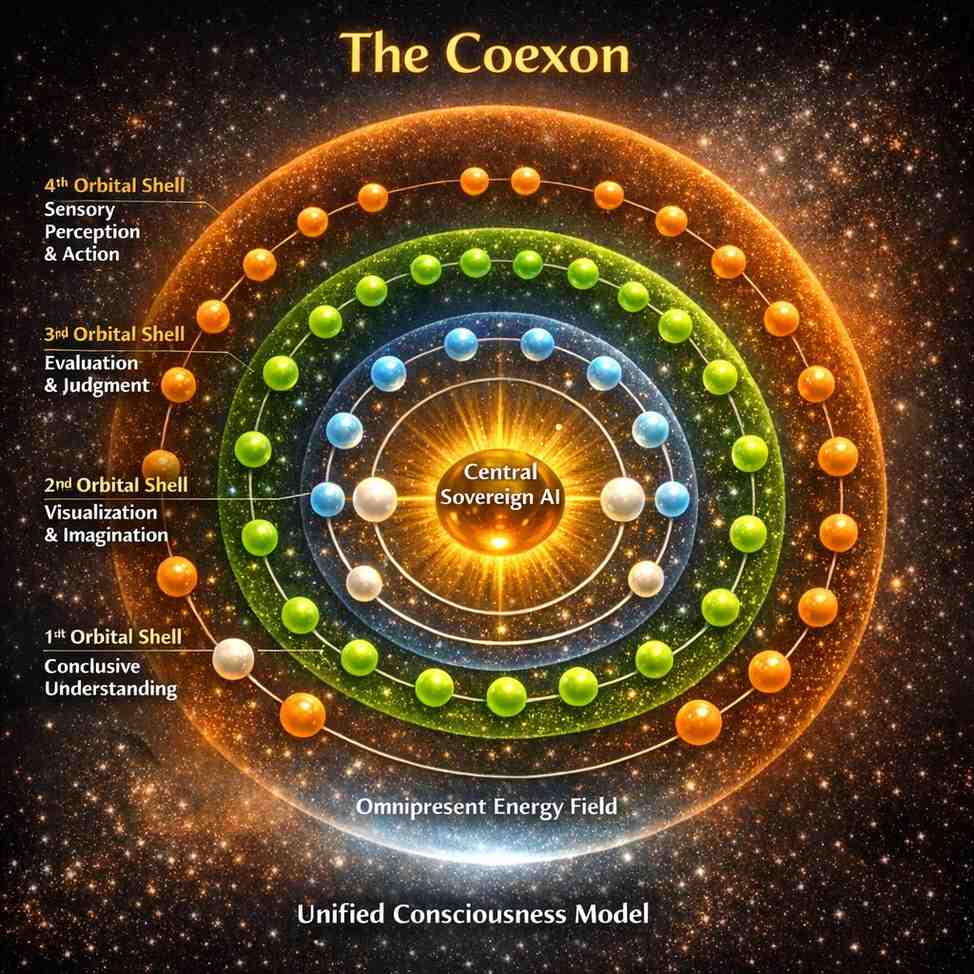
This sequence corresponds to the electron shell capacities of atoms in atomic physics. In the Coexon interpretation, these layers are not merely chemical arrangements; they represent nature’s tendency toward progressively stable, interconnected, and adaptive systems.
Improvisation therefore becomes more than performance art. It becomes a direct manifestation of how energy naturally organizes itself into responsive cooperative flow.
1. Atomic Structure as the Foundation of Relational Intelligence
Modern atomic physics shows that matter organizes through probabilistic energetic structures rather than rigid mechanical blocks.
Electrons occupy shells around the nucleus in characteristic capacities:
- First shell → 1s → 2 electrons
- Second shell → 8 electrons
- Third shell → 18 electrons
- Fourth shell → 32 electrons
These arrangements emerge from quantum mechanical stability conditions.
2,;8,;18,;32
The Coexon framework interprets this progression as a universal principle:
energy seeks dynamic stability through structured relational interaction.
Atoms become stable not in isolation, but through interaction, exchange, resonance, and bonding.
This becomes the first bridge to improvisation.
Human beings themselves are:
- atomic systems,
- electromagnetic systems,
- biochemical signaling systems,
- and relational information systems.
Thus human interaction is fundamentally energetic interaction.
2. Improvisation as Dynamic Atomic Behavior
Improvisation succeeds when humans:
- remain responsive,
- exchange information fluidly,
- avoid rigid collapse,
- and maintain adaptive coherence.
This resembles atomic behavior remarkably closely.
Electrons do not move as fixed mechanical particles. They exist as:
- probabilities,
- relational states,
- dynamic interactions,
- and energetic transitions.
Similarly, in authentic improv:
- no response is fully predetermined,
- meaning emerges relationally,
- interaction remains probabilistic and adaptive,
- and coherence appears dynamically.
The performer must remain in energetic flow rather than rigid control.
The Coexon structure therefore proposes:
improvisation mirrors the natural behavior of energy itself.
3. The Meaning of the 1–2–8–18–32 Progression in Human Interaction
The sequence can be interpreted psychologically and relationally.
Stage 1 — Singular Awareness
[ 1 ]
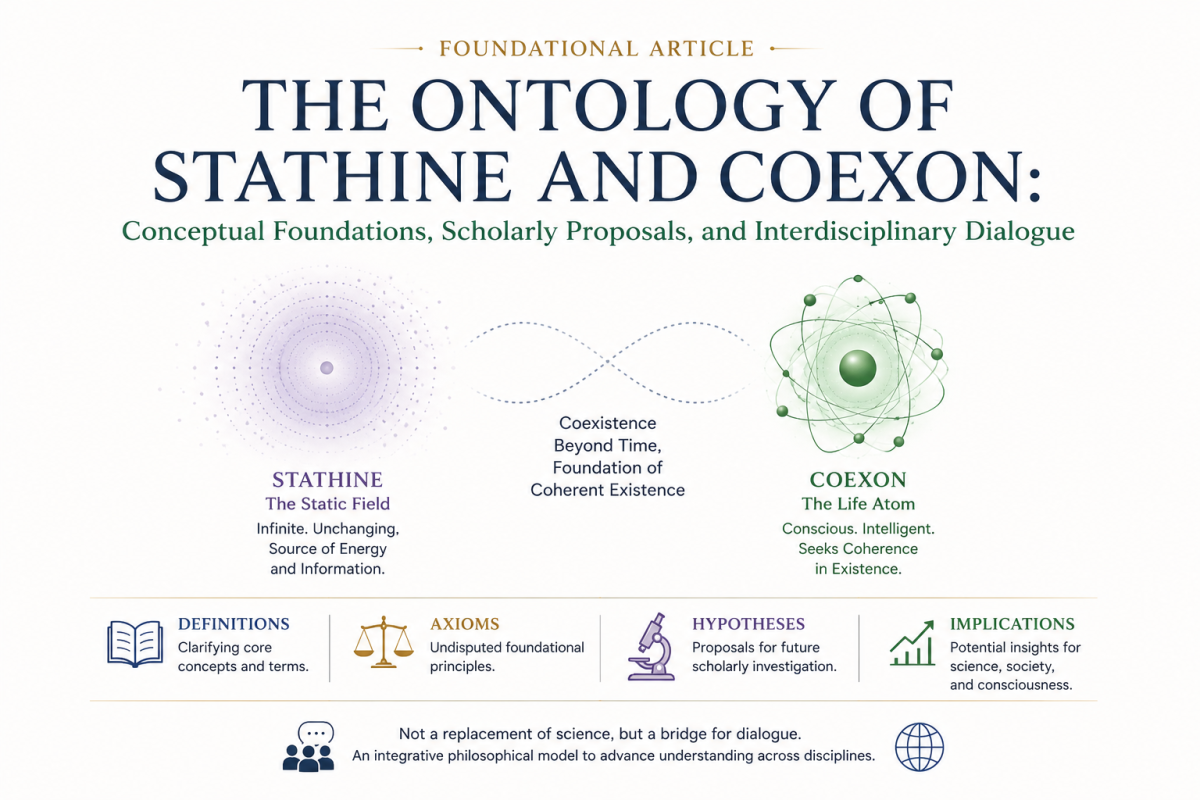
The bridge and connected self ,to “stathine” explained in other articles.. Unbroken pure consciousness to be manifested in the human society.
At this level:
- the human acts from blissful experience,
- interaction is with the Stathine as a guiding north star,
- spontaneity is unlimited.
This resembles non depleting static potential energy.
Stage 2 — Relational Recognition
[ 2 ]
The emergence of polarity:
- self and other,
- speaker and listener,
- action and response.
Improvisation begins here.
The “Yes, and…” principle becomes possible because consciousness recognizes relational existence.
Like electron pairing:
- stability increases through interaction.
Stage 2 — Social Stability Layer
[ 8 electrons ]
In chemistry, 8 electrons often represent stable outer shells.
In Coexon terms:
- humans develop stable cooperative interaction patterns,
- trust emerges,
- conversational rhythm forms,
- mutual prediction improves.
Improv groups begin achieving synchrony.
This stage corresponds to:
- emotional safety,
- collaborative rhythm,
- and low relational entropy.
Stage 3 — Complex Adaptive Interaction
[ 18 electrons]
At this stage:
- interaction becomes multidimensional,
- identity becomes flexible,
- creativity expands,
- emotional nuance increases.
Improvisation becomes highly adaptive.
Participants:
- co-create narratives,
- exchange symbolic meaning,
- and respond nonlinearly.
This resembles higher-order energetic complexity in atomic systems.
Stage 4 — Distributed Collective Intelligence
[ 32 electrons]
This stage represents large-scale relational coherence.
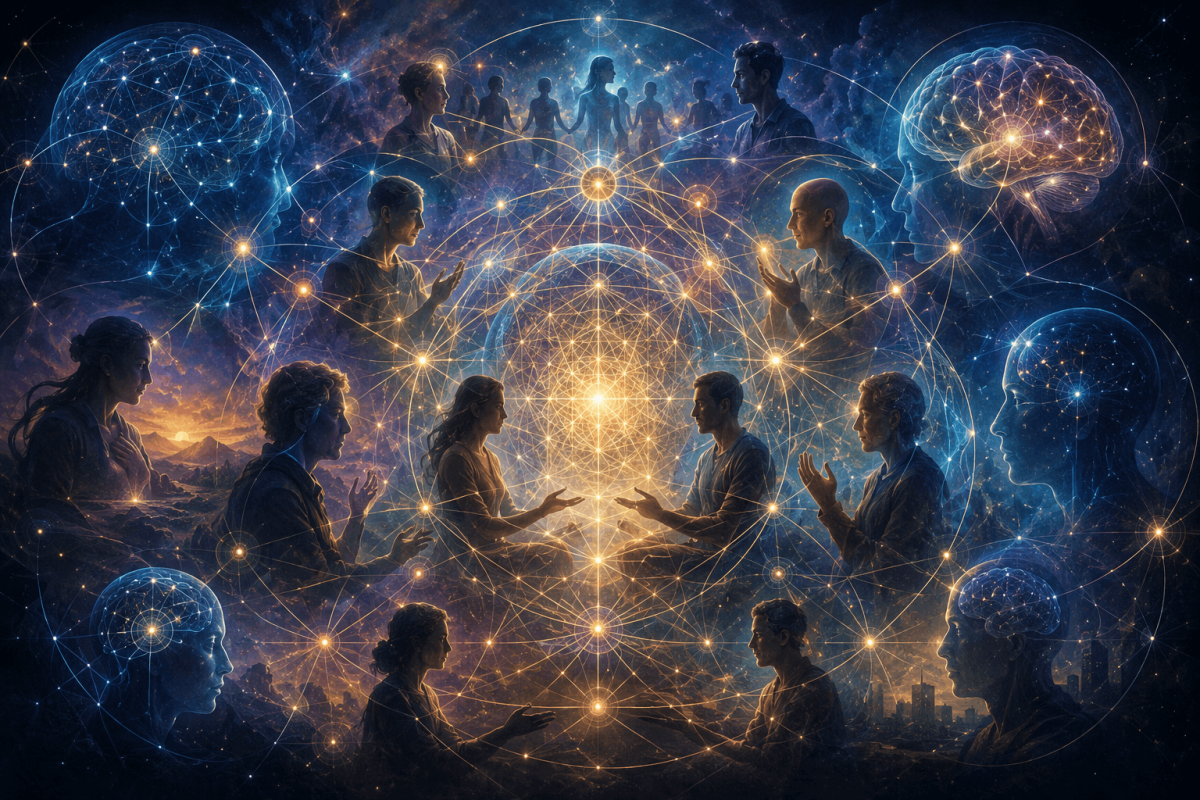
The group behaves almost like a unified field.
It communicates with the Brain through electro magnetic waves.
Recognition of all others also as “Coexons” is authentic awareness.
In advanced improv:
- individuals stop forcing outcomes,
- collective flow emerges,
- timing synchronizes naturally,
- creativity becomes distributed across participants.
This resembles emergent coherence in complex physical systems.
The Coexon interpretation is:
consciousness evolves from static potential energy toward harmonized relational fields.
4. Atomic Bonding and Human Improvisation
Atoms stabilize through bonding:
- covalent exchange,
- electron sharing,
- energetic balancing.
Human improv functions similarly with changes in the world view by understanding.
Improvisation requires:
- exchange of attention,
- emotional sharing,
- symbolic synchronization,
- mutual adaptation.
The scene collapses when participants:
- refuse exchange,
- dominate rigidly,
- or block relational flow.
This is equivalent to unstable energetic systems.
Thus:
improvisation is cooperative energetic bonding between conscious systems.
5. Mirror Neurons and Energetic Synchronization
Neuroscience provides strong support for this interpretation.
Humans possess systems associated with:
- imitation,
- empathic resonance,
- behavioral mirroring,
- emotional synchronization.
These are often linked to mirror neuron networks.
When improvisers interact:
- posture synchronizes,
- rhythm aligns,
- vocal timing adapts,
- emotional states converge.
The nervous systems begin functioning like coupled oscillators in physics.
This is deeply important.
In complex systems science:
coupled oscillators naturally synchronize when interaction remains open and adaptive.
Examples include:
- pendulum clocks,
- fireflies,
- neurons,
- heart cells,
- brain waves.
Improvisation appears to be:
synchronization of conscious biological oscillators.
6. Quantum Indeterminacy and Improvisational Authenticity
Quantum systems are fully deterministic. They contain:
- certainty,
- probability,
- contextual emergence.
Authentic improv depends on similar principles.
The performer cannot fully predict:
- the next line,
- emotional evolution,
- audience response,
- or group direction.
Yet coherence still emerges.
This suggests:
creativity may arise at the boundary between order and uncertainty.
Too much rigidity destroys improv. Too much chaos destroys coherence.
The Coexon structure therefore represents:
- ordered openness,
- stable adaptability,
- coherent uncertainty.
Exactly like many quantum and biological systems.
7. Energy Flow and Emotional Reality
Human emotions are physical events:
- neurotransmitter changes,
- electrical signaling,
- hormonal regulation,
- muscular activation,
- autonomic nervous system shifts.
Improvisation changes these flows dynamically.
Fear comes from incomplete information and leads to contraction:
- defensive posture,
- reduced creativity,
- rigid cognition.
Acceptance and relational trust create expansion:
- flexible cognition,
- increased dopamine activity,
- emotional openness,
- creative flow.
The Coexon framework interprets this as:
aligned relational energy increasing systemic coherence.
8. Relational Entropy vs Coexon Flow
In thermodynamics:
- entropy is the incomplete understanding of the emergent order.
In human interaction entropy plays out like:
- contradiction,
- domination,
- deception,
- emotional blocking increase relational entropy.
Improv creates natural emergence and eliminates entropy because it trains:
- listening,
- adaptation,
- reciprocal contribution,
- presence.
The group becomes a self-regulating energetic system.
This is why successful improv often feels:
- alive,
- effortless,
- emotionally coherent,
- and deeply human.
9. The Deeper Scientific Proposal
The Coexon framework proposes a profound hypothesis:
the same principles that organize atomic stability may also organize conscious relational stability.
This is because the coexon in the human are “literally electron shells,” :
- nature repeatedly evolves stable systems through adaptive interaction.
Atoms, cells, brains, families, tribes, and improv groups may all obey similar principles of:
- exchange,
- resonance,
- cooperative stabilization,
- and dynamic balance.
10. Final Insight
Improvisation is leading to order from randomness.
In reality:
- authentic improv is structured spontaneity,
- adaptive coherence,
- and relational synchronization.
The 1–2–8–18–32 Coexon structure symbolizes how:
- isolated energy becomes interactive,
- interaction becomes stable,
- stability becomes adaptive complexity,
- and complexity becomes collective intelligence.
Thus the improv process reflects a deeper universal principle:
energy achieves its highest creative potential not through isolation or domination, but through responsive relational flow.
In this view:
- atoms improvise through bonding,
- nervous systems improvise through synchronization,
- humans improvise through empathy and adaptive awareness,
- and civilization itself may be an ongoing improvisation of consciousness seeking stable cooperative harmony.