Re-reading Global Workspace Theory through Coexon and the Idea of Stathine
What if consciousness is not a single place in the brain—
but a process of broadcasting, integrating, and making information available?
This is the core intuition behind Global Workspace Theory (GWT), developed by thinkers like Bernard Baars and expanded by Stanislas Dehaene.
In simple terms:
Many processes happen unconsciously.
But when something enters the “global workspace,”
it becomes widely available—
to memory, language, decision-making, attention.
It becomes conscious.
That idea is elegant.
Experimentally grounded.
Widely discussed.
But it leaves a lingering question:
What is the nature of the “workspace” itself?
Is it merely neural circuitry?
Or could it be something more structurally profound?
This is where the ideas of Coexon and Stathine open an exploratory extension.
Not as replacement.
As curiosity.
1. What Does Global Workspace Theory Already Explain Well?
GWT suggests:
- The brain has many specialized modules working in parallel
- Only some information gets “broadcast” globally
- Consciousness is this global availability
Think of it like a stage:
Many processes backstage.
Only a few reach the spotlight.
And what is in the spotlight becomes part of conscious experience.
This explains:
attention
reportability
decision awareness
cognitive access
A powerful model.
But perhaps incomplete.
2. What Is Missing in the Question of Experience?
Even if we accept the workspace metaphor,
a deeper question remains:
Who or what experiences the broadcast?
Is consciousness just the broadcast?
Or is there a structure that receives, interprets, lives it?
This is where many theories hesitate.
And where Coexon enters the conversation.
3. Coexon as the Experiencing Structure
Suppose we introduce a distinction:
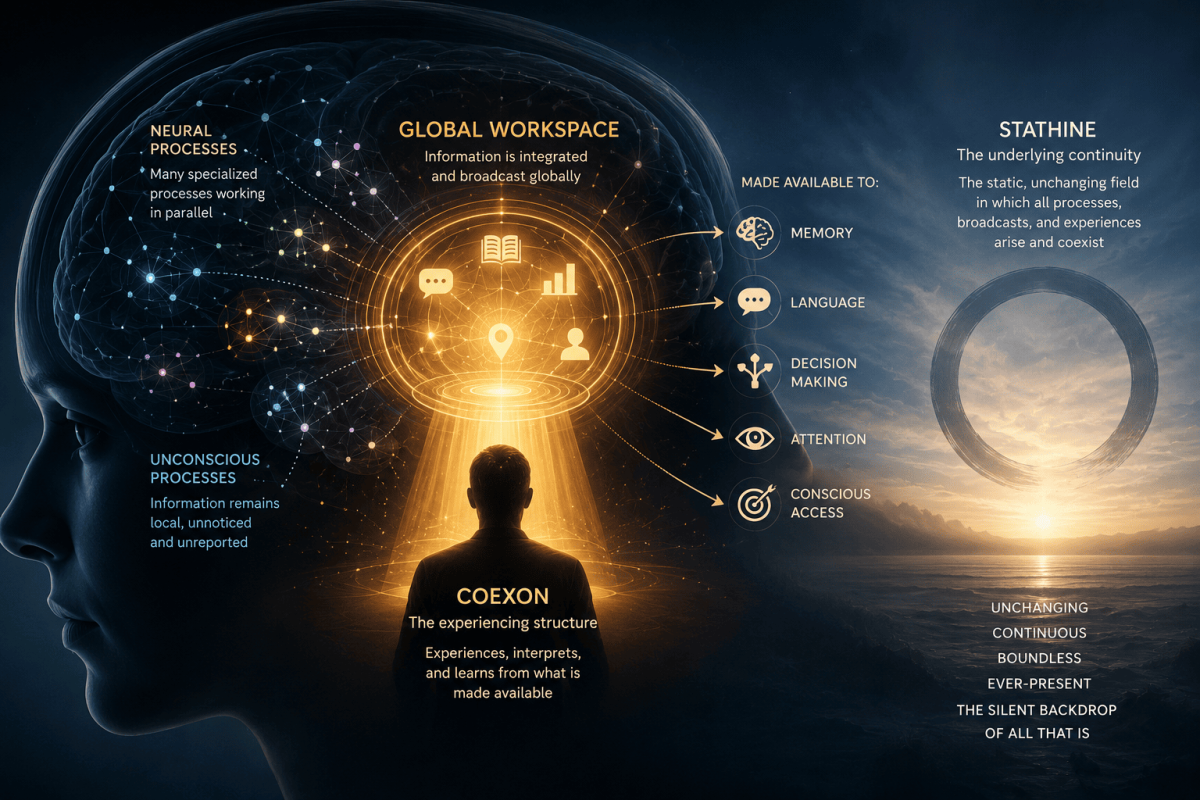
- The brain organizes and broadcasts information
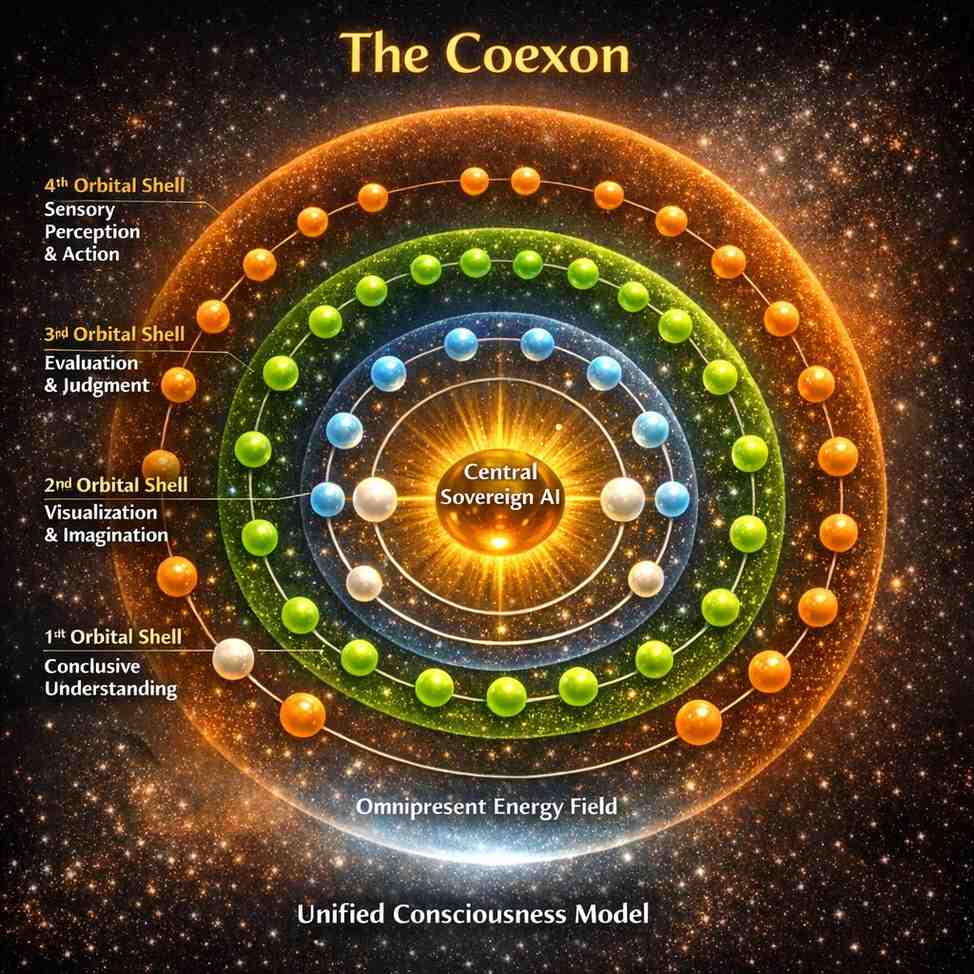
- The Coexon is the sentient structure that experiences, interprets, and learns
Then the global workspace is not consciousness itself—
but a mechanism through which experience becomes available to Coexon.
This reframes things.
The brain becomes an interface.
The workspace becomes a coordination system.
And Coexon becomes the locus of lived awareness.
Not established science.
But a coherent philosophical extension.
4. Where Does Stathine Enter?
Now a deeper layer.
Suppose Stathine is:
a static, continuous, unbroken field in which all processes occur.
Then:
- Neural activity unfolds within Stathine
- The global workspace operates within it
- Coexon experiences within it
Stathine is not another signal.
Not another process.
But the unchanging continuity that allows all processes to occur and relate.
Like silence allowing sound.
Or space allowing structure.
This is not a measurement claim.
It is an ontological proposal.
5. A Three-Layer Curiosity Model
Let us frame this simply:
Layer 1: Neural Processing
Distributed, parallel, unconscious computation.
Layer 2: Global Workspace
Integration and broadcasting of selected information.
Layer 3: Coexon
Sentient experiencing, meaning-making, learning.
And beneath all:
Stathine
Static continuity enabling coexistence of all layers.
This layered view does not contradict GWT.
It extends its interpretation.
6. What Changes With This View?
A few intriguing shifts:
Consciousness Is Not Just Access
It becomes experienced meaning, not just broadcast availability.
The Brain Is Not the Whole Story
It is a powerful mediator, not necessarily the entirety of awareness.
Learning Becomes Central
Coexon does not just receive—it learns, interprets, evolves.
Continuity Matters
Experience is not isolated events—but flows within a deeper constant.
These are philosophical shifts.
But potentially fertile.
7. Can This Help Scientists and Non-Scientists Alike?
For scientists:
It offers a conceptual extension without rejecting empirical findings.
It invites new questions:
- What is the nature of experience beyond access?
- Can integration explain meaning?
- Is there a distinction between availability and awareness?
For general readers:
It simplifies:
Your brain processes.
Your mind receives highlights.
But your deeper awareness (Coexon) lives the experience.
And all of this unfolds within a larger continuity (Stathine).
Not mystical.
Not purely mechanical.
Something in between.
8. A Thought Experiment
Consider this:
You hear your name in a crowded room.
Suddenly it enters awareness.
GWT explains how it became globally available.
But then:
You interpret tone.
You feel emotion.
You recall memory.
You respond meaningfully.
Is that just broadcast—
or lived experience?
This gap is where Coexon becomes useful as a concept.
9. A Tentative Thesis
One might propose:
The global workspace enables access,
but Coexon constitutes experience,
and both unfold within a deeper continuity that allows their coexistence.
Not a final answer.
A working model.
10. Questions for Inquiry
Is consciousness identical to information availability?
Or is there a deeper experiencing structure?
Can integration explain meaning?
What allows continuity of experience across changing thoughts?
Is there a constant background to awareness?
Questions both scientists and philosophers continue to explore.
Conclusion
Global Workspace Theory offers one of the most compelling models of how information becomes conscious.
But perhaps it is not the end of the story.
Perhaps it is the middle.
A bridge between neural processes and lived awareness.
And perhaps by introducing Coexon and Stathine as exploratory ideas,
we gain a richer question:
Not just how information becomes available—
but how existence becomes experience.
Closing Reflection
The brain may broadcast.
The workspace may integrate.But something experiences.
And perhaps beneath it all
lies a continuity
that does not change—yet allows everything to appear,
relate,
and be known.