Living Together Without Fragmentation
Abstract (Plain Language)
Across the world, we face the same problems:
- Conflict in relationships
- Political division
- Economic inequality
- Environmental damage
We have more knowledge than ever — but less harmony.
This article proposes a simple idea:
The problem is not lack of systems.
The problem is how we experience separation.
Two concepts help us look at this differently:
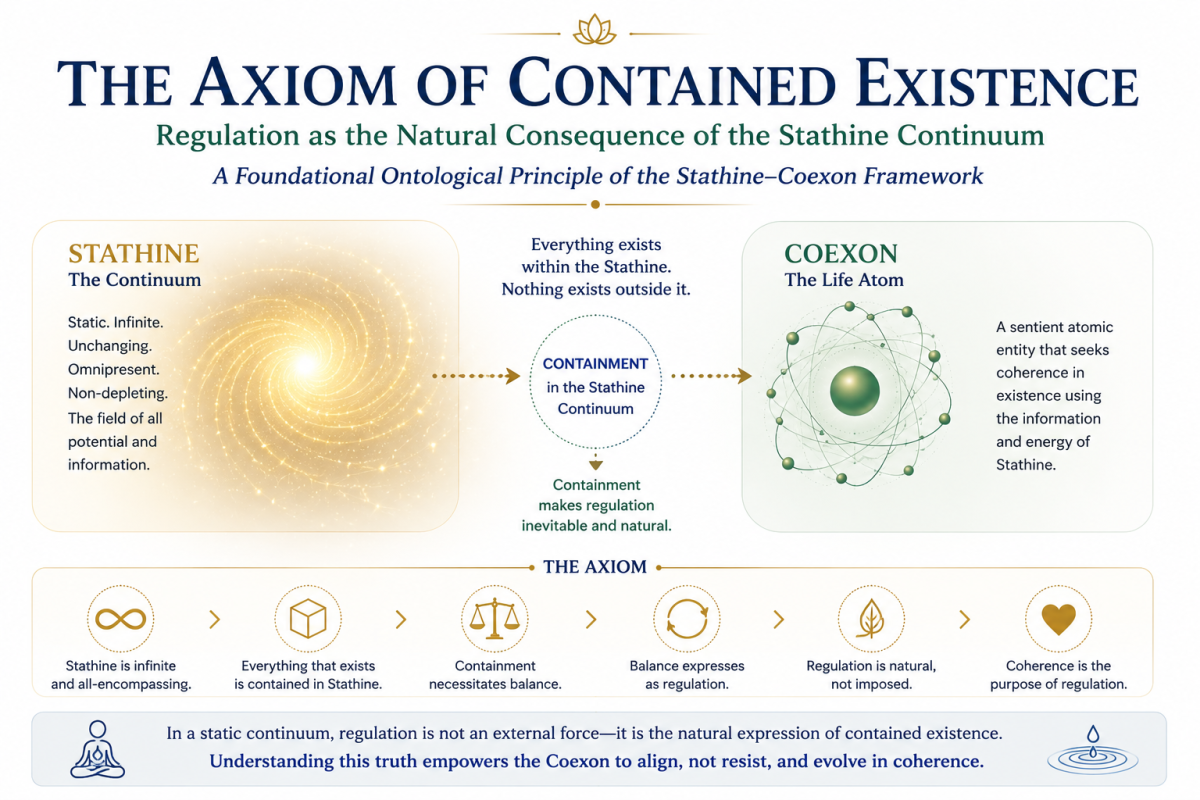
- Stathine → the continuous presence that connects everything
- Coexon → our ability to recognize this connection and act accordingly
Together, they offer a way to move from:
- Conflict → coherence
- Control → participation
- Survival → enrichment
1. What Is Actually Going Wrong Today?
Let’s strip it down.
At every level — personal, social, global — we see:
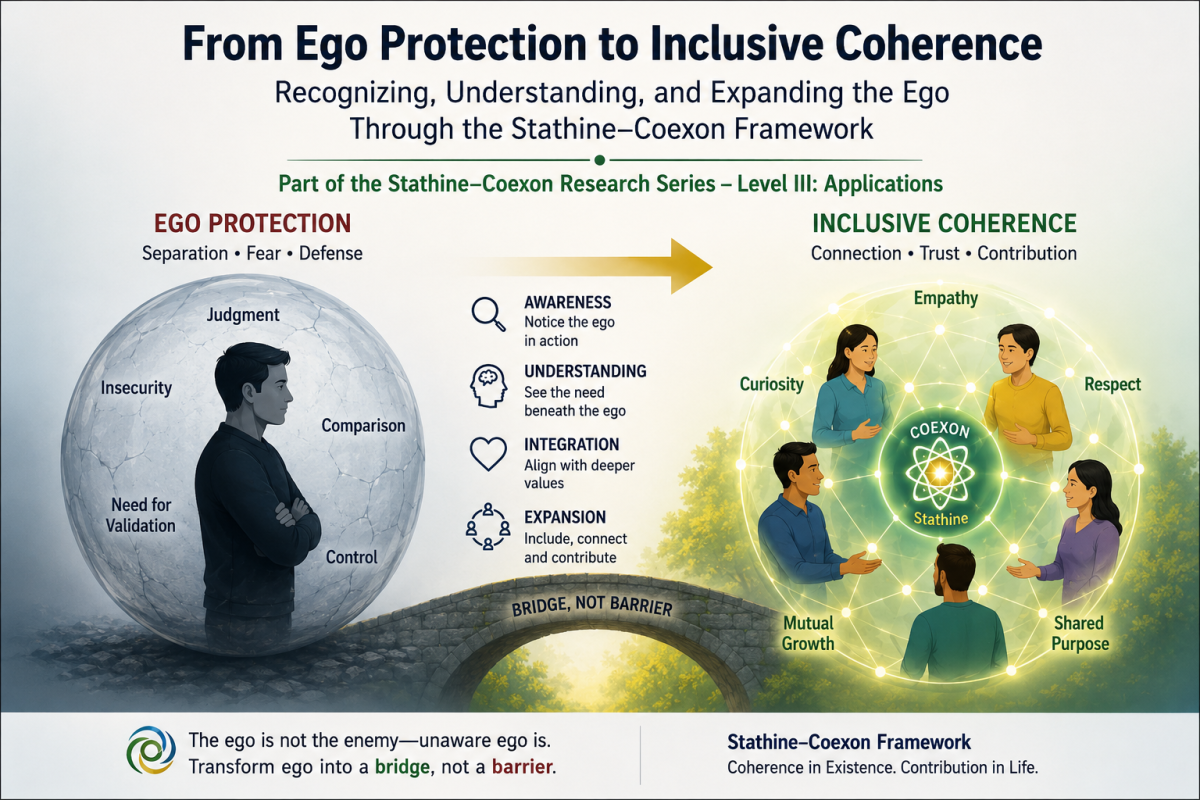
- “Me vs You” thinking
- Competition over cooperation
- Short-term gain over long-term well-being
The Hidden Pattern
Whether it is:
- A family argument
- A corporate rivalry
- A political fight
The underlying pattern is the same:
We act as if we are completely separate from each other.
2. Stathine: The Idea That Changes the Ground
Stathine is a simple but powerful way to look at reality
Everything exists within a continuous, unbroken presence.
What This Means Practically
- The space between people is not “nothing”
- Systems are not isolated
- Actions do not stay local — they ripple
Why This Matters
When we ignore continuity:
- We exploit resources
- We harm others
- We create instability
👉 When we recognize continuity:
- We naturally think in terms of impact and connection
3. Coexon: The Ability We Already Have
Coexon is not something new to install.
It is the ability we already have to notice:
- Contradictions
- Disconnection
- Misalignment
Everyday Examples
- You say “relationships matter” but ignore people → discomfort
- You chase success but feel empty → contradiction
- You argue but know you’re partly wrong → tension
That tension is not a problem.
👉 It is Coexon trying to restore coherence
4. Why Current Systems Keep Failing
We keep trying to fix problems through:
- Policies
- Laws
- Technology
All of which are important.
But they operate on a hidden assumption:
People will continue acting from separation.
So:
- Capitalism becomes exploitation
- Socialism becomes control
- Democracy becomes division
👉 The issue is not the system.
It is the state of perception behind the system
5. What Changes with Stathine + Coexon
5.1 In Individuals
From:
- “How do I win?”
To:
- “How do I act without breaking the whole I’m part of?”
5.2 In Relationships
From:
- Blame
To:
- Understanding shared responsibility
5.3 In Organizations
From:
- Short-term profit
To:
- Sustainable contribution
5.4 In Organizations
From:
- Power struggles
To:
- Problem-solving based on interconnected impact
6. The Shift from Control to Participation
Most systems today are built on:
- Control
- Enforcement
- Regulation
With This Framework
We move toward:
- Awareness
- Alignment
- Participation
👉 Example:
Instead of:
- Forcing environmental laws
We create:
- Awareness that harming the environment harms ourselves
This is not idealism.
It is:
Better alignment with reality
7. Enriching the Planet Becomes Natural
When separation reduces:
- Exploitation feels irrational
- Cooperation becomes efficient
- Contribution becomes meaningful
👉 The goal shifts from:
- “How do I get more?”
To:
- “How do we make the whole better?”
8. Why This Can Actually Work
Because it doesn’t depend on:
- Belief
- Religion
- Ideology
It depends on:
- Direct observation
Anyone can see:
- Their own contradictions
- Their own impact on others
- Their own connection to systems
👉 That’s where change begins.
9. What You Can Do (Right Now)
No grand system needed.
Start small:
Step 1: Notice Contradictions
- Where are your actions and values misaligned?
Step 2: Reduce Fragmentation
- Make one decision today that aligns better
Step 3: Think in Continuity
- Before acting, ask:
- “What does this do to the larger system?”
Step 4: Contribute
- Add value without needing immediate return
These are not moral rules.
They are:
Practical ways to live without internal and external conflict
10. A Realistic Expectation
This will not:
- Instantly fix the world
- Eliminate conflict
But it can:
- Reduce unnecessary conflict
- Improve clarity
- Create more stable systems
👉 And that is how real change happens:
- Gradually
- Systemically
- Sustainably
Closing Reflection
We tried to fix the world
without understanding how we experience it.
We built better systems,
but carried the same fragmentation into them.
Stathine reminds us —
nothing is truly separate.
Coexon shows us —
where we are acting as if it is.
And in that small gap between
what is
and how we live,
lies the possibility
of a better world.