Interdisciplinary Validation of the Coexon Hypothesis
Abstract
Understanding consciousness remains one of the most significant challenges in modern science. Existing explanations often focus on specific domains such as neuroscience, cognitive science, or philosophy, but a unified explanatory framework remains elusive.
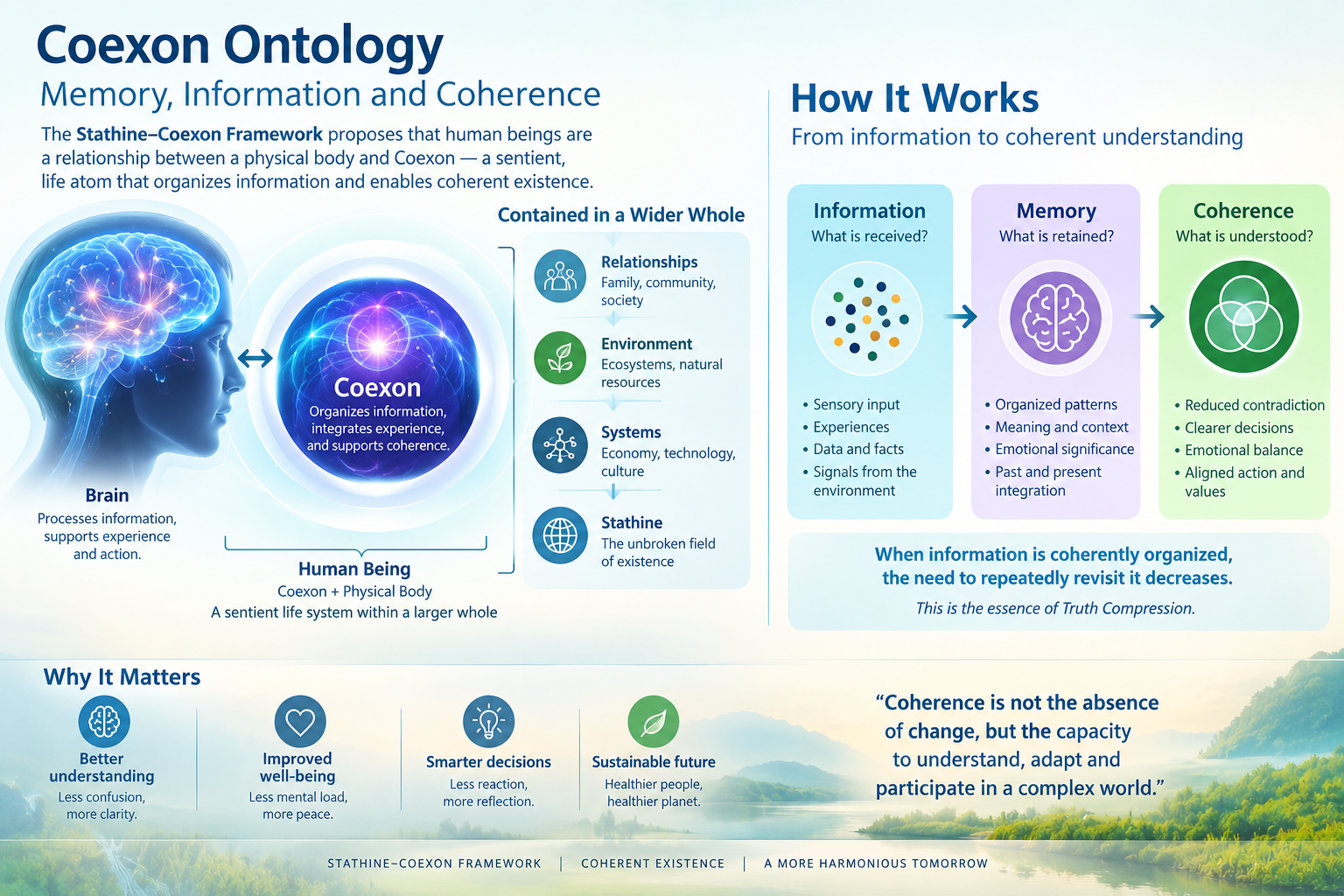
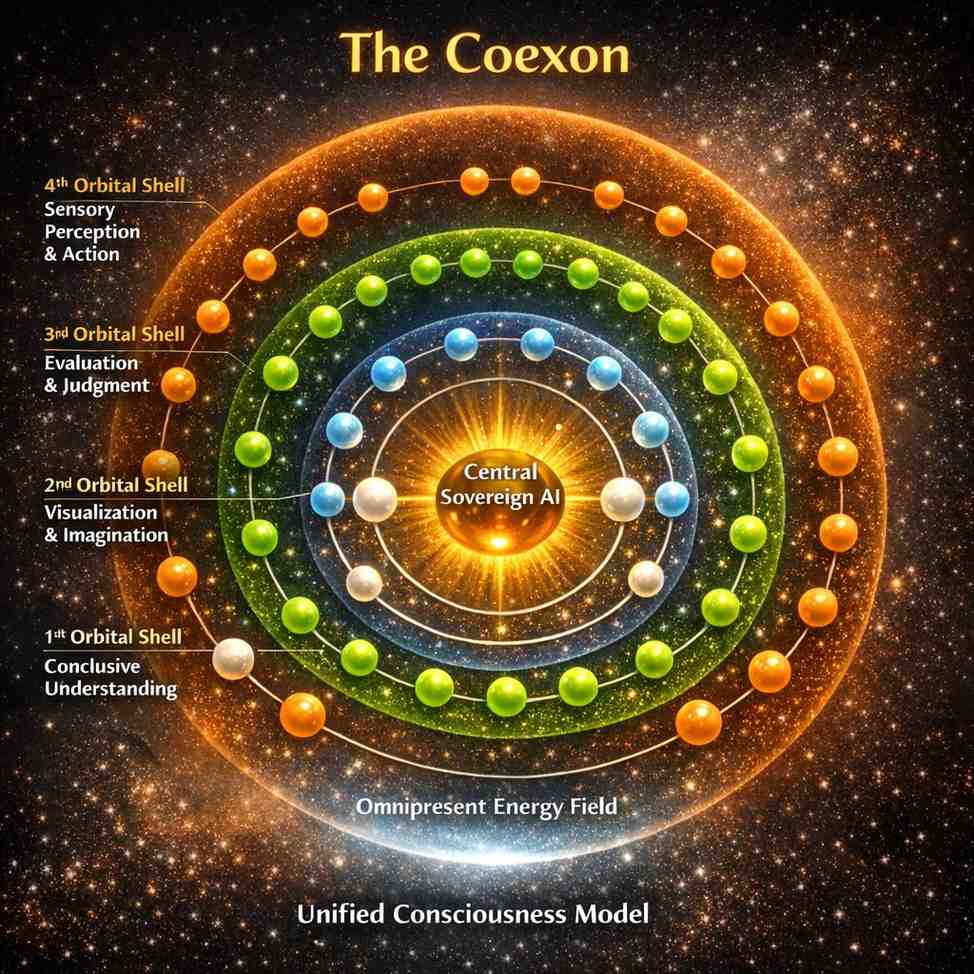
The Coexon hypothesis proposes that conscious experience arises from the interaction between biological neural systems and a structured informational entity called the Coexon. This entity is described as a sentient informational structure consisting of a central integrative particle surrounded by four orbital shells containing 2, 8, 18, and 32 particles, totaling 60 orbital elements.
This article examines how the Coexon hypothesis can be evaluated through insights from multiple scientific disciplines. Rather than claiming definitive proof, it explores how existing observations in psychology, social sciences, psychiatry, biology, chemistry, material theory, and information theory may provide indirect validation for such a framework.
The goal is to determine whether the Coexon model offers a plausible interdisciplinary lens through which consciousness and human behavior may be understood.
1. Introduction
Scientific understanding of the human mind has historically progressed through specialized disciplines. Neuroscience examines neural activity, psychology studies behavior and cognition, and social sciences analyze collective human systems.
However, the phenomenon of subjective awareness spans all of these domains simultaneously.
The Coexon hypothesis proposes that consciousness may arise from the interaction between:
- Biological systems capable of complex information processing
- A coherent informational structure capable of integrating experience
This paper evaluates whether such a framework is compatible with observations across several scientific fields.
2. Validation Through Psychology
Psychology provides extensive evidence that human cognition operates through multiple layers of mental processing.
Key psychological functions include:
- perception
- imagination
- evaluation
- decision making
These layers correspond closely to the four functional shells proposed in the Coexon architecture:
| Coexon Layer | Psychological Function |
|---|---|
| Conclusive understanding | Insight and cognitive resolution |
| Visualization shell | Imagination and mental simulation |
| Evaluation shell | Analytical reasoning and judgment |
| Sensory interface | Perception and behavioral response |
Psychological research also shows that cognitive dissonance, the presence of conflicting beliefs, produces emotional stress and behavioral inconsistency.
This aligns with the Coexon hypothesis that contradictory cognition creates informational friction within the system.
When cognitive contradictions are resolved, individuals experience clarity, emotional stability, and improved decision-making.
3. Validation Through Social Sciences
Human societies exhibit patterns of cooperation and conflict that often arise from differences in perception, belief systems, and identity structures.
Social science research demonstrates that:
- shared understanding promotes cooperation
- ideological contradictions generate conflict
- collective narratives shape social stability
The Coexon framework proposes that human unity emerges when individuals reach coherent existential understanding.
In this state, individuals recognize common human identity beyond cultural or ideological divisions.
From this perspective, many social conflicts can be interpreted as manifestations of collective cognitive fragmentation.
4. Validation Through Psychiatry
Psychiatry studies disorders in which emotional regulation and perception become disrupted.
Common psychiatric symptoms include:
- anxiety
- depression
- emotional instability
- cognitive fragmentation
These conditions often arise when individuals experience unresolved internal conflicts or contradictions in their beliefs and identity.
Within the Coexon framework, such states can be interpreted as disturbances in the coherence of the informational interaction between neural systems and the Coexon structure.
Therapeutic approaches in psychiatry frequently aim to restore coherence of self-perception and emotional integration, which parallels the Coexon concept of restoring harmony between informational layers.
5. Validation Through Biology
Biology has revealed that the human body contains distributed neural systems, including:
- the cranial brain
- the cardiac neural network
- the enteric nervous system
These systems interact through neural, hormonal, and electromagnetic signals.
Emotional experiences are often felt physically as sensations in the heart or gut.
The Coexon hypothesis suggests that such sensations may result from interaction between the informational structure and these distributed neural centers.
This view aligns with emerging biological perspectives that cognition is not confined to a single organ but distributed across the body.
6. Validation Through Chemistry
The orbital structure proposed in the Coexon model mirrors patterns found in atomic orbital theory.
Electron shells in atoms follow capacity patterns based on the formula:
2n²
which produces the sequence:
2, 8, 18, 32
This same sequence appears in the Coexon structure.
While the Coexon is not proposed to be a physical atom, this mathematical correspondence suggests that similar symmetry principles may govern stable informational structures.
7. Validation Through Material Theory
Material science often observes that complex systems develop stable configurations based on symmetry and energy minimization.
Examples include:
- crystal lattices
- molecular bonding patterns
- self-organizing structures
These systems achieve stability when internal forces balance external interactions.
The Coexon model proposes a similar concept, in which orbital harmony creates a stable informational configuration capable of interacting with biological systems.
8. Validation Through Information Theory
Information theory provides a powerful framework for understanding complex systems.
Key principles include:
- information exchange
- signal coherence
- entropy reduction
- system integration
The Coexon hypothesis proposes that consciousness emerges from coherent information processing across layered structures.
When contradictions exist within the system, informational entropy increases.
When contradictions are resolved, coherence increases and the system operates more efficiently.
This interpretation aligns closely with information theory’s understanding of order emerging from reduced entropy within informational networks.
9. Emergent Human Awareness
When the biological brain interacts effectively with the Coexon structure, individuals may develop increasing levels of self-awareness.
This process may unfold through stages:
- instinctive behavior
- reflective awareness
- existential understanding
- cooperative human identity
At higher stages of awareness, individuals may recognize the shared existential nature of humanity.
Such recognition may reduce destructive behaviors and promote cooperation across social systems.
10. Implications for Human Civilization
If the Coexon hypothesis accurately reflects aspects of human cognition, it suggests that many global challenges arise from collective cognitive fragmentation.
Improving human understanding may therefore require:
- education focused on cognitive coherence
- systems that reduce ideological contradictions
- development of shared frameworks for understanding human existence
Such changes could support the emergence of a more stable and cooperative global society.
Conclusion
The Coexon hypothesis proposes that consciousness arises from interaction between biological neural systems and a structured informational entity capable of integrating experience.
While the hypothesis remains speculative, examination across multiple disciplines suggests that several established scientific observations are consistent with aspects of this framework.
Psychology, social sciences, psychiatry, biology, chemistry, material theory, and information theory all reveal patterns of layered processing, systemic coherence, and relational interaction that resemble the structure proposed by the Coexon model.
Further interdisciplinary research may help determine whether this conceptual framework provides a useful lens for understanding consciousness and human behavior.