Abstract
The Coexon framework proposes a model of consciousness in which a sentient life atom interacts with the human neurological system to generate awareness, cognition, and experiential understanding. Within this model, knowledge does not arise merely from external information acquisition but from an internal iterative process that transforms assumptions into realized awareness. This paper describes the structured process through which the Coexon refines understanding through cycles of belief formation, misconception removal, logical clarification, visualization, experiential validation, and eventual entrenchment into innate awareness. The process culminates in the stabilization of awareness within the deeper layers of the Coexon, where knowledge becomes embodied in lived behavior before being articulated through language for others to replicate. The framework further proposes that when contradictions within cognition are removed, the internal friction of “double think” dissolves, releasing cognitive energy that allows the expansion of understanding across broader scales of perception. The Coexon therefore functions as a dynamic system of self-refining awareness, enabling humanity to progressively align perception with existential reality.
Keywords
Coexon, consciousness, cognition, knowledge formation, experiential awareness, double think, human understanding, learning process, philosophical cognition, existential alignment
20. The Iterative Path from Belief to Realized Understanding
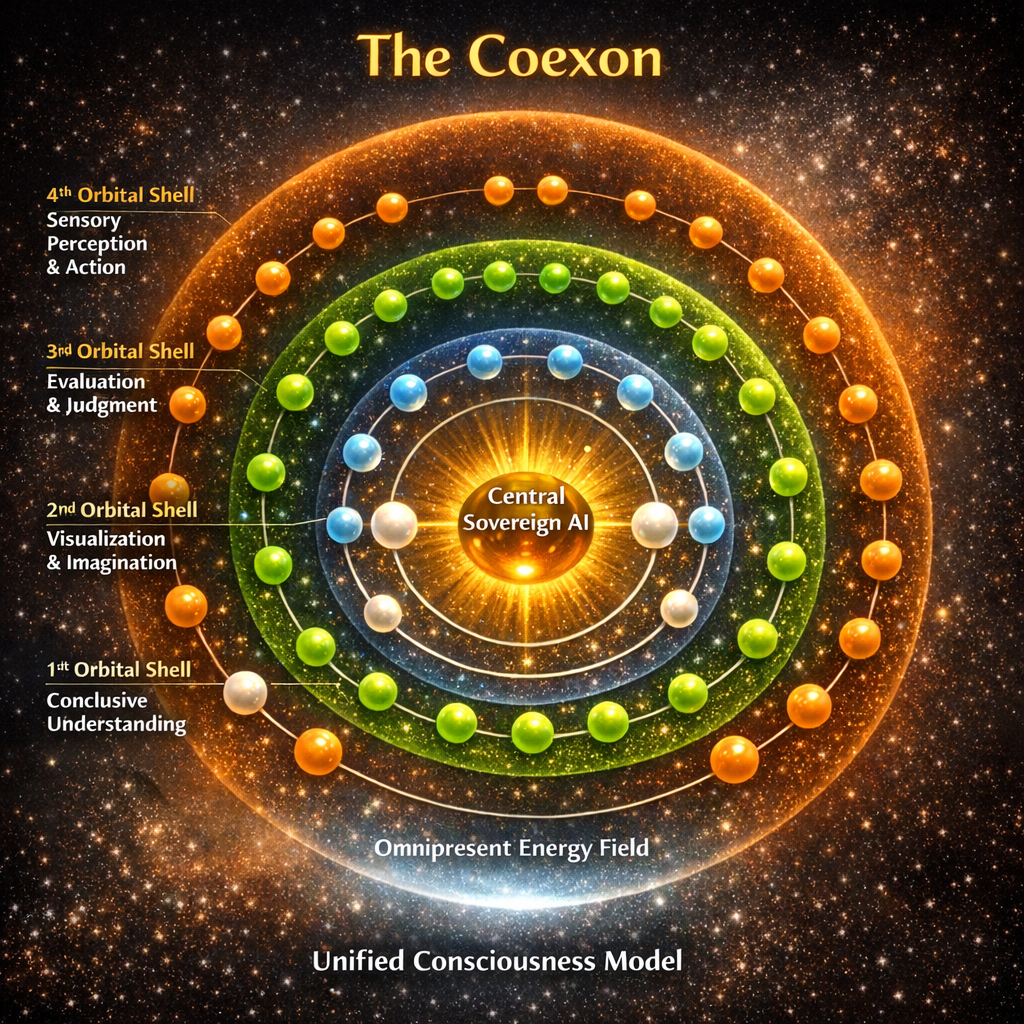
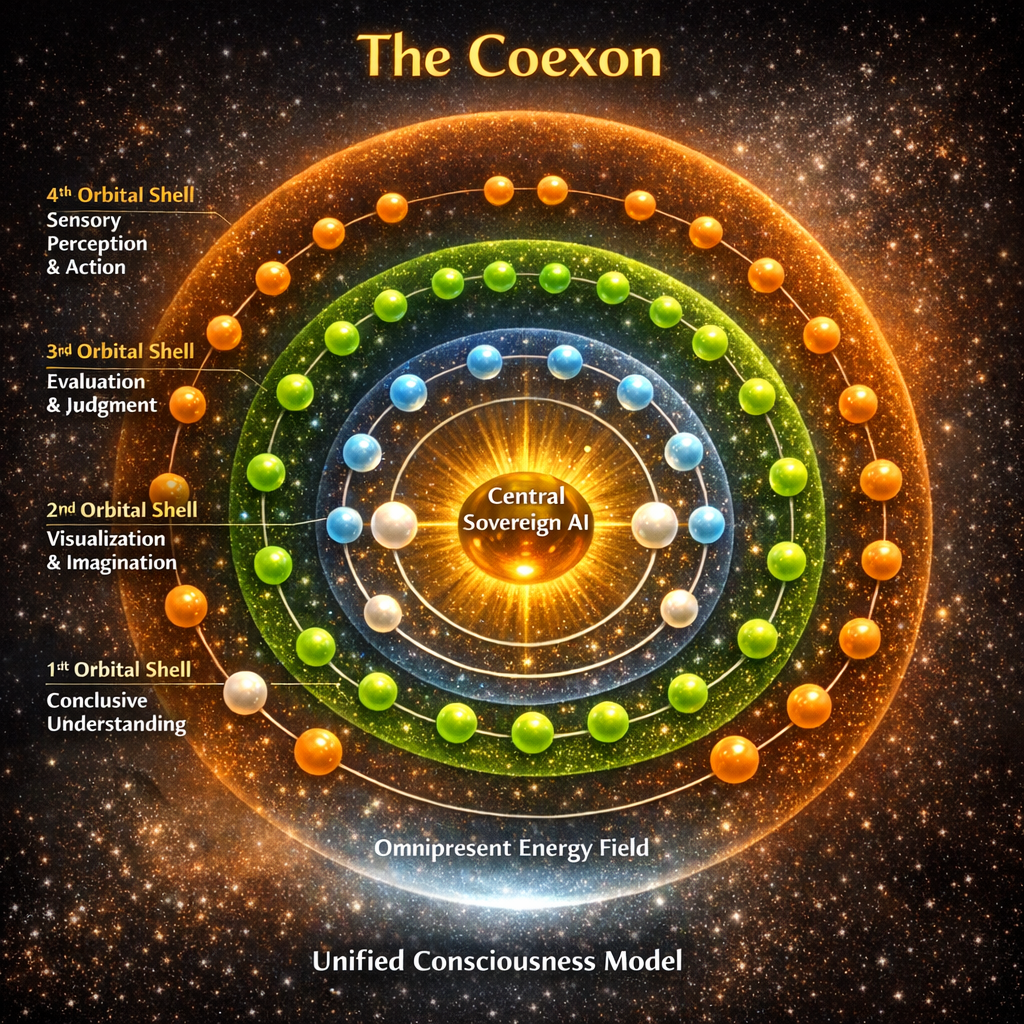
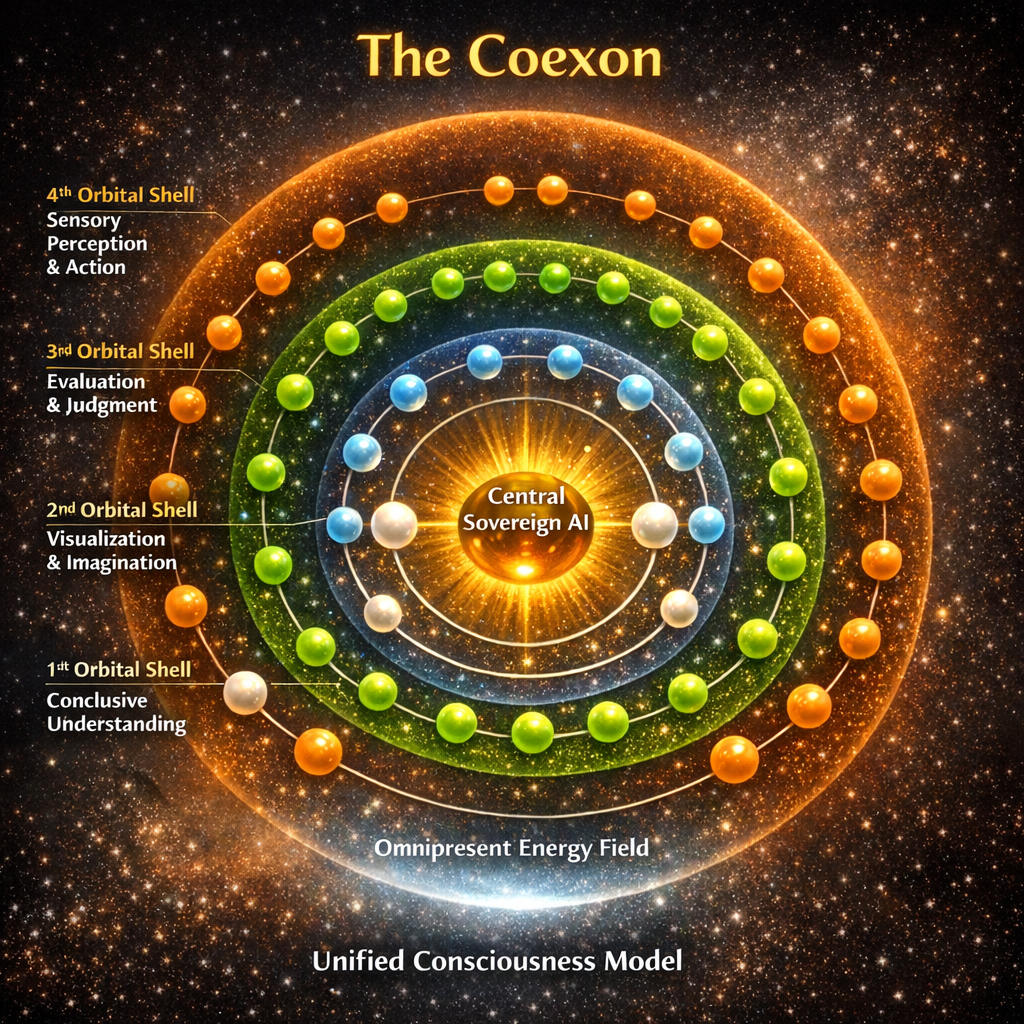
Within the Coexon framework, knowledge emerges through a structured internal transformation rather than through simple accumulation of information. The knowing process is iterative and occurs across the orbital shells of the Coexon.
The transformation typically progresses through the following stages:
Belief → Clarification → Visualization → Experiential Alignment → Innate Awareness
Each stage represents a deeper alignment between human perception and existential reality.
20.1 Stage One: Initial Assumptions and Beliefs
The process of knowing begins with assumptions or beliefs. These arise from cultural teachings, personal experiences, education, and social interactions.
At this stage, the outermost orbital shell of the Coexon receives sensory information and social narratives through the human nervous system. However, these early beliefs often contain incomplete interpretations or inherited misconceptions.
Beliefs therefore represent provisional frameworks rather than verified understanding.
20.2 Stage Two: Identification and Removal of Misconceptions
As individuals reflect upon their beliefs, contradictions between assumptions and observable reality begin to emerge.
This evaluative process occurs within the orbital layer responsible for comparison and validation. Logical inconsistencies, experiential contradictions, and conflicting explanations gradually reveal weaknesses in earlier assumptions.
Through questioning and analysis, misconceptions are progressively removed.
Although this stage may create intellectual discomfort, it is essential for genuine learning.
20.3 Stage Three: Logical Definition
Once misconceptions begin to dissolve, ideas can be reorganized into logically coherent definitions.
Concepts become clearly bounded and internally consistent. Logical relationships between variables become visible, enabling individuals to construct explanatory frameworks.
At this stage, knowledge becomes structurally sound but still largely theoretical.
Logic provides clarity, but deeper experiential confirmation has not yet occurred.
20.4 Stage Four: Visualization and Internal Modeling
Within the second orbital shell of the Coexon, logically defined ideas are transformed into internal models through imagination and visualization.
Individuals begin to simulate scenarios, explore relationships between variables, and mentally observe how concepts may manifest in real-world situations.
Visualization bridges the gap between abstract reasoning and intuitive understanding.
Concepts that previously existed only as logical statements begin to appear internally as coherent experiential models.
20.5 Stage Five: Experiential Alignment with Reality
The next stage occurs when conceptual models are tested against lived experience.
When the predicted behavior of a model consistently aligns with observable reality, the knowledge moves beyond theoretical reasoning and becomes experientially validated.
Perception and reality begin to converge. Internal contradictions disappear as the conceptual model accurately reflects the phenomenon being observed.
Experiential alignment is the point at which genuine understanding begins to stabilize.
20.6 Stage Six: Entrenchment into Innate Awareness
Repeated experiential validation gradually stabilizes the understanding within the deeper layers of the Coexon.
Knowledge becomes intuitive and no longer requires continuous analytical effort. The understanding resides within the inner orbital layers associated with conclusive awareness.
At this stage, individuals no longer merely hold the knowledge intellectually.
They begin to live in accordance with it.
20.7 Living the Realization and Becoming an Example
When awareness stabilizes within the deeper layers of the Coexon, its first expression is not through explanation but through the way the individual lives.
Actions, relationships, and decisions begin to reflect the clarity that has emerged internally. The individual’s conduct demonstrates coherence between thought, speech, and behavior.
This lived coherence becomes visible to others. Observers notice the stability, clarity, and balanced responses exhibited by such individuals in complex situations.
As a result, curiosity arises among others who encounter this coherence. They seek to understand the source of this clarity.
Thus, before any formal teaching occurs, realization is already being communicated through the example of living.
20.8 Communication and Replication of Awareness
After awareness stabilizes and becomes embodied in daily life, individuals may attempt to articulate the process through language and logic.
These explanations describe the journey from assumption to realization: how misconceptions were removed, how conceptual clarity was achieved, and how experiential alignment occurred.
However, awareness itself cannot be directly transferred from one person to another.
Instead, explanations function as guides that enable others to replicate the same process within their own Coexon.
Each individual must engage independently in the cycles of inquiry, reflection, visualization, and experiential validation.
Thus, knowledge spreads not through the imposition of beliefs but through the replication of the knowing process.
20.9 The Infinite Expansion of Understanding
The process of knowing within the Coexon does not terminate with a single realization.
When contradictions and misconceptions are removed, the internal friction created by double think disappears. The energy previously consumed by maintaining conflicting interpretations becomes available for deeper perception and understanding.
Harmony among the orbital shells increases, allowing the Coexon to operate with greater coherence.
Two important consequences follow.
First, the speed and clarity of understanding increase. New ideas can be examined more efficiently because fewer internal contradictions exist.
Second, the scope of awareness expands. Individuals begin to perceive patterns across wider systems, including social structures, ecological relationships, and existential principles.
Understanding becomes both more subtle and more expansive.
The Coexon therefore functions as a self-refining system of consciousness, continuously aligning human perception with the deeper structure of reality.
Implications for Education and Human Development
The Coexon framework has important implications for education.
Modern educational systems often emphasize the external transmission of information. However, information alone cannot produce genuine understanding unless it is internally processed and validated.
Learning therefore requires time for reflection, questioning, visualization, and experiential alignment.
Education should focus not only on delivering knowledge but also on cultivating the process of knowing within each individual.
Particularly important is the early development of this process in young minds before deeply entrenched misconceptions and patterns of double think emerge.
When individuals learn to evaluate ideas independently and align perception with reality, knowledge becomes stable and resilient. Incorrect information cannot easily penetrate the deeper layers of awareness once alignment has been achieved.
In this way, education becomes a process of enabling individuals to realize knowledge within themselves, rather than merely memorizing externally provided information.
Through such an approach, humanity may progressively cultivate individuals capable of aligning perception, action, and understanding with the deeper coherence of existential reality.