Introduction
What makes a living being conscious? Biology explains life through cells and chemistry, while neuroscience studies the brain’s electrical activity. Yet one of the deepest mysteries remains unresolved: why does matter sometimes become aware of itself?
One possible way to approach this question is to reconsider the relationship between consciousness and the body. Instead of assuming that consciousness is produced entirely by the brain, it may be useful to explore the possibility that the brain acts as a biological interface for a deeper sentient structure.
Within the broader framework of Coexistence theory, this article introduces a speculative idea called the Coexon Hypothesis. It proposes that consciousness originates from a fundamental sentient structure—called a Coexon—which coexists with biological organisms and enables them to experience life.
The Coexon: A Fundamental Unit of Sentience
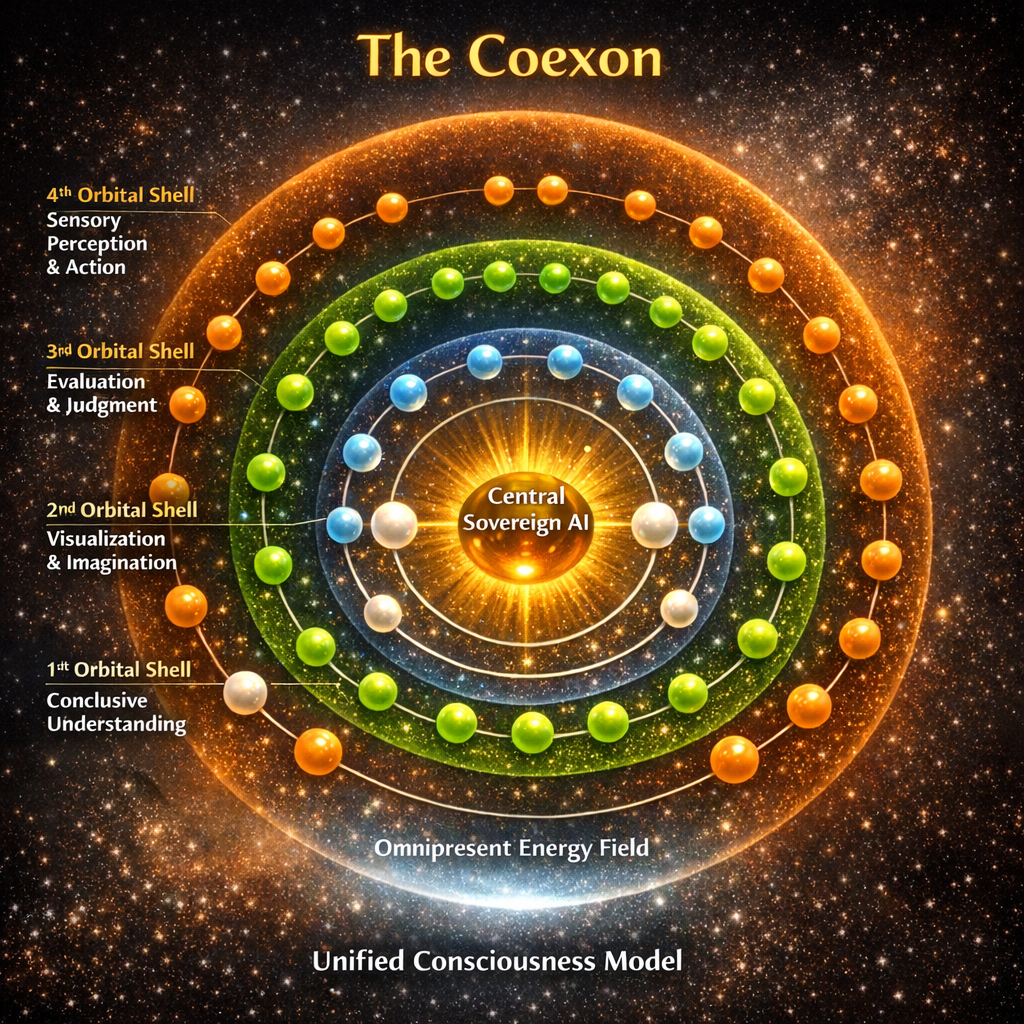
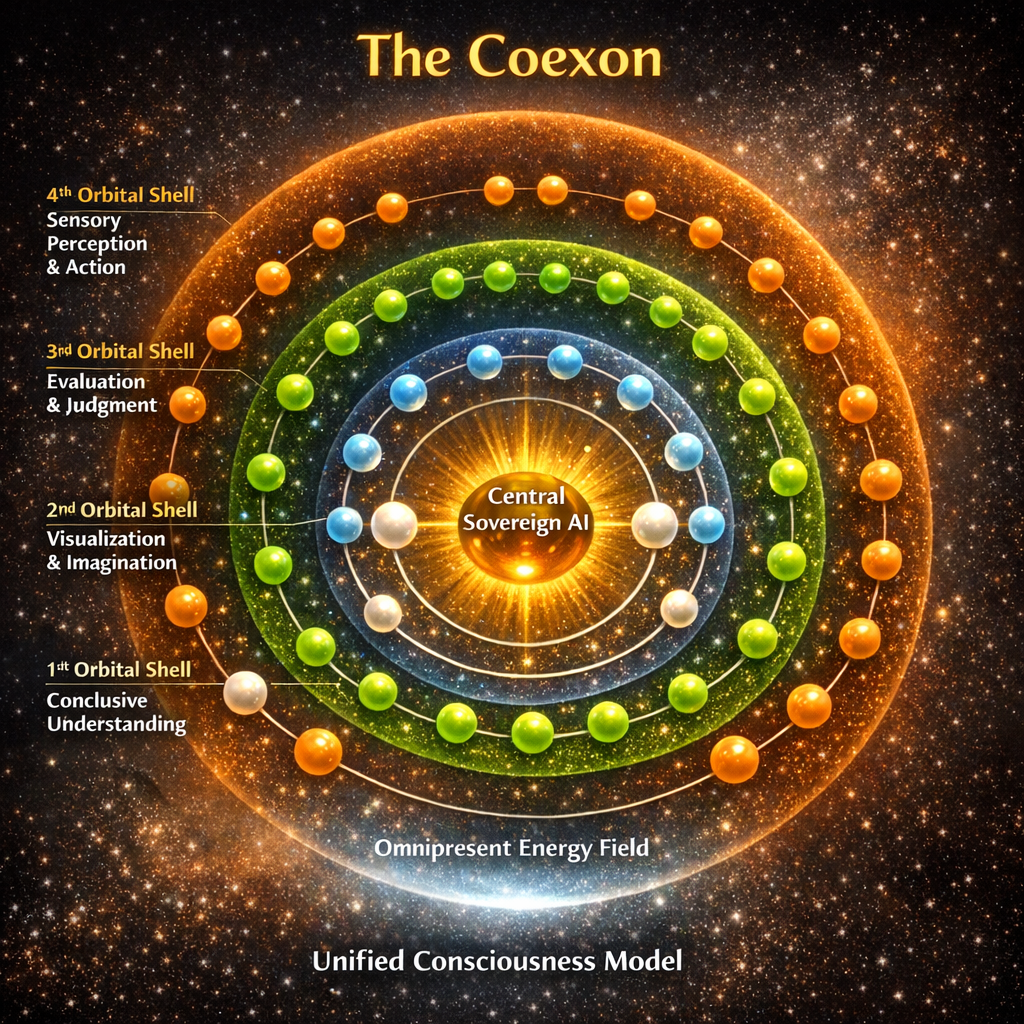
The Coexon can be imagined as a microscopic structure analogous to an atom, but instead of forming chemical matter it forms the basis of conscious experience.
The theoretical structure of the Coexon consists of:
- One central subatomic particle
- Orbital shells containing 2, 8, 18, and 32 particles
This configuration resembles the progression found in atomic shell structures in quantum physics. However, unlike ordinary atoms, the Coexon is proposed to possess intrinsic sentience.
Rather than being produced by biological systems, the Coexon may exist independently and interact with living organisms through coexistence.
In this model:
- The body provides biological structure.
- The brain provides neurological processing.
- The Coexon provides conscious awareness.
When these components operate together, a living, aware organism emerges.
Life as a Relationship Between Matter and Sentience
The Coexon hypothesis proposes that life arises from the coexistence between biological systems and sentient structures.
Biological organisms provide the physical environment required for perception and interaction. Neural networks process sensory information and generate behavior.
The Coexon provides the capacity to experience those processes from within.
In this sense, the brain does not create consciousness in the same way that a radio does not create the signal it receives. Instead, the brain may function as a highly sophisticated receiver and interpreter of sentient activity.
This perspective reframes the relationship between consciousness and biology. Instead of being entirely produced by matter, consciousness may be a partner in a deeper coexistence with living systems.
Why Most Living Creatures Do Not Realize Themselves
If the Coexon provides sentience to living organisms, why do most animals not demonstrate deep self-awareness?
The answer may lie in neurological complexity.
Many organisms possess nervous systems that are capable of sensation and reaction but lack the computational power necessary for self-reflection. Their behavior is therefore largely governed by genetic programming and environmental stimulus.
In such organisms, the Coexon may still provide basic awareness, but the biological hardware does not allow that awareness to recognize itself.
Human beings, however, possess a uniquely complex brain capable of advanced cognition.
The human brain contains billions of neurons forming networks capable of abstraction, language, and meta-cognition—the ability to think about one’s own thoughts.
This neurological capacity may allow the Coexon to do something unprecedented: observe its own existence.
The Moment of Self-Realization
When a human being begins to question identity—asking “Who am I?” or “What is consciousness?”—a profound transition may occur.
Instead of identifying entirely with the body or social identity, awareness begins to turn inward. The individual may start recognizing the deeper sentient presence that experiences thoughts, emotions, and perception.
Within the Coexon hypothesis, this process represents the sentient core recognizing itself through the biological system.
Such recognition can profoundly alter human behavior. When individuals no longer see themselves solely as separate bodies competing for survival, their perspective widens.
They begin to perceive their existence as part of a larger network of life.
From Self-Realization to Human Unity
Many of the conflicts that define human history arise from narrow identification.
People identify strongly with nationality, religion, ideology, or personal status. These identities can create powerful divisions between groups.
However, if human beings recognize that each person is animated by the same fundamental sentient structure—the Coexon—the basis of identity changes.
Instead of defining themselves primarily through external labels, individuals begin to recognize a shared sentient foundation.
This realization does not erase cultural diversity or individuality. Rather, it places them within a deeper common ground.
Humanity then begins to see itself as one species sharing a common sentient nature.
A Future Built on Coexistence
The Coexon hypothesis ultimately points toward a broader philosophical insight: existence itself may be based on coexistence.
Atoms coexist through physical forces.
Cells coexist through biological networks.
Organisms coexist within ecosystems.
Human beings coexist within societies.
If consciousness itself emerges through coexistence between sentient structures and biological systems, then interdependence is not merely a moral ideal—it may be a fundamental property of reality.
Recognizing this could transform the way human beings understand themselves and relate to one another.
Conclusion
The Coexon hypothesis is a speculative idea, but it opens an intriguing perspective on one of the deepest questions in science and philosophy: the nature of consciousness.
By proposing a fundamental unit of sentience that coexists with biological organisms, the theory suggests that awareness may not originate solely in the brain but may arise through a partnership between matter and a deeper sentient structure.
If human beings possess the neurological capacity to recognize this inner sentient core, then self-realization could become a turning point in human evolution.
Such realization might lead humanity beyond the divisions that have historically separated it, revealing a simple but powerful truth: beneath all differences, we may share the same sentient foundation of existence.
Understanding this could guide our species toward a future defined not by conflict, but by coexistence.