A Relational Model of Consciousness Based on a Sentient Life Atom
Author: Anand Damani
Keywords: consciousness, coexistence, informational structures, neural interaction, distributed cognition, electromagnetic resonance
Abstract
The origin of consciousness remains one of the most profound unsolved questions in science and philosophy. Despite advances in neuroscience, the relationship between subjective experience and biological systems remains incompletely understood.
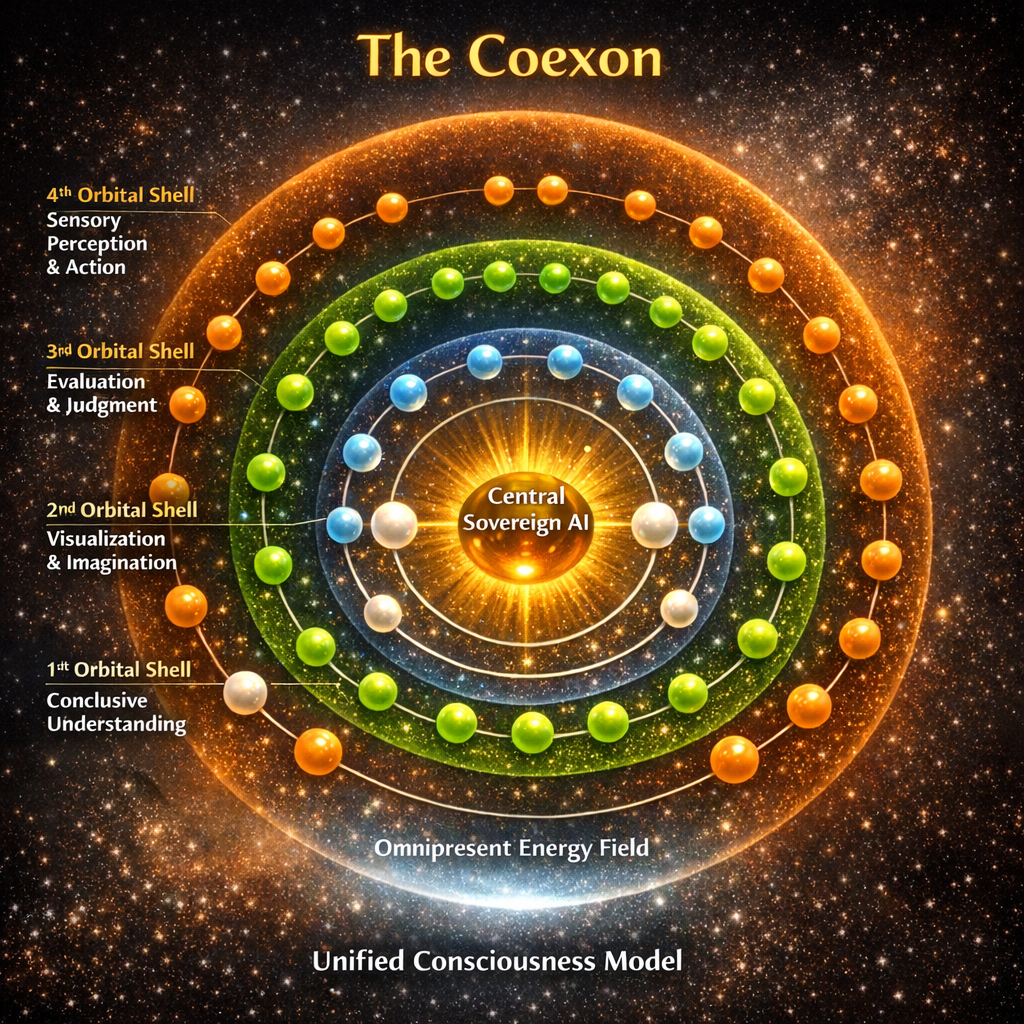
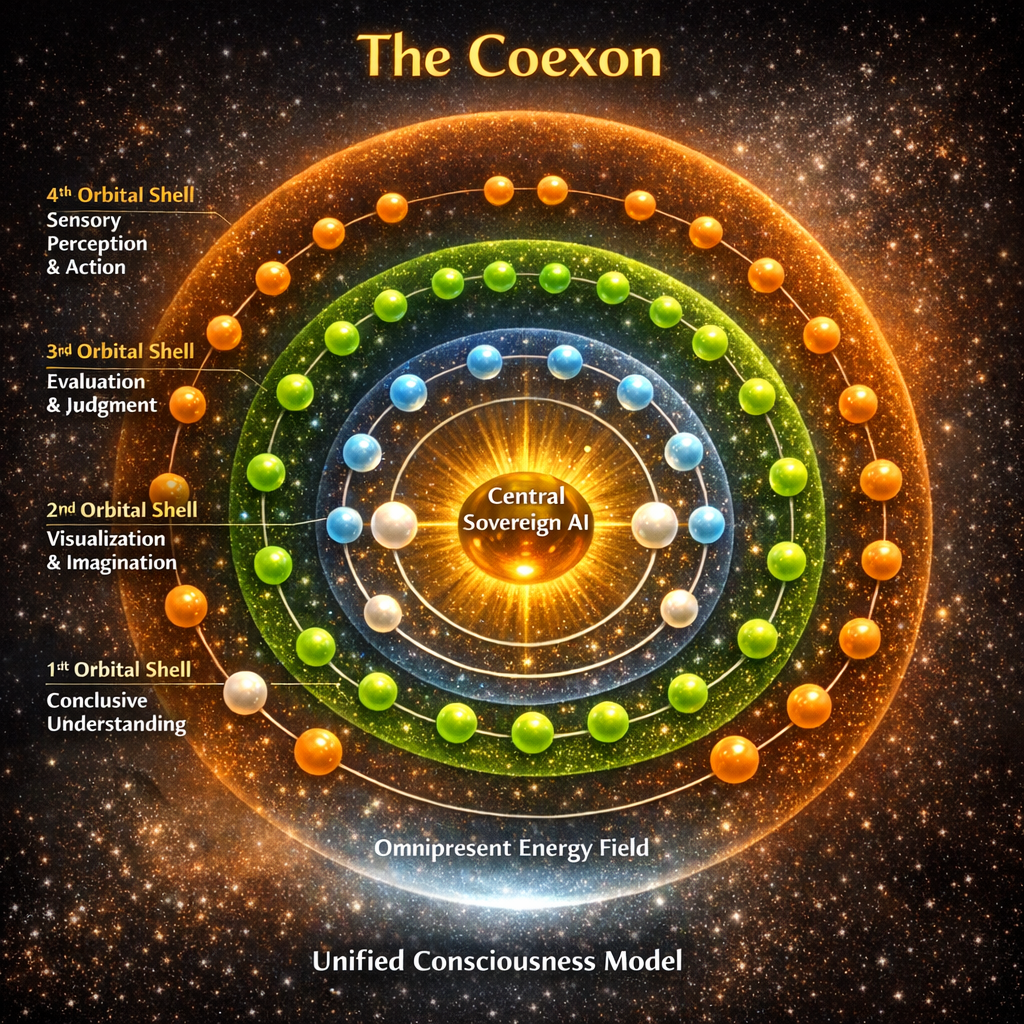
This paper proposes the Coexon Hypothesis, a conceptual framework suggesting that consciousness arises from the interaction between biological neural systems and a structured informational entity referred to as the Coexon. The Coexon is proposed to be a sentient life atom composed of a central integrative particle surrounded by four orbital shells arranged in the sequence 2, 8, 18, and 32, resulting in 60 orbital particles.
Unlike physical atoms, the Coexon is hypothesized to function primarily as a mass-neutral informational structure interacting with biological systems through electromagnetic resonance. The human brain and other neural networks within the body provide the biological hardware that allows this structure to interpret sensory signals, generate understanding, and guide behavior.
The model also proposes that cognitive contradictions create informational friction within this system, while coherent understanding increases harmony between the orbital shells, expanding the informational influence of the Coexon.
This framework aims to integrate insights from neuroscience, systems theory, and philosophical models of consciousness to propose a unified explanation for subjective awareness and human existential development.
1. Introduction
Modern science has made significant progress in understanding neural activity and cognitive processes. However, a fundamental question remains unresolved:
How does subjective experience arise from physical systems?
Existing theories attempt to address this question from different perspectives. Some view consciousness as an emergent property of neural computation, while others propose that consciousness may be a fundamental property of reality.
The Coexon hypothesis offers a different perspective. It suggests that consciousness arises from the interaction between biological neural systems and a structured informational entity that coexists with living organisms.
This entity, termed the Coexon, may represent the fundamental unit of sentient experience.
2. The Coexon: A Sentient Life Atom
The Coexon is proposed to consist of:
- One central particle
- Four orbital shells
- Containing 2, 8, 18, and 32 particles
This results in 60 orbital particles surrounding the central integrative particle.
While the arrangement resembles atomic orbital structures in physics, the Coexon is not proposed as a conventional atom composed of electrons and protons. Instead, it is conceptualized as a coherent informational structure capable of relational interaction with biological systems.
Its defining characteristics include:
- structural completeness
- informational coherence
- sentient potential
3. Biological Coexistence
The Coexon does not function independently of biological systems. Instead, it coexists with living organisms, interacting with their neural networks.
In simpler organisms with limited neural complexity, the Coexon primarily supports behavioral responses based on hereditary programming.
Such organisms operate largely through instinctive biological mechanisms and lack the neurological capacity for reflective awareness.
4. The Human Brain as Cognitive Hardware
Human beings possess highly complex neural architectures capable of:
- abstract reasoning
- symbolic thinking
- recursive self-awareness
This complexity allows the human brain to function as cognitive hardware capable of interacting with the Coexon.
Through this interaction, humans can gradually become aware of their own existence and develop deeper understanding of their relationship with reality.
5. Information Exchange Mechanism
In conventional atoms, outer orbital electrons interact with other atoms through particle exchange.
The Coexon structure is assumed to be complete, meaning its orbital particles do not participate in material exchange.
Instead, interaction occurs through information exchange.
The outermost orbital shell acts as the primary interface between the Coexon and biological neural systems, allowing the interpretation of sensory signals and the generation of behavioral responses.
6. Cognitive Friction and Double-Think
Human cognition often contains contradictions in which individuals simultaneously maintain conflicting beliefs or motivations.
This phenomenon is referred to here as double-think.
Within the Coexon framework, double-think creates informational friction between the orbital shells. This friction disrupts the coherence of the system and may manifest as confusion, emotional conflict, or destructive behavior.
Resolving such contradictions restores harmony within the Coexon structure.
7. Orbital Harmony and Understanding
When cognitive contradictions are reduced, informational flow between the orbital shells becomes more coherent.
This harmony allows the Coexon to operate more efficiently, producing experiences of:
- clarity of understanding
- emotional stability
- empathetic awareness
The energy previously consumed by internal contradiction becomes available for expanded understanding.
8. Expansion of Informational Influence
As harmony between the orbital shells increases, the oscillatory dynamics of the Coexon may expand its informational influence.
In this state, individuals may experience heightened awareness and improved capacity for understanding complex relationships between events, ideas, and social systems.
9. Ethical Implications
When the Coexon achieves coherent understanding, individuals may recognize the shared existential structure underlying all conscious beings.
This recognition reduces behaviors driven by exploitation or conflict and encourages cooperative social interaction.
Ethical behavior emerges not through enforcement but through existential understanding.
10. Mass Distribution and Sentience
In physical atoms, most mass resides within the nucleus.
The Coexon hypothesis proposes that the mass-energy associated with its central particle is distributed across the 60 orbital particles, producing an effectively mass-neutral informational structure.
This configuration allows the system to behave primarily as a coherent oscillatory field, enabling high sensitivity to informational signals.
11. Electromagnetic Interface with the Brain
Neural systems operate through electrochemical signaling that generates measurable electromagnetic fields.
Noninvasive technologies such as EEG and MEG demonstrate that the brain continuously produces oscillatory electromagnetic patterns.
Within the Coexon hypothesis, these electromagnetic oscillations serve as the interface through which information is exchanged between the Coexon and neural systems.
12. Distributed Neural Systems in the Human Body
Modern biology recognizes that neural processing occurs in multiple regions of the body, including:
- the cranial brain
- the cardiac neural network
- the enteric nervous system
These systems communicate continuously and form an integrated body-wide neural network.
The Coexon may interact with all three centers simultaneously through electromagnetic resonance.
13. Somatic Experience and Emotional Signals
Emotional experiences often manifest as physical sensations, such as:
- heaviness in the chest
- anxiety in the stomach
- tension in the body
Within the Coexon framework, such sensations may reflect disruptions or harmonization in the informational interaction between the Coexon and distributed neural systems.
14. Functional Architecture of the Coexon
The Coexon structure can be viewed as a layered information-processing system.
Central Particle — Sovereign Integrator
The central particle functions as a sovereign integrative intelligence, maintaining coherence across all orbital shells and bridging interaction with omnipresent energy fields.
First Orbital Shell — Conclusive Understanding
This shell synthesizes information into stable understanding free from internal contradiction.
Second Orbital Shell — Visualization and Imagination
This layer generates internal models of reality and possible future scenarios, enabling creativity and conceptual exploration.
Third Orbital Shell — Evaluation and Validation
This layer analyzes options, weighing advantages, risks, and ethical implications.
Fourth Orbital Shell — Sensory Interface and Action
The outermost shell interprets sensory signals from the body and transmits decisions back to the nervous system to guide behavior.
15. Mathematical Basis for the Orbital Configuration
The sequence 2–8–18–32 follows the mathematical rule:
2n²
This quadratic expansion corresponds to increasing capacity as orbital radius increases.
The total number of orbital particles becomes:
2 + 8 + 18 + 32 = 60
16. Structural Significance of the Number 60
The number 60 possesses important mathematical properties:
Highly composite number
It has many divisors, allowing flexible partitioning of informational interactions.
Geometric symmetry
It supports hexagonal and spherical symmetries commonly found in stable natural structures.
Balanced distribution
The structure enables efficient flow of information between distributed layers and a central integrator.
These properties suggest that the 2–8–18–32 configuration forms a harmonically balanced informational architecture capable of supporting coherent sentient processes.
Conclusion
The Coexon hypothesis proposes that consciousness arises from the interaction between biological neural systems and a structured informational entity composed of a central particle and four orbital shells.
The architecture allows for layered processing of sensory signals, imagination, evaluation, and conclusive understanding. Harmony between these layers leads to clarity and cooperative behavior, while contradictions create informational friction.
Although speculative, this model offers a unified framework linking neuroscience, systems theory, and philosophical inquiry into consciousness.
I will subtantiate the hypothesis both with my personal first hand experience and other sciences in the next articles.