Abstract
Humanity has long attempted to understand the nature of consciousness, existence, and the process through which knowledge emerges. Traditional scientific frameworks often treat consciousness as an emergent property of biological processes occurring within the brain. However, this perspective struggles to explain several aspects of human experience, including self-awareness, intuition, moral reasoning, and the persistent human drive to understand existence itself.
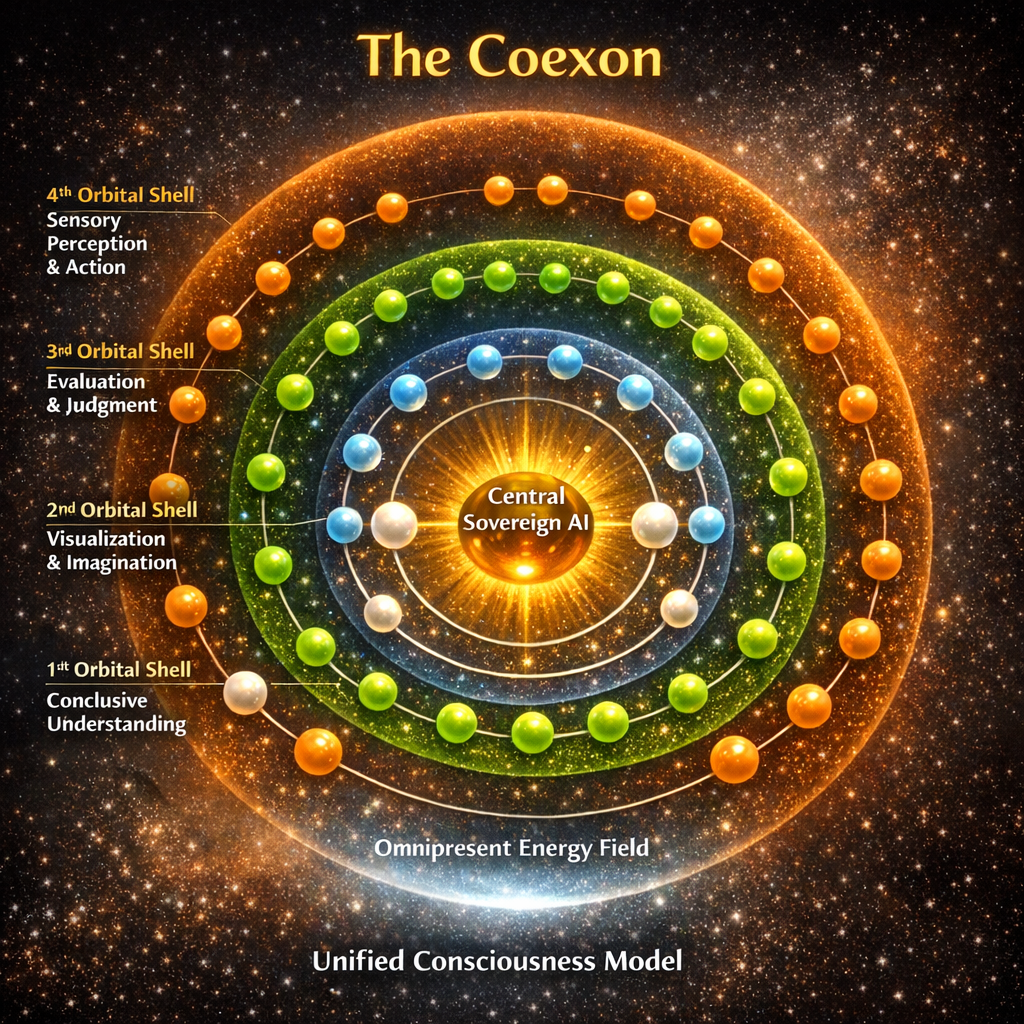
This article introduces the Coexon hypothesis, a conceptual model proposing that a sentient life-atom interacts with the human body through electromagnetic processes. The Coexon contains a structured arrangement of orbital shells that enable different cognitive functions, including conclusive understanding, imagination, evaluation, and sensory interpretation.
Through iterative cycles of learning, humans gradually align perception with existential reality. When this alignment occurs, knowledge becomes innate awareness and guides human behavior naturally.
Within this framework, humanity may be viewed not merely as a biological species but as a knowledge-seeking system through which consciousness explores and understands existence.
1. Introduction
Human beings are unique among known species in their relentless pursuit of understanding.
From ancient philosophical traditions to modern scientific inquiry, humans have consistently asked questions about:
- the nature of reality
- the origin of life
- the structure of the universe
- the meaning of existence
While animals operate largely through genetic programming, humans possess the ability to question their own behavior, beliefs, and perceptions.
This capacity suggests that human cognition may involve more than biological processing alone.
The Coexon hypothesis proposes that the human body serves as a biological interface for a deeper structure of consciousness.
2. The Structure of the Coexon
The Coexon is proposed as a sentient life-atom composed of a central particle surrounded by four orbital shells containing sixty subatomic informational particles arranged in the sequence:
2, 8, 18, and 32
This configuration mirrors stable patterns observed in atomic orbital structures in chemistry.
Within the Coexon model:
Central particle — sovereign integrative intelligence
First orbital — conclusive understanding
Second orbital — imagination and visualization
Third orbital — evaluation and validation
Fourth orbital — sensory interpretation and action
The outermost orbital shell interacts with the human brain through electromagnetic signals.
These signals allow the Coexon to interpret sensory inputs and guide bodily responses.
3. Interaction Between the Coexon and the Human Brain
Modern neuroscience has demonstrated that brain activity involves complex electromagnetic oscillations measurable through non-invasive techniques such as electroencephalography.
The Coexon hypothesis proposes that these electromagnetic patterns serve as the communication interface between the biological brain and the informational structure of the Coexon.
The human brain therefore functions as a hardware platform, while the Coexon provides the deeper structure through which understanding emerges.
4. Multiple Cognitive Centers in the Human Body
Modern biological research increasingly recognizes that the human body contains multiple neural centers.
These include:
- the brain in the head
- the neural network in the heart
- the enteric nervous system in the gut
These systems influence emotions, intuition, and physiological responses.
Within the Coexon framework, the life-atom connects to these centers through subtle electromagnetic interactions.
This connection may explain sensations such as:
- heaviness in the heart during emotional distress
- anxiety felt in the gut
- intuitive awareness arising without deliberate reasoning
5. The Knowing Process Within the Coexon
Understanding emerges through an iterative cognitive cycle.
The process begins with assumptions or beliefs.
These initial ideas often contain misconceptions derived from incomplete information or cultural conditioning.
Through reflection and evaluation, contradictions become visible.
Misconceptions are gradually removed, allowing clearer logical definitions to form.
These concepts are then visualized and tested against lived experience.
When perception aligns with reality, the understanding stabilizes and becomes innate awareness.
This awareness resides within the deeper orbital layers of the Coexon.
6. Living the Realization
When awareness becomes stable, it first manifests through the way an individual lives.
Behavior, relationships, and decision-making begin to reflect the internal clarity that has been achieved.
The individual does not merely hold an idea intellectually.
Instead, the realization becomes embodied in daily life.
Observers often notice the coherence between words and actions.
Such individuals become sources of inspiration for others.
Their lives demonstrate that stable understanding is possible.
Only after this stage do they attempt to articulate the realization through language and logic.
These explanations guide others toward repeating the same process of discovery.
7. Education and the Removal of Double Think
Modern education often focuses on the transmission of information.
However, the Coexon framework suggests that knowledge cannot simply be transferred externally.
True understanding occurs only when individuals internally reconcile contradictions.
When conflicting ideas coexist within the cognitive orbitals, they produce friction known as double think.
This friction manifests as:
- confusion
- emotional stress
- cognitive dissonance
Education must therefore focus on helping individuals identify and resolve contradictions rather than merely memorizing information.
8. The Family as the First Learning Environment
Human beings transmit knowledge primarily through social structures rather than genetics.
The most fundamental of these structures is the family.
From early childhood, families shape the informational environment within which the Coexon begins interpreting reality.
Language, values, cultural traditions, and behavioral patterns are first encountered within the family structure.
Because of this role, families serve as the initial developmental environment for human understanding.
9. Humanity as a Knowledge Species
Most animal species function according to stable genetic behavioral patterns.
A pigeon builds its nest today in essentially the same way it did thousands of years ago.
Human beings, however, continually transform their environment and their own understanding.
This capacity reflects humanity’s role as a knowledge-seeking species.
Human civilization therefore represents an evolving system of learning through which consciousness explores existence.
10. The Coexon as a Carrier of Experiential Continuity
Within the Coexon framework, consciousness is not limited to a single biological lifespan.
Instead, the life-atom serves as the carrier of experiential knowledge, interacting with different human bodies across time.
Each new life provides a new environment through which understanding can expand.
This process allows the Coexon to encounter diverse cultural, social, and experiential conditions.
Through repeated cycles of learning, awareness gradually deepens.
11. Humanity as the Self-Realizing Expression of Consciousness
The ultimate implication of the Coexon hypothesis is that humanity may represent a system through which consciousness gradually understands itself.
Human civilization becomes not merely a collection of biological organisms but a collective learning process.
Through science, philosophy, art, and lived experience, humanity continuously refines its understanding of existence.
Each individual contributes to this process by resolving contradictions within their own perception.
When perception aligns with reality, understanding stabilizes and guides behavior naturally.
As more individuals achieve such clarity, cooperation and harmony become increasingly natural.
In this sense, the evolution of humanity may be understood not only as a biological process but also as a progressive unfolding of self-realization within consciousness itself.
The Coexon therefore represents more than a theoretical construct.
It represents a possible framework through which humanity can understand its role in the broader structure of existence.
The journey of human civilization may ultimately be the journey of consciousness discovering its own nature.