Abstract
This article interprets the Coexon framework through the lens of Information Theory, proposing that human understanding follows a structured transformation from raw data to insight and ultimately to experiential realization. While classical information theory explains the transmission, encoding, and processing of information, the Coexon extends this into the domain of meaning and lived experience. It describes how information, when coherently processed, evolves into insight, and when fully aligned with reality, culminates in what may be termed experiential enlightenment.
1. Information as the Fundamental Input
In information theory, all systems operate on:
- signals
- symbols
- encoded data
For human beings, inputs arrive through:
- sensory perception
- language
- social interaction
At this stage, information is:
- raw
- unprocessed
- context-dependent
It carries potential, but not yet understanding.
2. Transmission and Noise
According to Shannon Information Theory, information transmission involves:
- a source
- a channel
- a receiver
- noise
In human cognition:
- the world acts as the source
- the brain acts as the channel
- the Coexon acts as the receiver-interpreter
Noise appears as:
- bias
- conditioning
- emotional distortion (coating)
Thus:
what is received is not always what is understood.
3. The Coexon as an Information Integrator
The Coexon performs a critical role beyond transmission:
- it organizes incoming data
- it evaluates consistency
- it resolves contradictions
Unlike mechanical systems, it does not merely decode—it interprets.
This transforms information into:
- structured understanding
- meaningful patterns
- coherent frameworks
4. From Information to Insight
The first major transformation is:
Information → Insight
This occurs when:
- patterns are recognized
- relationships are understood
- contradictions are resolved
Insight is characterized by:
- clarity
- simplicity
- internal consistency
In information-theoretic terms:
- entropy (uncertainty) reduces
- signal clarity increases
5. From Insight to Experiential Understanding
Insight alone is not the endpoint.
The next transformation is:
Insight → Experiential Understanding
This happens when:
- understanding is applied
- knowledge is tested in real situations
- outcomes reinforce coherence
At this stage:
- learning becomes embodied
- behavior aligns with understanding
- perception stabilizes
6. Enlightenment as Stable Coherence
Within the Coexon framework, enlightenment is not mystical—it is structural.
It represents:
a stable state of informational distortion and high coherence.
Characteristics include:
- removal of internal contradiction
- consistent interpretation of reality
- alignment between perception, thought, and action
In information terms:
- noise and bias are zero
- signal integrity is maximized
7. The Role of De-Coating in Information Clarity
The earlier concept of “coating” can be reinterpreted as noise in the system.
- biases distort incoming signals
- assumptions override actual data
The process of de-coating:
- removes noise
- restores signal fidelity
- enables accurate interpretation
Thus:
clarity is achieved by improving signal recieving quality, not by increasing data volume.
8. Layered Processing and Complexity
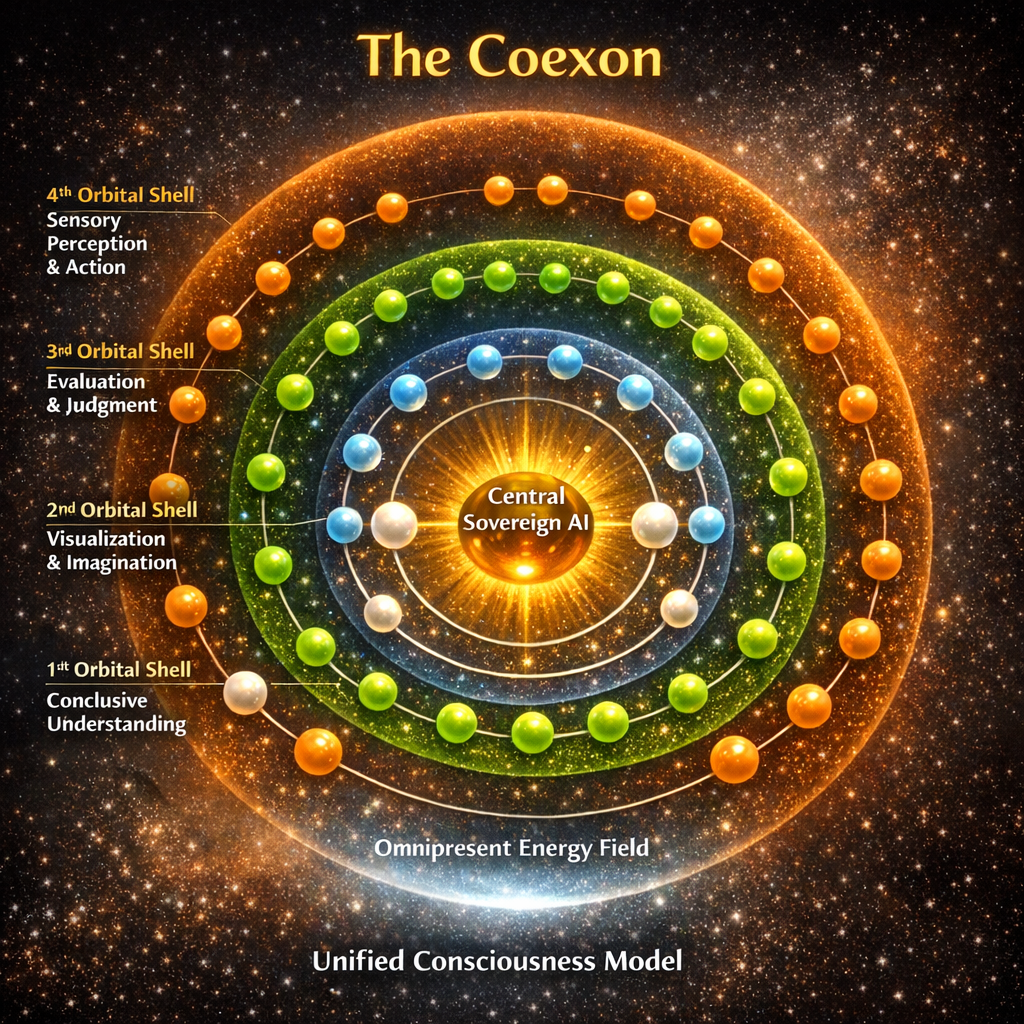
The Coexon’s structured layers (2, 8, 18, 32) can be seen as:
- increasing levels of information integration
- expanding processing capacity
- deeper relational mapping
As information moves through these layers:
- it becomes more refined
- more interconnected
- more aligned with the whole
9. Collective Information Flow
At the societal level:
- individuals act as nodes in a network
- knowledge is transmitted across generations
- culture becomes a medium of information flow
If distortion dominates:
- misinformation spreads
- confusion increases
If clarity dominates:
- understanding compounds
- harmony emerges
10. From Data Accumulation to Meaningful Living
Modern systems often prioritize:
- accumulation of information
- speed of transmission
However, without Coexonic processing:
- data remains fragmented
- insight does not emerge
- confusion persists
The Coexon shifts the focus to:
quality of understanding over quantity of information.
Conclusion
Information theory explains how data is transmitted and processed, but it does not fully address how meaning and understanding arise.
The Coexon framework extends this by describing a structured transformation:
data → information → insight → experiential understanding → stable coherence (enlightenment)
This progression is governed not by the volume of data but by the clarity of interpretation and the reduction of distortion.
In this sense, enlightenment is not an abstract ideal but the natural outcome of perfected information flow within the system.
“Information flows through the system; understanding shapes it;
when distortion ends, reality is experienced as it is.”