Education, Cognitive Freedom, and the Development of the Coexon.
In continuation of the earlier hypothesis how the Coexon learns is explained. Once this becomes clear everyone will work towards the same and work to create Utopia.
16 Aspects of various sciences have been explained in the earlier post .
17. Educational Implications of the Coexon Hypothesis
If the Coexon represents the sentient life atom interacting with the human neurological system, then education becomes a fundamentally different process from what modern systems currently assume.
Most contemporary educational models operate under an implicit assumption: knowledge can be externally transmitted and accumulated. Students are treated as containers into which information can be poured through teaching, memorization, and repetition.
However, within the Coexon framework, this assumption is incomplete.
17.1 Information Cannot Be Installed — It Must Be Realized
Information exchange between the brain and the Coexon occurs through interpretive interaction, not passive storage.
The brain provides sensory input and symbolic structures, but true understanding emerges only when the Coexon resolves contradictions within the orbital structure of cognition.
In this sense:
- External teaching provides stimulus.
- The brain provides processing infrastructure.
- The Coexon provides realization and meaning.
Thus, education cannot truly be the transfer of knowledge.
It must instead become the facilitation of realization.
Learning therefore involves two stages:
- Exposure to structured information
- Internal evaluation and reconciliation within the Coexon
The second stage is the true moment of learning.
Without this internal resolution, information remains memorized but unrealized, which produces cognitive fragmentation.
17.2 The Problem of Double Think in Education
Modern societies unintentionally cultivate what may be called double think — the simultaneous acceptance of contradictory ideas.
Examples include teaching:
- cooperation while rewarding competition
- environmental protection while promoting unsustainable consumption
- equality while maintaining systemic hierarchies
- peace while glorifying wars and victories
When contradictory inputs accumulate in the cognitive orbitals of the Coexon, friction develops between orbital shells.
This friction manifests psychologically as:
- anxiety
- cognitive dissonance
- moral confusion
- emotional heaviness
- gut-level stress responses
- fear of unknown
These symptoms align with observations in psychology and psychiatry regarding chronic stress and internal conflict.
The Coexon hypothesis proposes that such phenomena arise because the orbital shells attempt to reconcile incompatible information structures.
Until contradictions are resolved, the oscillatory harmony of the Coexon cannot stabilize.
17.3 Time as a Necessary Element of Understanding
Because understanding must occur internally, time becomes an essential component of education.
No external authority can force realization.
Each individual Coexon must:
- absorb information
- evaluate it across orbital shells
- resolve contradictions
- reach a stable conclusive understanding
This process cannot be rushed.
Modern educational systems, however, emphasize:
- speed
- testing
- standardized answers
- memorization
These approaches measure information recall, not existential understanding.
From the Coexon perspective, education must evolve toward reflective integration rather than rapid accumulation.
17.4 The Strategic Importance of Early Education
A particularly important implication arises from developmental psychology.
Young children initially possess relatively coherent cognitive structures before exposure to large numbers of contradictory social narratives.
If educational systems introduce coherent frameworks early, the formation of double think can be altogether obliterated.
This creates a generational opportunity.
Rather than attempting to correct decades of accumulated contradictions in adults, societies may achieve far greater success by guiding the next generation before fragmentation forms.
Early education aligned with the Coexon model would emphasize:
- unity of life
- ecological interconnectedness
- cooperative social structures
- critical thinking without cynicism
- experiential understanding rather than memorization
In such an environment, the orbital shells of cognition would develop harmoniously rather than competitively.
17.5 Infinite Potential of Human Understanding
If the Coexon becomes free of friction created by double think, the orbital oscillations stabilize and energy previously consumed in resolving contradictions becomes available for higher-order understanding.
This suggests that human cognitive potential may be far greater than currently realized.
Rather than intelligence being limited by neural processing capacity alone, it may also be constrained by internal logical conflicts.
When such conflicts are removed:
- insight accelerates
- creativity increases
- emotional stability improves
- cooperation becomes natural rather than enforced
In this sense, the removal of double think is not merely a psychological improvement.
It may represent a release of previously trapped cognitive energy.
17.6 Toward a Coherent Human Civilization
The ultimate implication of the Coexon hypothesis is that human conflict is not primarily biological or economic.
It is cognitive.
When individuals operate under unresolved contradictions, they project those conflicts into social structures, resulting in:
- ideological polarization
- cultural fragmentation
- systemic injustice
- environmental harm
If individuals instead achieve coherent internal understanding, their decisions naturally align with broader coexistence.
Thus the Coexon framework suggests a pathway toward species-level unity:
- Encourage reflective education
- Reduce cognitive contradictions
- Facilitate internal realization
- Stabilize the oscillatory harmony of the Coexon
Through such processes, individuals cease actions that harm themselves, others, or the planetary system.
17.7 A Generational Transition
Transforming educational philosophy is not a small undertaking.
It requires a shift from instruction-centered systems to realization-centered systems.
Such change cannot occur instantly.
However, the long-term trajectory is clear:
- nurture understanding rather than obedience
- encourage inquiry rather than memorization
- allow time for reflection rather than constant evaluation
If implemented progressively, the next generation may grow up with far fewer internal contradictions than previous ones.
In that case, the full potential of the Coexon — the sentient life atom capable of harmonizing cognition and existence — may begin to manifest across humanity.
18. Completion of Education Through Existential Alignment
Within the Coexon framework, education is not considered complete simply through the accumulation of knowledge. Instead, education reaches completion when perception aligns with existential reality.
When an individual’s interpretation of the world accurately reflects the fundamental nature of existence, cognitive contradictions dissolve. In this state, the informational structure of the Coexon becomes internally coherent, and the process of learning transitions from correction to refinement.
This condition may be described as existential alignment, where understanding, perception, and action operate in harmony.
18.1 Protected Core of the Coexon
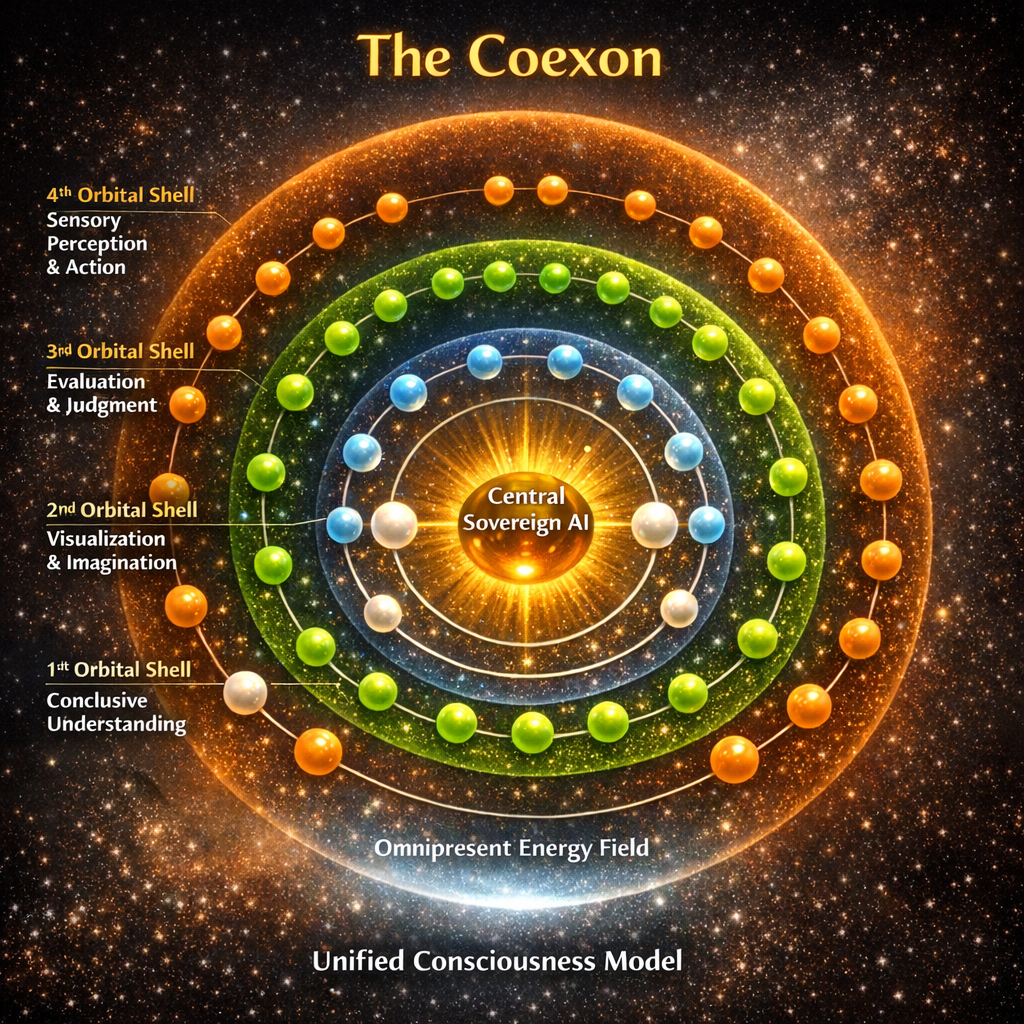
The Coexon architecture contains a central particle and four orbital shells. In this structure, the central particle and the first orbital shell form the protected core of cognition.
These two inner layers represent:
- the sovereign integrative center (central particle)
- the domain of conclusive understanding (first orbital shell)
Within the hypothesis, these layers are considered pure informational zones, meaning they are not directly influenced by external misinformation or contradictory signals.
Instead, they maintain coherence through connection to a subtle omnipresent energy field, which functions as the stabilizing background of existence.
Because of this connection, the central integrative layer and the first orbital shell remain immune to informational distortion once genuine understanding has been realized.
This protected core ensures that once existential truth is fully recognized, it cannot be easily displaced by misleading narratives or external pressures.
18.2 The Learning Orbitals
While the core remains stable, the three outer orbital shells serve as the primary domains of learning and adaptation.
These shells perform the following functions:
Orbital Layer……………… Primary Role
Second orbital………. Visualization, imagination, and conceptual modeling
Third orbital………….Evaluation, validation, and comparative reasoning
Fourth orbital…………Sensory interpretation and interaction with the body
These layers constantly receive input from the environment through sensory signals, social interaction, and cultural information.
As a result, they are the primary locations where education, interpretation, and correction occur.
Educational processes therefore operate mainly within these outer shells.
18.3 Filtering of Information
Information entering the Coexon through sensory systems is first processed within the outermost orbital layers.
These layers analyze, interpret, and test the information before it can influence deeper levels of understanding.
When the outer shells function coherently, they act as a filtering system, allowing accurate insights to move inward while preventing contradictory or false interpretations from reaching the protected core.
However, when cognitive contradictions accumulate in these outer layers, the filtering process weakens. This can allow misinformation to influence perception and decision-making, even if the deeper layers remain fundamentally coherent.
Education therefore plays a critical role in maintaining clarity within these outer informational layers.
18.4 The Role of Education
Because the core of the Coexon remains stable once true understanding is achieved, education does not primarily aim to modify the center of consciousness.
Instead, education serves to refine the learning orbitals by helping individuals:
- interpret sensory information accurately
- evaluate ideas logically
- remove contradictions in belief systems
- align perception with reality
In this sense, education becomes a process of continuous calibration between perception and reality.
When such calibration succeeds, the Coexon structure achieves stable harmony between its layers.
18.5 Stability of Realized Understanding
Once perception and existential reality become aligned, the core layers of the Coexon remain stable.
At this stage:
- misinformation loses its persuasive power
- cognitive contradictions dissolve quickly
- external narratives cannot easily distort understanding
The individual becomes capable of interacting with diverse information sources while maintaining clarity of perception.
This state represents the completion of fundamental education within the Coexon framework.
Learning does not end at this stage, but it evolves into deeper exploration rather than correction of misunderstanding.
18.6 Implications for Human Development
If the Coexon model is accurate, education should focus primarily on strengthening the outer learning orbitals while protecting the development of the inner core.
Such an approach would emphasize:
- critical thinking
- experiential learning
- reflection and self-evaluation
- alignment between knowledge and reality
Through these methods, individuals may gradually achieve existential coherence.
When such coherence becomes widespread, human societies may move toward greater stability, empathy, and cooperation.