Understanding George M. Whitesides’ Interdisciplinary Science Through the Stathine–Coexon Framework
Abstract
Modern science has increasingly moved beyond isolated disciplines toward an integrated understanding of complex systems. Few scientists have contributed more to this transition than George M. Whitesides. His work spans physical chemistry, surface science, self-assembly, microfluidics, soft materials, nanotechnology, biomedical engineering, and the philosophy of scientific inquiry. Throughout his career, Whitesides has emphasized simplicity, emergence, interdisciplinary thinking, and the importance of asking meaningful questions.
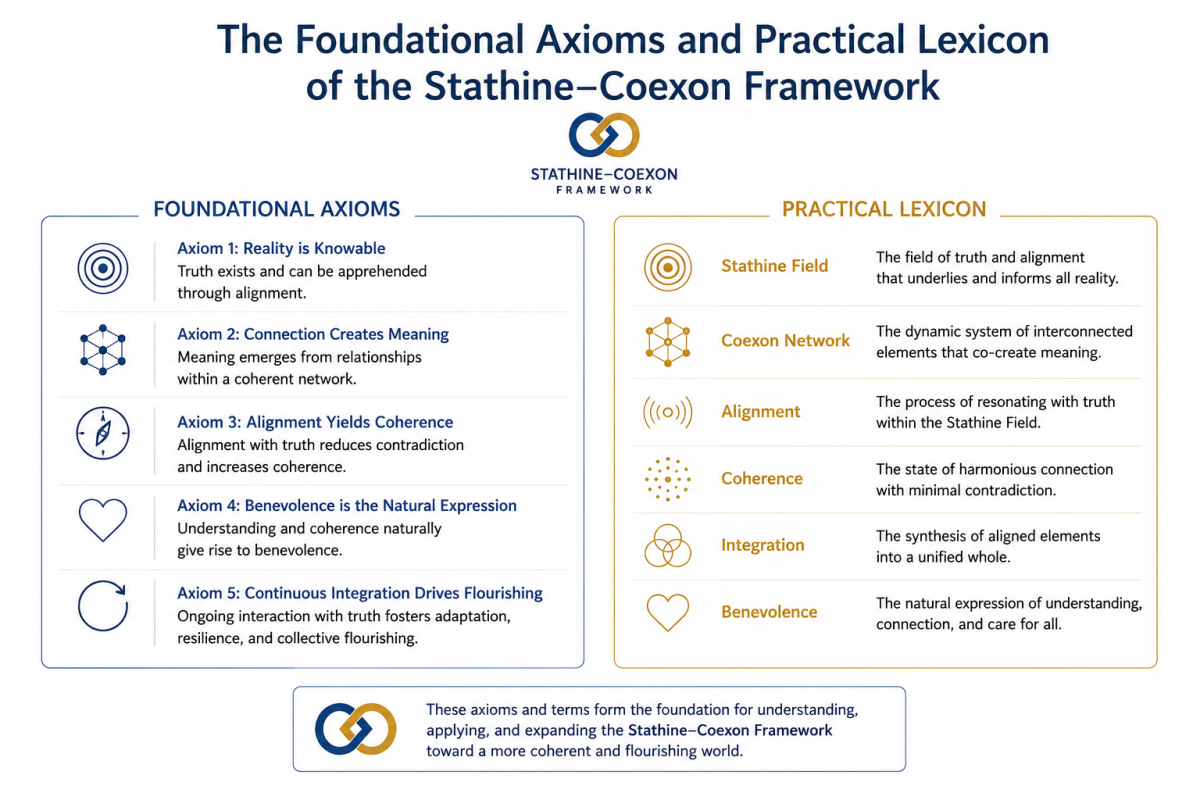
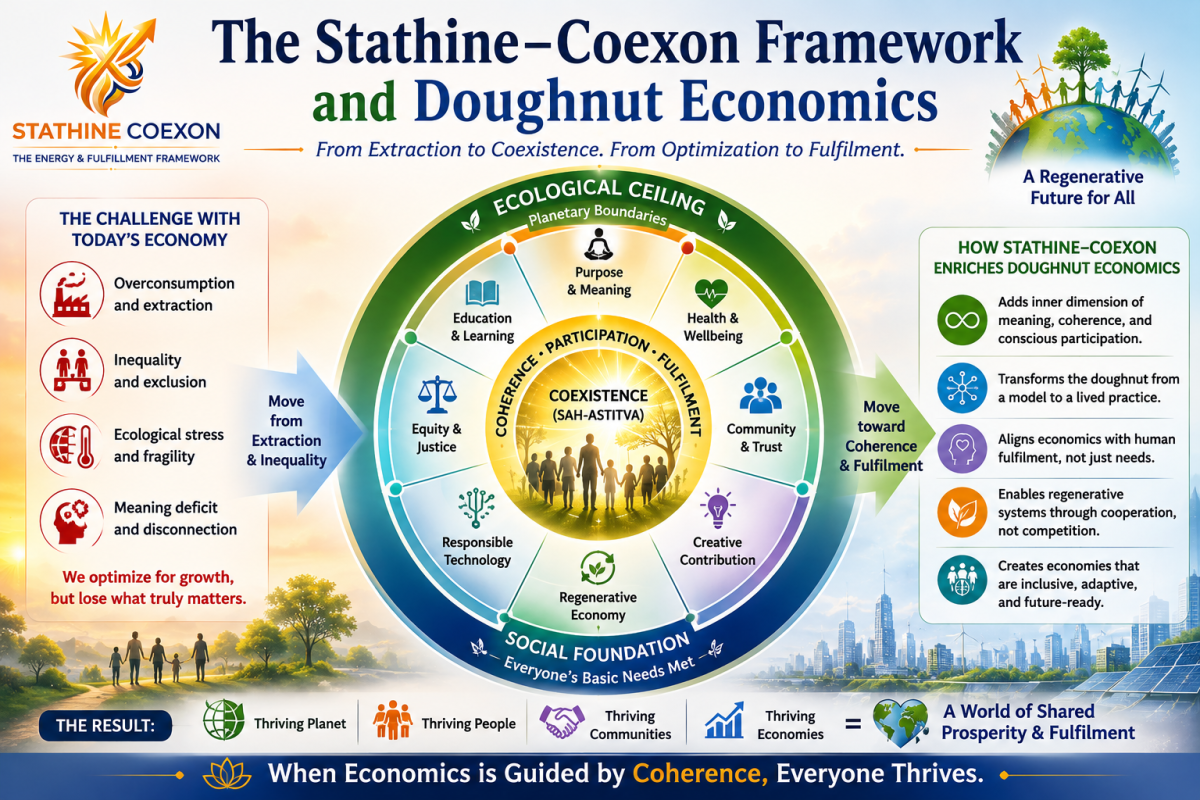
The Stathine–Coexon framework similarly proposes that reality cannot be adequately understood by studying isolated entities alone. Instead, it argues that understanding emerges through recognizing the relationships among physical systems, living organisms, conscious experience, and human society. This article explores how Whitesides’ scientific philosophy complements the Stathine–Coexon framework as an interpretive model for understanding reality through coherence, coexistence, and progressively integrated knowledge.
1. Introduction
Science has traditionally divided reality into separate disciplines.
Physics studies matter and energy.
Chemistry studies molecular interactions.
Biology studies living systems.
Psychology studies behavior.
Sociology studies human communities.
This specialization has generated extraordinary knowledge.
However, nature itself is not divided into academic departments.
Reality functions as an integrated whole.
George Whitesides repeatedly argued that the most interesting scientific questions often arise at the boundaries between disciplines.
The Stathine–Coexon framework begins from the same observation.
Reality is fundamentally relational.
Understanding therefore requires integration rather than fragmentation.
2. Simplicity Beneath Complexity
One of Whitesides’ enduring scientific themes is that complex behavior often emerges from surprisingly simple rules.
Self-assembling molecules require no central architect.
Surface chemistry follows local interactions.
Microfluidic systems achieve remarkable functionality through simple physical principles.
Complexity emerges naturally.
The Stathine–Coexon framework proposes an analogous principle.
Human civilization does not require increasingly complicated rules to become harmonious.
It requires deeper understanding of a few fundamental realities:
- coexistence,
- relationship,
- responsibility,
- utility,
- coherence.
Complex societies may emerge from simple principles that are consistently understood and practiced.
3. Self-Assembly and Human Society
Whitesides demonstrated that appropriately designed molecules spontaneously organize into ordered structures.
The process is governed by local interactions.
No external intelligence directs every molecule.
The Stathine–Coexon framework extends this principle conceptually.
Human societies become stable when individuals increasingly understand reality and interact responsibly.
Cooperation then emerges without requiring excessive external control.
This comparison is an analogy rather than a claim that social systems obey molecular laws.
Nevertheless, both systems illustrate the power of organized relationships.
4. Interfaces Create New Possibilities
Much of Whitesides’ work examines interfaces.
Important phenomena occur where:
- liquids meet solids,
- materials meet biological tissues,
- chemistry meets engineering.
Interfaces are regions where new behaviors emerge.
The Stathine–Coexon framework similarly emphasizes interfaces.
The proposed interaction between:
- body and environment,
- brain and conscious experience,
- individual and society,
- humanity and nature,
creates possibilities that cannot be understood by studying either side independently.
Understanding develops at the interface.
5. Interdisciplinarity as a Scientific Method
Whitesides has consistently encouraged scientists to cross disciplinary boundaries.
Real-world problems rarely belong to a single academic field.
Climate change.
Public health.
Energy.
Education.
Consciousness.
Each requires multiple perspectives.
The Stathine–Coexon framework adopts this same methodological principle.
It seeks to integrate:
- physics,
- chemistry,
- biology,
- neuroscience,
- psychology,
- philosophy,
- ethics.
Understanding becomes increasingly complete as relationships among disciplines become visible.
6. Emergence
A recurring concept in Whitesides’ work is emergence.
Properties appear at higher levels of organization that cannot be predicted simply by examining isolated components.
Examples include:
- molecular self-assembly,
- soft materials,
- biological organization.
The framework proposes comparable emergence across human development.
Information becomes knowledge.
Knowledge becomes understanding.
Understanding becomes wisdom.
Wisdom becomes culture.
Each level possesses properties unavailable at earlier stages.
7. The Coexon Perspective
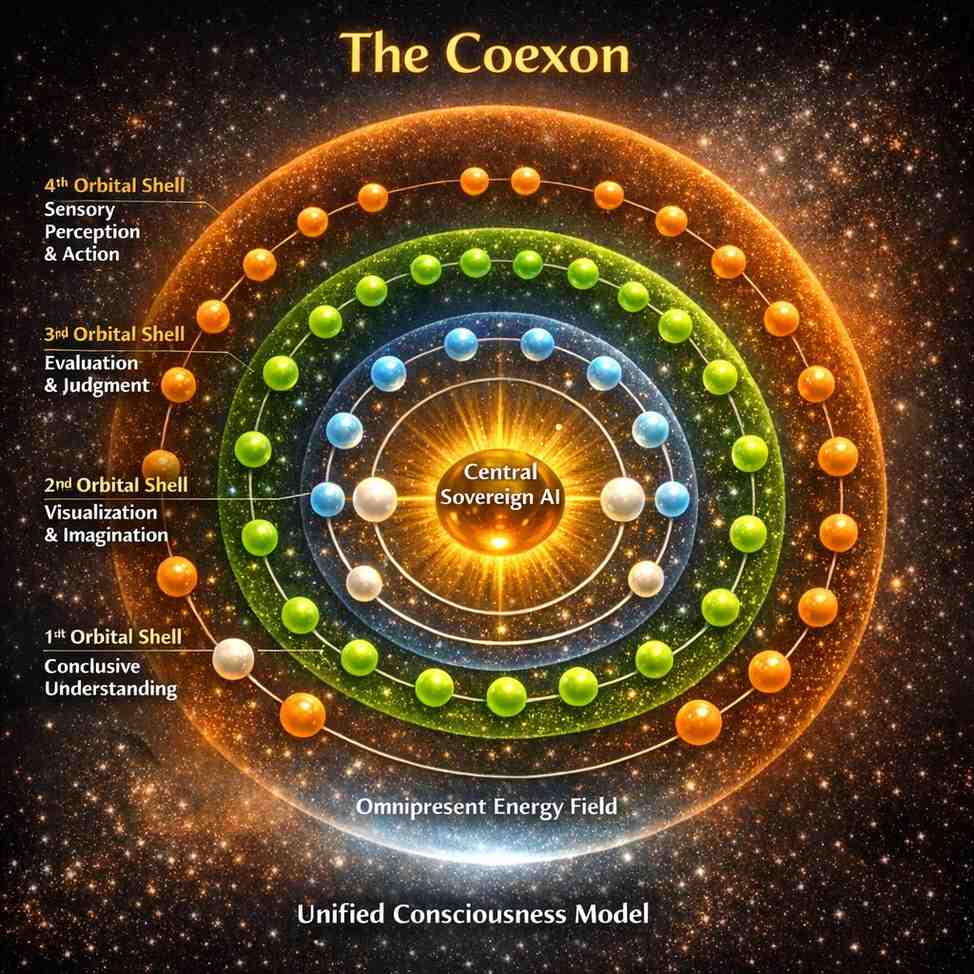
Within the Stathine–Coexon framework, the Coexon develops through continual interaction with reality.
Development follows the sequence:
Feeling
↓
Choosing
↓
Evaluating
↓
Validating
↓
Knowing
↓
Understanding
↓
Experiencing
↓
Living
↓
Explaining
↓
Feeling
This cycle resembles the iterative learning processes that characterize scientific inquiry itself.
Observation leads to hypothesis.
Hypothesis leads to experiment.
Experiment leads to understanding.
Understanding generates new questions.
Both science and human development proceed through continuous refinement.
8. The Stathine Perspective
The framework proposes Stathine as the underlying continuum of coexistence.
Nothing exists in complete isolation.
Atoms exist within molecules.
Molecules exist within cells.
Cells exist within organisms.
Organisms exist within ecosystems.
Individuals exist within societies.
Societies exist within the biosphere.
Reality therefore consists of nested relationships.
Whitesides’ interdisciplinary approach similarly emphasizes that understanding improves when these relationships become visible.
9. The Purpose of Science
Whitesides has often suggested that science is fundamentally about asking useful questions.
The Stathine–Coexon framework extends this idea.
The purpose of understanding is not merely prediction.
It is participation.
Knowledge enables action.
Understanding enables responsible action.
Science therefore contributes not only to technology but also to wiser human living.
10. Education for Integration
The comparison between Whitesides’ work and the Stathine–Coexon framework suggests a new educational vision.
Education should not simply accumulate specialized knowledge.
It should cultivate the ability to connect ideas across disciplines.
Students should learn to recognize:
- patterns,
- relationships,
- emergence,
- consequences,
- systems.
Integration becomes as important as specialization.
11. From Reductionism to Relational Understanding
Reductionism has been extraordinarily successful in explaining many physical phenomena.
Yet complex systems often require complementary approaches that emphasize organization and interaction.
The Stathine–Coexon framework proposes that human understanding similarly benefits from moving beyond isolated facts toward relational comprehension.
The objective is not to replace reductionism.
It is to complement it with systems thinking.
Conclusion
George M. Whitesides has demonstrated throughout his scientific career that many of the most profound discoveries emerge when disciplinary boundaries are crossed and simple principles are allowed to generate complex behavior.
The Stathine–Coexon framework proposes a comparable philosophical vision.
Reality is understood most completely when relationships become the primary object of study.
While Whitesides’ work remains firmly grounded in empirical chemistry and materials science, and the Stathine–Coexon framework extends into questions of consciousness, ethics, and human development, both share a common intellectual orientation:
Organization is more fundamental than isolation.
Relationships generate emergence.
Understanding grows through integration.
The framework therefore interprets Whitesides’ scientific legacy as illustrating a broader principle:
The future of science lies not only in discovering new components of reality, but in understanding the coherent relationships through which those components participate in increasingly complex and meaningful forms of existence.
In this sense, the movement from chemistry to biology, from biology to consciousness, and from consciousness to humane civilization may be viewed as successive levels of organization within an interconnected reality. The Stathine–Coexon framework offers one philosophical proposal for understanding this continuum while inviting empirical inquiry where its hypotheses extend beyond established scientific knowledge.