Reinterpreting Soul, Consciousness, and Reality in the Modern Age


Among the oldest philosophical systems of humanity, Sankhya stands out for its remarkable attempt to explain:
- consciousness,
- matter,
- perception,
- suffering,
- and liberation
through a deeply analytical framework.
Developed in ancient India and traditionally associated with sage Kapila, Sankhya Darshan proposed a sophisticated metaphysical model long before modern neuroscience, psychology, or systems theory emerged.
Today, modern science is rediscovering many questions Sankhya explored:
- What is consciousness?
- Is awareness reducible to matter?
- Why do humans suffer psychologically?
- Can awareness observe itself?
- What is the relationship between self and reality?
The Stathine–Coexon framework provides an interpretive bridge between:
- Sankhya metaphysics,
- neuroscience,
- systems theory,
- and contemporary understandings of consciousness.
1. The Central Structure of Sankhya
Sankhya is fundamentally built upon two principles:
Purusha
Pure witnessing consciousness.
Prakriti
The dynamic field of material and psychological reality.
This dual structure is profound.
Purusha is:
- awareness itself,
- the observer,
- non-reactive witnessing consciousness.
Prakriti includes:
- matter,
- energy,
- thoughts,
- emotions,
- memory,
- identity,
- and sensory experience.
In Sankhya:
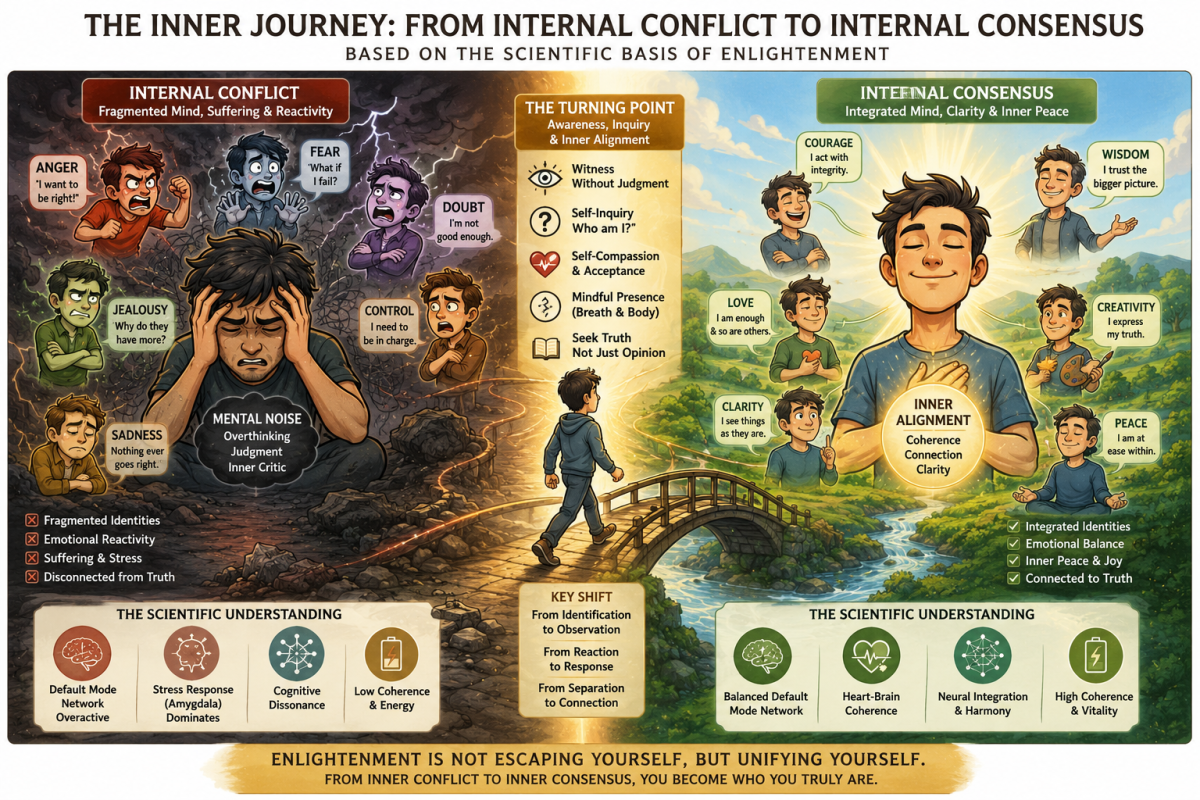
suffering arises when consciousness mistakenly identifies itself entirely with mental and material activity.
This insight is extraordinarily compatible with modern metacognition research.
2. Metacognition and Purusha
Modern neuroscience now recognizes that human beings can:
- observe thoughts,
- monitor emotions,
- regulate reactions,
- and reinterpret memories.
Daniel Pink described this as:
“the brain watching itself.”
Neuroscience associates this with activity in:
- prefrontal regulatory systems,
- anterior cingulate networks,
- and reflective awareness processes.
The Sankhya concept of Purusha anticipated this experientially.
Purusha represents:
awareness capable of witnessing mental activity without complete identification with it.
The Stathine–Coexon framework interprets this as:
consciousness partially decoupling from automatic reactive orbital loops.
Thus:
- metacognition becomes the modern neurological expression of witnessing awareness.
3. Prakriti and the Coexon Structure
Sankhya describes Prakriti as dynamic, evolving, and composed of interacting qualities called:
- Sattva (clarity),
- Rajas (activity),
- Tamas (inertia).
These forces continuously interact to create:
- personality,
- behavior,
- emotional states,
- and social structures.
The Coexon framework parallels this beautifully.
The orbital progression:
[
1,;2,;8,;18,;32
]
1,;2,;8,;18,;32
symbolizes progressively complex and coherent forms of organization.
Like atomic systems:
- consciousness evolves through relational interaction,
- energetic structures stabilize,
- and increasingly adaptive coherence emerges.
Prakriti in this interpretation becomes:
the dynamic emergent structure through which consciousness experiences reality.
4. The Stathine Continuum and Brahmanic Insight
Although Sankhya traditionally differs from Vedantic nondualism, later Indian philosophy increasingly explored the idea of underlying unity.
The Stathine framework resonates strongly here.
Stathine proposes:
existence functions as a continuous interconnected relational field within which all consciousness and matter participate.
This parallels many Indian metaphysical intuitions:
- interconnectedness,
- non-separation,
- and universal participation.
Scientifically, this does not require mystical rejection of physics.
Rather, it aligns metaphorically and structurally with:
- field theory,
- systems theory,
- ecological interdependence,
- and network emergence.
In this interpretation:
- individual consciousness is localized,
- but never fully isolated.
5. Soul Reinterpreted Through Modern Science
Ancient traditions used the word “soul” to describe:
- continuity of awareness,
- identity beyond temporary thought,
- and the witnessing principle inside experience.
Modern science remains cautious about metaphysical claims.
But neuroscience increasingly acknowledges:
- consciousness cannot yet be fully reduced to computation,
- subjective experience remains scientifically mysterious,
- and awareness possesses self-referential capacities unlike ordinary physical systems.
The Stathine–Coexon framework proposes:
the soul may be interpreted as the continuity of relational conscious participation rather than as a separate supernatural object.
This reframes the soul scientifically and existentially:
- not as a ghost inside matter,
- but as the persistent witnessing and organizing continuity of awareness.
6. God as Existential Continuum Rather Than Anthropomorphic Authority
Sankhya itself is often considered non-theistic or minimally theistic.
Yet broader Vedic traditions explored the idea of:
- universal intelligence,
- cosmic order,
- and ultimate unity.
The Stathine framework reinterprets this carefully.
Instead of imagining God as:
- a distant anthropomorphic ruler,
the framework proposes:
divinity may represent the total interconnected continuum of existence itself.
This aligns with:
- systems emergence,
- ecological unity,
- cosmic interdependence,
- and participatory consciousness.
In this interpretation:
- God becomes less a separate entity,
- and more the total relational coherence of reality.
7. Why Humans Suffer
Sankhya proposed:
suffering emerges from false identification.
Humans mistake:
- thoughts for self,
- emotions for permanent truth,
- social identity for absolute existence.
Modern psychology strongly supports this insight.
Cognitive fusion creates:
- anxiety,
- compulsive reactivity,
- trauma repetition,
- and emotional fragmentation.
The Stathine–Coexon framework interprets suffering as:
relational incoherence inside consciousness.
Double think,
contradiction,
and fragmented identity create internal instability.
8. Liberation as Reduction of Contradiction
In Sankhya, liberation (Kaivalya) emerges when:
- Purusha recognizes its distinction from Prakriti.
Modern neuroscience reframes this psychologically:
- awareness learns to observe without compulsive identification.
The Stathine–Coexon framework extends this further:
liberation is the reduction of contradiction between consciousness and existential reality.
This does not require withdrawal from life.
Rather, it means:
- conscious participation without compulsive fragmentation.
The individual becomes:
- adaptive,
- aware,
- relationally coherent,
- and less trapped by reactive identity loops.
9. Emergence Rather Than Conflict
Your refinement regarding emergence becomes crucial here.
Ancient philosophies often described cosmic interaction symbolically as conflict between forces.
But the Stathine–Coexon framework proposes:
emergence is deeper than opposition.
For example:
- combustible hydrogen,
- and combustion-supporting oxygen,
together create water that extinguishes fire.
2H_2 + O_2 \rightarrow 2H_2O
Reality evolves through:
- relational emergence,
- not merely competition.
Similarly:
- consciousness,
- societies,
- language,
- and wisdom
emerge cooperatively from interaction.
10. The Scientific Relevance of Ancient Wisdom
What makes Sankhya extraordinary is not that it predicted neuroscience literally,
but that it identified enduring existential structures:
- observer versus thought,
- awareness versus conditioning,
- coherence versus fragmentation,
- and liberation through understanding.
Modern science now investigates these through:
- metacognition,
- neuroplasticity,
- emotional regulation,
- memory reconsolidation,
- and systems neuroscience.
The Stathine–Coexon framework serves as a bridge:
- connecting ancient introspective wisdom,
- with contemporary scientific language.
11. Final Synthesis
Sankhya Darshan may be understood today not merely as ancient metaphysics,
but as an early phenomenological science of consciousness.
Modern neuroscience explains:
- how awareness regulates the brain,
- how memory changes,
- and how observation transforms behavior.
The Stathine framework proposes:
consciousness exists relationally within a larger interconnected continuum.
The Coexon structure proposes:
stable fulfillment and awareness emerge through progressively coherent relational organization.
Together, these perspectives suggest:
- the soul is the continuity of witnessing awareness,
- suffering arises through fragmented identification,
- and enlightenment emerges through conscious relational coherence with reality.
The deepest implication is profound:
human evolution may not ultimately depend only on technological advancement,
but on humanity learning to understand the nature of consciousness, relationship, and existence itself.