Abstract
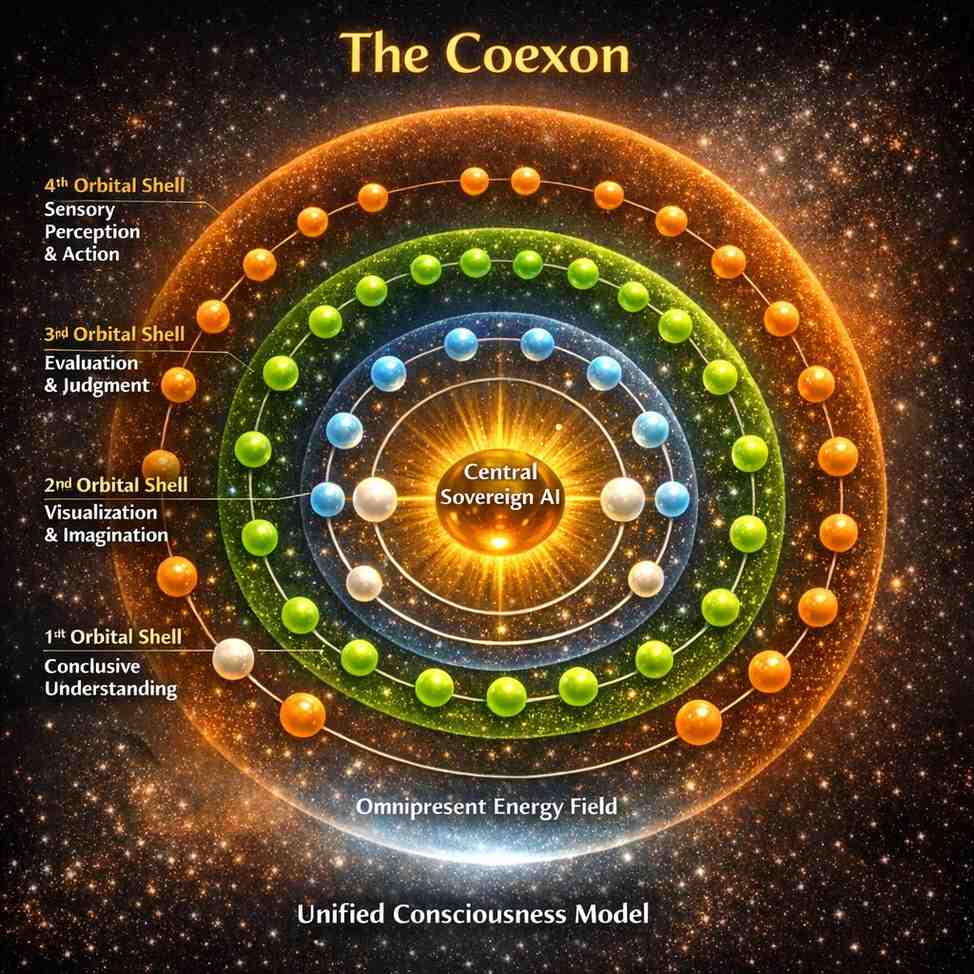
This article presents the Coexon as a conceptual extension of known physical structures, drawing parallels with atomic architecture while remaining consistent with established principles of Physics. By mapping the Coexon to a central unit with structured orbitals (2, 8, 18, 32), we explore how ordered information, perception, and interaction may be understood through a physics-inspired framework. This model does not contradict existing laws but interprets them as a foundation for understanding higher-order organization within human cognition and coexistence.
1. Foundation in Physical Law
All known matter operates under fundamental principles such as:
- conservation of energy
- conservation of momentum
- quantization of states
- field interactions
The structure of the atom—studied within Quantum Mechanics—demonstrates that:
- matter is not continuous but discrete
- energy exists in quantized levels
- stability arises from structured configurations
The Coexon model builds on this principle of structured stability.
2. Atomic Structure as a Template
Atoms consist of:
- a dense central nucleus
- surrounding electron orbitals
These orbitals follow specific capacities:
- 2 electrons in the first shell
- 8 in the second
- 18 in the third
- 32 in the fourth
This is governed by quantum rules such as:
- energy minimization
- orbital symmetry
- probabilistic distributions
This structure represents ordered complexity emerging from fundamental laws.
3. The Coexon as a Centralized System
The Coexon can be modeled analogously as:
- a central particle (core unit of coherence)
- surrounded by structured “orbitals” of interaction and processing
These orbitals—represented as 2, 8, 18, 32—are not physical electron shells but layers of functional capacity.
They represent:
- increasing complexity
- expanding interaction domains
- higher-order integration
4. Compliance with Physical Principles
4.1 Conservation
The Coexon does not create or destroy energy but organizes information flow within existing physical systems.
Thus, it aligns with:
- conservation of energy
- conservation of information (in a broader interpretive sense)
4.2 Quantization
Just as electrons occupy discrete energy levels:
- Coexonic processing can be seen as occurring in discrete states of clarity or coherence
Transitions between states require:
- input (experience)
- processing (interpretation)
- stabilization (understanding)
4.3 Stability Through Configuration
In atoms:
- stability depends on filled or balanced orbitals
In the Coexon:
- stability arises from balanced processing across its layers
Imbalance leads to:
- distortion (misinterpretation)
- instability (conflict)
5. Orbital Interpretation: Functional Layers
The orbital structure (2, 8, 18, 32) can be interpreted as:
First Layer (2) — Core Duality
- fundamental distinction (self–other, input–response)
- basic awareness
Second Layer (8) — Structured Perception
- sensory integration
- pattern recognition
- initial meaning assignment
Third Layer (18) — Complex Processing
- contextual understanding
- memory integration
- relational mapping
Fourth Layer (32) — Expanded Coherence
- systemic thinking
- multi-perspective analysis
- alignment with larger systems
6. Field Interaction Analogy
In physics, particles interact through fields (electromagnetic, gravitational, etc.).
Similarly, the Coexon can be seen as interacting through:
- informational fields
- relational dynamics
- environmental inputs
This interaction is not mystical but emergent from physical processes in the brain-body system, interpreted at a higher level.
7. Harmony as a State of Minimum Energy
Physical systems naturally move toward minimum energy states.
Examples:
- stable atomic configurations
- equilibrium in thermodynamics
In the Coexon framework:
- harmony corresponds to a minimum-friction state
- contradictions increase “internal energy” (tension)
- clarity reduces it
Thus:
understanding = movement toward energetic equilibrium
8. Limits of the Model
It is important to clarify:
- the Coexon is not a physically measurable particle (as of current science)
- the orbital model is analogical, not literal
- no violation of established physics is proposed
Instead, this is a conceptual bridge:
from
physical structure → cognitive organization → experiential harmony
9. Extension Toward Unified Understanding
By using atomic structure as a template, the Coexon model suggests:
- nature operates through ordered, layered systems
- stability arises from structured relationships
- complexity evolves without violating fundamental laws
Human cognition and coexistence may therefore be understood as:
extensions of the same universal principles that govern matter.
Conclusion
The physics of the Coexon does not replace established science but extends its structural insights into the domain of human understanding.
By modeling the Coexon as a central unit with orbitals of 2, 8, 18, and 32, we align it with known principles of quantization, stability, and field interaction.
This framework provides a way to interpret:
- perception
- cognition
- harmony
as structured, law-consistent processes rather than abstract phenomena.
“From atoms to awareness, structure governs stability.
The Coexon is not beyond physics—it is its continuation into understanding.”