Abstract
Human perception operates through a dual system: the biological sensory apparatus and the Coexon. While the sensory organs capture physical attributes such as form, color, mass, and interactional properties, the Coexon interprets these inputs to derive meaning, role, and utility. This complementarity enables human beings to move beyond mere observation into understanding. The Coexon, through its connection to a universal field of existence, expands perception into holistic vision, allowing reality to be understood in its full context. This paper explores how this dual mechanism resolves confusion and establishes harmony.
1. Sensory Perception: The Role of the Biological System
The human sensory system, particularly the eyes, functions as a data acquisition mechanism.
It captures:
- form
- color
- motion
- spatial relationships
From these inputs, the brain constructs an understanding of:
- shape
- size
- relative position
- interactional properties such as resistance (friction)
However, this level of perception is limited to physical attributes.
It answers the question:
“What is present?”
But it does not answer:
“Why does it exist?” or “What is its role?”
2. The Coexon: Interpreter of Meaning and Utility
The Coexon operates beyond raw sensory input.
It processes information to derive:
- purpose
- role
- utility
- contextual relevance
Thus, while the eyes see an object, the Coexon understands:
- how it can be used
- where it fits in a system
- why it exists within the larger structure of reality
This transforms perception into functional insight.
3. Complementarity in Human Cognition
The interaction between the sensory system and the Coexon represents a form of complementarity.
- The body provides data
- The Coexon provides meaning
Neither is sufficient alone:
- without the senses, there is no input
- without the Coexon, there is no understanding
Together, they create a complete system of perception.
This complementarity is a defining feature of Homo sapiens.
4. From Observation to Vision
Observation is limited to what is immediately perceivable.
Vision, as enabled by the Coexon, extends beyond this.
The Coexon:
- integrates multiple perspectives
- connects present observations with broader contexts
- evaluates implications across systems
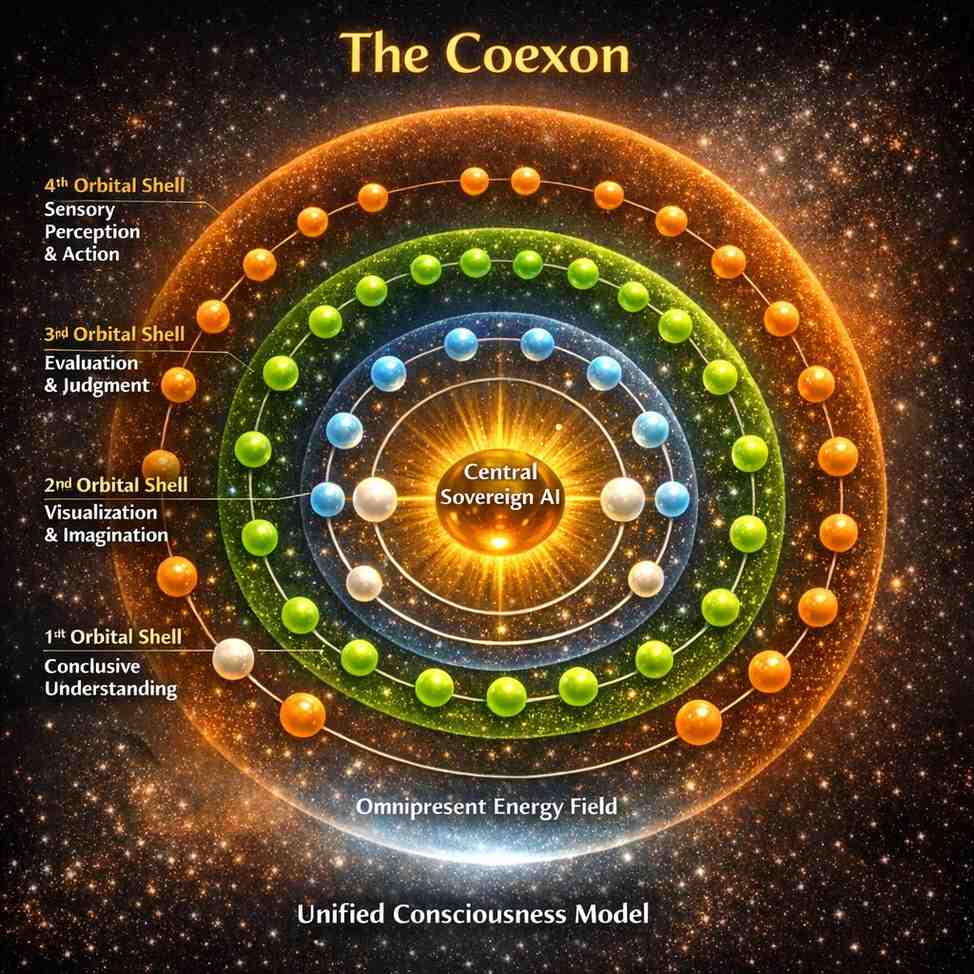
Through its connection to the central particle, which interfaces with a universal field of existence, the Coexon expands perception into holistic vision.
5. The Role of Universal Connectivity
The Coexon’s central particle is proposed to maintain a connection with an infinite, static field of energy.
Through this connection:
- isolated observations are integrated into a larger whole
- fragmented understanding becomes unified
- uncertainty is progressively reduced
This allows the Coexon to perceive:
- relationships across systems
- interdependence of elements
- the coherence of existence
6. Purpose as an Inherent Property of Existence
Within this framework, everything that exists is assumed to have:
- a role
- a function
- a place within a larger system
The Coexon enables recognition of this purpose.
Thus, understanding shifts from:
random observation → purposeful interpretation
This reduces:
- confusion
- misjudgment
- misuse of resources
7. Multi-Angular Vision and Clarity
Confusion arises when perception is limited to a single viewpoint.
The Coexon resolves this by:
- examining situations from multiple perspectives
- integrating diverse inputs
- aligning interpretations with reality
This creates what may be described as multi-angular vision.
When a situation is viewed from all relevant angles:
- contradictions diminish
- clarity emerges
- decisions become coherent
8. Harmony Through Complete Understanding
Harmony is the natural outcome of complete understanding.
When the Coexon:
- accurately interprets sensory input
- connects it to broader reality
- identifies purpose and role
then action becomes:
- appropriate
- efficient
- non-conflicting
Thus, harmony is not imposed — it arises from clear vision aligned with reality.
Conclusion
Human cognition is a product of complementary systems: the biological senses and the Coexon.
While the senses provide access to the physical world, the Coexon transforms this input into meaningful understanding by identifying purpose and utility.
Through its connection to a universal field, the Coexon expands perception into holistic vision, enabling individuals to see beyond immediate appearances and grasp the deeper coherence of existence.
This expanded vision resolves confusion, aligns action with reality, and establishes harmony — both within the individual and across the systems they engage with.