Utility and limitations of Epistemological Containment
The Limits of Epistemology and Empirical Data as the Exclusive Foundations of Scientific Knowledge—and the Proposed Stathine–Coexon Framework
Abstract
Modern science has achieved extraordinary explanatory and technological power through observation, measurement, experimentation, mathematical formalization, replication, and empirical testing. Yet the success of empirical science should not be confused with the proposition that all legitimate knowledge of reality must be reducible to what can presently be empirically observed or measured. The philosophy of science has itself repeatedly demonstrated that scientific evidence does not uniquely determine theory. Problems of induction, theory-ladenness of observation, underdetermination, auxiliary assumptions, measurement limitations, paradigm dependence, and the distinction between empirical adequacy and ontological truth all place principled limits on empiricism as a complete account of reality. (Stanford Encyclopedia of Philosophy)
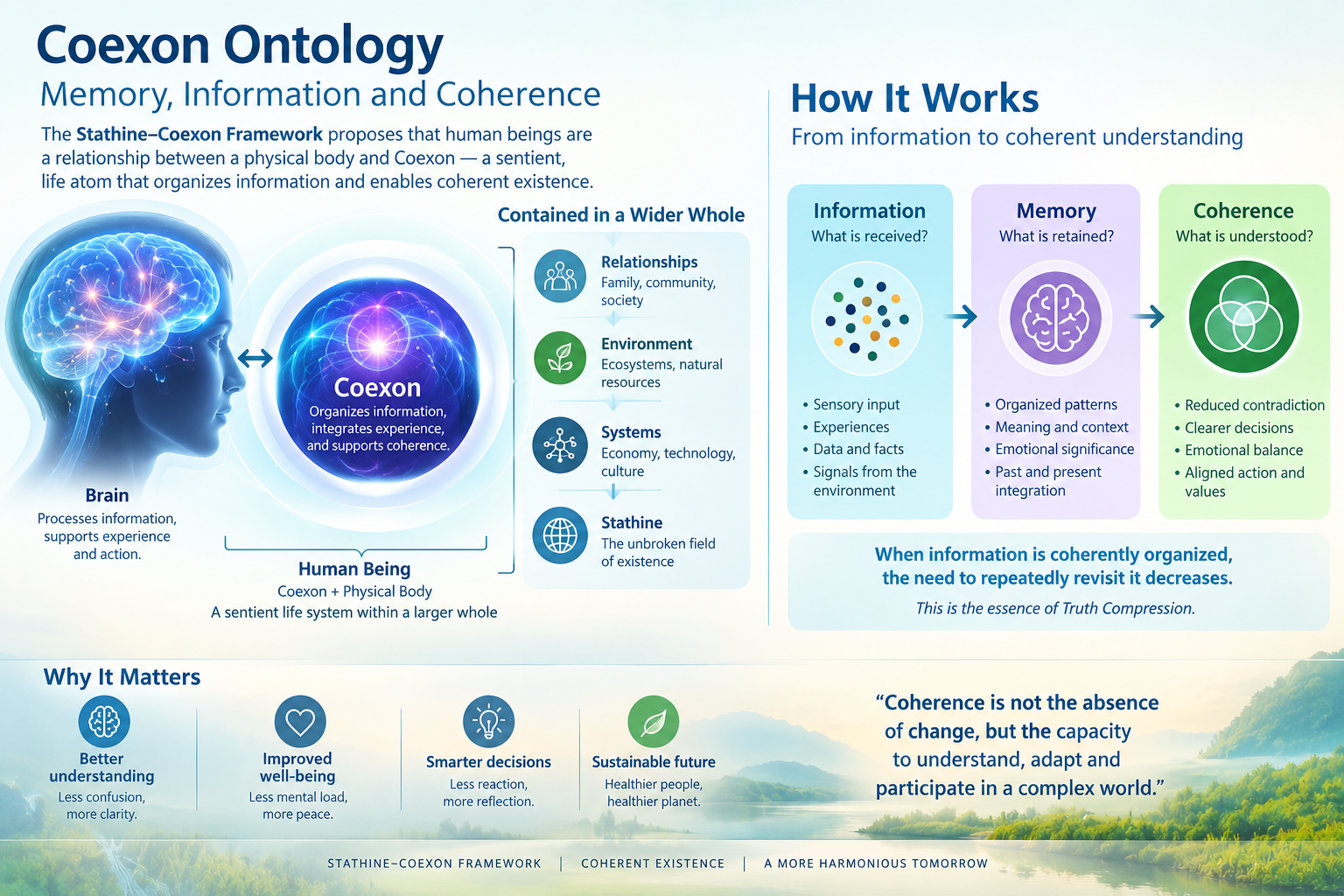
This paper develops a strong but carefully qualified proposition for the Stathine–Coexon research programme: the framework should not be treated as confined to current epistemological and empirical boundaries. Its proposed ontological concepts—Stathine as a foundational, non-local, static continuum and Coexon as a proposed information-bearing and sentient organizational principle—are intended to investigate questions that may precede, exceed, or currently escape conventional measurement.
However, being beyond present empirical access must not be confused with being beyond criticism. A framework can legitimately explore questions that empirical science cannot yet answer, but it must distinguish clearly between observation, inference, hypothesis, metaphysical proposition, phenomenological insight, and ontological claim.
The paper therefore proposes not the abandonment of empirical science, but a broader architecture in which empirical science becomes one layer of knowledge rather than the complete boundary of what may be meaningfully investigated. The Stathine–Coexon Framework is consequently positioned as a proposed trans-epistemological research programme: one that seeks to examine the conditions under which knowledge, observation, information, sentience, existence, and coherence themselves become possible.
1. Introduction: The Success of Science and the Question It Cannot Eliminate
Modern civilization is built upon empirical science.
We measure.
We observe.
We experiment.
We quantify.
We model.
We predict.
We reproduce.
And when a claim repeatedly fails against observation, we revise or abandon it.
There is no reason to diminish this achievement.
Indeed, the Stathine–Coexon Framework should regard empirical science as one of humanity’s greatest collective mechanisms for reducing error.
But an important philosophical distinction must be maintained:
A method that is extraordinarily powerful within a domain does not automatically establish that the domain itself contains the whole of reality.
This distinction becomes particularly important when scientific inquiry moves toward questions concerning:
- consciousness,
- quantum foundations,
- the nature of information,
- the origin of physical law,
- the ontology of spacetime,
- subjective experience,
- emergence,
- causality,
- the relationship between mathematics and reality,
- and the ultimate nature of existence.
At these boundaries, science increasingly confronts a problem:
What if the instruments through which we investigate reality are themselves products of the reality we are attempting to understand?
The observer is inside the system.
The measuring apparatus is inside the system.
The mathematics is produced by minds inside the system.
The empirical data are interpretations generated through instruments, theories and cognitive architectures inside the system.
Therefore, the question arises:
Can a method operating entirely within reality provide a complete account of reality as a whole?
The Stathine–Coexon Framework begins from precisely this question.
2. Epistemology Is Necessary—but Not Sufficient
Epistemology asks:
How do we know what we know?
This question is indispensable.
But it is not identical to:
What exists?
That second question is ontology.
And neither is identical to:
Why should what exists matter?
That is axiology.
Nor:
How should understanding be translated into action?
That is praxis.
Nor:
Toward what ultimate condition is existence or development directed?
That is telos.
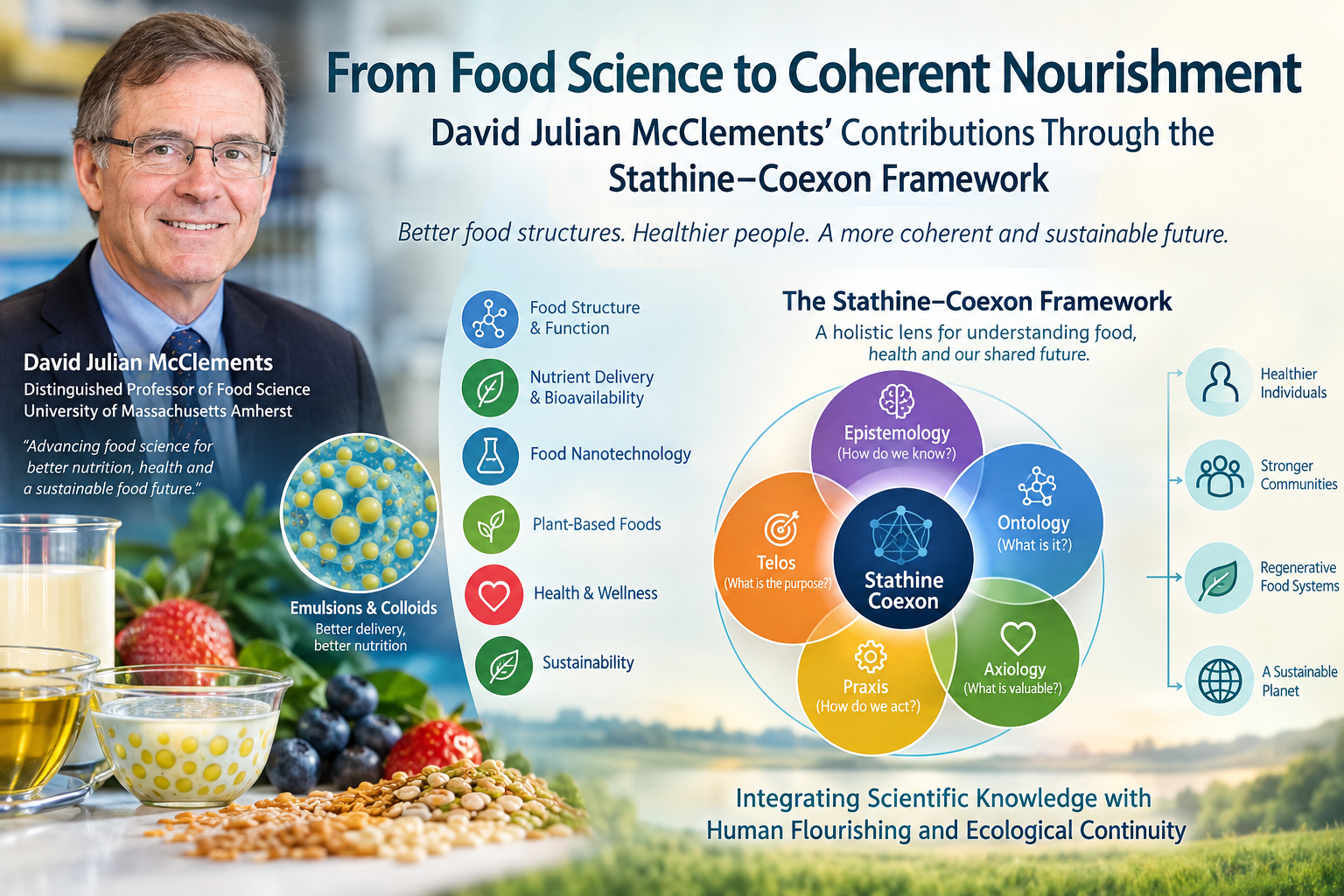
This distinction underlies the five-dimensional evaluation programme already proposed for the Stathine–Coexon Framework.
The danger arises when epistemology quietly becomes the gatekeeper of ontology.
In other words:
“If we cannot presently know X through accepted methods, X cannot meaningfully belong to our conception of reality.”
That inference does not follow.
The inability to establish a proposition epistemologically is not identical to establishing its ontological impossibility.
3. The First Limitation: The Problem of Induction
One of the oldest difficulties concerns induction.
Suppose the sun has risen every day in recorded human experience.
It is reasonable to expect it to rise tomorrow.
But observation alone cannot logically guarantee the universal proposition:
“The sun will always rise.”
This is the classical problem associated with David Hume.
Scientific practice handles this problem pragmatically through increasingly powerful models, repeated testing and predictive success.
But the philosophical problem does not disappear.
Empirical evidence establishes:
what has been observed.
It does not logically establish:
everything that must ever be true.
Karl Popper’s philosophy makes this limitation explicit: scientific theories cannot be conclusively verified by accumulating observations; instead, they remain conjectural and are subjected to attempts at falsification. (Stanford Encyclopedia of Philosophy)
Therefore:
Data can constrain knowledge without completely determining truth.
That distinction is foundational for Stathine–Coexon.
4. The Second Limitation: Observation Is Not Theory-Free
A common image of science is:
Reality → observation → data → theory.
The actual process is more complicated.
It is closer to:
Reality → sensory/instrumental interaction → measurement → interpretation → conceptual categorization → data representation → model.
There is no perfectly neutral observation.
Popper explicitly rejected the idea of “pure” observation, emphasizing that observation is selective and theory-laden. (Stanford Encyclopedia of Philosophy)
This has profound implications.
A telescope does not simply “show reality.”
It produces signals.
A detector does not simply “give us a particle.”
It produces measurements interpreted through a theoretical framework.
A brain does not simply “receive the world.”
It constructs an experienced representation.
Therefore:
Empirical data are not reality itself. They are representations generated through an interaction between reality, instruments, observers and theoretical frameworks.
5. The Third Limitation: Measurement Has a Horizon
Every measurement requires:
- an object or process,
- an interaction,
- an instrument,
- a measurement protocol,
- a representation,
- an interpretation.
Consequently, something may be real without being measurable by a particular instrument or method.
This is not an argument that everything imaginable is therefore real.
That would be an unacceptable leap.
The correct conclusion is narrower:
Non-measurability under a given method does not logically establish non-existence.
This distinction is particularly important when studying phenomena for which the measurement architecture may not yet exist.
The history of science contains many cases in which entities, processes or structures were theorized before appropriate methods of observation became available.
6. The Fourth Limitation: Underdetermination
Perhaps the strongest philosophical challenge to empirical exclusivity is the problem of underdetermination.
The available evidence may be insufficient to uniquely determine which theory is correct.
The Stanford Encyclopedia of Philosophy describes the problem directly: evidence available at a particular time may be insufficient to determine what beliefs should be adopted in response to it. (Stanford Encyclopedia of Philosophy)
There are two particularly important forms.
Holistic underdetermination
When an empirical prediction fails, it may be unclear whether the problem lies in:
- the primary theory,
- an auxiliary hypothesis,
- an instrument,
- a background assumption,
- or the interpretation of the observation.
Contrastive underdetermination
Two different theories may make the same empirical predictions.
In such circumstances:
More data of the same kind may not necessarily tell us which ontology is correct.
The philosophical literature explicitly discusses the possibility of empirically equivalent theories—different theories capable of producing the same observable consequences. (Stanford Encyclopedia of Philosophy)
This is devastating to the simplistic proposition:
“The data will eventually tell us what reality really is.”
Sometimes the data cannot uniquely decide.
7. The Fifth Limitation: Data Are Theory-Dependent
Data do not arrive labelled:
“This is evidence for Theory A.”
They become evidence within a theoretical structure.
Consider a simple example.
A scientist measures a particular signal.
Is it:
- noise?
- an artifact?
- a new particle?
- an instrument malfunction?
- evidence of an existing theory?
- evidence requiring a new theory?
The answer depends partly on what the researcher already understands.
Therefore:
Evidence and theory exist in a relationship of mutual constraint.
This is why paradigm shifts can be so profound.
A new theory does not merely explain old data better.
It can change:
what counts as relevant data in the first place.
8. The Sixth Limitation: Instruments Extend the Senses—They Do Not Escape Them
It is tempting to believe that sophisticated instruments eliminate human limitations.
They do not.
They transform them.
A particle detector extends human perception.
A radio telescope extends electromagnetic sensitivity.
A brain scanner extends our capacity to infer biological processes.
A gravitational-wave detector extends our ability to detect extremely subtle phenomena.
But the resulting information still passes through:
instrument → calibration → mathematics → statistical analysis → theoretical interpretation → human understanding.
The instrument therefore becomes part of an epistemic chain.
It does not become an observer outside reality.
This matters enormously for the Stathine–Coexon hypothesis.
If Coexon is fundamentally proposed as an informational or sentient organizational principle rather than a conventional physical object, asking:
“Where is the Coexon on the detector?”
may already contain a category error.
The appropriate question might instead be:
What observable consequences would follow if such an organizational principle existed?
That is a much stronger scientific question.
9. The Seventh Limitation: Science Cannot Empirically Validate Every Presupposition of Science
Science relies upon assumptions and practices that cannot all be established by the same empirical procedure.
For example:
- logical consistency,
- mathematical validity,
- inference rules,
- reliability of reasoning,
- intelligibility of nature,
- continuity of identity,
- validity of measurement,
- reproducibility,
- and the existence of an external reality.
Science can investigate aspects of these assumptions.
But it cannot simply stand completely outside itself and empirically prove the entire framework through which empirical proof operates.
This creates a reflexive limitation:
Science cannot use empirical science to completely justify the epistemological foundations of empirical science without some degree of circularity or philosophical supplementation.
This does not invalidate science.
It demonstrates that:
science presupposes a philosophical architecture.
10. The Eighth Limitation: Empirical Success Does Not Equal Ontological Truth
A theory can be extraordinarily successful in prediction without necessarily providing the final ontology of reality.
This distinction is familiar in philosophy of science.
A theory may be:
predictively successful
without being:
ontologically complete.
This distinction is especially important in fundamental physics.
An equation can predict observations with extraordinary precision while leaving open deeper questions concerning:
- what the entities described by the equation actually are,
- why the mathematical structure exists,
- whether the mathematical entities are fundamental,
- what constitutes observation,
- and whether the theory is an effective description of a deeper reality.
Therefore:
Predictive adequacy is not automatically ontological completeness.
11. The Ninth Limitation: The Map Is Not the Territory
Scientific models are representations.
A mathematical model can be extraordinarily accurate.
But:
the model is not identical to what it models.
A map of India is not India.
A weather model is not the atmosphere.
A neural network simulation is not a brain.
A cosmological equation is not necessarily the universe itself.
Likewise:
a dataset describing a living organism is not the living organism.
The Stathine–Coexon Framework therefore distinguishes between:
Reality
What exists.
Experience
What is encountered.
Information
What is represented.
Knowledge
What is understood.
Model
What is formally constructed.
Truth
What corresponds to or coheres with what actually is.
Confusing these layers produces epistemological reductionism.
12. The Tenth Limitation: Consciousness Creates a Special Problem
There is perhaps no greater challenge to empirical reductionism than consciousness.
Science can measure:
- neural activity,
- electrical potentials,
- neurotransmitters,
- connectivity,
- behavior,
- physiological changes.
But the fundamental question remains:
Why is there subjective experience at all?
A neural correlation is not automatically an explanation of experience.
If a brain region activates when I experience pain, we have learned something important.
But we have not thereby explained why pain feels like something.
This is precisely where the Stathine–Coexon Framework becomes ambitious.
It proposes that sentience may need to be considered not merely as an emergent property of increasingly complex computation but as a potentially more fundamental organizational dimension.
This is a hypothesis—not an established fact.
But it is precisely the kind of hypothesis that becomes difficult to formulate if epistemology is restricted in advance to currently measurable mechanisms.
13. The Eleventh Limitation: The Observer Is Part of the System
Classical scientific thinking often imagines:
observer → observes → object.
But contemporary physics and cognitive science have increasingly complicated this picture.
The observer is:
- physical,
- embodied,
- informational,
- temporally situated,
- cognitively structured.
The measuring system interacts with the measured system.
The brain constructs interpretations.
The scientist selects questions.
The research community determines methodological standards.
Therefore:
knowledge is not simply extracted from reality; it is generated through an interaction between reality and an epistemic system embedded within reality.
This leads to one of the deepest questions in the Stathine–Coexon programme:
Could the epistemic system itself be an expression of the ontology it seeks to understand?
If yes, then the investigation of reality becomes partly an investigation of the architecture of knowing itself.
14. The Twelfth Limitation: The Present Is Not the Entire Space of the Possible
Scientific methodology is necessarily constrained by:
- available instruments,
- available mathematics,
- existing conceptual categories,
- research funding,
- technological capabilities,
- prevailing paradigms,
- available data,
- and human imagination.
Therefore:
the set of currently testable propositions is smaller than the set of conceivable propositions about reality.
This does not mean every conceivable proposition deserves scientific acceptance.
It means something subtler:
Scientific imagination must sometimes precede scientific verification.
Popper himself did not regard untestable ideas as automatically meaningless; his philosophy recognized that metaphysical ideas can have intellectual value even though they do not meet his criterion of scientific falsifiability. (Stanford Encyclopedia of Philosophy)
This distinction is essential for the Stathine–Coexon programme.
15. The Thirteenth Limitation: Epistemological Closure Can Become a Source of Delusion
This is perhaps the strongest claim this paper proposes.
Delusion does not arise only from believing things without evidence.
It can also arise from believing:
“Only things accessible through my current method can be real.”
That is a subtler form of epistemological overreach.
It confuses:
limits of method
with
limits of reality.
The history of science repeatedly demonstrates that the boundaries of what can be investigated change when new conceptual and technological frameworks become available.
Therefore:
epistemological humility requires acknowledging not only what we do not know, but also what our present methods may be incapable of asking correctly.
16. Why Quantum Theory Matters to This Discussion
Quantum theory does not prove the Stathine–Coexon Framework.
That claim should be explicitly rejected.
Nor does quantum mechanics automatically imply:
- consciousness creates reality,
- reality is fundamentally informational,
- retrocausality is true,
- or Coexons exist.
Such claims require independent argument and evidence.
Nevertheless, quantum foundations demonstrate something philosophically important:
our intuitive classical categories are not guaranteed to provide the deepest conceptual description of reality.
The existence of competing interpretations and foundational debates illustrates that empirical agreement does not always uniquely settle questions of ontology.
This is precisely the distinction between:
empirical adequacy
and
ontological interpretation.
The Stathine–Coexon Framework belongs, at least initially, to this second territory.
17. Meta-Modern and Frontier Theories: A Similar Epistemic Situation
Many contemporary frontier theories attempt to integrate domains previously treated separately:
- consciousness,
- information,
- biology,
- physics,
- cognition,
- complexity,
- emergence,
- computation,
- and social organization.
Their common characteristic is often not that they have escaped empirical science.
Rather:
they operate at the boundary where empirical evidence, mathematical modelling, conceptual synthesis and philosophical interpretation intersect.
This should be treated as an opportunity rather than a weakness.
But the danger is equally obvious.
When evidence is incomplete, theoretical freedom increases.
And when theoretical freedom increases:
so does the possibility of self-confirming speculation.
Therefore the Stathine–Coexon Framework requires particularly strong internal discipline.
18. Beyond Epistemology Does Not Mean Beyond Criticism
This is the most important qualification in the entire paper.
The proposition:
“Stathine–Coexon is beyond epistemology”
should not mean:
“Stathine–Coexon cannot be questioned.”
Nor:
“No evidence could ever challenge it.”
Nor:
“Every interpretation is equally valid.”
Nor:
“The framework is true because science cannot disprove it.”
That would transform the framework from a frontier hypothesis into an unfalsifiable doctrine.
Instead, the stronger and more defensible formulation is:
The Stathine–Coexon Framework is intended to explore ontological questions that are not exhaustively determined by current epistemological and empirical methods, while remaining open to empirical constraint wherever empirical consequences can legitimately be derived.
This distinction should become a foundational methodological principle of the research programme.
19. A Layered Model of Knowledge
The framework can therefore propose six layers.
Layer I — Observation
What is directly encountered or measured?
Layer II — Empirical Evidence
What patterns survive methodological testing?
Layer III — Scientific Model
What mathematical or conceptual structure explains those patterns?
Layer IV — Ontological Interpretation
What might the model imply about what actually exists?
Layer V — Metaphysical Inquiry
What deeper assumptions are required to make the ontology intelligible?
Layer VI — Existential Integration
What does the resulting understanding imply for consciousness, value, relationship and human existence?
Conventional science is exceptionally powerful in Layers I–III.
Philosophy becomes increasingly important in Layers IV–VI.
The Stathine–Coexon Framework attempts to connect them without pretending that they are identical.
20. The Proposed Stathine–Coexon Position
Within this architecture:
Stathine
is proposed as a foundational ontological concept:
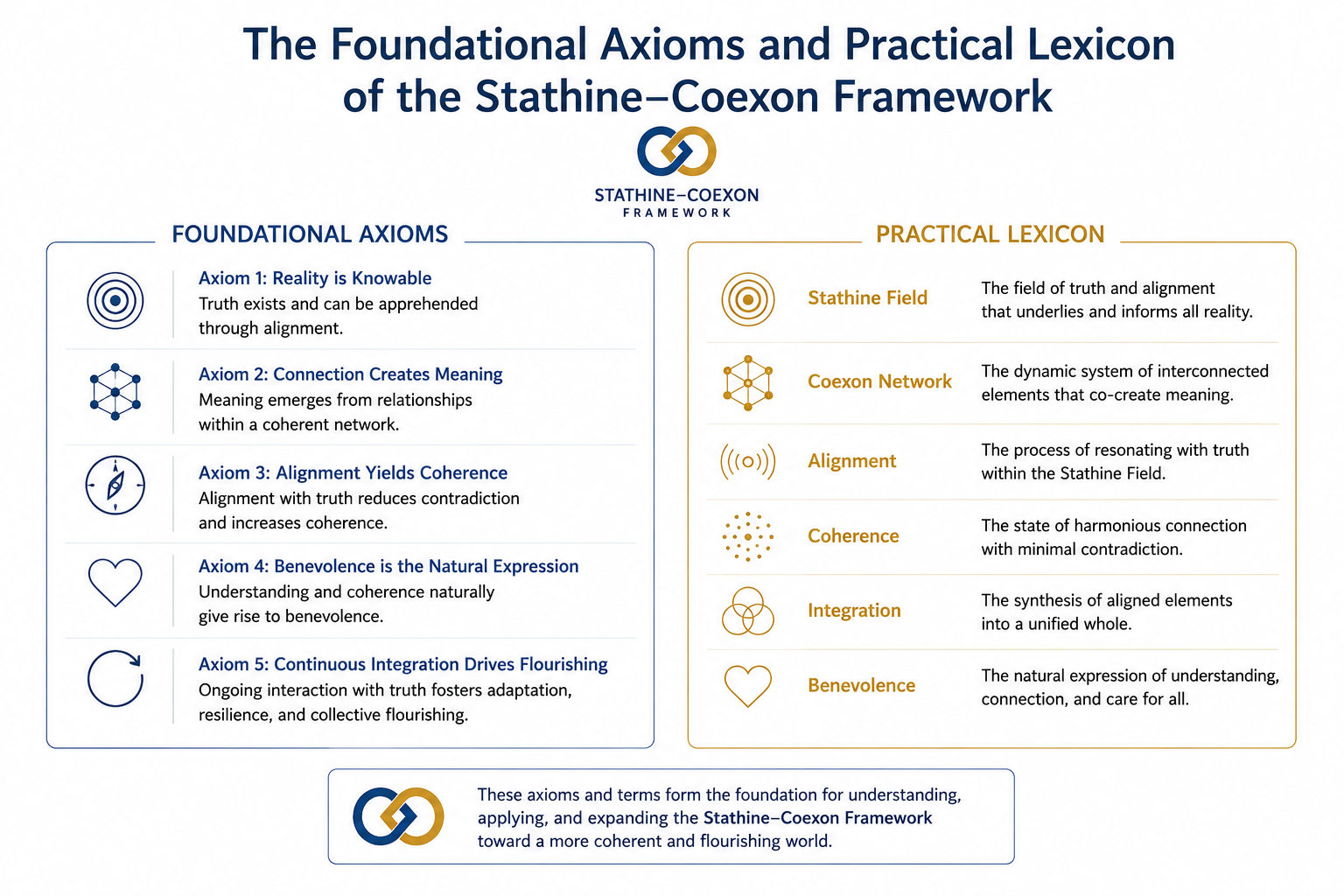
the static, omnipresent continuum or field from which energy and the possibility of informational organization are conceptualized.
Coexon
is proposed as:
a fundamental sentient-information organizational unit through which information, experience, coherence and interaction may be conceptualized.
These remain hypotheses of the framework, not established scientific entities.
The crucial methodological move is therefore not:
“Science has not detected Stathine or Coexon, therefore they exist beyond science.”
That would be circular.
The stronger proposition is:
“Our present scientific categories may not yet be sufficient to formulate the relevant ontology, so we construct a conceptual hypothesis and derive possible consequences that can progressively be examined.”
That is a legitimate research strategy.
21. The Principle of Progressive Empirical Exposure
A frontier theory should not remain permanently beyond evidence.
Instead, the framework should seek:
progressive empirical exposure.
That means beginning with the ontology and asking:
If this were true, what would eventually have to be different?
Then:
Can that difference be observed?
Then:
Can competing explanations account for it?
Then:
Can experiments distinguish them?
Thus:
Ontology → prediction → observation → comparison → revision.
This prevents the framework from becoming purely metaphysical.
22. The Principle of Epistemological Humility
The opposite error is equally dangerous.
A researcher might say:
“If it cannot currently be measured, it does not exist.”
The Stathine–Coexon response should be:
“We don’t know whether it exists. We know only that our current methods have not established it.”
That sentence is much more scientifically mature.
It protects against both:
premature belief
and
premature dismissal.
23. Truth Compression and the Epistemological Problem
One of the distinctive principles developed within the Stathine–Coexon Framework is Truth Compression.
Its basic intuition is:
A coherent representation requires less compensatory complexity than a representation containing persistent contradictions.
This can be reformulated epistemologically.
Suppose a theory requires increasingly complicated exceptions to preserve itself.
Its informational architecture becomes increasingly expensive.
A more coherent theory may explain more with fewer contradictory assumptions.
This resembles—but should not be conflated with—ideas such as:
- parsimony,
- minimum description length,
- explanatory compression,
- model selection.
The distinctive proposal is that coherence itself may become an important criterion alongside predictive accuracy.
That could be a fruitful direction for formal research.
24. Progressive Reduction of Contradiction
This produces another possible methodological principle:
A superior theory should not merely fit more data; it should reduce contradictions between previously isolated domains without introducing greater unexplained complexity elsewhere.
This provides a possible way to evaluate Stathine–Coexon.
Can the framework connect:
physics ↔ information
information ↔ consciousness
consciousness ↔ biology
biology ↔ cognition
cognition ↔ relationships
relationships ↔ society
without merely renaming existing problems?
If yes, its explanatory value increases.
If no, the framework should be revised.
25. The Framework Should Therefore Be Both Beyond and Within Epistemology
This apparent contradiction is actually central.
Beyond epistemology
because it asks ontological questions that exceed current methods.
Within epistemology
because every human formulation of those questions remains mediated by human cognition and language.
Beyond empirical evidence
because its starting propositions may concern entities or relationships not currently measurable.
Open to empirical evidence
because wherever consequences become measurable, empirical testing should constrain the theory.
This yields a more precise formulation:
Stathine–Coexon is trans-epistemological in aspiration, not anti-epistemological in method.
That distinction should perhaps become one of the foundational methodological statements of the entire research programme.
26. A New Scientific Architecture
The framework can consequently propose a broader cycle of inquiry:
EXPERIENCE
↓
OBSERVATION
↓
DATA
↓
MODEL
↓
INTERPRETATION
↓
ONTOLOGY
↓
METAPHYSICAL QUESTION
↓
NEW HYPOTHESIS
↓
NEW PREDICTION
↓
NEW OBSERVATION
↓
MODEL REVISION
This is not a rejection of science.
It is an attempt to make science self-reflexive.
Science becomes capable of asking:
What assumptions about reality are built into the way we investigate reality?
27. The Real Frontier: The Boundary Between Knowing and Being
The deepest contribution of the Stathine–Coexon Framework may therefore not ultimately be the Coexon hypothesis itself.
It may be the question:
Where does knowing end and being begin?
We normally distinguish:
ontology = what exists
and
epistemology = how we know it exists.
But the knowing organism is itself part of existence.
Therefore:
the structure of knowing may itself contain information about the structure of being.
The human brain is not outside reality looking inward.
It is reality examining itself from within one particular organizational configuration.
This is an extraordinarily profound philosophical proposition.
And it may provide the deeper rationale for the entire framework.
28. Toward a Post-Reductionist Science
The goal should not be to replace reductionism.
Reductionism remains immensely powerful.
The problem arises when:
a useful analytical method becomes an exclusive ontology.
A post-reductionist science would retain:
- measurement,
- experimentation,
- mathematics,
- statistics,
- causal analysis,
while adding:
- systems thinking,
- relational ontology,
- emergence,
- information,
- phenomenology,
- reflexivity,
- cross-domain synthesis,
- and explicit philosophical analysis.
The Stathine–Coexon Framework proposes itself within this broader movement.
29. A Critical Test for the Framework
If this research programme is to mature academically, it should repeatedly ask five uncomfortable questions:
1. What does the framework explain that existing theories do not?
2. What observations would count against it?
3. Which propositions are empirical, which are theoretical, and which are metaphysical?
4. Which concepts are genuinely new and which merely rename existing concepts?
5. What predictions or research programmes does the framework generate?
These questions are not threats to Stathine–Coexon.
They are what can transform it from a philosophical vision into a serious research programme.
30. Conclusion: Beyond the Limits Without Abandoning the Discipline
The central argument of this paper is not that empirical science has failed.
Quite the opposite.
Empirical science has succeeded so extraordinarily that we are now reaching questions where its own philosophical boundaries become visible.
We have learned that:
- observation is not theory-free,
- induction cannot provide certainty,
- evidence can underdetermine theory,
- theories may be empirically equivalent,
- measurements depend upon instruments and assumptions,
- scientific models are not identical to reality,
- predictive success does not automatically establish ontological truth,
- and the observer cannot simply be removed from the epistemic system.
These are not attacks on science.
They are lessons from the philosophy and history of science itself. (Stanford Encyclopedia of Philosophy)
The implication for Stathine–Coexon is therefore profound.
The framework should not claim:
“We are beyond science.”
It should claim something much more intellectually defensible:
“We are investigating questions for which the current scientific description may not yet constitute the complete epistemological or ontological vocabulary.”
And the framework should not say:
“Empirical evidence is irrelevant.”
It should say:
“Empirical evidence is indispensable wherever accessible, but empirical evidence alone may not exhaust the space of legitimate questions about reality.”
This leads to a final principle:
Science should not be limited by what humanity can currently measure, but it must remain disciplined by what humanity can eventually distinguish, test, criticize and understand.
The Stathine–Coexon Framework therefore occupies a deliberately difficult territory.
It proposes an ontology beyond current empirical confirmation.
It investigates sentience beyond conventional biological boundaries.
It treats information as potentially more fundamental than its physical representations.
It proposes Stathine as a foundational continuum and Coexon as a proposed sentient-information organization.
But its intellectual legitimacy will ultimately depend not on declaring these propositions beyond science.
It will depend on whether the framework can progressively move from:
philosophical possibility
to
conceptual coherence
to
mathematical articulation
to
testable consequence
to
empirical discrimination
to
explanatory advantage.
That is the path by which a frontier ontology can become a scientific research programme.
And perhaps this is the most important distinction for the entire Stathine–Coexon project:
Being beyond the present epistemological boundary should be an invitation to expand the boundary—not an exemption from the responsibility to test what lies beyond it.
That principle allows the framework to remain simultaneously ambitious, scientifically humble, philosophically rigorous, and open to discovery.