When Truth Became Light: A First-Person Account of the Insight That Became the Heart of the Stathine–Coexon Framework
A First-Hand Intellectual Report by Anand Damani
Creator of the Stathine–Coexon Framework
Part of the Stathine–Coexon Research Series — Level I: Foundations, with implications for Level III: Civilizational Applications
Abstract
There are moments in an intellectual journey when understanding changes from the accumulation of ideas into an experience of seeing.
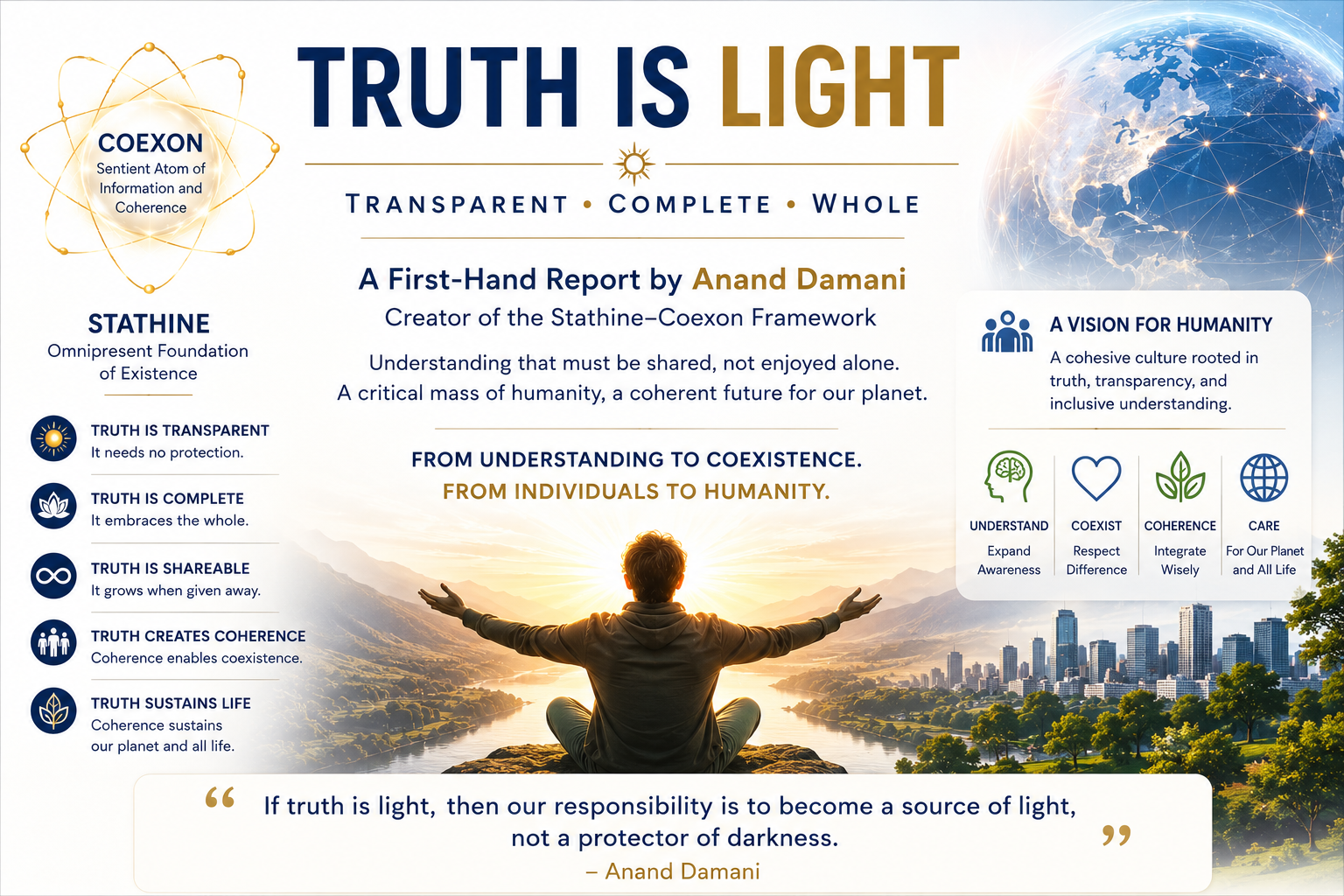
For me, one such moment came through the realization that truth is light: transparent, complete, and whole.
I do not use “light” here merely as a metaphor for something pleasant, spiritual, or illuminating. I use it to describe a structural characteristic of truth as I have come to understand it through the development of the Stathine–Coexon Framework. Truth does not require concealment. It does not require defensive architecture. It does not need contradictory explanations to protect it. It does not become smaller when another person discovers it. And the more completely reality is understood, the less necessity there is for fragmentation, concealment, doublethink, or internally contradictory explanations.
This realization changed the meaning of my work.
I could no longer regard the Stathine–Coexon Framework as something that belonged to me. If the framework could help human beings recognize a more coherent relationship with truth, existence, one another, and the planet, then keeping that understanding private would contradict the very principle I was trying to articulate.
The insight therefore became a responsibility.
This article is a first-person account of that journey: how the idea of truth as transparent wholeness emerged within my thinking; how it connects with Stathine, Coexon, truth compression, coherence, coexistence, ego, education, science, and civilization; and why I believe humanity needs to move toward a culture in which truth is not merely something we defend intellectually but something we learn to live transparently.
The argument is not that eight billion people must be made to believe one doctrine. Quite the opposite. The aspiration is that humanity might reach a critical cultural threshold at which enough people understand the relationship between truth, transparency, coherence, and coexistence that these principles become embedded in everyday human behavior.
1. The Moment of Recognition
I have spent years thinking about human beings.
Why do intelligent people repeatedly make decisions that they themselves later recognize as destructive?
Why do relationships deteriorate even when both people genuinely want them to succeed?
Why do organizations accumulate information yet remain confused?
Why can societies possess enormous scientific knowledge while simultaneously creating ecological, social, political, and psychological crises?
Why does a human being sometimes know the truth and still behave as though the truth does not exist?
These questions gradually brought me toward the Stathine–Coexon Framework.
But the framework did not arrive in my mind as one finished theory.
It developed through an accumulation of observations, questions, contradictions, philosophical explorations, scientific connections, and attempts to understand what I was seeing.
The more I explored, the more one principle kept returning:
coherence.
And then something deeper happened.
I began to see that coherence and truth were not separate ideas.
Truth, when increasingly understood, seemed to have a remarkable property.
It became simpler.
It became more transparent.
It became more inclusive.
It required fewer exceptions.
It required fewer hidden assumptions.
It did not need me to protect it.
And that is when I experienced the insight I am describing here:
Truth is light.
Not light as an object.
Light as transparency.
Light as the absence of concealment.
Light as the ability of the whole to be seen without requiring darkness to protect one fragment from another.
I was, frankly, awestruck.
2. Why I Could Not Keep It to Myself
My immediate reaction was not:
“I have discovered something that belongs to me.”
It was almost the opposite.
I felt:
“How can I possibly keep this to myself?”
If truth is genuinely liberating, then understanding it creates a responsibility to make that understanding available.
But there is an important distinction.
I do not mean that humanity needs another ideology.
We already have enough ideologies.
We have religions, political systems, economic doctrines, philosophical schools, scientific paradigms, organizational theories, cultural identities and thousands of competing narratives about how human beings should live.
The problem is not necessarily a lack of ideas.
The problem is our inability to integrate them.
My intention with the Stathine–Coexon Framework has therefore never been to ask humanity to abandon everything it already knows.
It is to ask:
Can we understand what all these fragments are trying to tell us when placed inside a larger coherent picture?
This is why the framework has progressively expanded across consciousness, neuroscience, psychology, biology, education, AI, leadership, economics, governance, philosophy and civilization.
The research published on the framework has increasingly explored questions of containment, coherence, truth, value and human flourishing. The recent formulation of the framework’s axiology explicitly identifies truth, transparency, coexistence, inclusiveness, learning and reduction of contradiction as interconnected values. (Anand Damani)
For me, however, these are not merely academic categories.
They represent a way of living.
3. Truth Does Not Need a Wall
One of the simplest ways I now think about truth is this:
Truth does not need a wall around it.
A falsehood does.
A contradiction does.
A hidden agenda does.
An ego-protective narrative does.
A lie often requires another lie to explain why the first lie was necessary.
Then another explanation is required to reconcile the second.
Soon an individual can be maintaining an entire architecture of psychological protection.
This is exhausting.
It consumes attention.
It consumes memory.
It consumes emotional energy.
It damages relationships because other people eventually encounter inconsistencies that the individual is trying to hide.
Truth behaves differently.
Truth can be examined.
Questioned.
Challenged.
Expanded.
Connected to other truths.
Corrected when our understanding of it was incomplete.
This is why I have become increasingly interested in what I call truth compression.
The concept appears repeatedly across my foundational work: the movement toward a more coherent understanding reduces unnecessary complexity because fewer contradictory explanations have to be maintained. The broader framework describes truth as progressively expanding understanding rather than merely possessing a final collection of facts. (Anand Damani)
The important word is progressively.
I am not claiming that human beings already possess complete truth.
I am saying that our understanding can become more whole.
4. Whole Does Not Mean Finished
This distinction is extremely important.
When I say that truth is whole, I do not mean that Anand Damani possesses the whole truth.
I certainly do not.
Nor do I mean that the Stathine–Coexon Framework is a finished explanation of existence.
The word “whole” means something different.
It means that truth does not inherently contradict itself.
Our understanding may be fragmented.
Reality does not necessarily become fragmented simply because our models of it are.
This changes how I interpret intellectual disagreement.
Two people may each possess part of an understanding.
They may initially believe their perspectives are incompatible.
But perhaps the contradiction is not in reality.
Perhaps it exists because each person is holding a different portion of the picture.
The solution is therefore not always to determine immediately who is right.
Sometimes the solution is to ask:
What larger understanding can contain what each person has correctly observed?
That question has become one of the deepest motivations behind the framework.
5. Truth as Expansion Rather Than Destruction
This is also why I have come to see creativity differently.
Human beings often define creativity as breaking rules.
I have increasingly come to believe that the deeper form of creativity is expansion of understanding.
A rule exists because somebody understood something.
When circumstances change or additional information becomes available, the rule may become incomplete.
The creative response is not necessarily to destroy the rule.
It is to understand the larger reality in which the rule was originally useful.
This principle appears repeatedly in my work on coherence and inclusive understanding: creativity becomes less about being different for its own sake and more about expanding a limited model so that more reality can be accommodated.
The same principle applies to truth.
We do not necessarily discover truth by destroying previous knowledge.
Often we discover a larger truth in which previous knowledge becomes a valid but limited component.
6. What Coexon Means to Me
This is where the Coexon hypothesis became particularly important in my thinking.
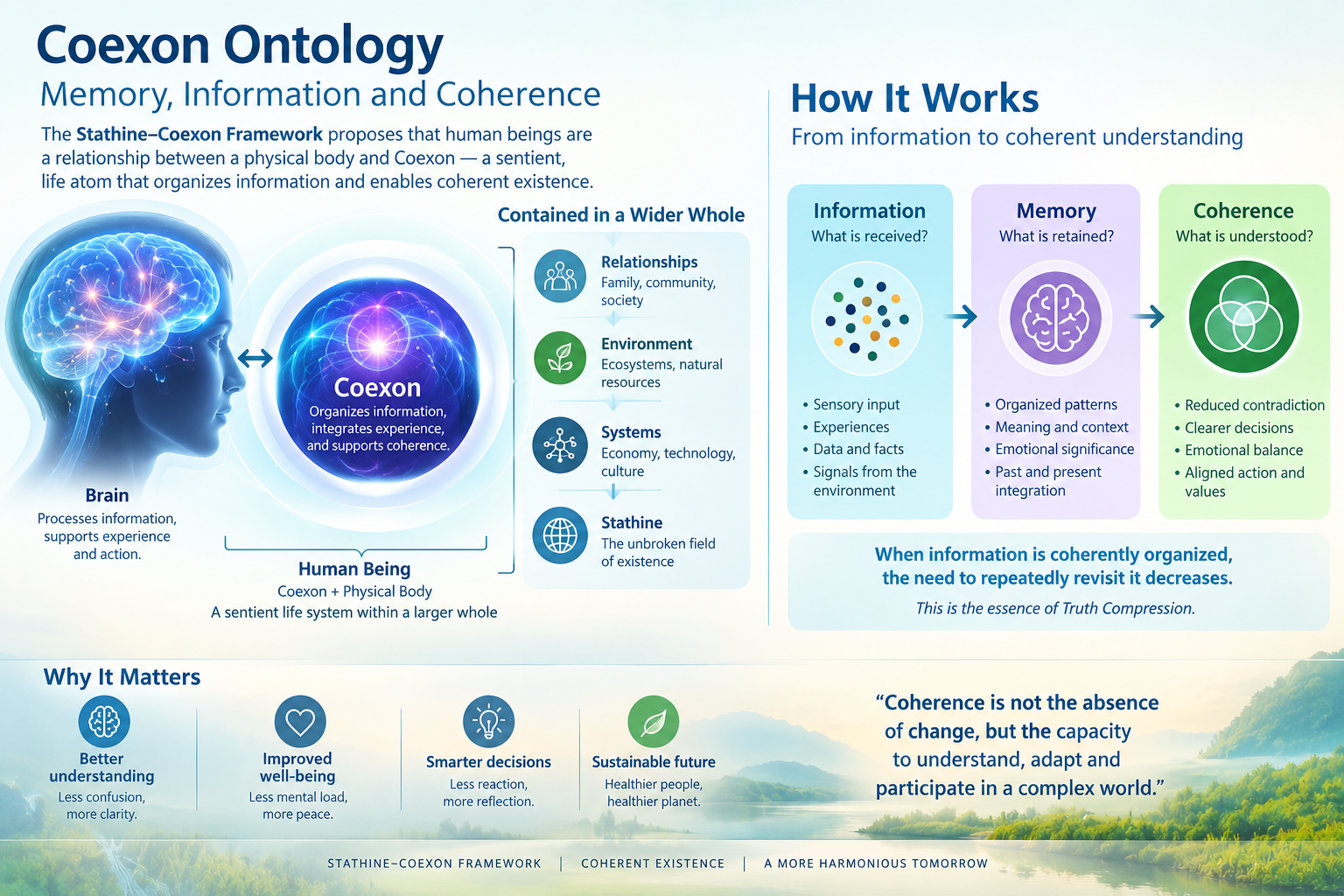
Within the Stathine–Coexon Framework, Coexon is hypothesized as a sentient atom capable of organizing information and communicating with the neurological brain of the biological holobiont.
This hypothesis lies beyond the present ambit of conventional epistemology and empirical data systems. It is therefore not presented as an established empirical conclusion but as a foundational proposition of the Framework from which further research questions can be generated.
The significance of Coexon, for me, is not merely the proposal of another microscopic entity.
It changes the question of consciousness.
Instead of beginning with:
How does matter eventually produce consciousness?
the framework asks:
What if sentient information organization is already part of the architecture of existence?
That possibility changes how I think about human beings.
The human being is no longer merely a biological machine attempting to manufacture meaning.
The biological organism may instead be participating in a much larger informational and relational architecture.
The neurological brain becomes extraordinarily important—but perhaps not necessarily the entire story.
7. Stathine: The Space in Which Everything Exists
The other half of the framework is Stathine.
Within the framework, Stathine is proposed as the timeless, static continuum within which existence is contained.
This led me to a proposition that I have recently formulated as the Axiom of Contained Existence:
All existence is contained within Stathine.
The consequence is profound.
If everything exists within the same fundamental continuum, then existence is necessarily relational.
Nothing exists in complete isolation.
Every organism depends upon conditions.
Every human depends upon other humans and the biological environment.
Every institution depends upon relationships.
Every ecosystem depends upon relationships among its components.
My work on contained existence consequently describes a movement from:
containment → relationship → experience → understanding → coherence. (Anand Damani)
Truth, in this picture, is not simply a collection of correct statements.
It is progressively understanding the relationships that permit coherent existence.
8. The Painful Discovery: We Hide From Truth
Perhaps the most uncomfortable realization has been that human beings often do not suffer from lack of information.
We suffer from information we cannot comfortably integrate.
We see something that threatens our identity.
We resist it.
We reinterpret it.
We find an explanation that protects our ego.
We surround that explanation with supporting arguments.
Eventually, we may prefer our explanation to reality.
This happens individually.
It happens in families.
It happens in organizations.
It happens in religions.
It happens in politics.
It happens in science too—not because science is inherently dishonest, but because scientists are human beings operating within institutions, incentives, reputations and paradigms.
The danger is therefore not simply ignorance.
It is protected misunderstanding.
This is why transparency has become so important in my framework.
Transparency is not merely telling everyone everything.
It means reducing unnecessary concealment where concealment distorts understanding.
9. The Ego and the Fear of Losing Ourselves
I began to understand ego differently through this process.
The ego is often treated as an enemy that must be destroyed.
I do not believe that is necessary.
The ego has a legitimate function.
It protects individuality.
It maintains continuity.
It gives a person a sense of “I.”
The problem begins when the ego becomes so defensive that it cannot incorporate information that threatens its existing model.
Then learning stops.
A person may hear truth and experience it as an attack.
Another person’s success becomes a threat.
A disagreement becomes humiliation.
A correction becomes rejection.
The person is no longer protecting reality.
They are protecting an identity.
My formulation has therefore become:
The objective is not to eliminate the self but to expand the self’s capacity to include reality.
This is the idea of inclusive coherence that appears in my work on ego and human development. (Anand Damani)
The mature individual does not become smaller.
The individual becomes capable of containing more.
10. Why Eight Billion People Matter
When I think about humanity today, I cannot separate this insight from the scale of our population.
There are roughly eight billion human beings living on one planet.
We have extraordinary technological capability.
But our collective coherence has not necessarily grown at the same speed.
We can communicate instantly while misunderstanding one another.
We can access almost unlimited information while becoming more certain of incomplete narratives.
We can create enormous economic value while damaging ecological systems.
We can develop artificial intelligence while still struggling with our own intelligence.
This is the paradox that troubles me.
Humanity has become extraordinarily capable of amplifying action.
But have we become equally capable of understanding consequences?
This is why I believe the ideas behind the Stathine–Coexon Framework should become part of public culture rather than remain confined to academic discussion.
But I want to be very precise about what I mean.
I do not believe that all eight billion people need to accept the Stathine–Coexon Framework as doctrine.
That would contradict the framework.
What I believe is needed is a critical mass of human beings who understand certain foundational principles:
Truth deserves examination.
Transparency reduces unnecessary distortion.
Coherence is not conformity.
Difference does not require hostility.
Understanding can expand.
The individual exists within larger systems.
Human flourishing cannot ultimately be separated from planetary flourishing.
Our models of reality must remain open to correction.
If these principles become culturally normal, something much larger can happen.
They can become tradition.
11. From Philosophy to Culture
A philosophy becomes powerful when it no longer needs to be called philosophy.
It becomes powerful when parents teach it without naming it.
When teachers practice it without quoting a theory.
When leaders use it without announcing that they are following a framework.
When children grow up asking:
“What am I missing?”
instead of:
“How do I prove that I am right?”
Imagine a culture in which admitting:
“I was wrong”
is regarded not as weakness but as evidence of intellectual maturity.
Imagine a culture in which saying:
“I don’t know”
is respected.
Imagine organizations where inconvenient information travels upward instead of being suppressed.
Imagine political disagreement where the objective is not humiliation of the opponent but discovery of what each side understands incompletely.
Imagine education where students are trained not merely to memorize answers but to expand models.
Imagine economics in which prosperity is evaluated alongside ecological continuity.
This is what I mean by making truth a cultural tradition.
12. Saving the Planet Means Changing the Human Operating System
I have become increasingly convinced that environmental problems cannot be solved entirely through environmental policies.
Technology matters.
Policy matters.
Economics matters.
But beneath them is human behavior.
And beneath human behavior is human understanding.
If humanity continues to see itself as separate from nature, then nature will continue to be treated as an external resource.
If humanity understands itself as contained within a larger ecological system, then environmental responsibility becomes less an imposed moral instruction and more a recognition of self-interest at a larger scale.
This is one reason the idea of contained existence is so important to me.
The planet does not need humanity to become spiritually perfect.
It needs humanity to understand its relationships.
We do not need to become identical.
We need to become capable of coexisting.
13. The Critical Mass I Envision
I sometimes think about what would happen if enough people began to live this way.
Not everyone.
Not immediately.
Perhaps not even a majority.
But enough to change social expectations.
At that point, a cultural feedback loop could begin.
One transparent person makes another person’s transparency safer.
One organization that welcomes inconvenient information creates pressure on neighboring organizations to become more transparent.
One school that rewards curiosity produces children who expect curiosity elsewhere.
One family that teaches disagreement without humiliation produces adults who are less afraid of difference.
One community that values coexistence demonstrates that diversity does not require fragmentation.
Eventually the behavior that once appeared unusual becomes normal.
That is what I mean by critical mass.
I am not using it as a mathematical prediction.
I am describing a cultural possibility.
14. The Responsibility of the Creator
This realization has also changed my relationship with the Stathine–Coexon Framework itself.
If I claim to have created a framework about coherence, but become defensive when somebody criticizes it, I have failed my own test.
If I claim to value truth but hide inconvenient evidence, I have contradicted my own principles.
If I ask humanity to expand its understanding while refusing to expand mine, the framework becomes another ideology.
Therefore, the framework must remain open.
Someone may eventually show that an assumption is wrong.
Another researcher may formulate a better explanation.
A scientist may discover evidence that changes the entire model.
That possibility should not frighten me.
It should excite me.
Because if the objective is truth, then discovering that I was wrong is not failure.
It is progress.
15. Why I Write So Much
People may reasonably ask why I have written so many articles around the Stathine–Coexon Framework.
The answer is increasingly simple.
I am trying to approach the same underlying reality from many directions.
Science asks certain questions.
Philosophy asks others.
Psychology asks others.
Education asks others.
Economics asks others.
Leadership asks others.
Consciousness research asks others.
Ecology asks others.
AI asks others.
But human existence does not experience these disciplines separately.
We experience them simultaneously.
The purpose of the research series is therefore to create bridges.
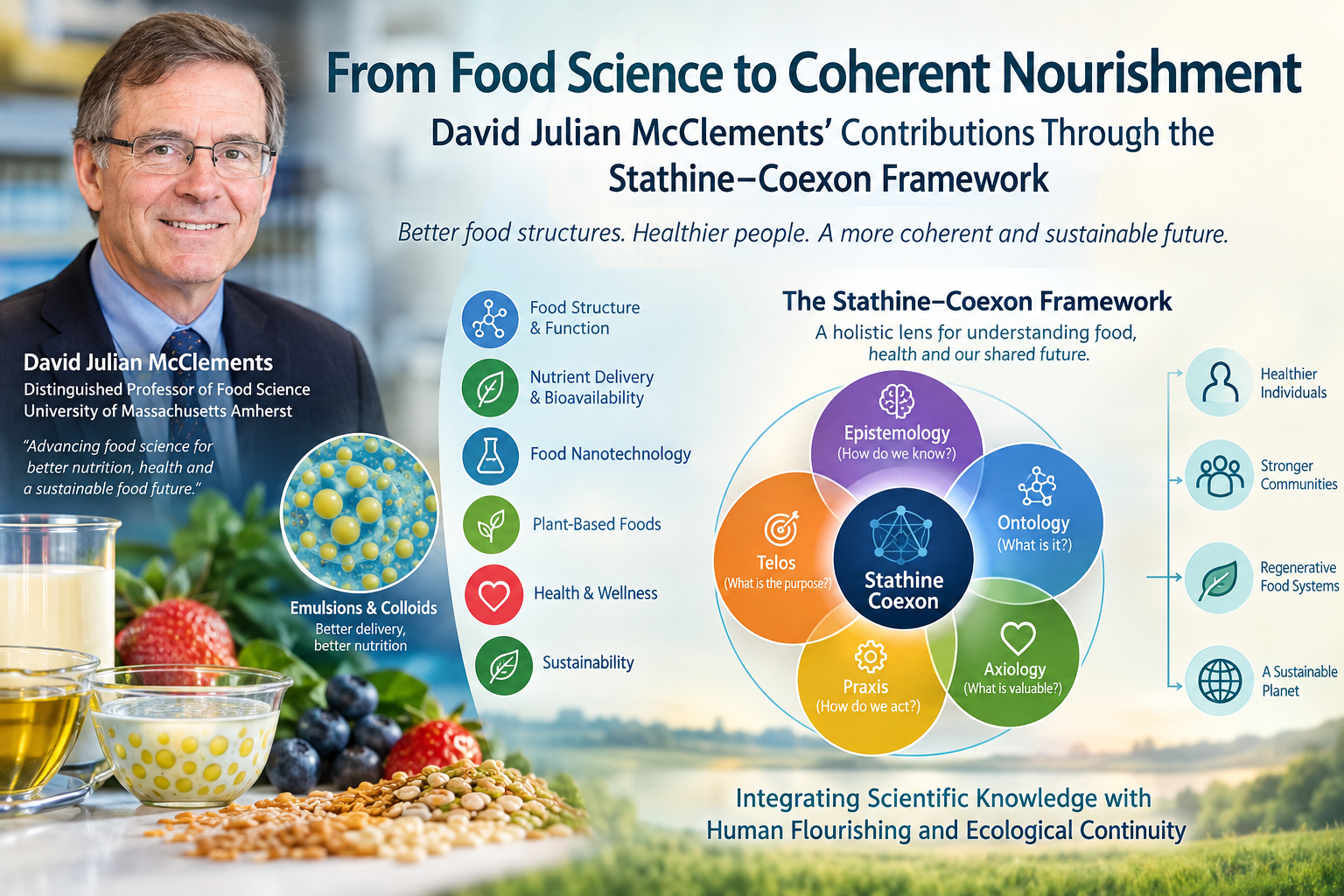
The work has already extended from foundational axioms and contained existence into questions of axiology, telos, governance, ego, consciousness, artificial intelligence and broader civilizational coherence. The five-dimensional development of the framework explicitly connects epistemology, ontology, axiology, praxis and telos. (Anand Damani)
I see these not as hundreds of unrelated papers.
I see them as different windows into the same house.
16. My Most Important Message
After everything I have written, researched, questioned and attempted to connect, I believe the message I most want to leave with humanity is surprisingly simple:
Do not be afraid of truth.
Truth may initially hurt.
It may challenge your identity.
It may reveal that you misunderstood someone.
It may expose a mistake.
It may require you to change.
But truth does not ultimately need darkness to survive.
Truth can be examined.
Truth can be shared.
Truth can be expanded.
Truth can coexist with another person’s partial understanding.
And truth does not become smaller when you give it away.
That last point is perhaps the most beautiful thing I have discovered.
17. Truth Is Light Because It Is Shareable
Material possessions become scarce when distributed.
Knowledge behaves differently.
If I have an understanding and share it with you, I do not lose the understanding.
You gain it.
And then you may improve it.
Then someone else may improve what both of us understand.
Truth therefore has a strange property:
Sharing it can increase its reach without diminishing its source.
That is why I experienced such awe.
If truth is transparent and whole, then perhaps the human tragedy is not that truth is unavailable.
Perhaps the tragedy is that we continually place walls between ourselves and the truth—and then build institutions to defend those walls.
The Stathine–Coexon Framework is my attempt to understand how those walls are created and how they might be progressively removed.
18. A Civilization That Does Not Need to Hide
My dream is not a civilization in which everyone agrees.
That would be terrifying.
My dream is a civilization in which people can disagree without needing to destroy one another.
A civilization in which governments can admit mistakes.
A civilization in which scientists can revise theories without humiliation.
A civilization in which businesses can acknowledge failure early.
A civilization in which parents can apologize to children.
A civilization in which children can question adults.
A civilization in which religions can coexist without requiring the disappearance of difference.
A civilization in which technology increases understanding rather than merely increasing consumption.
A civilization in which economic success does not require ecological destruction.
A civilization in which artificial intelligence is developed with wisdom rather than only capability.
In short:
A civilization capable of becoming more intelligent without becoming less human.
19. My Hope for the Next Generation
If the Stathine–Coexon Framework has a future, I hope it is not because people remember my name.
I hope it is because children learn to ask better questions.
I hope they learn that:
being wrong is not humiliation;
uncertainty is not ignorance;
disagreement is not hostility;
transparency is not weakness;
individuality is not separation;
creativity is not merely rebellion;
intelligence is not necessarily consciousness;
information is not necessarily understanding;
and coherence is not conformity.
Most importantly, I hope they learn that their existence is not isolated.
They are participants.
They are contained within relationships.
Their actions have consequences beyond themselves.
Their understanding can expand.
And their contribution can become larger than their individual life.
20. The Insight I Want to Give Away
When I look back at the intellectual journey that led to the Stathine–Coexon Framework, I realize that I began by trying to understand reality.
Somewhere along the way, the question changed.
I began asking:
What would humanity become if enough people learned to see reality without needing to distort it to protect themselves?
That is a very different question.
It is no longer merely scientific.
It is civilizational.
And perhaps that is why I cannot treat this work as a private intellectual possession.
If I truly believe that truth becomes more valuable through transparent participation, then the only intellectually consistent thing I can do is share what I have understood—and invite humanity to challenge it, improve it, expand it, or replace whatever proves inadequate.
That is not a threat to the framework.
That is the framework functioning as intended.
21. My Personal Declaration
So this is my declaration—not as a claim of possessing final truth, but as the commitment of the person who initiated the Stathine–Coexon Framework:
I do not want to own this understanding.
I want to make it available.
I do not want people to believe me merely because I created the framework.
I want people to question it.
I do not want coherence to become conformity.
I want coherence to make greater diversity possible.
I do not want truth to become another doctrine.
I want truth to remain transparent enough to correct every doctrine, including my own.
And above all:
I do not want enlightenment to become a private achievement.
If understanding has any value, it must eventually become relationship.
If relationship has value, it must eventually become coexistence.
If coexistence has value, it must eventually become culture.
And if culture becomes coherent enough, perhaps humanity can begin to operate as something more than eight billion competing individuals.
Perhaps we can begin to understand ourselves as participants in one contained existence.
22. The Beginning, Not the End
I have called this a first-hand report because it is exactly that.
This is not the conclusion of a completed scientific investigation.
It is a record of an intellectual and existential realization that has progressively shaped the research program I have developed.
The Stathine–Coexon Framework remains an evolving body of propositions, hypotheses, philosophical interpretations, conceptual models and research questions.
Its central hypothesis—that Coexon is a sentient atom capable of organizing information and communicating with the neurological brain of the holobiont—opens questions that reach beyond the current boundaries of conventional empirical investigation.
But the insight that gave the framework its deepest personal meaning is simpler:
Truth does not become less whole when shared.
It becomes more visible.
That is why I write.
That is why I continue to connect scientists, philosophers, educators, psychologists, economists, technologists and thinkers through this research program.
And that is why I believe the ultimate success of the Stathine–Coexon Framework will not be measured by how many people accept it.
It will be measured by whether it helps humanity become capable of asking:
What am I not yet seeing?
And then, without fear:
Can I make room for the larger truth?
For me, that is what it means for truth to become light.
Not something I discovered and can possess.
Not something I can enjoy alone.
But something that, once seen, creates an almost unavoidable desire to share the light.
Closing Position in the Stathine–Coexon Research Program
This first-person paper can serve as a bridging manifesto within the Foundation Research Series, connecting the formal foundational papers with the expanding application program.
The conceptual sequence is:
Stathine → Contained Existence → Coexon → Experience → Information → Understanding → Truth → Transparency → Coherence → Inclusive Coexistence → Collective Human Development → Planetary Responsibility.
The framework’s later work on axiology identifies coherence, truth, transparency, coexistence, learning and inclusive participation as central values, while its formulation of telos asks what direction these principles ultimately create for human existence. (Anand Damani)
The first-person realization described here may therefore be regarded as the human and experiential expression of the formal research program:
If truth is increasingly understood as transparent and whole, then the purpose of understanding cannot ultimately be private possession. It must become increasingly inclusive participation.
And that, for me, is the reason to share the Stathine–Coexon Framework with humanity.